
BuddhistCatholicContemplativeEvangelicalGeneral ChristianHinduJewishLatter-day SaintMuslimNew VisionsProgressive Christian
Beliefs
- Buddhist
- Catholic
- Contemplative
- Evangelical
- General Christian
- Hindu
- Jewish
- Latter-day Saint
- More Voices
- Muslim
- New Visions
- Pagan
- Progressive Christian
Topics
- Religion News
- Food and Religion
- Sports and Religion
- Religious Art
- Religious Music and Entertainment
- Religious Events
- History and Religion
- Style and Religion
- Politics and Religion
- Women in Religion
- Recreation Outdoors and Religion
- Business Finance and Religion
- Careers Workplace and Religion
- Education and Religion
- Family Parenting and Religion
- Health Fitness and Religion
- Home and Religion
- Relationships and Religion
- Technology and Religion
- Travel and Religion
Columnists
- Buddhist Columnists
- Business Finance and Religion Columnists
- Careers Workplace and Religion Columnists
- Catholic Columnists
- Contemplative Columnists
- Education and Religion Columnists
- Evangelists Columnists
- Family Parenting and Religion Columnists
- General Christian Columnists
- Health Fitness and Religion Columnists
- Hindu Columnists
- History and Religion Columnists
- Home and Religion Columnists
- Jewish Columnists
- More Voices Columnists
- Latter Day Columnists
- Muslim Columnists
- New Visions Columnists
- Nonreligious Columnists
- Pagan Columnists
- Politics and Religion Columnists
- Progressive Columnists
- Recreation Outdoors and Religion Columnists
- Relationships and Religion Columnists
- Religion News Columnists
- Religious Art Columnists
- Religious Events Columnists
- Religious Music and Entertainment Columnists
- Sports and Religion Columnists
- Style and Religion Columnists
- Technology and Religion Columnists
- Travel and Religion Columnists
- Women in Religion Columnists
Resource Library
- 2026 Calendar
- Library of World Religions
- The 100 Most Holy Places on Earth
- Patheos Answers
- Podcasts
- Videos
- Faith Leaders Database
- Anglican Episcopalian
- Bahai
- Baptist
- Buddhism
- Christianity
- Confucianism
- Eastern Orthodoxy
- Hinduism
- Holiness and Pentecostal
- ISKCON
- Islam
- Judaism
- Lutheran
- Methodist
- The Church of Jesus Christ of Latter-day Saints
- New Age
- Paganism
- Presbytarian and Reformed
- Protestantism
- Religion Behind the Scenes
- Roman Catholic
- Scientology
- Shia Islam
- Sikhism
- Sufism
- Sunni Islam
- Taoism
- Zen
- See all religions
Research Tools
 Ad-Free & Subscriber Log-In Subscription Support
Ad-Free & Subscriber Log-In Subscription Support
Follow Patheos 

- Trending:
- Forgiveness
- |
- Marriage
- |
- Consciousness
- |
- Death Penalty
- |
- Election
- |
- Halloween
 Black, White and Gray
-
About the Authors
- Home
- Evangelical
- Building a Better Asian American Survey
Building a Better Asian American Survey
Last updated on: July 20, 2012 at 11:32 am by Jerry Park
Building a Better Asian American Survey 2012-07-20T11:32:23-05:00 Jerry Park
Patheos Explore the world's faith through different perspectives on religion and spirituality! Patheos has the views of the prevalent religions and spiritualities of the world.
As some readers may know, the 2nd report on religion in Asian America was released. Given the additional time the advisory board (including me and over a dozen professors who do Asian American research) was given to send in comments and the notable changes incorporated into the final product, many of us feel a little better about this report than the first one. In this post I want to share the challenges of understanding religious prevalence in a hard-to-reach group. In the limited history of Asian American data collection (of the national-level variety), compromises are often made in one of two ways: obtain a stratified and fairly random sample in English or translate the survey in the major Asian language groups. Since trying to survey a smaller group that constitutes about 5-6% of the population, both of these factors are important and costly.
The implications of these differences are big when it comes to understanding religion in Asian America. What happens to the proportional distribution of Asian ethnic Christians based on different sampling techniques? (Some have wondered whether one particular ethnic group dominates Asian American Christianity or whether it’s an even spread across all groups).
CAVEAT: To keep matters simple and consistent across three survey examples, I am limiting the discussion to the six largest Asian American groups which have been unchanged since the 1990s: Chinese, Filipino, South Asian Indians, Vietnamese, Korean and Japanese in roughly that order). Surveying groups smaller than these (e.g. Bangladeshi, Cambodian, Laotian, Pakistani, Thai plus at least 20 others) will require some innovative survey techniques or way more research money than most scholars can acquire through grants. That said, I humbly show only these top 6 groups knowing that these illustrations miss out on a significant swath of Asian Americans numbering in millions.
The first example is less randomly stratified but language-inclusive:
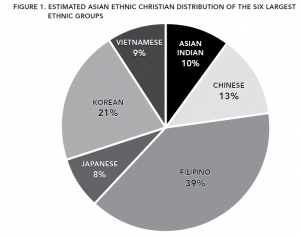
This snapshot was taken from a paper I wrote that tried to summarize the sociological study of Asian American Christianity. I created a pie graph of the top 6 Asian American groups all of whom described themselves as “Catholic”, “Protestant”, or “Other Christian.” I used the freely available survey, the Pilot National Asian American Politics Survey, 2001. While this survey was translated into 6 languages plus English for respondents to answer the survey was limited to 5 major cities with large Asian American populations (New York, Los Angeles, Honolulu, Chicago, San Francisco).
If you have used the PNAAPS, you’ll notice that the Christian Asian Indian figure is rather high. That’s because (as I state in the article) identifying some Asian Indians by surname (using marketing lists that try to approximate ethnicity or race based on household names) is really difficult when they are often based on important saints like Thomas, George etc. So I did some extrapolations based on other scholars who also gave best estimates and I came up with that rough number.
Aside from that this survey can basically tell us the proportion of adult Asian American Christians from 5 major cities around the year 2000.
This next one is more random and stratified but only done in English:
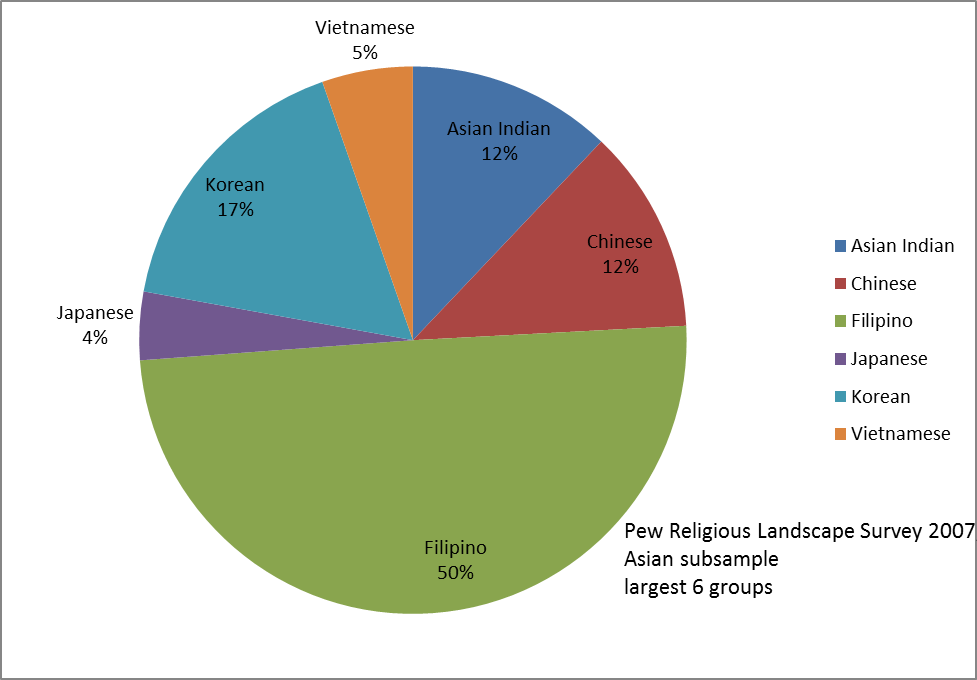
In 2007 the Pew Research Center released the Religious Landscape Survey, a massive survey of over 35,000 respondents. After appropriate weighting measures (basically adjusting the sample to approximate the population), this survey yielded about 800 Asian American respondents who gave detailed information. If survey respondents were not born in the US or if their parents were not born in the US, they were asked a follow up question of national origin. About a hundred or so only said they were Asian and did not submit any other identifying information and had no foreign-born ties of any sort. So this basically melds together any Asian American who was born in the US as a generic “Asian.” The other major problem with this survey is that it was only translated into Spanish. So that means Asian Americans (most of whom are foreign-born) were called in English to answer a complex survey. You can be sure that those who were not comfortable with their English proficiency didn’t continue the survey.
This chart tells us the prevalence of English-proficient adult Asian American Christians who were foreign-born or had foreign-born parents around 2007.
A social scientist is trained to report findings based on the parameters of the data. So in the case of the PNAAPS, the verbage for one of the data points would read: “Vietnamese American Christians represented about 9% of all Asian American Christians in 5 major cities with large Asian American populations [in 2001].” The Landscape Survey finding would read: “Vietnamese Americans who are English-proficient represented about 5% of all English-proficient Asian American Christians in the United States [in 2007].” That’s a lot of hedging but it’s faithful to the data.
So we turn now to the new Pew Asian American Religions report. None of the advisory board members have access to the survey so I took the raw figures and punched them in my spreadsheet to get best estimates. This survey is stratified and random and translated into multiple major Asian languages within the largest 6 groups. This is what I found:
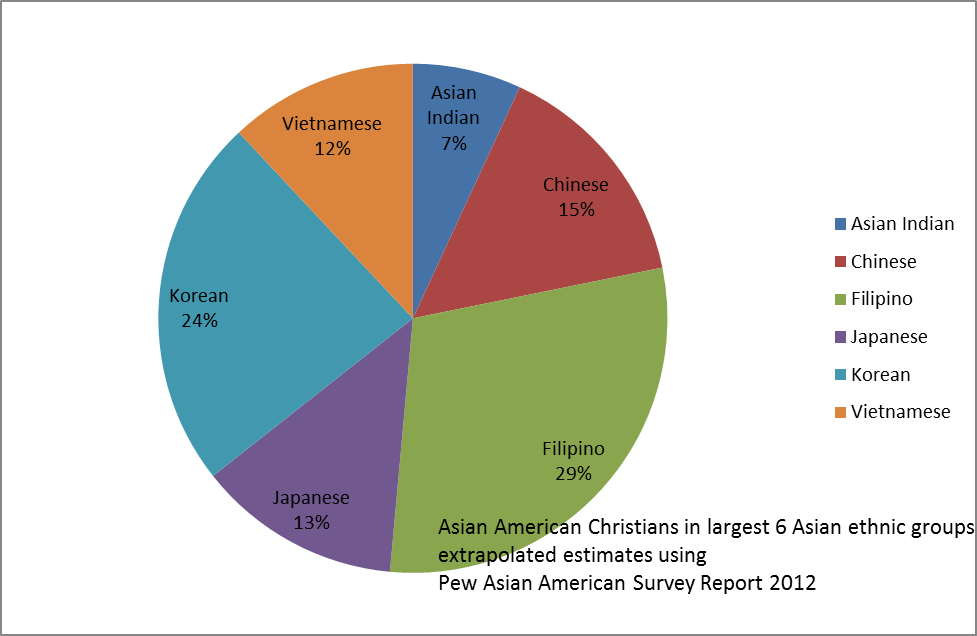
Time may be a significant factor here even when we account for methodological problems of the past. It’s possible that the PNAAPS and PRLS figures are close to the mark for their respective years. That said, if we see little fluctuation between surveys it might mean that accounting for language and stratified sampling does not make a big difference for this group; conversely if we do see big fluctuations, it might be a result of either of these two factors or something else like changes in immigration rates.
From personal experience, most of the Korean Christians I know are reluctant to answer a survey over the phone in English (trying to explain a medical condition or a legal issue is no small feat either). So when I see a jump from 17% of Asian American Christians are Korean in an English-only survey to 24%, I start thinking that maybe this survey picked up on those folks who can answer complex questions but in Korean only. The 3% difference between a 5-city survey and the new survey suggests to me that they are somewhat concentrated in certain major metro areas.
These explanations don’t make as much sense when I see the change in Japanese American figures. Since Japan is much less Christian, making a survey available in Japanese (I would think) would lower the proportion of Japanese American Christians (even if there is a pro-migration of Christians from Japan to the US, migration levels are very low in the past decade from Japan). On the other hand, it might be that Japanese American Christians are more dispersed than previous surveys found. The wildly different figures for Filipino American Christians suggests that many more of them (compared to other ethnic groups) are comfortable speaking in English, and to some extent they are likely less spread out (or geographically dispersed) compared to other groups.
Scholars and anyone interested in Asian American diversity have a better survey now and can make stronger statements (depending on the issue) about the prevalence rates in Asian America. To use the previous example about Vietnamese American Christians the new survey allows us to say this: “Vietnamese American Christians took up about 12% of all Asian American Christians [in 2012].” Simpler statements like this are possible when the sample is more rigorously obtained through sensitivity to location and language diversity. It also requires funding agencies to invest a lot for better data.
There’s much more to learn about religion in Asian America so I encourage readers to check it out. Hat tip to Pew for funding a well-executed survey.
Previous Post

July 17, 2012
The context of religion
Next Post

July 25, 2012 What is "It All" That Slaughter Says Women Can't Have?
Browse Our Archives
Select a Category Amy Reynolds Becky Hsu Brad Wright critical realism George Yancey Gerardo Marti Jeremy Rhodes Jerry Park John Schmalzbauer Margarita Mooney Mark Regnerus Nicolette Manglos positive sociology Richard Flory Robert Woodberry Uncategorized
Select a Month April 2017 August 2016 April 2016 March 2016 February 2016 January 2016 December 2015 November 2015 October 2015 September 2015 August 2015 July 2015 June 2015 May 2015 April 2015 March 2015 February 2015 January 2015 December 2014 November 2014 October 2014 September 2014 August 2014 July 2014 June 2014 May 2014 April 2014 March 2014 February 2014 January 2014 December 2013 November 2013 October 2013 September 2013 August 2013 July 2013 June 2013 May 2013 April 2013 March 2013 February 2013 January 2013 December 2012 November 2012 October 2012 September 2012 August 2012 July 2012 June 2012 May 2012 April 2012 March 2012 February 2012 January 2012 December 2011 November 2011 October 2011
Follow Us!
TAKE THE
Religious Wisdom Quiz
Who was the strongest man mentioned in the Bible?
Select your answer to see how you score.
Goliath Samson Saul David
Related posts from Black, White and Gray

One Step Forward, but Now What?
Greater Acceptance, Persisting Antipathy: 50 Years of Religious...

Keeping (and Losing) Faith, the Asian American Way...

The Top 11 from ’13: Academic Journals of...
TRENDING AT PATHEOS Evangelical

The REST of Your Life: A Creative Wrestles...
This week I had a conversation with a good friend from church....

How the author of the world's best hymn...
I've been working with John Newton for a while now. This makes...

Long before this Lectio Divina, Psalm 130 - the song - started...

What About the Trees? Another Living Parable
After I finished writing the last article about falling leaves as a...

Why Classical Education Is a Conversation, Not a...
Come and Read: Joy in Classical Education When I was a little...

Cornell University has received a great deal of negative publicity and intense...
view all Evangelical blogs
Ad-Free & Subscriber Log-In Subscription Support
- About Us
- 2026 Calendar
- Videos
- Podcasts
- Library of World Religions
- Faith In Media Tracker
- Advertise With Us
- Write for Us
- Privacy Policy
- Terms of Service
- Do Not Sell My Data
- Contact Us
- Radiant Digital
- Manage Newsletter Subscriptions
- Unsubscribe From Notifications
- Sitemap
Copyright 2008-2026, Patheos. All rights reserved.
Subscription Support Ad-Free & Subscriber Log-In
Follow Patheos