
BuddhistCatholicContemplativeEvangelicalGeneral ChristianHinduJewishLatter-day SaintMuslimNew VisionsProgressive Christian
Beliefs
- Buddhist
- Catholic
- Contemplative
- Evangelical
- General Christian
- Hindu
- Jewish
- Latter-day Saint
- More Voices
- Muslim
- New Visions
- Pagan
- Progressive Christian
Topics
- Religion News
- Food and Religion
- Sports and Religion
- Religious Art
- Religious Music and Entertainment
- Religious Events
- History and Religion
- Style and Religion
- Politics and Religion
- Women in Religion
- Recreation Outdoors and Religion
- Business Finance and Religion
- Careers Workplace and Religion
- Education and Religion
- Family Parenting and Religion
- Health Fitness and Religion
- Home and Religion
- Relationships and Religion
- Technology and Religion
- Travel and Religion
Columnists
- Buddhist Columnists
- Business Finance and Religion Columnists
- Careers Workplace and Religion Columnists
- Catholic Columnists
- Contemplative Columnists
- Education and Religion Columnists
- Evangelists Columnists
- Family Parenting and Religion Columnists
- General Christian Columnists
- Health Fitness and Religion Columnists
- Hindu Columnists
- History and Religion Columnists
- Home and Religion Columnists
- Jewish Columnists
- More Voices Columnists
- Latter Day Columnists
- Muslim Columnists
- New Visions Columnists
- Nonreligious Columnists
- Pagan Columnists
- Politics and Religion Columnists
- Progressive Columnists
- Recreation Outdoors and Religion Columnists
- Relationships and Religion Columnists
- Religion News Columnists
- Religious Art Columnists
- Religious Events Columnists
- Religious Music and Entertainment Columnists
- Sports and Religion Columnists
- Style and Religion Columnists
- Technology and Religion Columnists
- Travel and Religion Columnists
- Women in Religion Columnists
Resource Library
- 2026 Calendar
- Library of World Religions
- The 100 Most Holy Places on Earth
- Patheos Answers
- Podcasts
- Videos
- Faith Leaders Database
- Anglican Episcopalian
- Bahai
- Baptist
- Buddhism
- Christianity
- Confucianism
- Eastern Orthodoxy
- Hinduism
- Holiness and Pentecostal
- ISKCON
- Islam
- Judaism
- Lutheran
- Methodist
- The Church of Jesus Christ of Latter-day Saints
- New Age
- Paganism
- Presbytarian and Reformed
- Protestantism
- Religion Behind the Scenes
- Roman Catholic
- Scientology
- Shia Islam
- Sikhism
- Sufism
- Sunni Islam
- Taoism
- Zen
- See all religions
Research Tools
 Ad-Free & Subscriber Log-In Subscription Support
Ad-Free & Subscriber Log-In Subscription Support
Follow Patheos 

- Trending:
- Forgiveness
- |
- Marriage
- |
- Consciousness
- |
- Death Penalty
- |
- Election
- |
- Halloween
 Black, White and Gray
-
About the Authors
- Home
- Evangelical
- Socializing Character Through Popular Comic Books
Socializing Character Through Popular Comic Books
Last updated on: July 13, 2012 at 6:40 am by Jerry Park
Socializing Character Through Popular Comic Books 2012-07-13T01:27:12-05:00 Jerry Park
Patheos Explore the world's faith through different perspectives on religion and spirituality! Patheos has the views of the prevalent religions and spiritualities of the world.
Fill in the blank: “With great power _______” If you know the answer to this, you’ve been exposed to American comic books. “With great power comes great responsibility” is the lesson that a young Peter Parker ignores from his uncle who subsequently dies from a fatal gunshot wound that Parker could have prevented. So what’s sociology have to do with this? Maybe I’m just trying to rationalize something I just enjoy, but I do think comic books are a window into social life. And believe it or not, they can sometimes illuminate aspects about religion we would not normally think about.
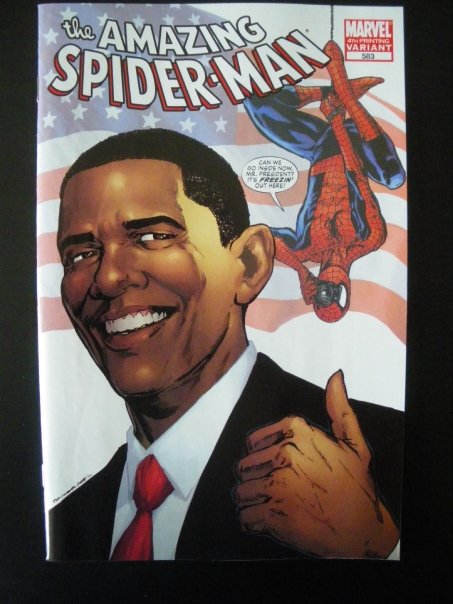
Comic books have received surprising new attention in part because the current President of the United States has stated publicly that he enjoyed them while growing up. Yes President Obama has gone on record as saying that his favorite comic book characters are Spiderman and Conan the Barbarian. Marvel Comics ran with this and showcased Spiderman with the new president:
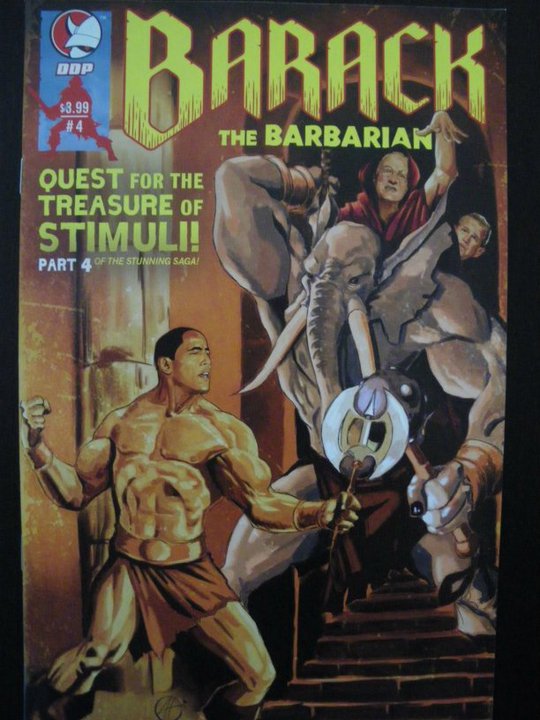
and an independent company went so far as to mythologize the 2008 election campaign as the adventures of “Barack the Barbarian”
The primary audience for comic books as we all know is males of nearly every age now it seems; the incredible disproportion of male heroes to female heroes demonstrates this. The male heroes usually exhibit power manifested in superhuman and sometimes unearthly form. Strength, speed, invulnerability, energy- all of these are part of the world of super heroes. But since these stories of grown men and women are geared primarily at youngsters, they serve as moral narratives that inform young minds about life. This is not all that shocking to most of us; we understand how this works in any story we share with children from Grimm’s Fairy Tales to Harry Potter. Mainstream comic books simply offer another world (or worlds) in which these same dilemmas of right and wrong, good and evil, trust and betrayal, competition and cooperation, choice and action are all worked out in dramatic fantasy. In sociological terms media like comic books usually (not always) narrate moral values and become part of the socialization experience of many. Parents are always the number one source for modeling morality since they are usually the most visible to children. But comic books and other media can also be a means of socialization.
That said, I was hooked when I discovered this PBS documentary called “Wham! Bam! Islam!” It was a delightful narration of a dream that one Kuwaiti Muslim psychologist, Dr. Naif Al-Mutawa shared with the world: to make his faith accessible to familiar and new audiences through the medium of comic books.
The comic books that most readers of this blog are familiar with are nearly entirely based in America (and almost exclusively in New York [even in DC comics, Gotham City and Metropolis are just “New York by day” and “New York at night”]). And the heroes are almost entirely white and/or American. Interestingly most of our mainstream characters are actually religious and specifically Christian (mainly Catholic and Protestant forms as seen in this list online [hat tip to the individual or group to construct this]).
What’s a Muslim kid (or adult) to do when there’s nary a character in mainstream comic books that he can identify with? Indeed this website of superhero religious affiliations shows a list of Muslim heroes and if you look carefully you will notice that none of the 55 or so are clear central characters in the Marvel and DC Universes. Thirteen are particularly new and appear as a result of Dr. Al-Mutawa’s efforts. 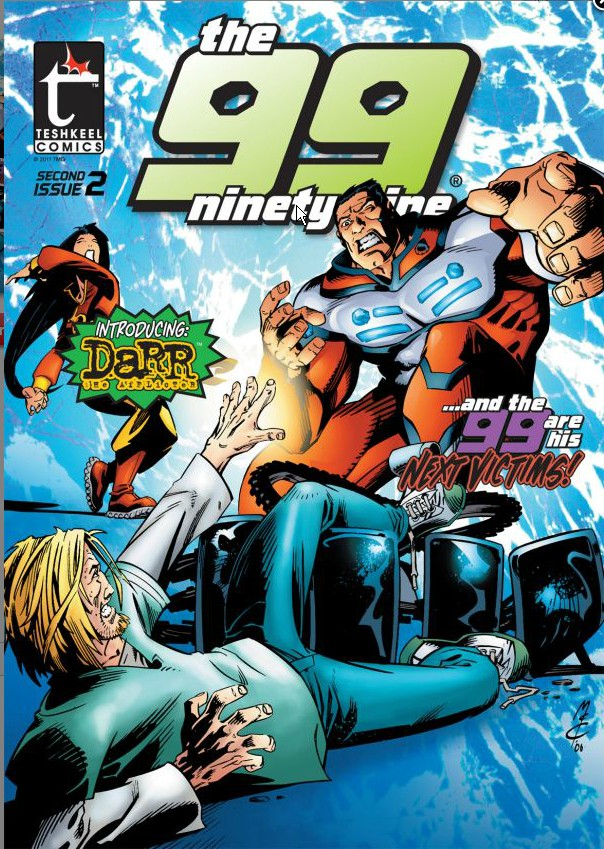
The aim was to create a world in which 99 superheroes emerged from a series of events linked to an archaeological object that’s significant in Muslim history. Each of the 99 represents an aspect of Allah’s character (technically 99 names of Allah). Through this story, the author can then portray Muslim virtue through the behavior and perhaps powers of superheroes that align with basic Muslim theology. As with any form of art that is intended for broad and young appeal, the specifics and accuracy of theology are tempered by clarity of narration. So it’s not surprising that Dr. Al-Mutawa has not gained sympathy from the most orthodox of Muslim theologians.
But for me, what’s so interesting here is not the theological content and whether it’s true to Islam. It’s about the social implications of this. As the second largest religion in the world, Islam has not had a positive portrayal in western cultures. Through the use of comic book superheroes that relate a relatively unheard of Islamic concept in Christian/secular environments, Al-Mutawa helps affirm Muslim identity for youngsters who might feel insecure about their faith in environments where they sense hostility. Imagine the Muslim kid who feels embarrassed about his Muslim faith in Iowa or Paris picking up an issue of The 99 and finding a new way to validate his culture and faith. And for those avid non-Muslim readers of comic books, we’re invited into this new world where heroism is linked with Muslim virtue.
So here’s my main and final point: why hasn’t any Christian thought about doing this with major characters? As the superhero religions website shows in the blurbs on the right, of the 14 “most consistently religious” only Wonder Woman stands out to me as a widely known character and her religion is “Greco-Roman Classical Religion” (she is Amazonian after all). From my experience, Daredevil’s Catholic background stood out to me as the only one among the pantheon of heroes to wrestle with his faith and his behavior. We have little evidence of comic book characters that portray Christian beliefs in ways that might model for young men and women the virtues described in the Christian traditions. Perhaps Christians who are concerned about the socialization of the next generation can learn from this new venture from a Muslim fan of comic books.
Previous Post

July 12, 2012
Map of religion in the United States
Next Post
July 15, 2012 The Left's War on Science
Browse Our Archives
Select a Category Amy Reynolds Becky Hsu Brad Wright critical realism George Yancey Gerardo Marti Jeremy Rhodes Jerry Park John Schmalzbauer Margarita Mooney Mark Regnerus Nicolette Manglos positive sociology Richard Flory Robert Woodberry Uncategorized
Select a Month April 2017 August 2016 April 2016 March 2016 February 2016 January 2016 December 2015 November 2015 October 2015 September 2015 August 2015 July 2015 June 2015 May 2015 April 2015 March 2015 February 2015 January 2015 December 2014 November 2014 October 2014 September 2014 August 2014 July 2014 June 2014 May 2014 April 2014 March 2014 February 2014 January 2014 December 2013 November 2013 October 2013 September 2013 August 2013 July 2013 June 2013 May 2013 April 2013 March 2013 February 2013 January 2013 December 2012 November 2012 October 2012 September 2012 August 2012 July 2012 June 2012 May 2012 April 2012 March 2012 February 2012 January 2012 December 2011 November 2011 October 2011
Follow Us!
TAKE THE
Religious Wisdom Quiz
Which parable features a man building on rock versus sand?
Select your answer to see how you score.
The Sower The Workers in the Vineyard The Talents The Wise and Foolish Builders
Related posts from Black, White and Gray

American and Chinese ways of mourning

One Step Forward, but Now What?

Greater Acceptance, Persisting Antipathy: 50 Years of Religious...

Keeping (and Losing) Faith, the Asian American Way...
TRENDING AT PATHEOS Evangelical

The REST of Your Life: A Creative Wrestles...
This week I had a conversation with a good friend from church....

How the author of the world's best hymn...
I've been working with John Newton for a while now. This makes...

Long before this Lectio Divina, Psalm 130 - the song - started...

What About the Trees? Another Living Parable
After I finished writing the last article about falling leaves as a...

Why Classical Education Is a Conversation, Not a...
Come and Read: Joy in Classical Education When I was a little...

Cornell University has received a great deal of negative publicity and intense...
view all Evangelical blogs
Ad-Free & Subscriber Log-In Subscription Support
- About Us
- 2026 Calendar
- Videos
- Podcasts
- Library of World Religions
- Faith In Media Tracker
- Advertise With Us
- Write for Us
- Privacy Policy
- Terms of Service
- Do Not Sell My Data
- Contact Us
- Radiant Digital
- Manage Newsletter Subscriptions
- Unsubscribe From Notifications
- Sitemap
Copyright 2008-2026, Patheos. All rights reserved.
Subscription Support Ad-Free & Subscriber Log-In
Follow Patheos