
BuddhistCatholicContemplativeEvangelicalGeneral ChristianHinduJewishLatter-day SaintMuslimNew VisionsProgressive Christian
Beliefs
- Buddhist
- Catholic
- Contemplative
- Evangelical
- General Christian
- Hindu
- Jewish
- Latter-day Saint
- More Voices
- Muslim
- New Visions
- Pagan
- Progressive Christian
Topics
- Religion News
- Food and Religion
- Sports and Religion
- Religious Art
- Religious Music and Entertainment
- Religious Events
- History and Religion
- Style and Religion
- Politics and Religion
- Women in Religion
- Recreation Outdoors and Religion
- Business Finance and Religion
- Careers Workplace and Religion
- Education and Religion
- Family Parenting and Religion
- Health Fitness and Religion
- Home and Religion
- Relationships and Religion
- Technology and Religion
- Travel and Religion
Columnists
- Buddhist Columnists
- Business Finance and Religion Columnists
- Careers Workplace and Religion Columnists
- Catholic Columnists
- Contemplative Columnists
- Education and Religion Columnists
- Evangelists Columnists
- Family Parenting and Religion Columnists
- General Christian Columnists
- Health Fitness and Religion Columnists
- Hindu Columnists
- History and Religion Columnists
- Home and Religion Columnists
- Jewish Columnists
- More Voices Columnists
- Latter Day Columnists
- Muslim Columnists
- New Visions Columnists
- Nonreligious Columnists
- Pagan Columnists
- Politics and Religion Columnists
- Progressive Columnists
- Recreation Outdoors and Religion Columnists
- Relationships and Religion Columnists
- Religion News Columnists
- Religious Art Columnists
- Religious Events Columnists
- Religious Music and Entertainment Columnists
- Sports and Religion Columnists
- Style and Religion Columnists
- Technology and Religion Columnists
- Travel and Religion Columnists
- Women in Religion Columnists
Resource Library
- 2026 Calendar
- Library of World Religions
- The 100 Most Holy Places on Earth
- Patheos Answers
- Podcasts
- Videos
- Faith Leaders Database
- Anglican Episcopalian
- Bahai
- Baptist
- Buddhism
- Christianity
- Confucianism
- Eastern Orthodoxy
- Hinduism
- Holiness and Pentecostal
- ISKCON
- Islam
- Judaism
- Lutheran
- Methodist
- The Church of Jesus Christ of Latter-day Saints
- New Age
- Paganism
- Presbytarian and Reformed
- Protestantism
- Religion Behind the Scenes
- Roman Catholic
- Scientology
- Shia Islam
- Sikhism
- Sufism
- Sunni Islam
- Taoism
- Zen
- See all religions
Research Tools
 Ad-Free & Subscriber Log-In Subscription Support
Ad-Free & Subscriber Log-In Subscription Support
Follow Patheos 

- Trending:
- Forgiveness
- |
- Marriage
- |
- Consciousness
- |
- Death Penalty
- |
- Election
- |
- Halloween
 Black, White and Gray
-
About the Authors
- Home
- Evangelical
- Fair Trade Battles
Fair Trade Battles
Last updated on: March 10, 2017 at 6:06 pm by Amy Reynolds
Fair Trade Battles 2017-03-10T18:06:48-05:00 Amy Reynolds
Patheos Explore the world's faith through different perspectives on religion and spirituality! Patheos has the views of the prevalent religions and spiritualities of the world.
At the end of 2011, Fair Trade USA resigned from its membership in FairTrade International (FLO). Just last month, an advertisement in the Burlington Free Press (Vermont) made headlines. Equal Exchange, the largest fair trade coffee company in the United States, urged Green Mountain Coffee to leave the Fair Trade USA network. Business Week and others covered the conflict.
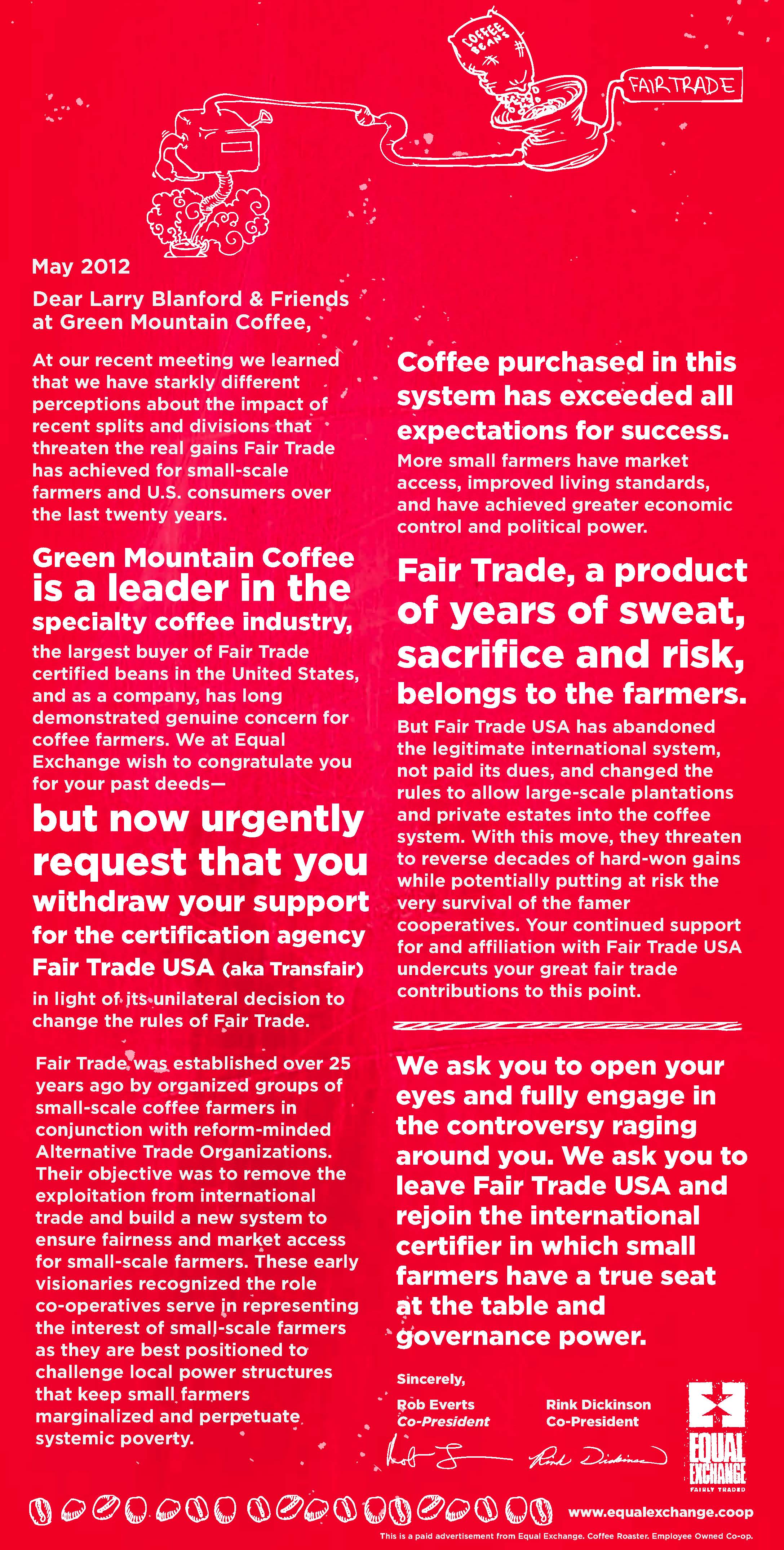
This incident represents growing division over how to best help the population that fair trade was intended to represent. Perhaps the central reason for the split between Fair Trade USA and FLO was the decision of Fair Trade USA to work with large plantations and estates (instead of the traditional small farmers and cooperatives). Is it better to work with large farms to promote fair wages for workers, even if the ideals of democratic governance and ownership of the product by producers (requirements of FLO) do not occur?
While not trying to simplify all of the issues involved with a decision to include large farms, one issue at stake concerns the relationships consumers and producers have within alternative markets. My guess is that most of us do not know the people that bake the bread that we eat, sew the clothes that we wear, build the houses we inhabit, or assemble the components in our computers. One of the initial aims of the fair trade network created in the early 1970s was to try and make the market more personal. Consumers were connected with producers through more direct buying relationships; narratives of producers were highlighted as important to the products themselves. You can drink coffee and know under what conditions (and where) the beans were picked.
As someone who studies the intersection of religion and the economy, I’m particularly interested in the role of Christian actors in alternative trade movements. Religious organizations were important to the formation of the first alternative trade network (following the United Nations Conference on Trade and Development in 1968). Yet twenty years before that, the Mennonite Central Committee was involved in selling artisan goods produced in the global South to consumers in the global North, in a precursor to what was to become Ten Thousand Villages.
Christians are a relational people, both in terms of their interactions with the Divine, and their interactions with other women and men. Different traditions talk about these relationships differently, but most highlight the importance of these relationships. For example, the Reformed tradition prioritizes the covenant among God’s people, while Catholics are more likely to rely upon concepts of solidarity and the common good.
This most recent disagreement between Fair Trade USA and FLO should cause us to think more critically about the relationships embedded within our economic transactions. I do not want to argue in this post for or against the decision of Fair Trade USA. But for those of us who try to engage in ethical consumerism, what do we value? Is the central goal higher wages for producers and workers? Is it something more? How do we see ourselves in relationships with those producers, and what does it mean to have integrity in such interactions?
Previous Post

June 4, 2012
Liking the Quotes more than the Books
Next Post
June 6, 2012 How Effective is Online Learning? Insights from Sociology of Religion Online
Browse Our Archives
Select a Category Amy Reynolds Becky Hsu Brad Wright critical realism George Yancey Gerardo Marti Jeremy Rhodes Jerry Park John Schmalzbauer Margarita Mooney Mark Regnerus Nicolette Manglos positive sociology Richard Flory Robert Woodberry Uncategorized
Select a Month April 2017 August 2016 April 2016 March 2016 February 2016 January 2016 December 2015 November 2015 October 2015 September 2015 August 2015 July 2015 June 2015 May 2015 April 2015 March 2015 February 2015 January 2015 December 2014 November 2014 October 2014 September 2014 August 2014 July 2014 June 2014 May 2014 April 2014 March 2014 February 2014 January 2014 December 2013 November 2013 October 2013 September 2013 August 2013 July 2013 June 2013 May 2013 April 2013 March 2013 February 2013 January 2013 December 2012 November 2012 October 2012 September 2012 August 2012 July 2012 June 2012 May 2012 April 2012 March 2012 February 2012 January 2012 December 2011 November 2011 October 2011
Follow Us!
TAKE THE
Religious Wisdom Quiz
What does the Bible warn about "idle chatter"?
Select your answer to see how you score.
Is educational Is entertaining Leads to poverty Is holy
Related posts from Black, White and Gray

Saving the Market: Harry Potter, Churches, and Globalization

The Personal and the Political: Violence in our...

Women in Leadership National Study: A First Glance

Economic Choices, the Media, and Racism
TRENDING AT PATHEOS Evangelical

The REST of Your Life: A Creative Wrestles...
This week I had a conversation with a good friend from church....

How the author of the world's best hymn...
I've been working with John Newton for a while now. This makes...

Long before this Lectio Divina, Psalm 130 - the song - started...

What About the Trees? Another Living Parable
After I finished writing the last article about falling leaves as a...

Why Classical Education Is a Conversation, Not a...
Come and Read: Joy in Classical Education When I was a little...

Cornell University has received a great deal of negative publicity and intense...
view all Evangelical blogs
Ad-Free & Subscriber Log-In Subscription Support
- About Us
- 2026 Calendar
- Videos
- Podcasts
- Library of World Religions
- Faith In Media Tracker
- Advertise With Us
- Write for Us
- Privacy Policy
- Terms of Service
- Do Not Sell My Data
- Contact Us
- Radiant Digital
- Manage Newsletter Subscriptions
- Unsubscribe From Notifications
- Sitemap
Copyright 2008-2026, Patheos. All rights reserved.
Subscription Support Ad-Free & Subscriber Log-In
Follow Patheos