
BuddhistCatholicContemplativeEvangelicalGeneral ChristianHinduJewishLatter-day SaintMuslimNew VisionsProgressive Christian
Beliefs
- Buddhist
- Catholic
- Contemplative
- Evangelical
- General Christian
- Hindu
- Jewish
- Latter-day Saint
- More Voices
- Muslim
- New Visions
- Pagan
- Progressive Christian
Topics
- Religion News
- Food and Religion
- Sports and Religion
- Religious Art
- Religious Music and Entertainment
- Religious Events
- History and Religion
- Style and Religion
- Politics and Religion
- Women in Religion
- Recreation Outdoors and Religion
- Business Finance and Religion
- Careers Workplace and Religion
- Education and Religion
- Family Parenting and Religion
- Health Fitness and Religion
- Home and Religion
- Relationships and Religion
- Technology and Religion
- Travel and Religion
Columnists
- Buddhist Columnists
- Business Finance and Religion Columnists
- Careers Workplace and Religion Columnists
- Catholic Columnists
- Contemplative Columnists
- Education and Religion Columnists
- Evangelists Columnists
- Family Parenting and Religion Columnists
- General Christian Columnists
- Health Fitness and Religion Columnists
- Hindu Columnists
- History and Religion Columnists
- Home and Religion Columnists
- Jewish Columnists
- More Voices Columnists
- Latter Day Columnists
- Muslim Columnists
- New Visions Columnists
- Nonreligious Columnists
- Pagan Columnists
- Politics and Religion Columnists
- Progressive Columnists
- Recreation Outdoors and Religion Columnists
- Relationships and Religion Columnists
- Religion News Columnists
- Religious Art Columnists
- Religious Events Columnists
- Religious Music and Entertainment Columnists
- Sports and Religion Columnists
- Style and Religion Columnists
- Technology and Religion Columnists
- Travel and Religion Columnists
- Women in Religion Columnists
Resource Library
- 2026 Calendar
- Library of World Religions
- The 100 Most Holy Places on Earth
- Patheos Answers
- Podcasts
- Videos
- Faith Leaders Database
- Anglican Episcopalian
- Bahai
- Baptist
- Buddhism
- Christianity
- Confucianism
- Eastern Orthodoxy
- Hinduism
- Holiness and Pentecostal
- ISKCON
- Islam
- Judaism
- Lutheran
- Methodist
- The Church of Jesus Christ of Latter-day Saints
- New Age
- Paganism
- Presbytarian and Reformed
- Protestantism
- Religion Behind the Scenes
- Roman Catholic
- Scientology
- Shia Islam
- Sikhism
- Sufism
- Sunni Islam
- Taoism
- Zen
- See all religions
Research Tools
 Ad-Free & Subscriber Log-In Subscription Support
Ad-Free & Subscriber Log-In Subscription Support
Follow Patheos 

- Trending:
- Forgiveness
- |
- Marriage
- |
- Consciousness
- |
- Death Penalty
- |
- Election
- |
- Halloween
 Black, White and Gray
-
About the Authors
- Home
- Evangelical
- Behind the Numbers: Asian Americans and Social Institutions
Behind the Numbers: Asian Americans and Social Institutions
Last updated on: June 13, 2012 at 12:07 pm by Jerry Park
Behind the Numbers: Asian Americans and Social Institutions 2012-06-13T12:07:17-05:00 Jerry Park
Patheos Explore the world's faith through different perspectives on religion and spirituality! Patheos has the views of the prevalent religions and spiritualities of the world.
As part of Asian Pacific American Heritage Month, the Census provides a fact sheet of the latest numbers on this particular collection of ethnic groups that are bundled under this racial term. Ever wonder why the Census Bureau knows about racial characteristics of the US? Believe it or not, it’s in our Constitution!
Article I. Section 2 reads:
“Representatives and direct Taxes shall be apportioned among the several States which may be included within this Union, according to their respective Numbers, which shall be determined by adding to the whole Number of free Persons, including those bound to Service for a Term of Years, and excluding Indians not taxed, three fifths of all other Persons.”
As you can see, in order to figure out how many seats a given state should have in the House of Representatives, we had to count households. But counting people and households is a complicated and in some ways a political statement. As you can see, Native Americans weren’t counted and non-free persons were not counted as fully a person. For the most part these were African American slaves. After the Civil War and Emancipation, the 13th Amendment nullified the Three-Fifths Compromise and all citizens were by law to be counted as persons. So while we have a more equal system of counting in place, we still continue to count people by their racial and ethnic backgrounds to this day. We do this because American society continues to have fairly unequal outcomes in proportion to the racial groups identified in the Census.
One of the most mainstream ways that we can establish a “social barometer” is by looking at certain demographic characteristics like the ones in the Census brief. Today I want to take a closer look at civic institutional involvement. By this I am referring specifically to educational participation and military service and voting.
Yale, Yonsei or Both? 
In terms of education, Asian Americans show an exceedingly high degree of participation. 50% of Asian Americans age 25 and older in 2010 had at least a BA degree- this is in comparison to the national rate of: 28%. This number is quite striking to be sure, but this kind of figure can be misleading if we assume that “educational attainment” refers to “educational attainment in the US.” In fact most Asian Americans (about two-thirds) are not born in the US. In some cases, some Asian immigrants start their new life in America through a student visa and gain a college or graduate education here (which remains highly prestigious in the eyes of many Asian countries today). Other Asian immigrants have been and continue to be intentionally recruited for their higher education and commensurate skill set. Think about nurses, techies, engineers of Chinese, Indian or Filipino descent. Therefore most of them understand the value of a college education and likely pass that value down to their US born or US raised children. So this reflects what sociologists call a selection bias: Asians do not immigrate at random; many of the highly educated are specifically recruited or sponsored by US firms, and some immigrate to gain advanced education.
The Voting Gap 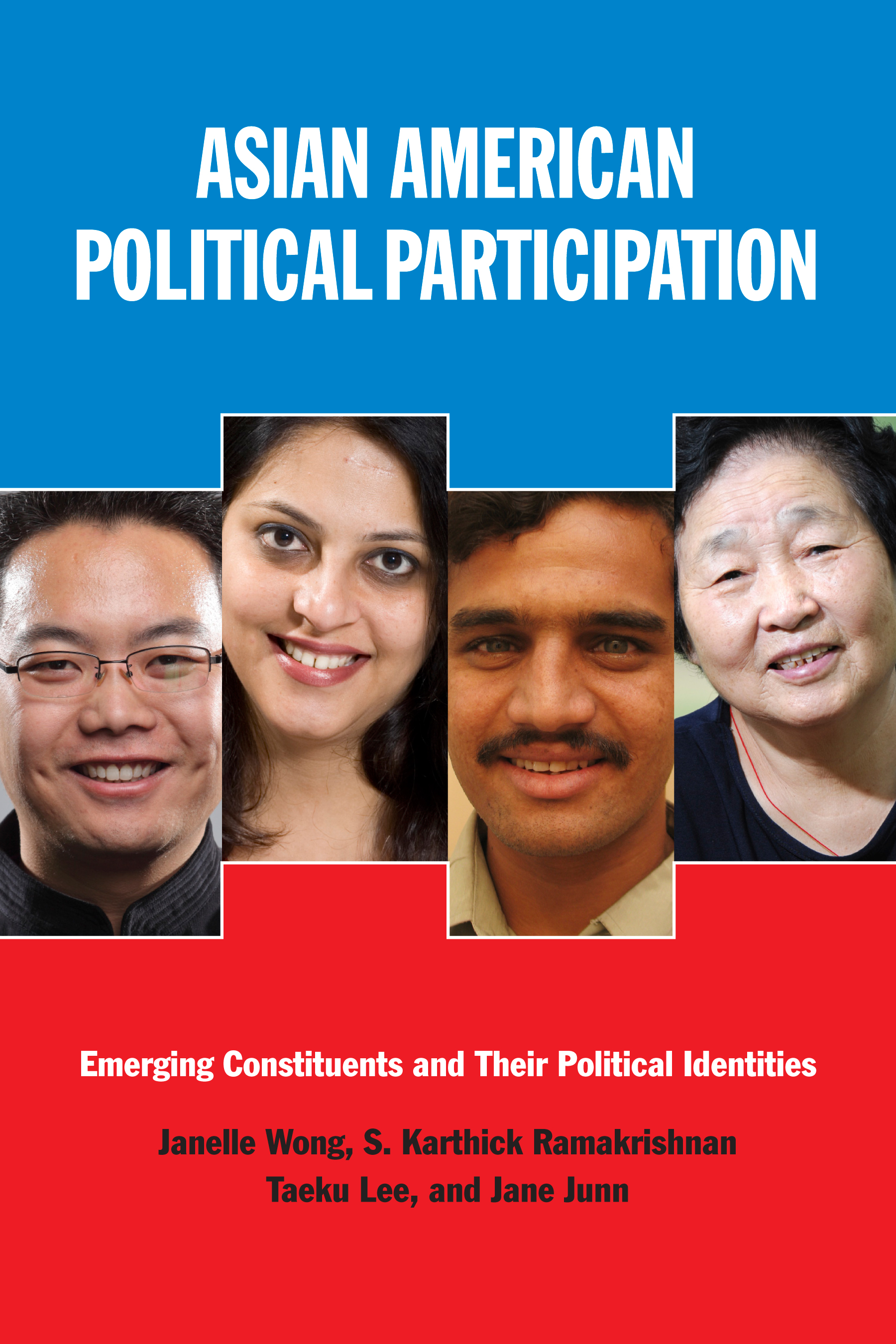
If it’s important to count people to determine representation in Congress, it’s that much more important for citizens to be able to vote. Aside from citizenship you must also be 18 years of age, and you must be registered to vote. This is not a huge set of hurdles for most adult Americans, but it’s not the same for Asian Americans exactly. In the big numbers in the 2008 national elections, America looked like this: 225 million Americans aged 18 and older, and of these, 206 million or so were citizens (about 91%), and about 146 million were registered (71% of all citizens) and about 131 million voted (about 90% of all registered voters). As a proportion of all adult American citizens, 64% came out to vote. How did Asian Americans fare? Of the 10.5 million Asian Americans over the age of 18 in 2008, about 7 million were citizens (about 68%), 3.9 million were registered (56% of all Asian American citizens) and about 3.4 million voted (about 87% of Asian American registered voters). As a proportion of all adult Asian American citizens, only 49% came out to vote in 2008. Clearly the initial hurdle is gaining citizenship which is an extremely lengthy process. But once they have citizenship, Asian Americans seem to vote at about the same levels as the national average. The 15% voter gap is a huge question for political scientists like Janelle Wong and Karthick Ramakrishnan who have noted some possible explanations such as: suspicion of political institutions from their experience in their previous home country, lack of translation of registration information since English fluency may be a problem.
Ambivalent Military Service
Military service is a powerful indication of social integration but it’s one of ambivalence for some Asian Americans. Consider that most Japanese Americans were interned during World War II while only a small minority of German and Italian Americans were treated in this way. Nevertheless the 442nd Regimental Combat Team, composed of Japanese American volunteers led by white officers was the most highly-decorated regiment in the US Armed Forces. War has changed since the 1940s and so has the military (just ask Captain America 😉 ). In the general population of 234 million civilians, 21.8 million were veterans – about 9.3%. Of the 11.4 million Asian American civilians in 2010, an estimated 265,198 or about 2.3% were vets. Considering the suicide of Danny Chen may have been a result of severe bullying while serving in the military (and to some extent Harry Lew as well), being Asian American in today’s military does not seem to be the kind of place where one’s patriotism is honored. In addition we should keep in mind that since the majority of Asian Americans are adult immigrants past their early years, they may be too old or otherwise unqualified to serve. Some folks like my uncles had served in the Republic of Korea army for a few years in their early 20s as part of their civic duty. By the time they arrived in the US in their late 20s and early 30s they were ready for something else.
In sum, understanding context is vital in interpreting what a statistic means. While I appreciate the efforts of the Census Bureau in sharing these facts and figures from their treasure-trove of data, it’s important to research the context and history behind these numbers. Asian Americans have rich histories both within and outside the US, and these play a huge role in their individual choices to get a college degree, vote, and serve in the military. In our multiracial environment we should take the figures we read in news releases with care as they can often understate important factors at play that can greatly affect what those numbers actually mean.
Previous Post

May 7, 2012
Wolves in Gaudy Sheepskin Clothing
Next Post
May 10, 2012 Gender and Christianity: Why Do Women Pray More?
Browse Our Archives
Select a Category Amy Reynolds Becky Hsu Brad Wright critical realism George Yancey Gerardo Marti Jeremy Rhodes Jerry Park John Schmalzbauer Margarita Mooney Mark Regnerus Nicolette Manglos positive sociology Richard Flory Robert Woodberry Uncategorized
Select a Month April 2017 August 2016 April 2016 March 2016 February 2016 January 2016 December 2015 November 2015 October 2015 September 2015 August 2015 July 2015 June 2015 May 2015 April 2015 March 2015 February 2015 January 2015 December 2014 November 2014 October 2014 September 2014 August 2014 July 2014 June 2014 May 2014 April 2014 March 2014 February 2014 January 2014 December 2013 November 2013 October 2013 September 2013 August 2013 July 2013 June 2013 May 2013 April 2013 March 2013 February 2013 January 2013 December 2012 November 2012 October 2012 September 2012 August 2012 July 2012 June 2012 May 2012 April 2012 March 2012 February 2012 January 2012 December 2011 November 2011 October 2011
Follow Us!
TAKE THE
Religious Wisdom Quiz
Who anointed Jesus with expensive perfume?
Select your answer to see how you score.
Mary Peter Salome Martha
Related posts from Black, White and Gray

One Step Forward, but Now What?

Greater Acceptance, Persisting Antipathy: 50 Years of Religious...

Keeping (and Losing) Faith, the Asian American Way...

The Top 11 from ’13: Academic Journals of...
TRENDING AT PATHEOS Evangelical

The REST of Your Life: A Creative Wrestles...
This week I had a conversation with a good friend from church....

How the author of the world's best hymn...
I've been working with John Newton for a while now. This makes...

Long before this Lectio Divina, Psalm 130 - the song - started...

What About the Trees? Another Living Parable
After I finished writing the last article about falling leaves as a...

Why Classical Education Is a Conversation, Not a...
Come and Read: Joy in Classical Education When I was a little...

Cornell University has received a great deal of negative publicity and intense...
view all Evangelical blogs
Ad-Free & Subscriber Log-In Subscription Support
- About Us
- 2026 Calendar
- Videos
- Podcasts
- Library of World Religions
- Faith In Media Tracker
- Advertise With Us
- Write for Us
- Privacy Policy
- Terms of Service
- Do Not Sell My Data
- Contact Us
- Radiant Digital
- Manage Newsletter Subscriptions
- Unsubscribe From Notifications
- Sitemap
Copyright 2008-2026, Patheos. All rights reserved.
Subscription Support Ad-Free & Subscriber Log-In
Follow Patheos