
BuddhistCatholicContemplativeEvangelicalGeneral ChristianHinduJewishLatter-day SaintMuslimNew VisionsProgressive Christian
Beliefs
- Buddhist
- Catholic
- Contemplative
- Evangelical
- General Christian
- Hindu
- Jewish
- Latter-day Saint
- More Voices
- Muslim
- New Visions
- Pagan
- Progressive Christian
Topics
- Religion News
- Food and Religion
- Sports and Religion
- Religious Art
- Religious Music and Entertainment
- Religious Events
- History and Religion
- Style and Religion
- Politics and Religion
- Women in Religion
- Recreation Outdoors and Religion
- Business Finance and Religion
- Careers Workplace and Religion
- Education and Religion
- Family Parenting and Religion
- Health Fitness and Religion
- Home and Religion
- Relationships and Religion
- Technology and Religion
- Travel and Religion
Columnists
- Buddhist Columnists
- Business Finance and Religion Columnists
- Careers Workplace and Religion Columnists
- Catholic Columnists
- Contemplative Columnists
- Education and Religion Columnists
- Evangelists Columnists
- Family Parenting and Religion Columnists
- General Christian Columnists
- Health Fitness and Religion Columnists
- Hindu Columnists
- History and Religion Columnists
- Home and Religion Columnists
- Jewish Columnists
- More Voices Columnists
- Latter Day Columnists
- Muslim Columnists
- New Visions Columnists
- Nonreligious Columnists
- Pagan Columnists
- Politics and Religion Columnists
- Progressive Columnists
- Recreation Outdoors and Religion Columnists
- Relationships and Religion Columnists
- Religion News Columnists
- Religious Art Columnists
- Religious Events Columnists
- Religious Music and Entertainment Columnists
- Sports and Religion Columnists
- Style and Religion Columnists
- Technology and Religion Columnists
- Travel and Religion Columnists
- Women in Religion Columnists
Resource Library
- 2026 Calendar
- Library of World Religions
- The 100 Most Holy Places on Earth
- Patheos Answers
- Podcasts
- Videos
- Faith Leaders Database
- Anglican Episcopalian
- Bahai
- Baptist
- Buddhism
- Christianity
- Confucianism
- Eastern Orthodoxy
- Hinduism
- Holiness and Pentecostal
- ISKCON
- Islam
- Judaism
- Lutheran
- Methodist
- The Church of Jesus Christ of Latter-day Saints
- New Age
- Paganism
- Presbytarian and Reformed
- Protestantism
- Religion Behind the Scenes
- Roman Catholic
- Scientology
- Shia Islam
- Sikhism
- Sufism
- Sunni Islam
- Taoism
- Zen
- See all religions
Research Tools
 Ad-Free & Subscriber Log-In Subscription Support
Ad-Free & Subscriber Log-In Subscription Support
Follow Patheos 

- Trending:
- Forgiveness
- |
- Marriage
- |
- Consciousness
- |
- Death Penalty
- |
- Election
- |
- Halloween
 Black, White and Gray
-
About the Authors
- Home
- Evangelical
- Religious Freedom: Why Now? Defending an Embattled Human Right
Religious Freedom: Why Now? Defending an Embattled Human Right
Last updated on: April 2, 2012 at 10:36 am by Margarita A. Mooney
Religious Freedom: Why Now? Defending an Embattled Human Right 2012-04-02T10:36:16-05:00 Margarita A. Mooney
Patheos Explore the world's faith through different perspectives on religion and spirituality! Patheos has the views of the prevalent religions and spiritualities of the world.
A public event on March 1, 2012, hosted by Georgetown University’s Berkely Center for Religion, Peace & World Affairs launched the monograph Religious Freedom: Why Now? Defending an Embattled Human Right, authored by Timothy Shah under the auspices of the Witherspoon Institute’s Task Force on International Religious Freedom. At this event, Princeton political science Professor Robert George quoted extensively from Martin Luther King’s Letters from the Birmingham Jail to illustrate why religious freedom deserves legal protection. In the Birmingham letters, Reverend King argued persuasively that human laws can be judged unjust when they degrade basic human goods. Racial segregation, King argued, debases human dignity because it designates one group (Whites) as superior to another group (African-Americans); thus such laws are unjust.

Too often, we think t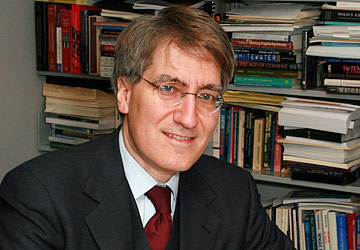 hat asserting “I want something” equals “I have a right to something.” But just as African-Americans had the right to civil equality because it upholds their human dignity, George explained that human rights exists only when if those rights leads to a human good. To illustrate, there is no human right to take an innocent human life because being dead is bad. The human good is to be alive, so our laws protect human life. To talk of human rights thus requires explaining the good those rights protects.
“Rights are not abstractions,” George explained. “They protect human goods.”
So what is the human good protected by the right to religious freedom? Much recent theorizing and empirical work in sociology of religion focuses on the instrumental benefits of religion—better health, positive emotions, social support networks, or group cohesion. Although the instrumental benefits of religion may provide practical reasons to protect religious freedom, George argued that even when religion has instrumental benefits for persons or societies, we have a right to religious freedom because religion is something humans do for its own sake, or a constitutive-end activity.
Echoing Martin Riesebrodt’s argument in The Promise of Salvation: A Theory of Religion, George pointed out that the instrumental benefits of religion–which may indeed be important–do not explain why humans practice religion. Understanding why humans practice religious requires seeing why religious practices are intrinsically important. Humans engage in a complex set of practices like liturgies, private prayer, offerings, baptisms and funerals in order to be in right relation with an unseen power, a power often (though not always) thought of as a transcendent or divine power.
Hence, just like human relationships and cooperation among people are intrinsically good things, similarly George asserted “religion is another irreducible element of the basic human good.”
Religion is also important to the human good because it shapes how one pursues other human goods, and people order their lives according to religious judgments about religious truths.
Because being religious means believing in something that is by definition unseen and outside the realm of science, some people, like the new atheists, assert that to be religious is to be unreasonable. However, unless one adopts a materialist view of the world—that the only thing that is real is what is material—it’s untenable to argue that religious belief is unreasonable anymore than other widely-held beliefs, such as in universal human rights.
Drawing on Aristotle, if humans are rational animals, then our intellectual well-being, not just our physical well-being, constitutes human flourishing. Hence, because religion engages both faith and reason, the flourishing of one’s religious life, like the flourishing of one’s intellectual life or community life is integral to all-around human well-being. Furthermore, religious freedom is constitutive or intrinsic to human well-being precisely because authentic faith requires engaging one’s reason to learn religious truths and then to order one’s life in accordance with those truths. If, as Aristotle argued, actions are only virtuous when both the deed and the intention are virtuous, then coercing someone into religious practice cannot be virtuous nor can it be virtuous to deny someone the right to practice their religion.
Granting religious freedom does not mean one has to agree with a particular religious group or doctrine. To the contrary, embracing religious freedom means one has to uphold people’s right to believe things that one may think are errors. To illustrate, George explained how the Catholic Church’s Vatican II document Dignitatus Humane argued that religious freedom upholds human dignity, and Nostra Aetate (Declaration on the Relation of the Church to Non-Christian Religions) further argued that non-Christian faiths also deserve respect and legal protection. Although the Catholic Church affirms that other religions contain errors about the nature of God, the free practice of those religions deserves to be protected because, even if erroneous, those religions represent an authentic search for the truth and a express a relationship with divine, transcendent or unseen powers. Furthermore, those who profess to be atheists also deserve protection, as to force them to engage in religious practices which they do not assent to with their reason would violate their rights.
In some cases, George admitted that the right to religious freedom may be limited. But in order to intervene with a religious belief, practice or group, the state must show a compelling state interest, and the restriction must be the least restrictive possible needed. As carefully illustrated in the monograph Religious Freedom: Why Now? Defending an Embattled Human Right, many people in the world live under governments with high restrictions on religion or strong social hostilities that limit the free practice of religion.
Pressing issues both domestically and internationally thus require a greater philosophical understanding of why religious freedom deserves to be protected from government infringement and social hostility. Americans should learn more about the importance of religious freedom in order to face current challenges to it in our own democracy. Although some Islamic scholars argue for religious freedom, many traditions within Islam do not currently uphold religious freedom either for other Muslims or non-Muslims, thus endangering the democratic transition recently begun in several Middle Eastern countries. The general expectation that religious belief and practice would subside as modernity progress has not proven true, but modernity has brought greater religious diversity to many nations, thus requiring a renewed commitment to religious freedom as essential to upholding human dignity and creating harmonious societies.
Previous Post

March 6, 2012
Burning of the Quran
Next Post
March 8, 2012 Dear China: Why Censor? Why Suppress Religion?
Browse Our Archives
Select a Category Amy Reynolds Becky Hsu Brad Wright critical realism George Yancey Gerardo Marti Jeremy Rhodes Jerry Park John Schmalzbauer Margarita Mooney Mark Regnerus Nicolette Manglos positive sociology Richard Flory Robert Woodberry Uncategorized
Select a Month April 2017 August 2016 April 2016 March 2016 February 2016 January 2016 December 2015 November 2015 October 2015 September 2015 August 2015 July 2015 June 2015 May 2015 April 2015 March 2015 February 2015 January 2015 December 2014 November 2014 October 2014 September 2014 August 2014 July 2014 June 2014 May 2014 April 2014 March 2014 February 2014 January 2014 December 2013 November 2013 October 2013 September 2013 August 2013 July 2013 June 2013 May 2013 April 2013 March 2013 February 2013 January 2013 December 2012 November 2012 October 2012 September 2012 August 2012 July 2012 June 2012 May 2012 April 2012 March 2012 February 2012 January 2012 December 2011 November 2011 October 2011
Follow Us!
TAKE THE
Religious Wisdom Quiz
What did David take from Saul's camp while he was sleeping?
Select your answer to see how you score.
A sack of gold Sword and scroll Spear and water jug Crown and robe
Related posts from Black, White and Gray

Using Critical Realism to Teach the Fundamentals of...

Incorporating Critical Realism into Research Methods Classes

5 Great Articles Using Critical Realism in Social...

Books on Critical Realism and Sociological Research Methods
TRENDING AT PATHEOS Evangelical

The REST of Your Life: A Creative Wrestles...
This week I had a conversation with a good friend from church....

How the author of the world's best hymn...
I've been working with John Newton for a while now. This makes...

Long before this Lectio Divina, Psalm 130 - the song - started...

What About the Trees? Another Living Parable
After I finished writing the last article about falling leaves as a...

Why Classical Education Is a Conversation, Not a...
Come and Read: Joy in Classical Education When I was a little...

Cornell University has received a great deal of negative publicity and intense...
view all Evangelical blogs
Ad-Free & Subscriber Log-In Subscription Support
- About Us
- 2026 Calendar
- Videos
- Podcasts
- Library of World Religions
- Faith In Media Tracker
- Advertise With Us
- Write for Us
- Privacy Policy
- Terms of Service
- Do Not Sell My Data
- Contact Us
- Radiant Digital
- Manage Newsletter Subscriptions
- Unsubscribe From Notifications
- Sitemap
Copyright 2008-2026, Patheos. All rights reserved.
Subscription Support Ad-Free & Subscriber Log-In
Follow Patheos