
BuddhistCatholicContemplativeEvangelicalGeneral ChristianHinduJewishLatter-day SaintMuslimNew VisionsProgressive Christian
Beliefs
- Buddhist
- Catholic
- Contemplative
- Evangelical
- General Christian
- Hindu
- Jewish
- Latter-day Saint
- More Voices
- Muslim
- New Visions
- Pagan
- Progressive Christian
Topics
- Religion News
- Food and Religion
- Sports and Religion
- Religious Art
- Religious Music and Entertainment
- Religious Events
- History and Religion
- Style and Religion
- Politics and Religion
- Women in Religion
- Recreation Outdoors and Religion
- Business Finance and Religion
- Careers Workplace and Religion
- Education and Religion
- Family Parenting and Religion
- Health Fitness and Religion
- Home and Religion
- Relationships and Religion
- Technology and Religion
- Travel and Religion
Columnists
- Buddhist Columnists
- Business Finance and Religion Columnists
- Careers Workplace and Religion Columnists
- Catholic Columnists
- Contemplative Columnists
- Education and Religion Columnists
- Evangelists Columnists
- Family Parenting and Religion Columnists
- General Christian Columnists
- Health Fitness and Religion Columnists
- Hindu Columnists
- History and Religion Columnists
- Home and Religion Columnists
- Jewish Columnists
- More Voices Columnists
- Latter Day Columnists
- Muslim Columnists
- New Visions Columnists
- Nonreligious Columnists
- Pagan Columnists
- Politics and Religion Columnists
- Progressive Columnists
- Recreation Outdoors and Religion Columnists
- Relationships and Religion Columnists
- Religion News Columnists
- Religious Art Columnists
- Religious Events Columnists
- Religious Music and Entertainment Columnists
- Sports and Religion Columnists
- Style and Religion Columnists
- Technology and Religion Columnists
- Travel and Religion Columnists
- Women in Religion Columnists
Resource Library
- 2026 Calendar
- Library of World Religions
- The 100 Most Holy Places on Earth
- Patheos Answers
- Podcasts
- Videos
- Faith Leaders Database
- Anglican Episcopalian
- Bahai
- Baptist
- Buddhism
- Christianity
- Confucianism
- Eastern Orthodoxy
- Hinduism
- Holiness and Pentecostal
- ISKCON
- Islam
- Judaism
- Lutheran
- Methodist
- The Church of Jesus Christ of Latter-day Saints
- New Age
- Paganism
- Presbytarian and Reformed
- Protestantism
- Religion Behind the Scenes
- Roman Catholic
- Scientology
- Shia Islam
- Sikhism
- Sufism
- Sunni Islam
- Taoism
- Zen
- See all religions
Research Tools
 Ad-Free & Subscriber Log-In Subscription Support
Ad-Free & Subscriber Log-In Subscription Support
Follow Patheos 

- Trending:
- Forgiveness
- |
- Marriage
- |
- Consciousness
- |
- Death Penalty
- |
- Election
- |
- Halloween
 Black, White and Gray
-
About the Authors
- Home
- Evangelical
- Non-Christian Asian Americans and Religious Tolerance
Non-Christian Asian Americans and Religious Tolerance
Last updated on: December 10, 2011 at 4:37 pm by Jerry Park
Non-Christian Asian Americans and Religious Tolerance 2011-12-10T16:37:57-05:00 Jerry Park
Patheos Explore the world's faith through different perspectives on religion and spirituality! Patheos has the views of the prevalent religions and spiritualities of the world.
In earlier posts I’ve shown how difficult it is to get a good survey of religion among Asian Americans, and I’ve shown what we sort of know about the actual religious prevalence of this racial group. The one group I have neglected to mention are the religiously-affiliated non-Christians. In the following pie charts I illustrate data using the Pew Religious Landscape Survey 2008 of the estimated distribution of major world religions for the entire sample and within the Asian American sample. As you recall this was only translated into Spanish so, the Asian American findings pertain to those who are comfortable answering a survey over the phone in English.
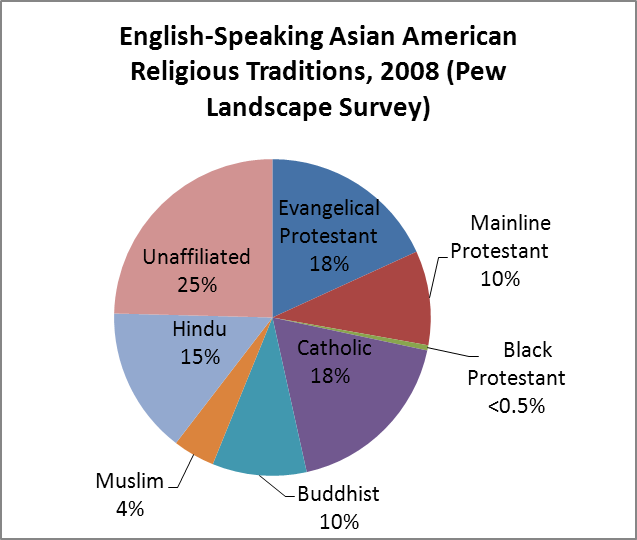
The largest three non-Christian traditions among English-preferred Asian Americans are Buddhism, Hinduism and Islam, and they take up 10, 15 and 4% respectively of all Asian Americans in the sample. This may not seem like much but consider the comparison to the overall sample where Buddhism, Hinduism and Islam combined account for less than 3%.
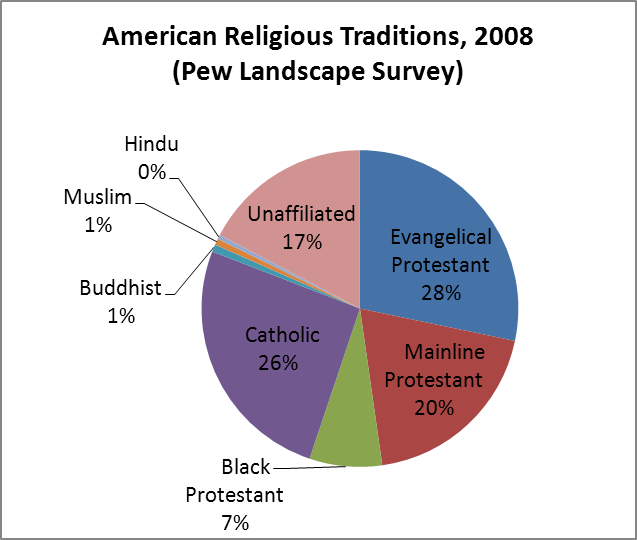
Another way of saying this is that major non-Christian religions are over-represented among Asian Americans. In gross numbers that around 5 million people. Keep in mind this estimate is based on a sample with no Asian-language translation, so this is a low estimate. In my opinion, if we want to understand the social and political (as well as religious) views of our non-Christian friends, neighbors and co-workers, we should survey Asian Americans.
Since 9/11 attention to our religious diversity and our tolerance of religious difference has been at an all-time high. From my limited purview of American history, we’ve not had a great track record at respecting our religious differences. It’s true, the magnitude of violence against religious minorities whether Catholic, Jewish, Mormon, Native American has not been as severe compared to the religious wars in Europe, but the issue is one of ideals: as a nation we actually were founded in part on religious tolerance, so if there’s one characteristic that should stand out as particularly American, it should be that. My hometown of Philadelphia was particularly known for advocating this idea. Nevertheless what we know is the following: anti-Catholic sentiment persisted right until Kennedy (and some would say continues so with the unbalanced attention given to the sexual misbehavior among Catholic clergy compared to Protestant clergy). Anti-Semitism remains the highest reported religious hate crime according to the FBI’s hate crime report (each report shows this as far back as 2002 in a quick look). And implicitly, with the exclusion of the Chinese and all Asian immigrants from the 1880s through the 1960s anti-Buddhist, anti-Hindu and anti-Muslim sentiment was implied. And most important, anti-Muslim sentiment has continued unabated since 2001.
Since this blog is largely aimed at a Christian audience, my question is this: what are our responsibilities toward our religious non-Christian friends and neighbors and co-workers? For some, I would guess that religious tolerance is one of the hallmark characteristics of a good American Christian. Just as we want our freedom to express our faith, so we wish that others would share in that freedom. In that way, being Christian and upholding the ideal of American religious tolerance go hand in hand. Such believers tend to say that Christianity is not the only religion containing ultimate truth. Other Christians might see this view at odds with their understanding of Christianity. Tolerance sure, but at the end of the day, Christianity (particularly their version of it) has the exclusive hold on ultimate truth. Sociologist Robert Wuthnow describes these two perspectives as “religious inclusivism” and “religious exclusivism” in his study on Americans’ views on religious diversity.
He found that Christians generally are quite supportive of religious diversity but the support seems to be rather thin. While religiously inclusive Americans tend to be more supportive of religious diversity, very few of these folks actually know all that much about Buddhism, Hinduism, or Islam. On top of that, they tend not to know anyone who follows these religions. Religious exclusivists may believe that their religion is the one that gets them to heaven, but apparently they too do little to actually try and “win” over their non-Christian co-workers and teammates. Apparently a culture of tolerance dampens their zeal. Indeed his chapter on interreligious marriages suggests that the main solution for respecting one another’s religious differences is to not talk about it at all.

Mazie Hirono US Rep (HI, 2010-), Buddhist American

actor Kal Penn, Hindu American

Actor/ Comedian Aasif Mandvi, Muslim American
As a point of scholarly interest, it would be interesting to learn what religious Asian Americans think about religious tolerance since they are much more likely to encounter diversity than other Americans either in their families or friendships.
What do Chinese Christians and Buddhists think of one another? What do Indian American Christians, Hindus and Muslims think of one another? Do they have meaningful relationships with each other while still holding to their faith? Does their ethnic minority status trump their religious differences in their identity?
On a prescriptive note, in a nation that prides itself on religious tolerance, it seems unfortunate that we choose to disengage one another. It’s great that we’re so tolerant but surely we can do better than just advocate for religious tolerance. Could we not learn from one another by having a dinner conversation or catching a game on a Saturday or Sunday afternoon?
Next Post

December 10, 2011 The New Evangelicals?
Browse Our Archives
Select a Category Amy Reynolds Becky Hsu Brad Wright critical realism George Yancey Gerardo Marti Jeremy Rhodes Jerry Park John Schmalzbauer Margarita Mooney Mark Regnerus Nicolette Manglos positive sociology Richard Flory Robert Woodberry Uncategorized
Select a Month April 2017 August 2016 April 2016 March 2016 February 2016 January 2016 December 2015 November 2015 October 2015 September 2015 August 2015 July 2015 June 2015 May 2015 April 2015 March 2015 February 2015 January 2015 December 2014 November 2014 October 2014 September 2014 August 2014 July 2014 June 2014 May 2014 April 2014 March 2014 February 2014 January 2014 December 2013 November 2013 October 2013 September 2013 August 2013 July 2013 June 2013 May 2013 April 2013 March 2013 February 2013 January 2013 December 2012 November 2012 October 2012 September 2012 August 2012 July 2012 June 2012 May 2012 April 2012 March 2012 February 2012 January 2012 December 2011 November 2011 October 2011
Follow Us!
TAKE THE
Religious Wisdom Quiz
What city was the capital of Israel before Jerusalem?
Select your answer to see how you score.
Hebron Jericho Shechem Bethel
Related posts from Black, White and Gray

One Step Forward, but Now What?

Greater Acceptance, Persisting Antipathy: 50 Years of Religious...

Keeping (and Losing) Faith, the Asian American Way...

The Top 11 from ’13: Academic Journals of...
TRENDING AT PATHEOS Evangelical

The REST of Your Life: A Creative Wrestles...
This week I had a conversation with a good friend from church....

How the author of the world's best hymn...
I've been working with John Newton for a while now. This makes...

Long before this Lectio Divina, Psalm 130 - the song - started...

What About the Trees? Another Living Parable
After I finished writing the last article about falling leaves as a...

Why Classical Education Is a Conversation, Not a...
Come and Read: Joy in Classical Education When I was a little...

Cornell University has received a great deal of negative publicity and intense...
view all Evangelical blogs
Ad-Free & Subscriber Log-In Subscription Support
- About Us
- 2026 Calendar
- Videos
- Podcasts
- Library of World Religions
- Faith In Media Tracker
- Advertise With Us
- Write for Us
- Privacy Policy
- Terms of Service
- Do Not Sell My Data
- Contact Us
- Radiant Digital
- Manage Newsletter Subscriptions
- Unsubscribe From Notifications
- Sitemap
Copyright 2008-2026, Patheos. All rights reserved.
Subscription Support Ad-Free & Subscriber Log-In
Follow Patheos