
BuddhistCatholicContemplativeEvangelicalGeneral ChristianHinduJewishLatter-day SaintMuslimNew VisionsProgressive Christian
Beliefs
- Buddhist
- Catholic
- Contemplative
- Evangelical
- General Christian
- Hindu
- Jewish
- Latter-day Saint
- More Voices
- Muslim
- New Visions
- Pagan
- Progressive Christian
Topics
- Religion News
- Food and Religion
- Sports and Religion
- Religious Art
- Religious Music and Entertainment
- Religious Events
- History and Religion
- Style and Religion
- Politics and Religion
- Women in Religion
- Recreation Outdoors and Religion
- Business Finance and Religion
- Careers Workplace and Religion
- Education and Religion
- Family Parenting and Religion
- Health Fitness and Religion
- Home and Religion
- Relationships and Religion
- Technology and Religion
- Travel and Religion
Columnists
- Buddhist Columnists
- Business Finance and Religion Columnists
- Careers Workplace and Religion Columnists
- Catholic Columnists
- Contemplative Columnists
- Education and Religion Columnists
- Evangelists Columnists
- Family Parenting and Religion Columnists
- General Christian Columnists
- Health Fitness and Religion Columnists
- Hindu Columnists
- History and Religion Columnists
- Home and Religion Columnists
- Jewish Columnists
- More Voices Columnists
- Latter Day Columnists
- Muslim Columnists
- New Visions Columnists
- Nonreligious Columnists
- Pagan Columnists
- Politics and Religion Columnists
- Progressive Columnists
- Recreation Outdoors and Religion Columnists
- Relationships and Religion Columnists
- Religion News Columnists
- Religious Art Columnists
- Religious Events Columnists
- Religious Music and Entertainment Columnists
- Sports and Religion Columnists
- Style and Religion Columnists
- Technology and Religion Columnists
- Travel and Religion Columnists
- Women in Religion Columnists
Resource Library
- 2026 Calendar
- Library of World Religions
- The 100 Most Holy Places on Earth
- Patheos Answers
- Podcasts
- Videos
- Faith Leaders Database
- Anglican Episcopalian
- Bahai
- Baptist
- Buddhism
- Christianity
- Confucianism
- Eastern Orthodoxy
- Hinduism
- Holiness and Pentecostal
- ISKCON
- Islam
- Judaism
- Lutheran
- Methodist
- The Church of Jesus Christ of Latter-day Saints
- New Age
- Paganism
- Presbytarian and Reformed
- Protestantism
- Religion Behind the Scenes
- Roman Catholic
- Scientology
- Shia Islam
- Sikhism
- Sufism
- Sunni Islam
- Taoism
- Zen
- See all religions
Research Tools
 Ad-Free & Subscriber Log-In Subscription Support
Ad-Free & Subscriber Log-In Subscription Support
Follow Patheos 

- Trending:
- Forgiveness
- |
- Marriage
- |
- Consciousness
- |
- Death Penalty
- |
- Election
- |
- Halloween
 Black, White and Gray
-
About the Authors
- Home
- Evangelical
- Did the Religious Right Lose 10 Million Christians?
Did the Religious Right Lose 10 Million Christians?
Last updated on: November 4, 2011 at 10:54 am by Bradley Wright
Did the Religious Right Lose 10 Million Christians? 2011-11-04T10:54:00-05:00 Bradley Wright
Patheos Explore the world's faith through different perspectives on religion and spirituality! Patheos has the views of the prevalent religions and spiritualities of the world.
In the 1990s, a seismic shift occurred in religious America. During that period, the percentage of Americans who did not affiliate with any religion more than doubled. In the 1980s, about 7% of Americans reported being religiously unaffiliated, and by 2000, this was up to 14% (and has since increased to about 17%). To be clear, many of these religiously unaffiliated still believe in God, but they don’t associate with any particular religion or denomination.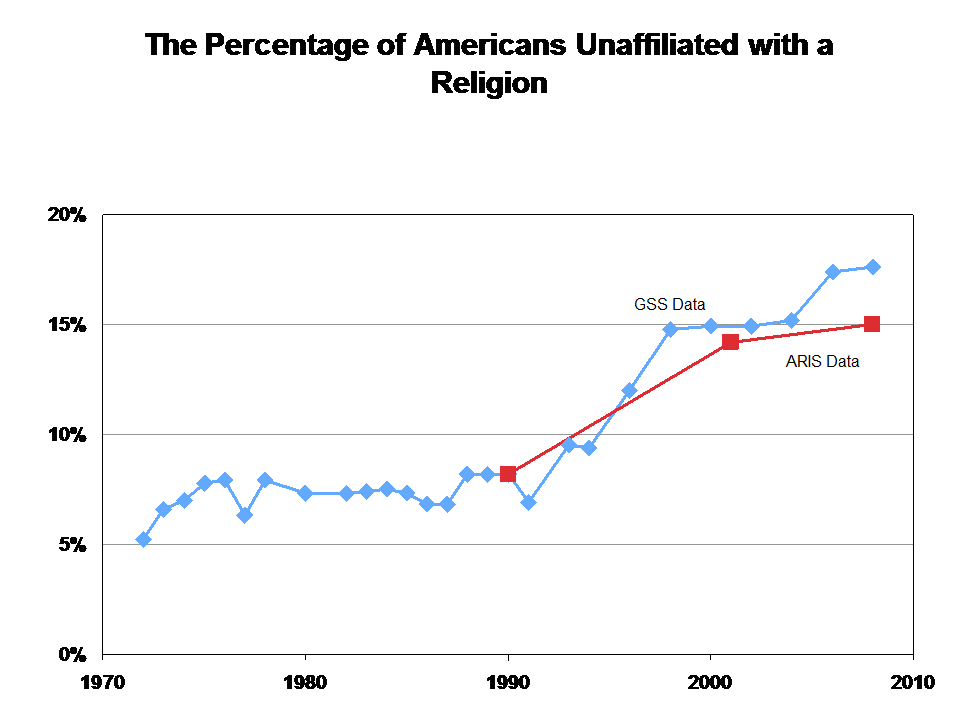
What happened, and why did it happen in the 1990s? Micheal Hout and Claude Fischer, sociologists at Berkeley, published a study that links part of this substantial drop of religious affiliation to politics. They examined what type of people left religion in the 1990s, and they found it closely tied to political beliefs. Unaffiliation among liberals increased 11 percentile points; among political moderates it increased 5-6 points; and among political conservatives it increased an insignificant 1.7 points.
So, why would liberal or moderate politics move people away from Christianity in the 1990s? Well, that was a time in which the Religious Right held considerable sway in American politics, and the linkage of a Republican agenda to Christianity served to politicize Christianity. This repelled people who accepted Christianity but not the Republican party. As a result, many people who would otherwise affiliate with Christianity perhaps moved away from it as a reaction against this Christian-Republican linkage. Hout and Fischer summarize:
Our conjecture is that the growing connection made in the press and in the Congress between Republicans and Christian evangelicals may have led Americans with moderate and liberal political views to express their distance from the Religious Right by saying they prefer no religion.
(I’ve had the chance to correspond with Michael Hout on this issue, and in more recent work, he has found that the reaction to the religious right started even earlier, in the mid-1980s, when the Religious Right was becoming well-known).
How much of an effect did the politicization of Christianity have? A very large effect. Hout and Fischer estimate that more than half of the people who disaffiliated from religion in the 1990s did so out of political concerns. As such, had American Christianity not become so politicized, the percentage of Americans preferring not to affiliate with religion would have risen only 3 or 4 percentage points instead of 7 points.
To appreciate the magnitude of this effect, let’s put some numbers to it. In 1990, there were about 250 million adults in United States, and let’s say that three-quarters of them were Christians. This gives us 187 million Christian adults. If 3.5% of them turned away from their faith due to the politicization of religion, that works out to be 6.5 million Christian adults lost in the 1990s due to politics.
This is a big number—a really, really big number. It appears that the work of the Religious Right—which was intended to advance the Kingdom—actually lost over 6 million Christians in the 1990s. Assuming that these unaffiliated adults in turn raised their children differently as a result of pulling away from Christianity, it’s entirely likely that we would have 10 million more Christians in America today had it not been for the previous work of the Religious Right.
Hout and Fischer found that the people who left Christianity in reaction to conservative politics were, on average, less committed than those who stayed, but this is not grounds for nonchalance. Many of those who left were committed to their faith, they just had very strong feelings about politics. Even for those who were less committed, it seems easier to reach them when they are already sometimes attending church and peripherally involved in the faith than when they disengage altogether, and so that too is a lose.
Politicizing Christianity in the liberal direction is also problematic. From personal experience, I have observed that churches or denominations that affiliate with politics to the Left lose many of their more-conservative members and the vitality that they bring to the faith. This fits with the conventional wisdom that the liberalization of Mainline Protestant churches has lost them considerable share in their religious marketplace. Based on data from the General Social Survey (which asks respondents in which religion they were raised), I estimate that in 1920, over 40% of Americans affiliated with a Mainline Protestant denomination. Now, that is down to less than 15%. Undoubtedly there are multiple factors undergirding this decline, but it seems reasonable to assume that liberal politics played a part.
Last week I posted my own thoughts about religion and politics. Perhaps some overlap between religion and politics is inevitable, and maybe even good can arise from it. I have little to add to how this should be done other than to point out that when we link our faith with a particular brand of politics, we will probably lose many believers.
Thanks Tim for the input!
Previous Post

November 2, 2011
Moving Forward the Science & Religion Debate
Next Post
November 4, 2011 Surveying Religion in Asian America
Browse Our Archives
Select a Category Amy Reynolds Becky Hsu Brad Wright critical realism George Yancey Gerardo Marti Jeremy Rhodes Jerry Park John Schmalzbauer Margarita Mooney Mark Regnerus Nicolette Manglos positive sociology Richard Flory Robert Woodberry Uncategorized
Select a Month April 2017 August 2016 April 2016 March 2016 February 2016 January 2016 December 2015 November 2015 October 2015 September 2015 August 2015 July 2015 June 2015 May 2015 April 2015 March 2015 February 2015 January 2015 December 2014 November 2014 October 2014 September 2014 August 2014 July 2014 June 2014 May 2014 April 2014 March 2014 February 2014 January 2014 December 2013 November 2013 October 2013 September 2013 August 2013 July 2013 June 2013 May 2013 April 2013 March 2013 February 2013 January 2013 December 2012 November 2012 October 2012 September 2012 August 2012 July 2012 June 2012 May 2012 April 2012 March 2012 February 2012 January 2012 December 2011 November 2011 October 2011
Follow Us!
TAKE THE
Religious Wisdom Quiz
What does "be salt and light" mean in Jesus' teaching?
Select your answer to see how you score.
Be a good example Change nothing Be invisible Lose your flavor
Related posts from Black, White and Gray

Want to Live Longer? Go to Church

Saving the Market: Harry Potter, Churches, and Globalization

If Physicians Acted Like Sociologists (or, Why We’re...

Marti and Ganiel's The Deconstructed Church: Understanding Emerging...
TRENDING AT PATHEOS Evangelical

The REST of Your Life: A Creative Wrestles...
This week I had a conversation with a good friend from church....

How the author of the world's best hymn...
I've been working with John Newton for a while now. This makes...

Long before this Lectio Divina, Psalm 130 - the song - started...

What About the Trees? Another Living Parable
After I finished writing the last article about falling leaves as a...

Why Classical Education Is a Conversation, Not a...
Come and Read: Joy in Classical Education When I was a little...

Cornell University has received a great deal of negative publicity and intense...
view all Evangelical blogs
Ad-Free & Subscriber Log-In Subscription Support
- About Us
- 2026 Calendar
- Videos
- Podcasts
- Library of World Religions
- Faith In Media Tracker
- Advertise With Us
- Write for Us
- Privacy Policy
- Terms of Service
- Do Not Sell My Data
- Contact Us
- Radiant Digital
- Manage Newsletter Subscriptions
- Unsubscribe From Notifications
- Sitemap
Copyright 2008-2026, Patheos. All rights reserved.
Subscription Support Ad-Free & Subscriber Log-In
Follow Patheos