
BuddhistCatholicContemplativeEvangelicalGeneral ChristianHinduJewishLatter-day SaintMuslimNew VisionsProgressive Christian
Beliefs
- Buddhist
- Catholic
- Contemplative
- Evangelical
- General Christian
- Hindu
- Jewish
- Latter-day Saint
- More Voices
- Muslim
- New Visions
- Pagan
- Progressive Christian
Topics
- Religion News
- Food and Religion
- Sports and Religion
- Religious Art
- Religious Music and Entertainment
- Religious Events
- History and Religion
- Style and Religion
- Politics and Religion
- Women in Religion
- Recreation Outdoors and Religion
- Business Finance and Religion
- Careers Workplace and Religion
- Education and Religion
- Family Parenting and Religion
- Health Fitness and Religion
- Home and Religion
- Relationships and Religion
- Technology and Religion
- Travel and Religion
Columnists
- Buddhist Columnists
- Business Finance and Religion Columnists
- Careers Workplace and Religion Columnists
- Catholic Columnists
- Contemplative Columnists
- Education and Religion Columnists
- Evangelists Columnists
- Family Parenting and Religion Columnists
- General Christian Columnists
- Health Fitness and Religion Columnists
- Hindu Columnists
- History and Religion Columnists
- Home and Religion Columnists
- Jewish Columnists
- More Voices Columnists
- Latter Day Columnists
- Muslim Columnists
- New Visions Columnists
- Nonreligious Columnists
- Pagan Columnists
- Politics and Religion Columnists
- Progressive Columnists
- Recreation Outdoors and Religion Columnists
- Relationships and Religion Columnists
- Religion News Columnists
- Religious Art Columnists
- Religious Events Columnists
- Religious Music and Entertainment Columnists
- Sports and Religion Columnists
- Style and Religion Columnists
- Technology and Religion Columnists
- Travel and Religion Columnists
- Women in Religion Columnists
Resource Library
- 2026 Calendar
- Library of World Religions
- The 100 Most Holy Places on Earth
- Patheos Answers
- Podcasts
- Videos
- Faith Leaders Database
- Anglican Episcopalian
- Bahai
- Baptist
- Buddhism
- Christianity
- Confucianism
- Eastern Orthodoxy
- Hinduism
- Holiness and Pentecostal
- ISKCON
- Islam
- Judaism
- Lutheran
- Methodist
- The Church of Jesus Christ of Latter-day Saints
- New Age
- Paganism
- Presbytarian and Reformed
- Protestantism
- Religion Behind the Scenes
- Roman Catholic
- Scientology
- Shia Islam
- Sikhism
- Sufism
- Sunni Islam
- Taoism
- Zen
- See all religions
Research Tools
 Ad-Free & Subscriber Log-In Subscription Support
Follow Patheos 

- Trending:
- Advent
- |
- Forgiveness
- |
- Thanksgiving
- |
- Election
- |
- Seasonal Holidays
- |
- Marriage
 Black, White and Gray
-
About the Authors
- Home
- Evangelical
- Does God Use Natural Disasters to Guide American Politics?
Does God Use Natural Disasters to Guide American Politics?
Last updated on: November 15, 2011 at 8:29 am by Bradley Wright
Does God Use Natural Disasters to Guide American Politics? 2011-11-15T08:29:13-05:00 Bradley Wright
Patheos Explore the world's faith through different perspectives on religion and spirituality! Patheos has the views of the prevalent religions and spiritualities of the world.
In recent weeks, I have written about my discomfort with people aligning religion with a particular party and the costs that it might impose. Today I examine what I view as an unhelpful instance of a bringing religion into a political debate. I use this not to critique the candidate who said it, but rather to examine its underlying logic.

In August, Republican candidate Michele Bachmann told an audience in Florida that God had sent deadly tornadoes and earthquakes in recent weeks to indicate his displeasure with the high levels of federal spending. She said:
“I don’t know how much God has to do to get the attention of the politicians. We’ve had an earthquake; we’ve had a hurricane. He said, ‘Are you going to start listening to me here?’ Listen to the American people, because the American people are roaring right now. They know government is on a morbid obesity diet, and we’ve got to rein in the spending.”
(Bachmann later claimed that she was joking, but having listened to her statement a couple of times, I’m not so sure.)
Whereas most religion-politics linkages take the form of “we’re on God’s side”, this takes it one step further and says “God is on our side.”
I’m quite comfortable with the idea of God communicating directly with people, but as I understand scripture (and that’s a big caveat), I would expect God to tell people to do things like love our enemies, take care of the sick and poor, and live a holy, devout life and other common themes from the New Testament.
But what if if God does send tornadoes and earthquakes to protest high levels of federal spending? This doesn’t sound right, but then again, God sometimes does things without checking with me first.
To understand what God thinks about federal spending, I looked up the number of tornado– and earthquake-related deaths since 1940. I used the number of deaths because they are a reasonable measure of the seriousness of a tornado and hurricane. I also looked up the corresponding federal budget, in 2005 dollars to adjust for inflation.
The figure below presents the data by decade, and as shown, the number of deaths due to tornadoes and hurricanes has dropped steadily. In the 1940s, an average of about 200 people died each year from these natural disasters. By the 1970s, the average was just over 100 people a year, and in the last decade it was just over 50.
During the same period, the federal budget steadily grew. In the 1940s, the Government spent an average of 500 billion dollars a year (in 2005 FY dollars). By the 1970s, this had increased to 1,100 billion, and in the last decade it was almost 2,300 billion a year.
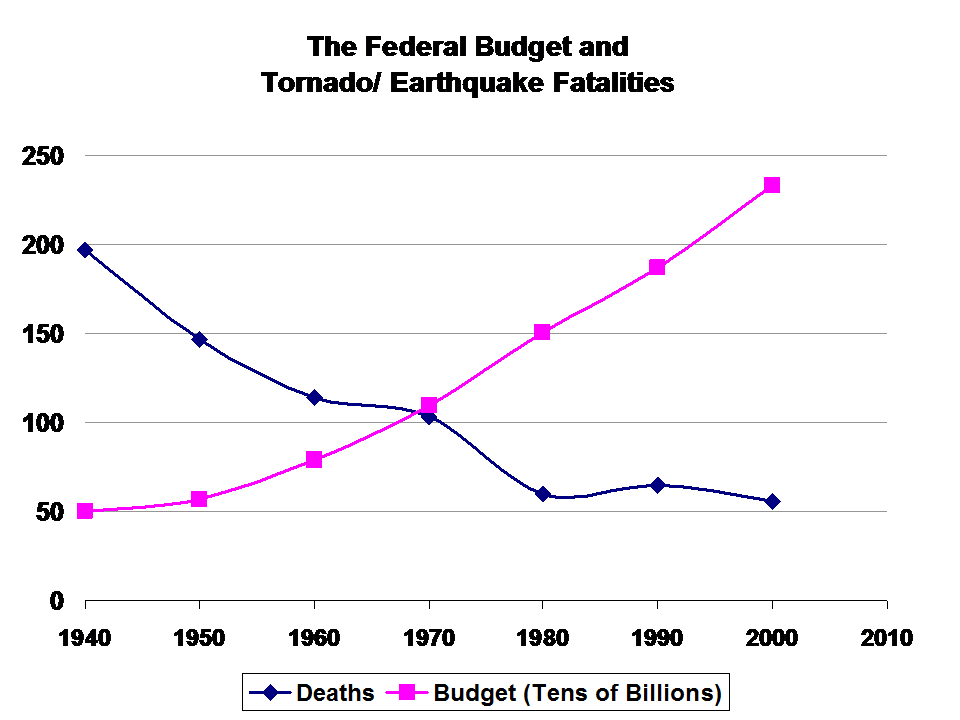
There is a strong, inverse relationship between tornado and earthquake deaths and federal spending. The more the government spends, the fewer people are killed in tornadoes and earthquakes.
Now, I would interpret this relationship as reflecting people responding more effectively to natural disasters. Government regulations result in safer housing; weather forecasting gives increased response time; medical technology gives better treatment to the injured; and so on. All of these are supported, in part, by federal spending.
(This drop in natural disaster fatalities is yet another way that the world is getting better—a topic I examine in depth in my recent book Upside: Surprising Good News about the State of the World.)
Are we to assume from this empirical relationship that God wants more Federal spending, not less? While federal spending has increased four-fold in the last 60 years, deaths from tornadoes and earthquakes have dropped three-fold. God must be very, very pleased with all this federal spending.
The moral of this story: Simple-minded insertions of religion into politics often don’t work out too well.
Previous Post

November 9, 2011
Civil Religion in America Then and Now
Next Post
November 11, 2011 Asian American Faith and the Problem With “No Religion”
Browse Our Archives
Select a Category Amy Reynolds Becky Hsu Brad Wright critical realism George Yancey Gerardo Marti Jeremy Rhodes Jerry Park John Schmalzbauer Margarita Mooney Mark Regnerus Nicolette Manglos positive sociology Richard Flory Robert Woodberry Uncategorized
Select a Month April 2017 August 2016 April 2016 March 2016 February 2016 January 2016 December 2015 November 2015 October 2015 September 2015 August 2015 July 2015 June 2015 May 2015 April 2015 March 2015 February 2015 January 2015 December 2014 November 2014 October 2014 September 2014 August 2014 July 2014 June 2014 May 2014 April 2014 March 2014 February 2014 January 2014 December 2013 November 2013 October 2013 September 2013 August 2013 July 2013 June 2013 May 2013 April 2013 March 2013 February 2013 January 2013 December 2012 November 2012 October 2012 September 2012 August 2012 July 2012 June 2012 May 2012 April 2012 March 2012 February 2012 January 2012 December 2011 November 2011 October 2011
Follow Us!
TAKE THE
Religious Wisdom Quiz
How many days did God take to create the world?
Select your answer to see how you score.
Five Six Seven Ten
Related posts from Black, White and Gray

Want to Live Longer? Go to Church

Saving the Market: Harry Potter, Churches, and Globalization

If Physicians Acted Like Sociologists (or, Why We’re...

Marti and Ganiel's The Deconstructed Church: Understanding Emerging...
TRENDING AT PATHEOS Evangelical

When you hear the word riches, what comes to mind? For most...

Don’t Miss the Parents: A Creative Christmas Meditation
As we enter the Advent Season, I see many people trying to...

Making Stones Into Bread: Choosing the “Right” Work
I was on my online arts ministry Zoom meeting with the International...

Ukraine’s exhausted Christians face fifth winter of war
By Julian Lukins The full-scale war in Ukraine is taking “a serious...

Russell Brand's Conviction is not anti-Christian Persecution
How do we shed the reputation that the Church is OK with...

Have you ever caught yourself saying, “I’ll do it tomorrow,” or “Now...
view all Evangelical blogs
Ad-Free & Subscriber Log-In Subscription Support
- About Us
- 2026 Calendar
- Videos
- Podcasts
- Library of World Religions
- Faith In Media Tracker
- Advertise With Us
- Write for Us
- Privacy Policy
- Terms of Service
- Do Not Sell My Data
- Contact Us
- Radiant Digital
- Manage Newsletter Subscriptions
- Unsubscribe From Notifications
- Sitemap
Copyright 2008-2026, Patheos, part of the Radiant Digital network of media brands. All rights reserved.
Subscription Support Ad-Free & Subscriber Log-In
Follow Patheos