
BuddhistCatholicContemplativeEvangelicalGeneral ChristianHinduJewishLatter-day SaintMuslimNew VisionsProgressive Christian
Beliefs
- Buddhist
- Catholic
- Contemplative
- Evangelical
- General Christian
- Hindu
- Jewish
- Latter-day Saint
- More Voices
- Muslim
- New Visions
- Pagan
- Progressive Christian
Topics
- Religion News
- Food and Religion
- Sports and Religion
- Religious Art
- Religious Music and Entertainment
- Religious Events
- History and Religion
- Style and Religion
- Politics and Religion
- Women in Religion
- Recreation Outdoors and Religion
- Business Finance and Religion
- Careers Workplace and Religion
- Education and Religion
- Family Parenting and Religion
- Health Fitness and Religion
- Home and Religion
- Relationships and Religion
- Technology and Religion
- Travel and Religion
Columnists
- Buddhist Columnists
- Business Finance and Religion Columnists
- Careers Workplace and Religion Columnists
- Catholic Columnists
- Contemplative Columnists
- Education and Religion Columnists
- Evangelists Columnists
- Family Parenting and Religion Columnists
- General Christian Columnists
- Health Fitness and Religion Columnists
- Hindu Columnists
- History and Religion Columnists
- Home and Religion Columnists
- Jewish Columnists
- More Voices Columnists
- Latter Day Columnists
- Muslim Columnists
- New Visions Columnists
- Nonreligious Columnists
- Pagan Columnists
- Politics and Religion Columnists
- Progressive Columnists
- Recreation Outdoors and Religion Columnists
- Relationships and Religion Columnists
- Religion News Columnists
- Religious Art Columnists
- Religious Events Columnists
- Religious Music and Entertainment Columnists
- Sports and Religion Columnists
- Style and Religion Columnists
- Technology and Religion Columnists
- Travel and Religion Columnists
- Women in Religion Columnists
Resource Library
- 2026 Calendar
- Library of World Religions
- The 100 Most Holy Places on Earth
- Patheos Answers
- Podcasts
- Videos
- Faith Leaders Database
- Anglican Episcopalian
- Bahai
- Baptist
- Buddhism
- Christianity
- Confucianism
- Eastern Orthodoxy
- Hinduism
- Holiness and Pentecostal
- ISKCON
- Islam
- Judaism
- Lutheran
- Methodist
- The Church of Jesus Christ of Latter-day Saints
- New Age
- Paganism
- Presbytarian and Reformed
- Protestantism
- Religion Behind the Scenes
- Roman Catholic
- Scientology
- Shia Islam
- Sikhism
- Sufism
- Sunni Islam
- Taoism
- Zen
- See all religions
Research Tools
 Ad-Free & Subscriber Log-In Subscription Support
Ad-Free & Subscriber Log-In Subscription Support
Follow Patheos 

- Trending:
- Forgiveness
- |
- Marriage
- |
- Consciousness
- |
- Death Penalty
- |
- Election
- |
- Halloween
 The Bite in the Apple
- Home
- Progressive Christian
- Where Does Evil Come From?
Where Does Evil Come From?
Last updated on: April 27, 2016 at 3:03 pm by Nancy Rockwell
Where Does Evil Come From? 2016-04-27T15:03:53-04:00 Nancy Rockwell
Patheos Explore the world's faith through different perspectives on religion and spirituality! Patheos has the views of the prevalent religions and spiritualities of the world.
 The question about evil opens this hour of Morgan Freeman’s peripatetic exploration of religious cultures. Within the question is a plaintive note, but he changes that to umbrage by rephrasing it: why should evil exist at all, if the world is under divine control?
A man who seemingly can’t sit still, Freeman travels more than Rick Steves, PBS’ longtime travel guy, who never tries to fit six continents into one hour. But for all the frequent flier miles, Freeman doesn’t come up with an answer to his question about evil and the divine.
Evil is never a comfortable thought, and Freeman’s inability to sit still and reflect on it is understandable. Yet he acknowledges from the start how agonizingly long evil’s tenure on earth is, using images of the Ku Klux Klan, lynchings, and the dire poverty of thin black Americans clad in tattered clothes and no shoes in the 1920s and 1930s.
Freeman asks us and perhaps God as well, if evil comes from an external force – a devil or demons – or from inside us. This question lingers, unanswered, through the hour. The brunt of his exploration is personal, individual stories, which perhaps is an indication of the direction of his answer, but he never says so directly.
He spends time with a neuroscientist who is studying the brains of psychopaths in a maximum security prison. A man who has raped more than two dozen women and murdered five of them, and who has been in that prison for thirty years, says if let out he would commit more crimes because he has no empathy for his victims and no ability to stop himself when he has the freedom to follow his urges. Was he born this way? Or is his violence and his lack of emotional empathy a result of trauma? The data leans toward fetal misdevelopment in his brain. A measurable percentage of humans, mostly men, have this brain pattern.
Freeman does not pursue any possible connection between the behavior of this one loner and the behavior of groups, like the KKK. I wondered what neuroscience would say about groups of people being drawn into evil, how that happens and what it says about us.
Nor does Freeman delve into the long lasting effects on society of experiences of terrible evil. How has evil changed Jewish identity since WW2? How does the memory of segregation shape African American identity today? What about police shootings in the last few years, how is that shaping American identity, black and white?
Instead, Freeman travels to Luxor Egypt, and then to India, to explore legendary understandings of evil. Christians and Jews share a creation story in which a capacity for evil is inherent in people. And Freeman asks, what about genetics?
In India he discovers exorcisms, available to address the common belief that the source of evil is unhappiness in the souls of the ancestors. In Zoroastrian thought, he finds a continual mental struggle to defeat evil.
And in New Zealand he finds a psychologist studying the effect of belief in supernatural beings on children, who, when they are told that a being is watching them, do not cheat in order to get a prize, but when they thought they were alone, they did. But such a minor test bears no relation to the evil acts of a psychopath, nor to evil groups like the KKK can do, and the minor cheating of the kids seems to be manipulative but not truly evil, nor is there any reason to think their cheating will turn into true evil.
The longest segment of the hour was Freeman talking to a reformed neo-Nazi skinhead, who for 16 years did terrible things as part of a group of skinhead group whose identity was much like the KKK. The man had an epiphany when he married and his wife became pregnant. He found God. And then he realized there is good and evil in us all. He changed his life, spending years getting face and neck tattoos removed, he went to church and transformed his hatred into compassion.
Again, Freeman declines to explore this story of personal transformation, and whether it might be applicable for groups, and how it might be promoted. Was there nothing anyone could have done to bring such a transformation about in this man, and is there no hope for other skinheads, other than to hope for pregnancy and epiphanies to transform them?
Freeman opines at the end of the hour that without evil, we would not develop our ability to express kindness, mercy, and forgiveness, or to do good in a cruel world.
American culture is obsessed by evil at present, seeking to destroying evildoers, throw out illegal immigrants, execute killers, get revenge. We yearn for superheroes.
I think Freeman shies away from such punishments as forms of deliverance, but I am unclear what he wants to do about evil. And I am perplexed, rather than persuaded, by his claim that evil develops our ability to do good.
Jesus never threw away anyone, that is clear. All of us are redeemable in his sight. Yet he does not do good because of evil, but despite it, and in the midst of it, and overcomes it with love.
Somehow Freeman missed this. The hour ended with its questions still hanging.
______________________________________________________________________________________________
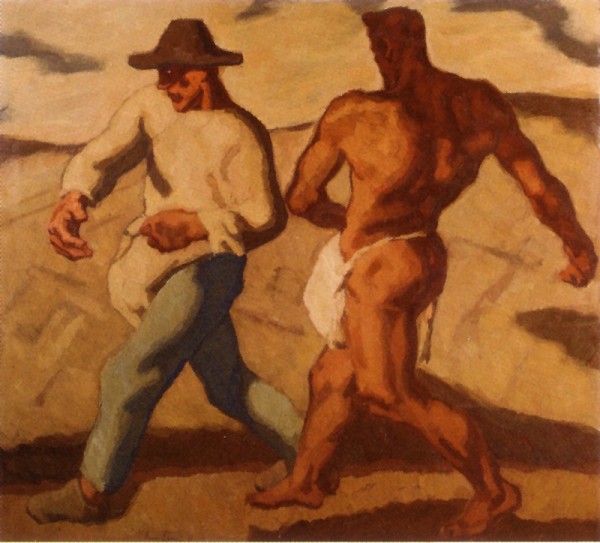
Image: The Sower and the Devil, 1921, by Egger-Lienz, Albin. Vanderbilt Divinity School Library, Art in the Christian Tradition.
Previous Post

April 23, 2016
The Word That Defies Death: Shakespeare and Jesus
Next Post

April 29, 2016 Trump Deals the Cards
Browse Our Archives
Select a Category Bites Uncategorized
Select a Month December 2017 November 2017 October 2017 September 2017 August 2017 July 2017 June 2017 May 2017 April 2017 March 2017 February 2017 January 2017 December 2016 November 2016 October 2016 September 2016 August 2016 July 2016 June 2016 May 2016 April 2016 March 2016 February 2016 January 2016 December 2015 November 2015 October 2015 September 2015 August 2015 July 2015 June 2015 May 2015 April 2015 March 2015 February 2015 January 2015 December 2014 November 2014 October 2014 September 2014 August 2014 July 2014 June 2014 May 2014 April 2014 March 2014 February 2014 January 2014 December 2013 November 2013 October 2013 September 2013 August 2013 July 2013 June 2013 May 2013 April 2013 March 2013 February 2013 January 2013 December 2012
Follow Us!
TAKE THE
Religious Wisdom Quiz
What were the Ten Commandments written down on?
Select your answer to see how you score.
The Ark of the Covenant Stone tablets Papyrus Scrolls
Related posts from The Bite in the Apple



TRENDING AT PATHEOS Progressive Christian

What Being a Modern-Day Apostle Means to Me
In my last column, I discussed the ins and outs of modern-day...

Did Ancient China Once Worship the God of...
Across human history, a common thread weaves through the origins of the...

Love Your Neighbor – Including Earth-Kin: Lev. 19,...
God’s command to love your neighbor means acting in an ethical and...

Lead a Church Study of “Jesus and Lao...
Guest writer Jack Thomas (The Irreverent Reverend) reflects on leading his church...

Pastoral Wisdom for Responding to Sermon Pushback
Getting sermon pushback on your social justice sermon? Learn practical, Proverbs-based strategies...

Principles for Understanding the Apostolic Ministry Today
Whenever people discover that my formal ministry title is "apostle," as in...
view all Progressive Christian blogs
Ad-Free & Subscriber Log-In Subscription Support
- About Us
- 2026 Calendar
- Videos
- Podcasts
- Library of World Religions
- Faith In Media Tracker
- Advertise With Us
- Write for Us
- Privacy Policy
- Terms of Service
- Do Not Sell My Data
- Contact Us
- Radiant Digital
- Manage Newsletter Subscriptions
- Unsubscribe From Notifications
- Sitemap
Copyright 2008-2026, Patheos. All rights reserved.
Subscription Support Ad-Free & Subscriber Log-In
Follow Patheos