
BuddhistCatholicContemplativeEvangelicalGeneral ChristianHinduJewishLatter-day SaintMuslimNew VisionsProgressive Christian
Beliefs
- Buddhist
- Catholic
- Contemplative
- Evangelical
- General Christian
- Hindu
- Jewish
- Latter-day Saint
- More Voices
- Muslim
- New Visions
- Pagan
- Progressive Christian
Topics
- Religion News
- Food and Religion
- Sports and Religion
- Religious Art
- Religious Music and Entertainment
- Religious Events
- History and Religion
- Style and Religion
- Politics and Religion
- Women in Religion
- Recreation Outdoors and Religion
- Business Finance and Religion
- Careers Workplace and Religion
- Education and Religion
- Family Parenting and Religion
- Health Fitness and Religion
- Home and Religion
- Relationships and Religion
- Technology and Religion
- Travel and Religion
Columnists
- Buddhist Columnists
- Business Finance and Religion Columnists
- Careers Workplace and Religion Columnists
- Catholic Columnists
- Contemplative Columnists
- Education and Religion Columnists
- Evangelists Columnists
- Family Parenting and Religion Columnists
- General Christian Columnists
- Health Fitness and Religion Columnists
- Hindu Columnists
- History and Religion Columnists
- Home and Religion Columnists
- Jewish Columnists
- More Voices Columnists
- Latter Day Columnists
- Muslim Columnists
- New Visions Columnists
- Nonreligious Columnists
- Pagan Columnists
- Politics and Religion Columnists
- Progressive Columnists
- Recreation Outdoors and Religion Columnists
- Relationships and Religion Columnists
- Religion News Columnists
- Religious Art Columnists
- Religious Events Columnists
- Religious Music and Entertainment Columnists
- Sports and Religion Columnists
- Style and Religion Columnists
- Technology and Religion Columnists
- Travel and Religion Columnists
- Women in Religion Columnists
Resource Library
- 2026 Calendar
- Library of World Religions
- The 100 Most Holy Places on Earth
- Patheos Answers
- Podcasts
- Videos
- Faith Leaders Database
- Anglican Episcopalian
- Bahai
- Baptist
- Buddhism
- Christianity
- Confucianism
- Eastern Orthodoxy
- Hinduism
- Holiness and Pentecostal
- ISKCON
- Islam
- Judaism
- Lutheran
- Methodist
- The Church of Jesus Christ of Latter-day Saints
- New Age
- Paganism
- Presbytarian and Reformed
- Protestantism
- Religion Behind the Scenes
- Roman Catholic
- Scientology
- Shia Islam
- Sikhism
- Sufism
- Sunni Islam
- Taoism
- Zen
- See all religions
Research Tools
 Ad-Free & Subscriber Log-In Subscription Support
Ad-Free & Subscriber Log-In Subscription Support
Follow Patheos 

- Trending:
- Forgiveness
- |
- Marriage
- |
- Consciousness
- |
- Death Penalty
- |
- Election
- |
- Halloween
 The Bite in the Apple
- Home
- Progressive Christian
- What’s Up?
What’s Up?
Last updated on: March 21, 2016 at 6:25 pm by Nancy Rockwell
What’s Up? 2016-03-21T18:25:01-04:00 Nancy Rockwell
Patheos Explore the world's faith through different perspectives on religion and spirituality! Patheos has the views of the prevalent religions and spiritualities of the world.
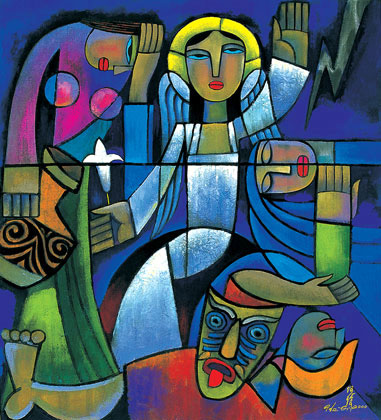
Easter is a head-scratcher, so What’s Up is a perplexing question. And Easter has so many possible answers, it’s a perennial question.
Between the four gospels, there are twelve Easter encounters – and no two of them are alike – making the puzzle more complex.
The one thing all twelve stories have in common is – no one was able to recognize Jesus right away.
And that’s a big help, really. You can rattle on about amazement all you like, but we do recognize people we are amazed to see when we see them. So the evidence is pretty clear that Jesus didn’t look the same. This is huge, the realization that no one comes Up after being that far Down without being significantly changed. So don’t expect a recognizable Jesus to appear anytime soon. Instead, expect to meet the Risen One in someone who seems to be a stranger.
Easter recognition comes in a variety of ways, depending on the disciple mostly, also depending on where it happens. At the tomb, for Peter, it was folded grave clothes that were convincing. For Mary, it was hearing her name come from his lips. After walking all day and talking with him, it was seeing him break bread at Emmaus that convinced James. On the beach, after a night’s labor catching nothing, it was the seine straining with fish that convinced Peter. For Thomas, it took touching the wounds, but for the others in the Upper Room, watching Jesus eat was the convincing thing.
Perhaps the point of all of this is that we don’t all have to discover Easter in the same way. Or at the same time. And in any given group of us, we will each experience our own mix of wild joy and major misgivings, and each ask our own questions.
The Aha Moments arrive sooner or later, but never on demand.
There are no wrong answers to the Easter question, What’s Up?
Easter is a Question. It is not, and never has been, a doctrine. Or a definition. Or a snapshot. Besides Jesus not being recognizable, the other common element in the Easter tales is this: all the amazed disciples were brimful of questions.
The questions brought them to the tomb, to the Upper Room to mull over the reports of those who had gone to the tomb, to the Inn at Emmaus, and to the beach where they fished in confusion and without answers till Jesus prepared them breakfast.
Easter rises from a cradle of questions. Each disciple sees, hears, touches it differently. Each stammering report raises more questions. In the abundance of questions, there’s room for more Rising. The questions act like yeast in the lives of those who stumble upon Easter.
There’s one question, though, that befouls Easter, because it takes us in entirely the wrong direction. Sadly, it is an all-too-common one, beguiling in its seeming reasonability. That question? It’s Who Killed Jesus?
The delusion is that this question has a clear answer. And so often, when we are uncomfortable with talk about an Easter Rising, we turn instead to the question, Who’s Guilty here? A thousand fingers can point in a thousand different directions, and we will never have a clear answer. The fingering will never be finished.
Who would you name? Herod? Pilate? The soldiers who drove in the nails? The one who used the spear to finish him? Caiaphas? The Sanhedrin? The mob who called for Barrabas to be spared? The rest of the city, letting this happen? Judas, for that betraying kiss?
What about Caesar, who put Pilate in charge and Herod on that puppet throne? Or what about God? Shall we say that God planned this? Or allowed it? If we place the blame on God, isn’t this blasphemy?
Why does that old canard, The Jews Killed Jesus, remain alive among us? The crucifixion fields were filled with Jews, hung on crosses by Roman soldiers. Jesus was one of those Jews.
Everyone who wept for Jesus was a Jew. Neither he nor they ever left off being Jewish. He was still a Jew on Easter.
Outside of a relatively small circle of folks in Jerusalem, no one else in all Israel knew about the death of the man called Jesus. And outside of the even smaller circle of his disciples and friends, his brothers and his mother, no one knew of Jesus’ Easter Rising.
The dark side of human nature, what we, at our worst, can do, is always present among us. Delving into that dark side is an important learning about being human. But it will not help us discover Easter, and it will not help us learn what the divine power of Love can do.
It is not as if this were a tale of a terrible injustice that needs to be addressed in court somewhere. Easter is a tale of the lasting power of love, the resilience of life itself, the strength of hope, and the unbreakable bond that unites people who love lastingly, to God who loves eternally.
The way to Easter winds among people who have glimmers of hope, occasional rippling laughter even in the midst of tears, and courage even when they are afraid. Peter may have run away, but he didn’t hide for long. The way to Easter lies among people who share life together, and bread, and loss, and how they collapse under pressure and how they rise again.
Gathering together will yeast the lifting of our hearts, and our recognition that the Lord is here. Easter is more contagious than terror. Hope, kindness, forgiveness, understanding, all these things, can spread among us when we share them with each other, and when we share the question we are all asking: What’s Up? Can there possibly be joy in this sorrow? Light in this darkness? An absence of death in the midst of our mortal fear? Without answers to these questions, but without despair, we gather and we shout them out: Christ Is Risen! Even if we have no idea what that could possibly mean, we shout Alleluia! And then Easter appears.
_________________________________________________________________
Image: Easter Morning, by He Qi, 2001, Nanjing China. Vanderbilt Divinity School Library, Art in the Christian Tradition.
Previous Post

March 16, 2016
Holding Up the Kingdom Vision
Next Post
March 26, 2016 Doubt: The Demon and the Angel of Easter
Browse Our Archives
Select a Category Bites Uncategorized
Select a Month December 2017 November 2017 October 2017 September 2017 August 2017 July 2017 June 2017 May 2017 April 2017 March 2017 February 2017 January 2017 December 2016 November 2016 October 2016 September 2016 August 2016 July 2016 June 2016 May 2016 April 2016 March 2016 February 2016 January 2016 December 2015 November 2015 October 2015 September 2015 August 2015 July 2015 June 2015 May 2015 April 2015 March 2015 February 2015 January 2015 December 2014 November 2014 October 2014 September 2014 August 2014 July 2014 June 2014 May 2014 April 2014 March 2014 February 2014 January 2014 December 2013 November 2013 October 2013 September 2013 August 2013 July 2013 June 2013 May 2013 April 2013 March 2013 February 2013 January 2013 December 2012
Follow Us!
TAKE THE
Religious Wisdom Quiz
How did Job's friends initially show their sympathy?
Select your answer to see how you score.
Sat in silence seven days Brought gifts Wept and tore clothes Offered sacrifices
Related posts from The Bite in the Apple



TRENDING AT PATHEOS Progressive Christian

Why Christians Have a Sacred Duty to Vote:...
The Bible offers strong support for the sacred duty to vote. Here...

What Being a Modern-Day Apostle Means to Me
In my last column, I discussed the ins and outs of modern-day...

Did Ancient China Once Worship the God of...
Across human history, a common thread weaves through the origins of the...

Love Your Neighbor – Including Earth-Kin: Lev. 19,...
God’s command to love your neighbor means acting in an ethical and...

Lead a Church Study of “Jesus and Lao...
Guest writer Jack Thomas (The Irreverent Reverend) reflects on leading his church...

Principles for Understanding the Apostolic Ministry Today
Whenever people discover that my formal ministry title is "apostle," as in...
view all Progressive Christian blogs
Ad-Free & Subscriber Log-In Subscription Support
- About Us
- 2026 Calendar
- Videos
- Podcasts
- Library of World Religions
- Faith In Media Tracker
- Advertise With Us
- Write for Us
- Privacy Policy
- Terms of Service
- Do Not Sell My Data
- Contact Us
- Radiant Digital
- Manage Newsletter Subscriptions
- Unsubscribe From Notifications
- Sitemap
Copyright 2008-2026, Patheos. All rights reserved.
Subscription Support Ad-Free & Subscriber Log-In
Follow Patheos