
BuddhistCatholicContemplativeEvangelicalGeneral ChristianHinduJewishLatter-day SaintMuslimNew VisionsProgressive Christian
Beliefs
- Buddhist
- Catholic
- Contemplative
- Evangelical
- General Christian
- Hindu
- Jewish
- Latter-day Saint
- More Voices
- Muslim
- New Visions
- Pagan
- Progressive Christian
Topics
- Religion News
- Food and Religion
- Sports and Religion
- Religious Art
- Religious Music and Entertainment
- Religious Events
- History and Religion
- Style and Religion
- Politics and Religion
- Women in Religion
- Recreation Outdoors and Religion
- Business Finance and Religion
- Careers Workplace and Religion
- Education and Religion
- Family Parenting and Religion
- Health Fitness and Religion
- Home and Religion
- Relationships and Religion
- Technology and Religion
- Travel and Religion
Columnists
- Buddhist Columnists
- Business Finance and Religion Columnists
- Careers Workplace and Religion Columnists
- Catholic Columnists
- Contemplative Columnists
- Education and Religion Columnists
- Evangelists Columnists
- Family Parenting and Religion Columnists
- General Christian Columnists
- Health Fitness and Religion Columnists
- Hindu Columnists
- History and Religion Columnists
- Home and Religion Columnists
- Jewish Columnists
- More Voices Columnists
- Latter Day Columnists
- Muslim Columnists
- New Visions Columnists
- Nonreligious Columnists
- Pagan Columnists
- Politics and Religion Columnists
- Progressive Columnists
- Recreation Outdoors and Religion Columnists
- Relationships and Religion Columnists
- Religion News Columnists
- Religious Art Columnists
- Religious Events Columnists
- Religious Music and Entertainment Columnists
- Sports and Religion Columnists
- Style and Religion Columnists
- Technology and Religion Columnists
- Travel and Religion Columnists
- Women in Religion Columnists
Resource Library
- 2026 Calendar
- Library of World Religions
- The 100 Most Holy Places on Earth
- Patheos Answers
- Podcasts
- Videos
- Faith Leaders Database
- Anglican Episcopalian
- Bahai
- Baptist
- Buddhism
- Christianity
- Confucianism
- Eastern Orthodoxy
- Hinduism
- Holiness and Pentecostal
- ISKCON
- Islam
- Judaism
- Lutheran
- Methodist
- The Church of Jesus Christ of Latter-day Saints
- New Age
- Paganism
- Presbytarian and Reformed
- Protestantism
- Religion Behind the Scenes
- Roman Catholic
- Scientology
- Shia Islam
- Sikhism
- Sufism
- Sunni Islam
- Taoism
- Zen
- See all religions
Research Tools
 Ad-Free & Subscriber Log-In Subscription Support
Ad-Free & Subscriber Log-In Subscription Support
Follow Patheos 

- Trending:
- Forgiveness
- |
- Marriage
- |
- Consciousness
- |
- Death Penalty
- |
- Election
- |
- Halloween
 The Bite in the Apple
- Home
- Progressive Christian
- Unquenchable Fire
Unquenchable Fire
Last updated on: December 1, 2013 at 1:00 am by Nancy Rockwell
Unquenchable Fire 2013-12-01T01:00:11-04:00 Nancy Rockwell
Patheos Explore the world's faith through different perspectives on religion and spirituality! Patheos has the views of the prevalent religions and spiritualities of the world.
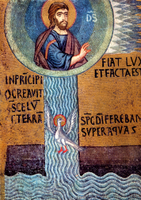 Flood, fire,
The desiccation of grasslands, restraint of princes,
Piracy on the high seas, physical pain and fiscal grief,
These after all are our familiar tribulations,
And we have been through them all before, many, many times.
. . . That was why
We were always able to say: “We are children of God,
And our Father has never forsaken His people.
— W. H. Auden, Narrator in the Advent section of
For The Time Being: A Christmas Oratorio.
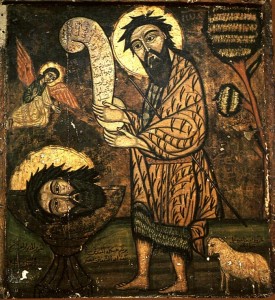 John has forsaken every familiar thing in this world, the comforts of town and culture, the clothing, even the food, shunning all of it to become a lone, wild thing. Suppers of lamb and tsimmis, with rugelach and almond cakes and sweet wine to wash it down, are behind him now. He has become a vegan living off the land, drinking river water. His single purpose is to cry out from the wilderness, Fools! Nothing familiar can save you from the approaching Spirit of God. Nothing you know, nothing you remember, neither your feasts nor your fasts nor your ancestors can avail you now.
He roars special contempt upon the pious, who have translated faith into habits and observances, the very opposite of wonder, mystery and awe. They are the good church folk of his time, of our own time, of every time. They preserve customs – the church fairs they learned from their grandmothers, the old familiar carols, the festivals carefully packed away from year to year. They bring them out, dust them off, hang them up, light the candles, yawn a bit as the service progresses, and are away home at the end, satisfied that they and God have come close enough.
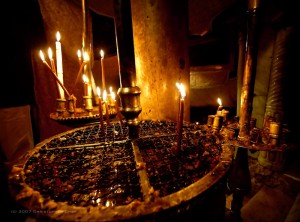 John knows this and only this: it is a hollow sham. The wild tiger spirit of God approaches, as the prophet Haggai said, to shake all nations, and the desire of all nations shall come: and I will fill this house with glory, says the Lord.
Perhaps the most important of John’s howling words for us to hear is: God is able from these stones to raise up children for Abraham.
The self-importance of being people of covenants and Advent candles, who know the right readings for the right occasions, who hold the world together for and through Abraham, falls away before these new creations, the stone children, fresh from the hand of God with a new word of life breathed into them. Their faith is not inherited from us. It is grace given.
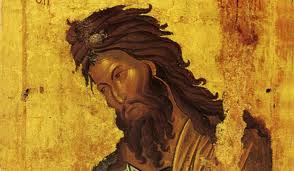 As well, John urges us away from the temptation of dwelling on Mary’s womb as the moment and the place, or on Jesus’ gender as the defining aspect, or on anything that can be a stumbling block to our own hour in the presence of the Holy Spirit. The Spirit pours from Mary as it has from John, in her sung devotion to the One who pulls the mighty from their thrones, exalts those of low degree, scatters the proud in the imaginations of their hearts, fills the hungry with good things, sends the rich empty away.
This is the unquenchable fire. This is the grandeur of God. And this is the wrath to come. John sees this, sees even as he baptizes the motley thousands. Josephus, the Roman historian, wrote of crowds as large as fifty thousand going out to the wilderness to hear John, but John sees that none of it is important, not the water, not the words, not the people kneeling in the river. In the end what it comes to is the unquenchable fire of the Holy Spirit, who will close every age we open, who will fill the world with children not because we are virtuous, but because even stones are fruitful when God touches them.
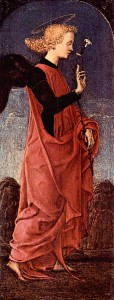 Mary will take that fire into herself, not because she is a pure virgin but because she sees with a prophetic eye, because she is willing to burn as John, and all the prophets before him, have burned. And when Jesus meets John at the river, standing waist deep with John pouring water over him, the fire burning in Jesus will flame out, and they will all see – unquenchable fire.
Often, in our churches, we name these Advent weeks sweetly, as Hope, Joy, Love, Peace. The texts name them otherwise: Bleak Earth. UnquenchableFire. Spirit in Darkness. Birth. This is the kind of time Auden describes: The Inevitable is what will seem to happen to you purely by chance; The Real is what will strike you as really absurd.
Yet neither John, nor Mary, nor Auden, are speaking about a time of winnowing the world by egos, or by totting up sins and virtues, or by sorting abstinence from indulgence. The winnowing will be of time itself, a sorting of the wheat of life from the political, religious, and folkloric foolishness of the ages. Here, then, comes John, crying out: I baptize you with water for repentance, but one who is more powerful than I is coming after me . . . . He will baptize you with the Holy Spirit and fire. His winnowing fork is in his hand, and he will clear his threshing floor and will gather his wheat into the granary; but the chaff he will burn with unquenchable fire.
The unquenchable fire, which is of God and is God, is not hellfire. It is the fire of redemption through re-creation. John struggles to tell us that God has not finished making the world. God is at work in it, is near, will shape us, and soon. We see the making of new earth in the deltas of rivers and the bogs of lakes, in the new isles which volcanos throw up into the sea. We are all in the fire of change.
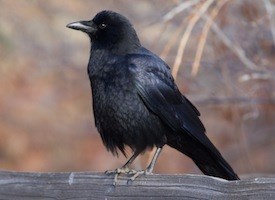 Sylvia Plath tells Advent time in her poem Black Rook in Rainy Weather:
Ignorant of whatever angel
may choose to flare suddenly at my elbow,
I only know that a rook,
ordering its black feathers,
can so shine as to seize my senses
and grant a brief respite from fear.
The wilderness is full of voices. Advent is a listening time.
___________________________________________
- Water. Creation, Day 1. Vanderbilt Divinity School Library. Art in the Christian Tradition.
- John the Baptist. Coptic Icon. Vanderbilt Divinity School Library. Art in the Christian Tradition.
- Grotto of the Nativity. Christopher Chan, 2007. Bethlehem, Palestinian Territories. Vanderbilt Divinity School Library. Art in the Christian Tradition
- John the Baptist. Contemporary Icon.
- Angel of the Annunciation. Ture, Cosme. 1474. National Gallery of Art, Washington, D.C. Vanderbilt Divinity School Library, Art in the Christian Tradition.
- American Crow. Photo by Christopher L. Wood, Cornell Lab of Ornithology website image.
Previous Post

November 25, 2013
The Great Wheel of the Year
Next Post
December 7, 2013 Forerunners
Browse Our Archives
Select a Category Bites Uncategorized
Select a Month December 2017 November 2017 October 2017 September 2017 August 2017 July 2017 June 2017 May 2017 April 2017 March 2017 February 2017 January 2017 December 2016 November 2016 October 2016 September 2016 August 2016 July 2016 June 2016 May 2016 April 2016 March 2016 February 2016 January 2016 December 2015 November 2015 October 2015 September 2015 August 2015 July 2015 June 2015 May 2015 April 2015 March 2015 February 2015 January 2015 December 2014 November 2014 October 2014 September 2014 August 2014 July 2014 June 2014 May 2014 April 2014 March 2014 February 2014 January 2014 December 2013 November 2013 October 2013 September 2013 August 2013 July 2013 June 2013 May 2013 April 2013 March 2013 February 2013 January 2013 December 2012
Follow Us!
TAKE THE
Religious Wisdom Quiz
Who is frequently described as "the fool" in Proverbs?
Select your answer to see how you score.
A foreigner One who hates wisdom One who is wealthy A king
Related posts from The Bite in the Apple




TRENDING AT PATHEOS Progressive Christian

Why Christians Have a Sacred Duty to Vote:...
The Bible offers strong support for the sacred duty to vote. Here...

What Being a Modern-Day Apostle Means to Me
In my last column, I discussed the ins and outs of modern-day...

Did Ancient China Once Worship the God of...
Across human history, a common thread weaves through the origins of the...

Love Your Neighbor – Including Earth-Kin: Lev. 19,...
God’s command to love your neighbor means acting in an ethical and...

Lead a Church Study of “Jesus and Lao...
Guest writer Jack Thomas (The Irreverent Reverend) reflects on leading his church...

Principles for Understanding the Apostolic Ministry Today
Whenever people discover that my formal ministry title is "apostle," as in...
view all Progressive Christian blogs
Ad-Free & Subscriber Log-In Subscription Support
- About Us
- 2026 Calendar
- Videos
- Podcasts
- Library of World Religions
- Faith In Media Tracker
- Advertise With Us
- Write for Us
- Privacy Policy
- Terms of Service
- Do Not Sell My Data
- Contact Us
- Radiant Digital
- Manage Newsletter Subscriptions
- Unsubscribe From Notifications
- Sitemap
Copyright 2008-2026, Patheos. All rights reserved.
Subscription Support Ad-Free & Subscriber Log-In
Follow Patheos