
BuddhistCatholicContemplativeEvangelicalGeneral ChristianHinduJewishLatter-day SaintMuslimNew VisionsProgressive Christian
Beliefs
- Buddhist
- Catholic
- Contemplative
- Evangelical
- General Christian
- Hindu
- Jewish
- Latter-day Saint
- More Voices
- Muslim
- New Visions
- Pagan
- Progressive Christian
Topics
- Religion News
- Food and Religion
- Sports and Religion
- Religious Art
- Religious Music and Entertainment
- Religious Events
- History and Religion
- Style and Religion
- Politics and Religion
- Women in Religion
- Recreation Outdoors and Religion
- Business Finance and Religion
- Careers Workplace and Religion
- Education and Religion
- Family Parenting and Religion
- Health Fitness and Religion
- Home and Religion
- Relationships and Religion
- Technology and Religion
- Travel and Religion
Columnists
- Buddhist Columnists
- Business Finance and Religion Columnists
- Careers Workplace and Religion Columnists
- Catholic Columnists
- Contemplative Columnists
- Education and Religion Columnists
- Evangelists Columnists
- Family Parenting and Religion Columnists
- General Christian Columnists
- Health Fitness and Religion Columnists
- Hindu Columnists
- History and Religion Columnists
- Home and Religion Columnists
- Jewish Columnists
- More Voices Columnists
- Latter Day Columnists
- Muslim Columnists
- New Visions Columnists
- Nonreligious Columnists
- Pagan Columnists
- Politics and Religion Columnists
- Progressive Columnists
- Recreation Outdoors and Religion Columnists
- Relationships and Religion Columnists
- Religion News Columnists
- Religious Art Columnists
- Religious Events Columnists
- Religious Music and Entertainment Columnists
- Sports and Religion Columnists
- Style and Religion Columnists
- Technology and Religion Columnists
- Travel and Religion Columnists
- Women in Religion Columnists
Resource Library
- 2026 Calendar
- Library of World Religions
- The 100 Most Holy Places on Earth
- Patheos Answers
- Podcasts
- Videos
- Faith Leaders Database
- Anglican Episcopalian
- Bahai
- Baptist
- Buddhism
- Christianity
- Confucianism
- Eastern Orthodoxy
- Hinduism
- Holiness and Pentecostal
- ISKCON
- Islam
- Judaism
- Lutheran
- Methodist
- The Church of Jesus Christ of Latter-day Saints
- New Age
- Paganism
- Presbytarian and Reformed
- Protestantism
- Religion Behind the Scenes
- Roman Catholic
- Scientology
- Shia Islam
- Sikhism
- Sufism
- Sunni Islam
- Taoism
- Zen
- See all religions
Research Tools
 Ad-Free & Subscriber Log-In Subscription Support
Ad-Free & Subscriber Log-In Subscription Support
Follow Patheos 

- Trending:
- Forgiveness
- |
- Marriage
- |
- Consciousness
- |
- Death Penalty
- |
- Election
- |
- Halloween
 The Bite in the Apple
- Home
- Progressive Christian
- Trinity
Trinity
Last updated on: May 20, 2013 at 12:05 pm by Nancy Rockwell
Trinity 2013-05-20T12:05:42-04:00 Nancy Rockwell
Patheos Explore the world's faith through different perspectives on religion and spirituality! Patheos has the views of the prevalent religions and spiritualities of the world.
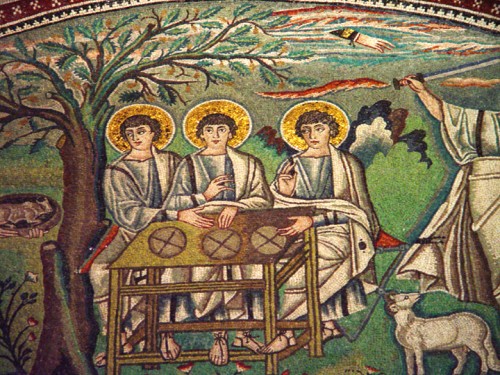 Genesis 1, the beautiful hymn to Imago Dei, the One God, opens the Bible by casting away an uproar of deities without naming any of them, describing instead the panoply of God’s Creation in days and nights. This Imago Dei is the great gift to which Judaism and Christianity belong. The One God: not pulling the sun across the sky in a chariot, nor lording the creatures of the dark into a nether world, but raising all, in days that begin when the sun goes down, from chaos to life.
Why, then, the Trinity?
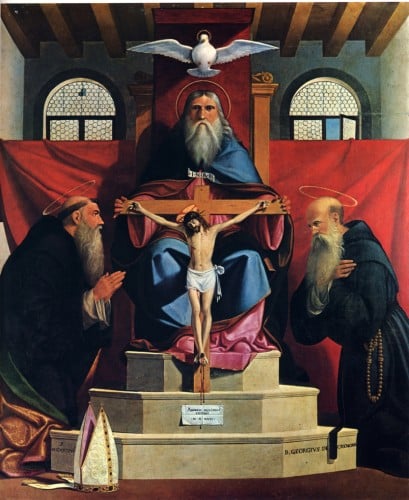 Jesus never said the word. Would he himself have shrunk away from this name, as from a blasphemy?
Alas, the Name of Trinity has been used for evil, as a righteous boot to bring the defiantly different to their knees, as an act of submission required from Jews who would teach in universities or practice medicine in hospitals, or from women who were threatened with death by fire as witches, and even at baptisms where it was thought to cast out demons from children.
More mundanely, it has been turned into a pledge of allegiance, salted throughout the liturgies of Christian worship, sorting Christians from each other as well as from all the peoples of this world whose imago dei is not invoked by these names.
And Yet:
The fire of Trinity does still light ways in the wilderness with its image of inclusive relationship: a Maker from whom all life rises; a Son whose many images (Babe, Wise Child, Rabbi, Beloved, Healer, Party Goer, Forgiving , Suffering, Fallen and Risen One) embrace all that is lost in us; and the Spirit, by whose enlightenment we all become the imago dei of the Maker and the Son.
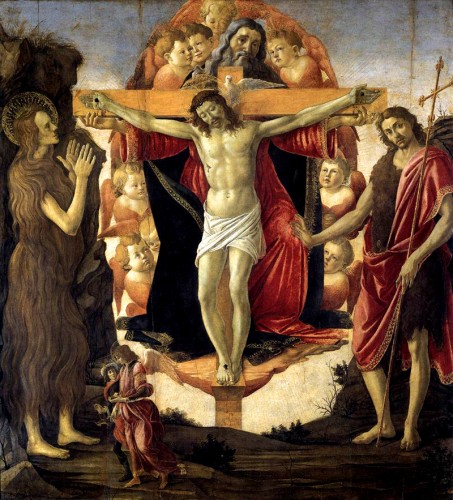 In Trinity the energy flows in all directions. Within Trinity is the good green pasture which is home: the place where we are safe, where the table is full and quiet waters flow. Here is the Holy City of God, where the Tree with leaves that heal nations drinks from the waters of four rivers, and where God is the light of all people.
St. Patrick spoke of Trinity in simple ways (three kinds of water: dew, rain and ice) and grand words*:*
I bind unto myself today the strong name of the Trinity, by Invocation of the same, the Three in One, the One in Three. I bind unto myself today, the virtues of the starlit heaven, the glorious sun’s life-giving ray, the whiteness of the moon at even, the flashing of the lightning free, the whirling wind’s tempestuous shocks, the stable earth, the deep salt sea, around the old appointed rocks. Christ beneath me, Christ above me, Christ in quiet, Christ in danger, Christ in hearts of all that love me, Christ in mouth of friend and stranger. (words from St. Patrick’s Breastplate)
Emily Dickinson wrote her own Trinity: In the name of the Bee, and the Butterfly, and the Breeze – Amen! In them she has caught an image for the Maker, the Christ, and the Spirit, without a transcendant descent. All live in, sanctify, and are vulnerable to this world.
Kris Kristofferson, Oxford Rhodes scholar and country western singer, writes softly after years of deep pain: Life is the question and life is the answer, God is the reason and Love is the Way. His experience of Trinity begins with the Spirit, then moves to God, and finally to Love.
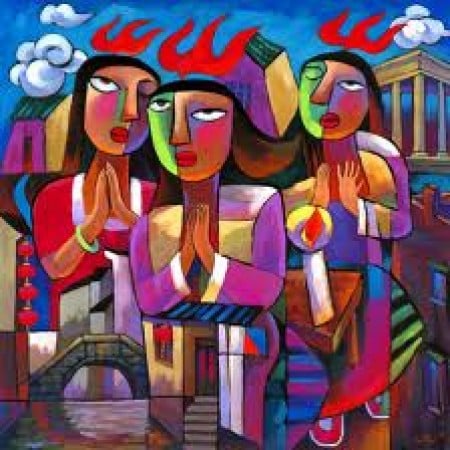 Threeness permeates our thinking:
morning, noon and night;
knife, fork and spoon;
father, mother, child;
sun, moon, and stars;
beginning, middle, end;
over, under, through;
win, lose, or draw;
take, give, share
reading, writing, ‘rithmetic . . .
you can fill pages with things that take their meaning from each other in threes, and describe a fullness, mundane or holy.
Like these, Trinity means to make connection, to overcome separation, to join what has been declared insignificant – to find, in the image of one, the others – an image that is all and also far beyond any.
It is our fall to see in the Trinity image any thing less than all.
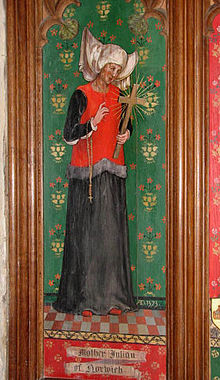 Julian of Norwich, 12th c. English mystic and survivor of the Black Death, wrote this of the Trinity:
I saw no difference between God and our substance, but, as it were, all God; and still my understanding accepted that our substance is in God, that is to say that God is God, and our substance is a creature in God. For the almighty truth of the Trinity is our Father, for he made us and keeps us in him. And the deep wisdom of the Trinity is our Mother, in whom we are enclosed. And the high goodness of the Trinity is our Lord, and in him we are enclosed and he in us. We are enclosed in the Father, and we are enclosed in the Son, and we are enclosed in the Holy Spirit. And the Father is enclosed in us, the Son is enclosed in us, and the Holy Spirit is enclosed in us, almighty, all wisdom and all goodness, one God, one Lord.
John wrote that Jesus said*, I still have many things to say to you, but you cannot bear them now. (John 16:12)*
Trinity Sunday, then, is a day for experiencing the world through wonder, and acknowledging that the end of the story is still unknown, as are the still–unfolding and unimaginable names of God. And that all of them are part of the holy and indivisible One.
__________________________________________
Illustrations:
1. Abraham and Three Angels, 521-27, Basilica di San Vitale, Ravenna, Italy. Vanderbilt Divinity School Library, Art in the Christian Tradition.
2. Trinity with Worshippers, 1517, Santa Maria della Consolazione, Andrea Previtali.Vanderbilt Divinity School Library, Art in the Christian Tradition.
3. Trinity with Magdalene, John the Baptist . . . Sandreo Botticelli, 1491, Courtauld Institute, London. Vanderbilt Divinity School Library, Art in the Christian Tradition.
4. The Fires of Pentecost, He Qi, Chinese Artist, Nanking. Vanderbilt Divinity School Library, Art in the Christian Tradition.
5. Julian of Norwich, her image present in The Church of Saints Andrew and Mary, Norwich, England. Wikipedia page image for Julian of Norwich.
Previous Post

May 12, 2013
Sense Where None Seems Possible
Browse Our Archives
Select a Category Bites Uncategorized
Select a Month December 2017 November 2017 October 2017 September 2017 August 2017 July 2017 June 2017 May 2017 April 2017 March 2017 February 2017 January 2017 December 2016 November 2016 October 2016 September 2016 August 2016 July 2016 June 2016 May 2016 April 2016 March 2016 February 2016 January 2016 December 2015 November 2015 October 2015 September 2015 August 2015 July 2015 June 2015 May 2015 April 2015 March 2015 February 2015 January 2015 December 2014 November 2014 October 2014 September 2014 August 2014 July 2014 June 2014 May 2014 April 2014 March 2014 February 2014 January 2014 December 2013 November 2013 October 2013 September 2013 August 2013 July 2013 June 2013 May 2013 April 2013 March 2013 February 2013 January 2013 December 2012
Follow Us!
TAKE THE
Religious Wisdom Quiz
What was the rider of the Red Horse in Revelation given?
Select your answer to see how you score.
A balance scale A crown A large sword A bow
Related posts from The Bite in the Apple




TRENDING AT PATHEOS Progressive Christian

Why Christians Have a Sacred Duty to Vote:...
The Bible offers strong support for the sacred duty to vote. Here...

What Being a Modern-Day Apostle Means to Me
In my last column, I discussed the ins and outs of modern-day...

Did Ancient China Once Worship the God of...
Across human history, a common thread weaves through the origins of the...

Love Your Neighbor – Including Earth-Kin: Lev. 19,...
God’s command to love your neighbor means acting in an ethical and...

Lead a Church Study of “Jesus and Lao...
Guest writer Jack Thomas (The Irreverent Reverend) reflects on leading his church...

Principles for Understanding the Apostolic Ministry Today
Whenever people discover that my formal ministry title is "apostle," as in...
view all Progressive Christian blogs
Ad-Free & Subscriber Log-In Subscription Support
- About Us
- 2026 Calendar
- Videos
- Podcasts
- Library of World Religions
- Faith In Media Tracker
- Advertise With Us
- Write for Us
- Privacy Policy
- Terms of Service
- Do Not Sell My Data
- Contact Us
- Radiant Digital
- Manage Newsletter Subscriptions
- Unsubscribe From Notifications
- Sitemap
Copyright 2008-2026, Patheos. All rights reserved.
Subscription Support Ad-Free & Subscriber Log-In
Follow Patheos