
BuddhistCatholicContemplativeEvangelicalGeneral ChristianHinduJewishLatter-day SaintMuslimNew VisionsProgressive Christian
Beliefs
- Buddhist
- Catholic
- Contemplative
- Evangelical
- General Christian
- Hindu
- Jewish
- Latter-day Saint
- More Voices
- Muslim
- New Visions
- Pagan
- Progressive Christian
Topics
- Religion News
- Food and Religion
- Sports and Religion
- Religious Art
- Religious Music and Entertainment
- Religious Events
- History and Religion
- Style and Religion
- Politics and Religion
- Women in Religion
- Recreation Outdoors and Religion
- Business Finance and Religion
- Careers Workplace and Religion
- Education and Religion
- Family Parenting and Religion
- Health Fitness and Religion
- Home and Religion
- Relationships and Religion
- Technology and Religion
- Travel and Religion
Columnists
- Buddhist Columnists
- Business Finance and Religion Columnists
- Careers Workplace and Religion Columnists
- Catholic Columnists
- Contemplative Columnists
- Education and Religion Columnists
- Evangelists Columnists
- Family Parenting and Religion Columnists
- General Christian Columnists
- Health Fitness and Religion Columnists
- Hindu Columnists
- History and Religion Columnists
- Home and Religion Columnists
- Jewish Columnists
- More Voices Columnists
- Latter Day Columnists
- Muslim Columnists
- New Visions Columnists
- Nonreligious Columnists
- Pagan Columnists
- Politics and Religion Columnists
- Progressive Columnists
- Recreation Outdoors and Religion Columnists
- Relationships and Religion Columnists
- Religion News Columnists
- Religious Art Columnists
- Religious Events Columnists
- Religious Music and Entertainment Columnists
- Sports and Religion Columnists
- Style and Religion Columnists
- Technology and Religion Columnists
- Travel and Religion Columnists
- Women in Religion Columnists
Resource Library
- 2026 Calendar
- Library of World Religions
- The 100 Most Holy Places on Earth
- Patheos Answers
- Podcasts
- Videos
- Faith Leaders Database
- Anglican Episcopalian
- Bahai
- Baptist
- Buddhism
- Christianity
- Confucianism
- Eastern Orthodoxy
- Hinduism
- Holiness and Pentecostal
- ISKCON
- Islam
- Judaism
- Lutheran
- Methodist
- The Church of Jesus Christ of Latter-day Saints
- New Age
- Paganism
- Presbytarian and Reformed
- Protestantism
- Religion Behind the Scenes
- Roman Catholic
- Scientology
- Shia Islam
- Sikhism
- Sufism
- Sunni Islam
- Taoism
- Zen
- See all religions
Research Tools
 Ad-Free & Subscriber Log-In Subscription Support
Ad-Free & Subscriber Log-In Subscription Support
Follow Patheos 

- Trending:
- Forgiveness
- |
- Marriage
- |
- Consciousness
- |
- Death Penalty
- |
- Election
- |
- Halloween
 The Bite in the Apple
- Home
- Progressive Christian
- Trinity, God’s Embracing Globalism
Trinity, God’s Embracing Globalism
Last updated on: June 5, 2017 at 10:45 am by Nancy Rockwell
Trinity, God’s Embracing Globalism 2017-06-05T10:45:31-04:00 Nancy Rockwell
Patheos Explore the world's faith through different perspectives on religion and spirituality! Patheos has the views of the prevalent religions and spiritualities of the world.
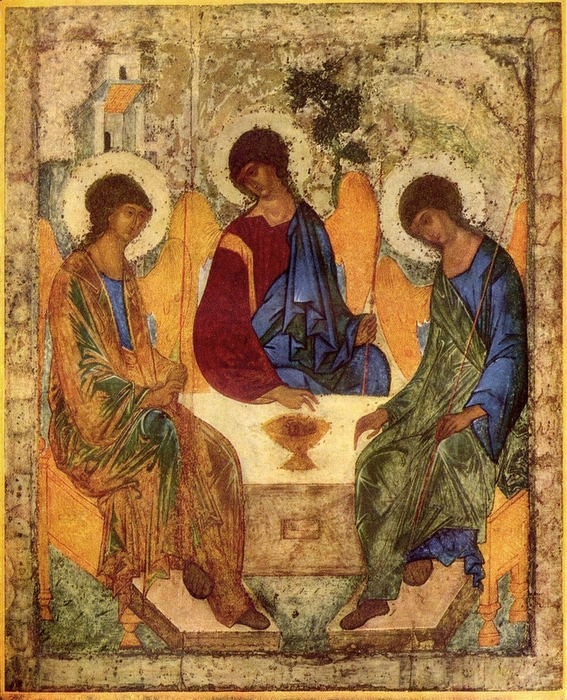 The One World Vision Within Trinity
The tale of the Spirit descending on a crowd of strangers in Jerusalem argues for globalism. In fact, it is an unequivocal embrace of globalism.
Here is a atory of God’s vast spiritual power, given in an embrace of strangers and enemies, given in an embrace of widely divergent cultures and faiths, given in the name of Jesus, whose lifetime embraced divergent and despised people and who, in resurrection, has promised his followers spiritual power.
The Spirit descends, and a tri-unity of divine energy is formed, not to protect cultures or to establish boundaries around religions or nations, but to make global citizens of all the disciples of Jesus.
The story says that on the fiftieth day after Easter the disciples were together in one place, a sound like a rushing wind filled the house, what appeared to be tongues of fire rested on each of them and they all began to speak in other tongues.
The sound of the rushing wind brought a ‘multitude’ of people ‘from every nation under heaven’ into the public square, and they all heard the Galileans speaking in their own languages, and marveled – for they were Mesopotamians and Egyptians, Asians and Arabians, Romans and Libyans and from many other nations. In other words, they were from all the corners of the known world. And they were Jews and non-Jews.
What they heard was Peter preaching, not about Easter, but about a vision, the dream that young and old, women and men, could all be transformed together. And more than three thousand chose to be baptized that day, the Book of Acts tells us.
So the church was commissioned to spread the vision to everyone, using the strength of the Spirit that claimed all the world as its own.
And in this, Trinity was born.
Trinity, which entirely misses the point when we focus on arguing about the relationship within it.
Trinity, which in its Threeness creates a space, like the space within a triangle, only this space is large enough to hold all the world.
In the Spirit space trinity creates, everyone belongs. Three thousand strangers in Jerusalem and a motley crew of strangely behaving disciples.
On the wings of the Spirit and in the discovery of this space, the disciples will start fanning out around the world. They understand their mission is to travel everywhere, to spread the vision far and wide in the now borderless and beckoning world.
The globalism in Pentecost stretches on, over centuries and seas. The articulation of the vision has suffered dreadfully over the centuries, and suffers badly now, in the prosperity gospel, in the punishing traditions which turn Jesus’ love into brutal enforcement of sex rules.
The wisdom of the preachers fails in every age, but the commitment to “everywhere, everywhere” remains throughout the centuries.
In this unerring sense of global purpose and international embrace, all the modern arguments, that closed cultures are more faithful, or are safer, or are more truthful for their citizens, even the so-called Christian argument that and that only one lifestyle, nuclear marriage, is holy, can be rightly seen as blasphemy.
All these arguments were on the tongues of various Jewish sects in Jesus’ own time. All these arguments were present in Jerusalem on Pentecost Day. And the Spirit descended to blast them all to smithereens.
The “don’t let the Moslems in” righteousness of some echoes the arguments articulated in Jerusalem then, echoes the Pharisees and Sadducees who said Jews should keep to themselves, who said faithfulness is about food and sex and clothing and saying the right prayers, who said pulling away from the rest of the world was the right thing to do.
But the creation is One, and holy in being One. As God is One, with triune faces and aspects that connect to make one sacred space for all the world.
The Garden of Eden is now the planet – and the whole planet has to be home, in order for any part of it to be home to anyone at all.
So there is no choice between Pittsburgh and Paris. As there was then no choice between Jerusalem and Rome.
Soon, we will read of Peter’s dream, which sent him to Rome to stay in the home of Cornelius, whom he knew ate foods considered unclean by Jewish law, whom he knew was an uncircumcised man, whom he knew had worshipped idols. In the dream, Peter saw all the ‘tref’ forbidden foods lowered to him in a sheet, and he heard the voice of God saying, “Rise, Peter, take and eat.”
And on the strength of that dream Peter set aside his fear and went to Rome to start, with Cornelius, a church.
Peter did not impose upon his church the requirement to become like Israeli. Instead he made the foundation of his church the vision of Jesus, and the sharing of Jesus’ stories, how unclean people become holy sons and daughters of God.
Trinity is this energy and this work, this vision and this welcome. And most of all, Trinity is this embrace.
We are not separate from, nor worshipful as if apart from, the One God, nor are we separable from anything God has made. And we are not separated from, nor worshipfully idolizing Jesus, nor does Jesus allow us for one moment to privatize his gospel or his salvation, keeping it only for our own kind.
We are living within the embrace in which the Spirit holds all of us, God, Jesus, and the entire world.
When terror happens, and God knows, in every age it does happen, it is not the most powerful word, not the final work, not powerful enough to undo the power of resurrection. Terror cannot separate us from Easter, as the cross, in its horror, could not separate Jesus from God.
To pull away from the triune world be to separate ourselves from everything holy, not simply from everything fearful.
And it is this vision we are called and commissioned to follow, not the tweets of the foolish or the loud leaders of this world.
In life, in death, and in life beyond death, we are embraced by God’s Spirit, and we are One.
_________________________________________________________________________________________
Image: Trinity Icon, by Andrei Rublev. 1400 AD. Gosudarstyennaia Tret’iakovskaia galereia. Moscow, Russia. Vanderbilt Divinity School Library, Art in the Christian Tradition.
Previous Post

May 27, 2017
It’s Pentecost – and Something Is Not Right
Next Post

June 7, 2017 Free Speech, Hate Speech, Tweet Speech, Truth and Lies
Browse Our Archives
Select a Category Bites Uncategorized
Select a Month December 2017 November 2017 October 2017 September 2017 August 2017 July 2017 June 2017 May 2017 April 2017 March 2017 February 2017 January 2017 December 2016 November 2016 October 2016 September 2016 August 2016 July 2016 June 2016 May 2016 April 2016 March 2016 February 2016 January 2016 December 2015 November 2015 October 2015 September 2015 August 2015 July 2015 June 2015 May 2015 April 2015 March 2015 February 2015 January 2015 December 2014 November 2014 October 2014 September 2014 August 2014 July 2014 June 2014 May 2014 April 2014 March 2014 February 2014 January 2014 December 2013 November 2013 October 2013 September 2013 August 2013 July 2013 June 2013 May 2013 April 2013 March 2013 February 2013 January 2013 December 2012
Follow Us!
TAKE THE
Religious Wisdom Quiz
What is the main symbol of Christianity?
Select your answer to see how you score.
Rainbow The cross Olive branch Lion
Related posts from The Bite in the Apple



TRENDING AT PATHEOS Progressive Christian

What Being a Modern-Day Apostle Means to Me
In my last column, I discussed the ins and outs of modern-day...

Did Ancient China Once Worship the God of...
Across human history, a common thread weaves through the origins of the...

Love Your Neighbor – Including Earth-Kin: Lev. 19,...
God’s command to love your neighbor means acting in an ethical and...

Lead a Church Study of “Jesus and Lao...
Guest writer Jack Thomas (The Irreverent Reverend) reflects on leading his church...

Pastoral Wisdom for Responding to Sermon Pushback
Getting sermon pushback on your social justice sermon? Learn practical, Proverbs-based strategies...

Principles for Understanding the Apostolic Ministry Today
Whenever people discover that my formal ministry title is "apostle," as in...
view all Progressive Christian blogs
Ad-Free & Subscriber Log-In Subscription Support
- About Us
- 2026 Calendar
- Videos
- Podcasts
- Library of World Religions
- Faith In Media Tracker
- Advertise With Us
- Write for Us
- Privacy Policy
- Terms of Service
- Do Not Sell My Data
- Contact Us
- Radiant Digital
- Manage Newsletter Subscriptions
- Unsubscribe From Notifications
- Sitemap
Copyright 2008-2026, Patheos. All rights reserved.
Subscription Support Ad-Free & Subscriber Log-In
Follow Patheos