
BuddhistCatholicContemplativeEvangelicalGeneral ChristianHinduJewishLatter-day SaintMuslimNew VisionsProgressive Christian
Beliefs
- Buddhist
- Catholic
- Contemplative
- Evangelical
- General Christian
- Hindu
- Jewish
- Latter-day Saint
- More Voices
- Muslim
- New Visions
- Pagan
- Progressive Christian
Topics
- Religion News
- Food and Religion
- Sports and Religion
- Religious Art
- Religious Music and Entertainment
- Religious Events
- History and Religion
- Style and Religion
- Politics and Religion
- Women in Religion
- Recreation Outdoors and Religion
- Business Finance and Religion
- Careers Workplace and Religion
- Education and Religion
- Family Parenting and Religion
- Health Fitness and Religion
- Home and Religion
- Relationships and Religion
- Technology and Religion
- Travel and Religion
Columnists
- Buddhist Columnists
- Business Finance and Religion Columnists
- Careers Workplace and Religion Columnists
- Catholic Columnists
- Contemplative Columnists
- Education and Religion Columnists
- Evangelists Columnists
- Family Parenting and Religion Columnists
- General Christian Columnists
- Health Fitness and Religion Columnists
- Hindu Columnists
- History and Religion Columnists
- Home and Religion Columnists
- Jewish Columnists
- More Voices Columnists
- Latter Day Columnists
- Muslim Columnists
- New Visions Columnists
- Nonreligious Columnists
- Pagan Columnists
- Politics and Religion Columnists
- Progressive Columnists
- Recreation Outdoors and Religion Columnists
- Relationships and Religion Columnists
- Religion News Columnists
- Religious Art Columnists
- Religious Events Columnists
- Religious Music and Entertainment Columnists
- Sports and Religion Columnists
- Style and Religion Columnists
- Technology and Religion Columnists
- Travel and Religion Columnists
- Women in Religion Columnists
Resource Library
- 2026 Calendar
- Library of World Religions
- The 100 Most Holy Places on Earth
- Patheos Answers
- Podcasts
- Videos
- Faith Leaders Database
- Anglican Episcopalian
- Bahai
- Baptist
- Buddhism
- Christianity
- Confucianism
- Eastern Orthodoxy
- Hinduism
- Holiness and Pentecostal
- ISKCON
- Islam
- Judaism
- Lutheran
- Methodist
- The Church of Jesus Christ of Latter-day Saints
- New Age
- Paganism
- Presbytarian and Reformed
- Protestantism
- Religion Behind the Scenes
- Roman Catholic
- Scientology
- Shia Islam
- Sikhism
- Sufism
- Sunni Islam
- Taoism
- Zen
- See all religions
Research Tools
 Ad-Free & Subscriber Log-In Subscription Support
Ad-Free & Subscriber Log-In Subscription Support
Follow Patheos 

- Trending:
- Forgiveness
- |
- Marriage
- |
- Consciousness
- |
- Death Penalty
- |
- Election
- |
- Halloween
 The Bite in the Apple
- Home
- Progressive Christian
- The Words of Angels
The Words of Angels
Last updated on: December 17, 2017 at 2:05 pm by Nancy Rockwell
The Words of Angels 2017-12-17T14:05:02-04:00 Nancy Rockwell
Patheos Explore the world's faith through different perspectives on religion and spirituality! Patheos has the views of the prevalent religions and spiritualities of the world.

Nothing Is Impossible with God
Angels. They appear throughout biblical stories, always unannounced, and always announcing something utterly unexpected.
Or something so long awaited that everyone has given up hope. If the memory of that hope lingers at all, it lingers as a sore that hurts to be touched.
Angels, in fact, are mostly unwelcome visitors.
Just think of Abraham and Sarah, wandering around in the wilderness for ever-so-long and then some. They’d left everything, to wander around with a God they could sense but not see, try to obey but never understand, a God who did not do things for them, but expected them to do things that made them afraid.
They’d been promised a child, and many heirs. You will be a great people, God has whispered to Abraham. Or had Abraham wished it, so much he thought he heard God say it? Because, you see, no child had come to them. It had been years since Abraham had made himself a son with Sarah’s maid, Hagar.
Then one day, along came three angelic visitors. No fancy robes. No noticeable wings. But Abraham could tell they were special. And he knocked himself out entertaining them – he made Sarah cook her best meat and cakes. And then the angels said, they’d come for Sarah, to tell her she would conceive, right then, in her old age.
Lot had an angelic visitor, a fellow without wings whom the villagers in Sodom took to be a stranger with evil intentions. And they threatened him, the stranger. If he’d looked like a Christmas card angel, the villagers wouldn’t have done that. They were mean cusses, but not stupid, after all.
And the angel, who brought destruction down on the town because of their cussedness and lack of hospitality (not because of homosexuality, that old canard!), told Lot to take his wife and family away – and never to look back. You remember the rest of the story, how Lot’s wife was turned to a pillar of salt because she looked back. It may be the hardest thing in the world, not looking back.
What angels announce is something that has to be done by the persons they are talking to. Something that is never easy. Never easy. It requires walking against the grain of the world. And it requires acting against your own common sense.
Think of Jonah. He took a ship in the opposite direction, then jumped overboard, in order to get away from want the angel wanted him to do.
And Gideon. He was in his winepress, treading out the grapes, when the angel came and told him he was going to be in charge of a war, and he groaned No about a thousand times, and set out quite a number of tests to make the angel prove he was a real angel. And then he had to do it, and he waged and won a war without killing, a war without bloodshed. It’s the only war in the Bible ordained by God, and the only one in which no one died.
So Gideon ended up a hero, sort of, and also a damn fool, which had been his reputation before the angel came.
The trouble with all these soul enchanting medieval paintings is that the angels are so very beautiful, and mesmerizing in their presence. But the Bible doesn’t describe them that way.
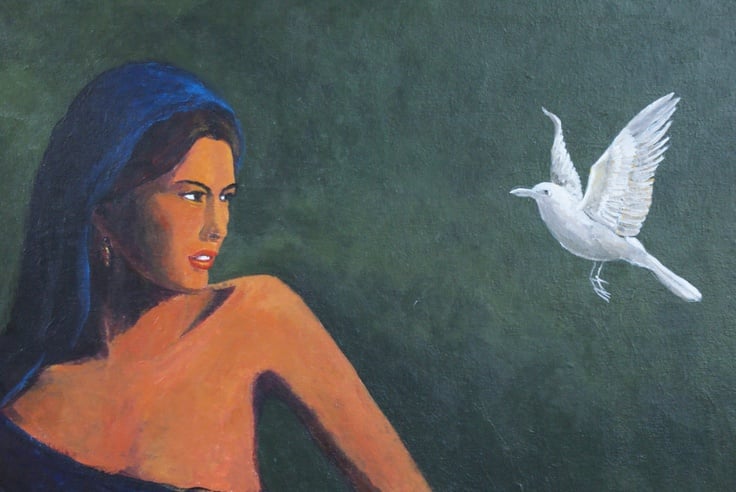
In fact, the details we get are few. The angel who announced Sampson’s birth to his mother rose up from a fire and was made of flames. Isaiah said he saw seraphim robed in black, with six wings. With two they covered their faces, he said, and with two their feet, and with the other two, they flew.
Jewish folklore, which is about as biblical as are medieval paintings, says somewhere that the Archangel Gabriel has one hundred and forty pairs of wings. How he could lift off and fly boggle the mind, and how anyone could hear him over all that flapping beats me.
The poet Sylvia Plath likens Gabriel to a black rook in rainy weather, saying of the Advent season we are in:
I only know that a rook
Ordering its black feathers can so shine
As to seize my senses, haul
My eyelids up, and grant
A brief respite from fear
Of total neutrality. With luck,
Trekking stubborn through this season
Of fatigue, I shall
Patch together a content
Of sorts. Miracles occur,
If you care to call those spasmodic
Tricks of radiance miracles. The wait’s begun again,
The long wait for the angel.
For that rare, random descent.
And here we are, arriving at that rare, random descent, when the Archangel, whatever his guise, whatever his mien, suddenly, and quite unexpectedly, appears to Mary and greets her, saying, Hail, Mary, full of grace, you have found favor with God.
Stunned, she questions the nature of the greeting, and then the nature of the offer made to her.
But, by God, she has courage. She does not ask for time to think about this. She does not consult anyone. Not her father, not her mother, not her fiancé.
When the angel tells her that her cousin Elizabeth is also bearing a miracle child, she accepts, and sets out on her own on a journey of about forty miles, to see Elizabeth.
On her way and in her heart, and from her heritage of faith, she composes her song, which has come to be known as the Magnificat.
In it, she declares in the strongest possible way that the Child she is gestating has a destiny to scatter the proud in the imagination of their hearts, to pull down the mighty from their thrones, to exalt the lowly, to fill the hungry with good things and to send the rich empty away.
Whew!
Meanwhile, the Angel Gabriel is wrestling with Joseph in his dreams, persuading him to accept this boggling reality – and to marry Mary. And the angel will be back, according to Matthew, after the birth, to get them out of Bethlehem before the massacre Herod is planning begins.
I dream of angels who will help me, enfold me. Ah, but the ones who come to people come to challenge, not to comfort.
Thank God for Mary, who was up to the challenge. Who did not submit, as much as she took command. Mary, who did not diminish herself, but, astonishingly, magnified God. Mary, who welcomed kings and some rather scruffy shepherds, and then ran away to Egypt to save her child, using, we presume, the gifts given to her to buy food and lodging for her little family.
And Luke tells us, the Child grew strong and flourished. And the grace of Mary, the mercy of Joseph, and the love of God were with him. Let us run to Bethlehem!
__________________________________________________________________________________________________
Annunciation by Dante Gabriel Rossetti Vanderbilt Divinity School Library, Art in the Christian Tradition.
Annunciation by Esmond Lyons, Vanderbilt Divinity School Library, art in the Christian Tradition.
Previous Post

December 10, 2017
The Voice in the Wilderness
Browse Our Archives
Select a Category Bites Uncategorized
Select a Month December 2017 November 2017 October 2017 September 2017 August 2017 July 2017 June 2017 May 2017 April 2017 March 2017 February 2017 January 2017 December 2016 November 2016 October 2016 September 2016 August 2016 July 2016 June 2016 May 2016 April 2016 March 2016 February 2016 January 2016 December 2015 November 2015 October 2015 September 2015 August 2015 July 2015 June 2015 May 2015 April 2015 March 2015 February 2015 January 2015 December 2014 November 2014 October 2014 September 2014 August 2014 July 2014 June 2014 May 2014 April 2014 March 2014 February 2014 January 2014 December 2013 November 2013 October 2013 September 2013 August 2013 July 2013 June 2013 May 2013 April 2013 March 2013 February 2013 January 2013 December 2012
Follow Us!
TAKE THE
Religious Wisdom Quiz
How many books are in the New Testament?
Select your answer to see how you score.
39 27 24 21
Related posts from The Bite in the Apple

TRENDING AT PATHEOS Progressive Christian

What Being a Modern-Day Apostle Means to Me
In my last column, I discussed the ins and outs of modern-day...

Did Ancient China Once Worship the God of...
Across human history, a common thread weaves through the origins of the...

Love Your Neighbor – Including Earth-Kin: Lev. 19,...
God’s command to love your neighbor means acting in an ethical and...

Lead a Church Study of “Jesus and Lao...
Guest writer Jack Thomas (The Irreverent Reverend) reflects on leading his church...

Pastoral Wisdom for Responding to Sermon Pushback
Getting sermon pushback on your social justice sermon? Learn practical, Proverbs-based strategies...

Principles for Understanding the Apostolic Ministry Today
Whenever people discover that my formal ministry title is "apostle," as in...
view all Progressive Christian blogs
Ad-Free & Subscriber Log-In Subscription Support
- About Us
- 2026 Calendar
- Videos
- Podcasts
- Library of World Religions
- Faith In Media Tracker
- Advertise With Us
- Write for Us
- Privacy Policy
- Terms of Service
- Do Not Sell My Data
- Contact Us
- Radiant Digital
- Manage Newsletter Subscriptions
- Unsubscribe From Notifications
- Sitemap
Copyright 2008-2026, Patheos. All rights reserved.
Subscription Support Ad-Free & Subscriber Log-In
Follow Patheos