
BuddhistCatholicContemplativeEvangelicalGeneral ChristianHinduJewishLatter-day SaintMuslimNew VisionsProgressive Christian
Beliefs
- Buddhist
- Catholic
- Contemplative
- Evangelical
- General Christian
- Hindu
- Jewish
- Latter-day Saint
- More Voices
- Muslim
- New Visions
- Pagan
- Progressive Christian
Topics
- Religion News
- Food and Religion
- Sports and Religion
- Religious Art
- Religious Music and Entertainment
- Religious Events
- History and Religion
- Style and Religion
- Politics and Religion
- Women in Religion
- Recreation Outdoors and Religion
- Business Finance and Religion
- Careers Workplace and Religion
- Education and Religion
- Family Parenting and Religion
- Health Fitness and Religion
- Home and Religion
- Relationships and Religion
- Technology and Religion
- Travel and Religion
Columnists
- Buddhist Columnists
- Business Finance and Religion Columnists
- Careers Workplace and Religion Columnists
- Catholic Columnists
- Contemplative Columnists
- Education and Religion Columnists
- Evangelists Columnists
- Family Parenting and Religion Columnists
- General Christian Columnists
- Health Fitness and Religion Columnists
- Hindu Columnists
- History and Religion Columnists
- Home and Religion Columnists
- Jewish Columnists
- More Voices Columnists
- Latter Day Columnists
- Muslim Columnists
- New Visions Columnists
- Nonreligious Columnists
- Pagan Columnists
- Politics and Religion Columnists
- Progressive Columnists
- Recreation Outdoors and Religion Columnists
- Relationships and Religion Columnists
- Religion News Columnists
- Religious Art Columnists
- Religious Events Columnists
- Religious Music and Entertainment Columnists
- Sports and Religion Columnists
- Style and Religion Columnists
- Technology and Religion Columnists
- Travel and Religion Columnists
- Women in Religion Columnists
Resource Library
- 2026 Calendar
- Library of World Religions
- The 100 Most Holy Places on Earth
- Patheos Answers
- Podcasts
- Videos
- Faith Leaders Database
- Anglican Episcopalian
- Bahai
- Baptist
- Buddhism
- Christianity
- Confucianism
- Eastern Orthodoxy
- Hinduism
- Holiness and Pentecostal
- ISKCON
- Islam
- Judaism
- Lutheran
- Methodist
- The Church of Jesus Christ of Latter-day Saints
- New Age
- Paganism
- Presbytarian and Reformed
- Protestantism
- Religion Behind the Scenes
- Roman Catholic
- Scientology
- Shia Islam
- Sikhism
- Sufism
- Sunni Islam
- Taoism
- Zen
- See all religions
Research Tools
 Ad-Free & Subscriber Log-In Subscription Support
Ad-Free & Subscriber Log-In Subscription Support
Follow Patheos 

- Trending:
- Forgiveness
- |
- Marriage
- |
- Consciousness
- |
- Death Penalty
- |
- Election
- |
- Halloween
 The Bite in the Apple
- Home
- Progressive Christian
- The Wedding Feast
The Wedding Feast
Last updated on: October 4, 2014 at 9:49 pm by Nancy Rockwell
The Wedding Feast 2014-10-04T21:49:32-04:00 Nancy Rockwell
Patheos Explore the world's faith through different perspectives on religion and spirituality! Patheos has the views of the prevalent religions and spiritualities of the world.
 The Wedding of the Year was just held in Venice: George Clooney, world’s most eligible bachelor, who’s twice been named Sexiest Man Alive by People Magazine (and ten years apart, to boot, 1997 and 2006) wed the stunningly beautiful Amal Alamuddin, reknowned civil rights attorney, born in Lebanon, educated at Oxford and NYU Law School, clerked for Justice Sotomayor, and at 36 has earned her silk at the London bar.
Meanwhile, the text this week tells the story of a very different wedding, a wedding no one wanted to attend. A king gave a wedding banquet for his son and invited everyone of importance, Jesus says, but they all declined to come. He sent messengers to describe the elaborate feast he was preparing, but they all said they were too busy. Hurt and insulted, the angry king sent out messengers to the city streets and the slum alleys, inviting anyone and everyone. And a huge crowd came. But one fellow came without cleaning up and putting on his best, and the king was furious again. He had that man cast out into the darkness. And so it will be in the kingdom, Jesus said, for many are called but few are chosen.
 Weddings are of such importance that even in our time people will make a special effort to come. Invitations garner a dependable 66% acceptances, and from the rest, heartfelt apologies. Guests come from the far corners of the earth, sparing no expense, to join in the joy. And the joy of weddings is a multi-layered affirmation of life. The generations rejoice at the prospect of new lineage, and in the memory of love they themselves lifted in their youth. From friends there wells up of hope of a bright future. From the couple a promise of fidelity. And from the religious traditions, prayers for happiness, a blessing of children, a celebration of homes.
Faithfulness, fruitfulness, fecundity: weddings are celebrations of these things.
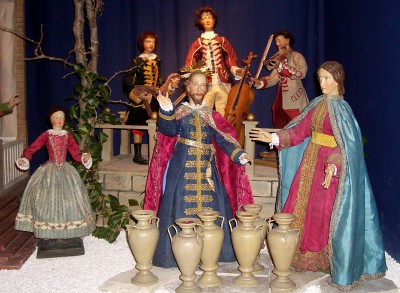
 In each of the Days of Creation faithfulness, fruitfulness, and fecundity were present, and God pronounced them, on each of the Days, good: and so the Creation is, at heart and in expression, the marriage of God and heaven and earth.
The prophets remember this marriage in their outcries against the abuses of their age, and they speak of restoration using the language of feasts: a feast of fat things on the leas; a feast where the lion will eat straw like the ox and the cow and the bear will feed together. Jesus speaks of a heavenly banquet.
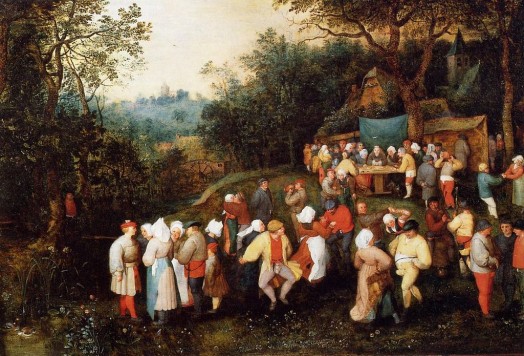
And in this story, he speaks of a wedding feast without guests, a tragedy of love. After all, the words do change over the ages, the rituals vary with the millennia and the culture, but the world around, a wedding is celebrated with a feast. What makes a couple married? More than the license, and certainly more than sex, in truth, it is in this sharing of abundance with others that Faith becomes a visible grace.
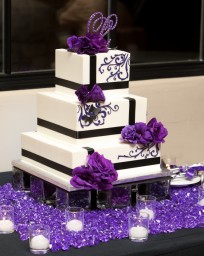
 Bridegroom theology is not at all a part of traditional New England religious understanding. Many a furrowed brow would greet the preacher who tossed out images of Christ the Bridegroom of the Church. And yet, wedding feasts are always well kept, the art of the wedding cake is endlessly elaborated, the grace of the Blessing is ardently invoked for each marriage. But the marriage of all of us to God the Creator, and our trust in the power of God’s blessing to be vital for us, has just about left our cultural thinking. The paired reading for Sunday, of the creation of the false idol in the Exodus, might aptly apply to our modern weddings, which are about the adoration of cakes and clothes, and the feast.
 In Jesus’ own time, it seems to have been like this. They placed their hope, as we do, in our prosperity, our chances to get ahead in the economy, our strength. Not in the One who calls forth life, who says, Let there be . . . . and brings forth fruitfulness from our ground.
Throughout the gospels, Jesus flings out curious comments about the marriage of heaven and earth, comments which startle and remain mysterious. I piped and you would not dance, he says, I wept and you did not mourn. And then there are the injunctions of the fig tree, which is fruitful as a sign, and when unfruitful, receives his curse. There are the wise and foolish bridesmaids at one wedding, which mysteriously occurs at night, and this puzzling royal wedding to which no one will come. At Cana, Jesus is irked by his mother’s request, yet performs a miracle. At the Last Supper, he offers them the Marriage of Eternity and Time, Life and Death, Heaven and Earth. Yet they are confused, and so, in truth, are we. And they are a bit irked that he does not produce a miracle right then.
 What shall we make of the anger of the king? Will we be cast out? God knows, weddings are fraught with snits, smoldering feuds, broken relations. And the prophets say we behave like that towards God. But does God behave like that?
In all of the weddings Jesus speaks of, and in the feasts he shares, there is both a shadow and a warning. There is also a bright hope, that the outer darkness will not consume the light within, and we will all be present. For, fierce as the warnings are, the power of the wedding is not about death, it is about life’s renewal, life’s rising. And we are reminded to dress for the occasion . . . . wear your glad rags, for in the end, there is joy.
As the Vatican Synod on the Family opens its discussions, all of this needs to be welcomed, for it is the lives of God’s people. And the life and loves of George Clooney, and his recent marriage, are emblematic of the lives of lay Catholics everywhere, whom the Church must learn to bless and acknowledge, for faith, in our age, is inscrutable in ancient doctrines, and is made visible in the adventures of open, loving lives.
_____________________________________________________________
Illustrations:
1. George Clooney and Amal, Hello magazine cover***.*** Google Images.
2. The Wedding at Cana. 17th c. Gutenzell, Germany. Vanderbilt Divinity School Library, Art in the Christian Tradition.
3. Wedding Cake. Baker’s photo. Google Images.
4. The Wedding Feast, Jan Brueghel the Elder, EnWikipedia.org.
5. Wedding Cake. Baker’s photo. Google Images.
6. Miracle at Cana. He Qi, Nanjing, China. Vanderbilt Divinity School Library, Art in the Christian Tradition.
Previous Post

September 27, 2014
The Vineyard and the Days of Awe
Next Post
October 12, 2014 God and Caesar
Browse Our Archives
Select a Category Bites Uncategorized
Select a Month December 2017 November 2017 October 2017 September 2017 August 2017 July 2017 June 2017 May 2017 April 2017 March 2017 February 2017 January 2017 December 2016 November 2016 October 2016 September 2016 August 2016 July 2016 June 2016 May 2016 April 2016 March 2016 February 2016 January 2016 December 2015 November 2015 October 2015 September 2015 August 2015 July 2015 June 2015 May 2015 April 2015 March 2015 February 2015 January 2015 December 2014 November 2014 October 2014 September 2014 August 2014 July 2014 June 2014 May 2014 April 2014 March 2014 February 2014 January 2014 December 2013 November 2013 October 2013 September 2013 August 2013 July 2013 June 2013 May 2013 April 2013 March 2013 February 2013 January 2013 December 2012
Follow Us!
TAKE THE
Religious Wisdom Quiz
What does Paul say happens when we are baptized into Christ Jesus?
Select your answer to see how you score.
We are saved We become children of God We receive the Holy Spirit We are baptized into his death
Related posts from The Bite in the Apple




TRENDING AT PATHEOS Progressive Christian

Why Christians Have a Sacred Duty to Vote:...
The Bible offers strong support for the sacred duty to vote. Here...

What Being a Modern-Day Apostle Means to Me
In my last column, I discussed the ins and outs of modern-day...

Did Ancient China Once Worship the God of...
Across human history, a common thread weaves through the origins of the...

Love Your Neighbor – Including Earth-Kin: Lev. 19,...
God’s command to love your neighbor means acting in an ethical and...

Lead a Church Study of “Jesus and Lao...
Guest writer Jack Thomas (The Irreverent Reverend) reflects on leading his church...

Principles for Understanding the Apostolic Ministry Today
Whenever people discover that my formal ministry title is "apostle," as in...
view all Progressive Christian blogs
Ad-Free & Subscriber Log-In Subscription Support
- About Us
- 2026 Calendar
- Videos
- Podcasts
- Library of World Religions
- Faith In Media Tracker
- Advertise With Us
- Write for Us
- Privacy Policy
- Terms of Service
- Do Not Sell My Data
- Contact Us
- Radiant Digital
- Manage Newsletter Subscriptions
- Unsubscribe From Notifications
- Sitemap
Copyright 2008-2026, Patheos. All rights reserved.
Subscription Support Ad-Free & Subscriber Log-In
Follow Patheos