
BuddhistCatholicContemplativeEvangelicalGeneral ChristianHinduJewishLatter-day SaintMuslimNew VisionsProgressive Christian
Beliefs
- Buddhist
- Catholic
- Contemplative
- Evangelical
- General Christian
- Hindu
- Jewish
- Latter-day Saint
- More Voices
- Muslim
- New Visions
- Pagan
- Progressive Christian
Topics
- Religion News
- Food and Religion
- Sports and Religion
- Religious Art
- Religious Music and Entertainment
- Religious Events
- History and Religion
- Style and Religion
- Politics and Religion
- Women in Religion
- Recreation Outdoors and Religion
- Business Finance and Religion
- Careers Workplace and Religion
- Education and Religion
- Family Parenting and Religion
- Health Fitness and Religion
- Home and Religion
- Relationships and Religion
- Technology and Religion
- Travel and Religion
Columnists
- Buddhist Columnists
- Business Finance and Religion Columnists
- Careers Workplace and Religion Columnists
- Catholic Columnists
- Contemplative Columnists
- Education and Religion Columnists
- Evangelists Columnists
- Family Parenting and Religion Columnists
- General Christian Columnists
- Health Fitness and Religion Columnists
- Hindu Columnists
- History and Religion Columnists
- Home and Religion Columnists
- Jewish Columnists
- More Voices Columnists
- Latter Day Columnists
- Muslim Columnists
- New Visions Columnists
- Nonreligious Columnists
- Pagan Columnists
- Politics and Religion Columnists
- Progressive Columnists
- Recreation Outdoors and Religion Columnists
- Relationships and Religion Columnists
- Religion News Columnists
- Religious Art Columnists
- Religious Events Columnists
- Religious Music and Entertainment Columnists
- Sports and Religion Columnists
- Style and Religion Columnists
- Technology and Religion Columnists
- Travel and Religion Columnists
- Women in Religion Columnists
Resource Library
- 2026 Calendar
- Library of World Religions
- The 100 Most Holy Places on Earth
- Patheos Answers
- Podcasts
- Videos
- Faith Leaders Database
- Anglican Episcopalian
- Bahai
- Baptist
- Buddhism
- Christianity
- Confucianism
- Eastern Orthodoxy
- Hinduism
- Holiness and Pentecostal
- ISKCON
- Islam
- Judaism
- Lutheran
- Methodist
- The Church of Jesus Christ of Latter-day Saints
- New Age
- Paganism
- Presbytarian and Reformed
- Protestantism
- Religion Behind the Scenes
- Roman Catholic
- Scientology
- Shia Islam
- Sikhism
- Sufism
- Sunni Islam
- Taoism
- Zen
- See all religions
Research Tools
 Ad-Free & Subscriber Log-In Subscription Support
Ad-Free & Subscriber Log-In Subscription Support
Follow Patheos 

- Trending:
- Forgiveness
- |
- Marriage
- |
- Consciousness
- |
- Death Penalty
- |
- Election
- |
- Halloween
 The Bite in the Apple
- Home
- Progressive Christian
- The Things We Do for Love
The Things We Do for Love
Last updated on: February 28, 2015 at 11:48 pm by Nancy Rockwell
The Things We Do for Love 2015-02-28T23:48:35-04:00 Nancy Rockwell
Patheos Explore the world's faith through different perspectives on religion and spirituality! Patheos has the views of the prevalent religions and spiritualities of the world.
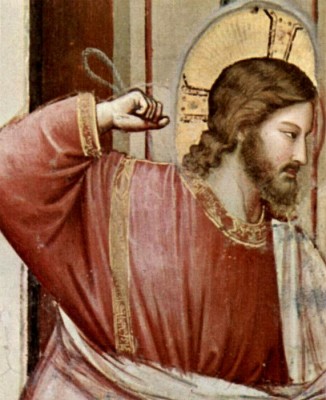 In the temple he found people selling cattle, sheep, and doves, and the money changers seated at their tables. Making a whip of cords, he drove all of them out . . .
The unforgettable rage of Jesus is stunning and dramatic – his clenched fist holds high the whip of cords he has made, and he brings it down with stunning force, scattering the tables, the coins, the sheep, the cattle, the doves, frightening them all, and all the worshippers who have come from afar to enter into these holy days in their beloved Temple.
Of course the priests challenge him, alarm and outrage rising at the same time.
Why on earth did he do this?
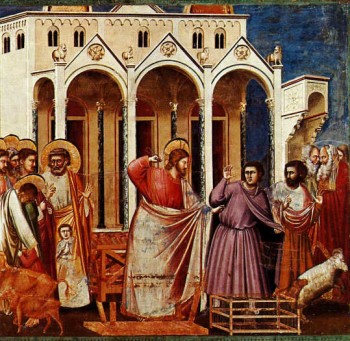 A hundred reasons at least have been put forward over the centuries: price gouging, usury, scapegoating, selling on the Sabbath, the substitution of ritual sacrifices for actions born of deep compassion; his exquisite awareness of the sacrifice that was really needed to save his people, a sacrifice he was preparing himself to make; then, too, this was the first of a succession of challenges to the whole system of authorities, from Temple to Palace to Pilate’s Court.
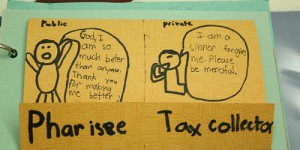
Left out of these considerations is Jesus’ frustration with public piety, and especially with the pious rituals of worship. He tells the parable of the tax collector and the Pharisee at worship as a clear illustration of his objections: in the Pharisee the rituals of worship are ingrained, he knows his prayerbook by season and day; the tax collector, ignorant and unpracticed, pours out his heart earnestly but is lost in liturgy, bringing out disdain in the Pharisee, who distractedly continues to read proper prayers. 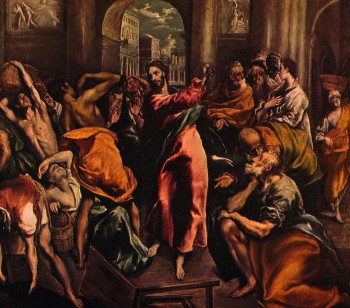
Jesus’ own sermon in his hometown synagogue made the congregation so angry they turned into a mob and ran him towards a cliff. In every town, he takes the local scribes to task for misguiding the faithful and misreading the tradition. He breaks Sabbath laws, and preaches a less observant and more compassionate interpretation of what Sabbath is and how to observe it.
At the Temple, the atmosphere is entirely devoted to ritual observances, and not at all to ‘rending your heart and not your garments’, not at all to profound repentance and rededication of heart and mind to God. The substitutionary offering of an animal (small or large depended on your income, not your sins) and the obligatory gift of money were, for the thousands who came on these holidays, the heart and the whole of their participation, except for singing and listening and saying Amen.
 The heart of Jesus’ outrage about our worship has to do with who is the receiver, and who the giver. At a Christian altar the receivers are always the people and the giver is always God, who offers an endless fullness of grace, renewable forgiveness, and a mercy that does not need to be ‘oiled’ with presents. But most congregations turn that around, pressed by the longing in the pews to offer God just what God wants, and to be recognized, by the pews and by God, as faithful saints.
High or low church, our habits tend to be ritualistic, and we solicit ceremonial money just as they did in the ancient Temple. Yes, we receive the sacrament that comes from God at the Table, not a sacrifice of our own making. But the table also holds our offerings: money, pledges, prayer shawls, Third Grade Bibles, memorial flowers, food for pantries, Christmas gifts for the needy, so many things we believe will please God and for which we want to be given recognition.
And money does change hands in our parish halls in ways that support our ritual life: Fairs, suppers, SERRV goods, Fair Trade coffee, are hallmarks of churches everywhere. Large churches have gift shops, where books on faith, Bibles of many kinds, and some religious art are available. And small churches offers books for reading groups, left-over Fair food, Advent wreath kits and many another thing, before and after worship for a modest sum. 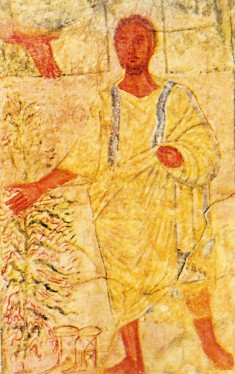
The Law, given to Moses and then to the people, came from a man whose whole life was tested by peril, in the waters of the Nile, at the tombs of Pharoah, at the burning bush, at the edge of the Sea, and at the top of Mt Sinai. There was nothing dry and legalistic about Moses, who was never half-heartedly present to God, never distracted from holiness. Jesus seeks this wholeness of focus in us. To him, the Temple of God is in the people. The people are not in God’s Temple, they are God’s temple.
For most of us, though, the building holds us, and shapes our memories, doubts and hopes. And so we love it, because here we have known the presence of God. We are not blindly fanatical people. We err on the side of blandly social faithfulness. Many days it is hard for us to be sure that there is any holiness in suffering, and the suffering of Jesus holds our loyalty but not our attention. We place our trust in the place that has welcomed us, offered us chances to feel both awe and welcome. We are glad for small things we can do to participate: fill Mite Boxes, make palm crosses, give an altar lily at Easter. Easter becomes known to us in rituals and customs, a glory remembered in our temples, where we do not think of Jesus with a whip of cords, or, for that matter, nails in his hand. ________________________________________________________ Illustrations:
1. Cleansing the Temple. Giotto di Bondone 1371, Scroveni Chapel, Padua, Italy. Vanderbilt Divinity School Library, Art in the Christian Tradition. Detail.
2. Cleansing the Temple. Giotto di Bondone, 1371. En Wikipedia.org Gallery.
3. Jesus Cleanses the Temple. El Greco. Google Images.
4. Pharisee and Tax Collector, child’s drawing. Google Images.
5. Moses and the Burning Bush. Fresco, 250 AD. Dura-Europos, Syria. Vanderbilt Divinity School Library, Art in the Christian Tradition.
Previous Post

February 22, 2015
Names
Next Post
March 7, 2015 Eternal Life and Selma
Browse Our Archives
Select a Category Bites Uncategorized
Select a Month December 2017 November 2017 October 2017 September 2017 August 2017 July 2017 June 2017 May 2017 April 2017 March 2017 February 2017 January 2017 December 2016 November 2016 October 2016 September 2016 August 2016 July 2016 June 2016 May 2016 April 2016 March 2016 February 2016 January 2016 December 2015 November 2015 October 2015 September 2015 August 2015 July 2015 June 2015 May 2015 April 2015 March 2015 February 2015 January 2015 December 2014 November 2014 October 2014 September 2014 August 2014 July 2014 June 2014 May 2014 April 2014 March 2014 February 2014 January 2014 December 2013 November 2013 October 2013 September 2013 August 2013 July 2013 June 2013 May 2013 April 2013 March 2013 February 2013 January 2013 December 2012
Follow Us!
TAKE THE
Religious Wisdom Quiz
Who was cast into a fiery furnace but was unharmed?
Select your answer to see how you score.
Elijah and Elisha Shadrach, Meshach, and Abednego Daniel Moses, Aaron, and Joshua
Related posts from The Bite in the Apple




TRENDING AT PATHEOS Progressive Christian

Why Christians Have a Sacred Duty to Vote:...
The Bible offers strong support for the sacred duty to vote. Here...

What Being a Modern-Day Apostle Means to Me
In my last column, I discussed the ins and outs of modern-day...

Did Ancient China Once Worship the God of...
Across human history, a common thread weaves through the origins of the...

Love Your Neighbor – Including Earth-Kin: Lev. 19,...
God’s command to love your neighbor means acting in an ethical and...

Lead a Church Study of “Jesus and Lao...
Guest writer Jack Thomas (The Irreverent Reverend) reflects on leading his church...

Principles for Understanding the Apostolic Ministry Today
Whenever people discover that my formal ministry title is "apostle," as in...
view all Progressive Christian blogs
Ad-Free & Subscriber Log-In Subscription Support
- About Us
- 2026 Calendar
- Videos
- Podcasts
- Library of World Religions
- Faith In Media Tracker
- Advertise With Us
- Write for Us
- Privacy Policy
- Terms of Service
- Do Not Sell My Data
- Contact Us
- Radiant Digital
- Manage Newsletter Subscriptions
- Unsubscribe From Notifications
- Sitemap
Copyright 2008-2026, Patheos. All rights reserved.
Subscription Support Ad-Free & Subscriber Log-In
Follow Patheos