
BuddhistCatholicContemplativeEvangelicalGeneral ChristianHinduJewishLatter-day SaintMuslimNew VisionsProgressive Christian
Beliefs
- Buddhist
- Catholic
- Contemplative
- Evangelical
- General Christian
- Hindu
- Jewish
- Latter-day Saint
- More Voices
- Muslim
- New Visions
- Pagan
- Progressive Christian
Topics
- Religion News
- Food and Religion
- Sports and Religion
- Religious Art
- Religious Music and Entertainment
- Religious Events
- History and Religion
- Style and Religion
- Politics and Religion
- Women in Religion
- Recreation Outdoors and Religion
- Business Finance and Religion
- Careers Workplace and Religion
- Education and Religion
- Family Parenting and Religion
- Health Fitness and Religion
- Home and Religion
- Relationships and Religion
- Technology and Religion
- Travel and Religion
Columnists
- Buddhist Columnists
- Business Finance and Religion Columnists
- Careers Workplace and Religion Columnists
- Catholic Columnists
- Contemplative Columnists
- Education and Religion Columnists
- Evangelists Columnists
- Family Parenting and Religion Columnists
- General Christian Columnists
- Health Fitness and Religion Columnists
- Hindu Columnists
- History and Religion Columnists
- Home and Religion Columnists
- Jewish Columnists
- More Voices Columnists
- Latter Day Columnists
- Muslim Columnists
- New Visions Columnists
- Nonreligious Columnists
- Pagan Columnists
- Politics and Religion Columnists
- Progressive Columnists
- Recreation Outdoors and Religion Columnists
- Relationships and Religion Columnists
- Religion News Columnists
- Religious Art Columnists
- Religious Events Columnists
- Religious Music and Entertainment Columnists
- Sports and Religion Columnists
- Style and Religion Columnists
- Technology and Religion Columnists
- Travel and Religion Columnists
- Women in Religion Columnists
Resource Library
- 2026 Calendar
- Library of World Religions
- The 100 Most Holy Places on Earth
- Patheos Answers
- Podcasts
- Videos
- Faith Leaders Database
- Anglican Episcopalian
- Bahai
- Baptist
- Buddhism
- Christianity
- Confucianism
- Eastern Orthodoxy
- Hinduism
- Holiness and Pentecostal
- ISKCON
- Islam
- Judaism
- Lutheran
- Methodist
- The Church of Jesus Christ of Latter-day Saints
- New Age
- Paganism
- Presbytarian and Reformed
- Protestantism
- Religion Behind the Scenes
- Roman Catholic
- Scientology
- Shia Islam
- Sikhism
- Sufism
- Sunni Islam
- Taoism
- Zen
- See all religions
Research Tools
 Ad-Free & Subscriber Log-In Subscription Support
Ad-Free & Subscriber Log-In Subscription Support
Follow Patheos 

- Trending:
- Forgiveness
- |
- Marriage
- |
- Consciousness
- |
- Death Penalty
- |
- Election
- |
- Halloween
 The Bite in the Apple
- Home
- Progressive Christian
- The Test
The Test
Last updated on: July 1, 2013 at 7:05 am by Nancy Rockwell
The Test 2013-07-01T07:05:04-04:00 Nancy Rockwell
Patheos Explore the world's faith through different perspectives on religion and spirituality! Patheos has the views of the prevalent religions and spiritualities of the world.
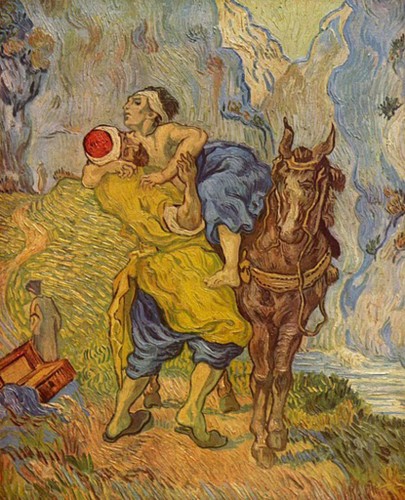 Who is my neighbor? asked the lawyer, testing Jesus in that age-old theological sport: debate. And specifically, debate over moral reasoning. You know, it isn’t only church folks who do this, we all do it, and we do it all day long, every day, every day, every day.
We constantly evaluate every little thing – we shoulda, coulda, woulda ourselves and each other. We cast shadows and take them away, in an instant application of this kind of measuring.
And, while we do it everywhere and to everyone, politicians, celebrities, bosses, parents and kids, it is always open season on neighbors, neighbors in the next house, or at the next desk, or in the next pew, neighbors whom we’ve known forever and neighbors who are strangers. It’s so endemic among us, it is the basic stuff of our situation comedies.
Jesus answered the lawyer with a story: A man was going down from Jerusalem to Jericho, and fell into the hands of robbers, who stripped him, beat him, and went away, leaving him half dead. Now by chance . . . .
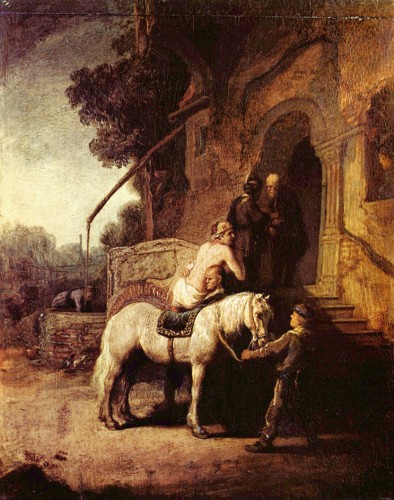 Jesus continues, telling of three passersby: a priest, a Levite, a Samaritan. The first two moved to the other side of the highway, avoiding the mess, the problem, the implications – and the risks. The Samaritan, moved by compassion, moved to the injured man, treated his wounds, took the man to an inn, paid for his care there.
Now Jesus asks a question, and it is a test: which one was a neighbor to the man? Well, you know the answer.
And we’ve striven to organize society to be sure that such unfortunates are never neglected. We’ve created careers for First Responders, and government departments to deal with Disasters, and watchdog agencies to monitor behavior and church mission committees to get us involved where it counts. We send youth on mission trips to learn these lessons.
This week alone, I’ve read a e-conversation over many days between clergy who were struggling to grasp the meaning of charitableness, of compassion, of mercy. Many wrote of the negative associations with the Let Me Help You public attitude, that assumes a kind of moral superiority in the helper, that can foster dependence in the helped, that can generate anger over disempowerment, not to mention repugnance at the proferred help. FEMA, the disaster response agency, takes a drubbing for its responses. So do churchladies, the proverbial icon of helping. The clergy were struggling to to find a way through the thicket of all this. How can you help without hurting, was the focus of their discussion.
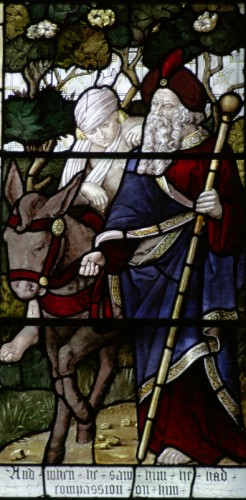 But I think the discussion, for all its sincerity, missed the main point.
The lawyer who questioned Jesus was asking for this kind of debate, this kind of thoughtful articulation of limits and lines, of behaviors and responsibilities, of goodness and meddling.
But Jesus has posed a situation where there isn’t time to think about it, and where the only decision to be made is whether you will let yourself be interrupted in what you were planning to do, whether you will shift your whole day, whether you will interfere with your own finances. Or not.
The Jericho road was not a country lane where folks went out for a walk, it was a highway, and everyone on it had somewhere to go and something to do, and a schedule to meet. The first two passersby, the priest and the Levite (a lawyer, in fact), were in harness to their schedules, their tasks, their appointments, their world.
The Samaritan stepped out of his day, upended his plans and commitments, and spent the money in his pocket, not on what he was planning to use it for, but for a beaten man. He didn’t stand there and weigh the merits. He acted. And he acted not to improve someone’s lifestyle, and not to mete out justice, but to help a man survive.
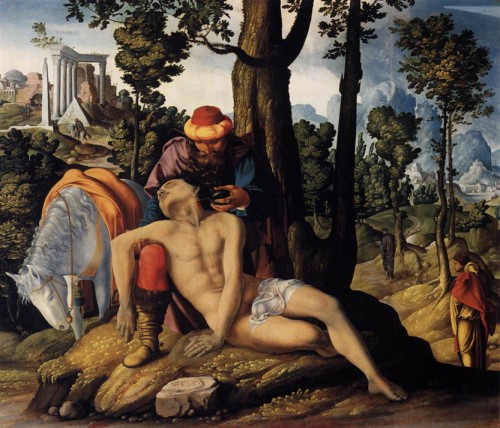 So the answer to the question, who is my neighbor, which is really the question: exactly who do I have to love as much as I love myself; is turned by Jesus into a questions about the self: how good a neighbor are you? And the answer has two parts: for what stranger do you unhestitatingly interrupt yourself to offer aid? and, can you see that people you would not like to have to love (Samaritans) may be better at this than people you admire?
Jesus holds up, for our loving, a stranger who has has badly treated. God knows who he is: drunk or brigand, traveling salesman, fool or innocent. All we know is, he isn’t one of us, and he needs immediate help.
In Boston, there’s been a lot of rejoicing over the response at the Marathon bombings of those who ran towards the bombed, those who saved lives and limbs by quick action and courage in a scary situation. Indeed, this was wonderful! We also know there were those who ran the other way, terrified and reacting in fear – and they might have been me, had I been there. I just don’t know how I would respond to bombs. But Jesus isn’t pressing us to brave bombs in this story, instead he is asking us to have the courage to interrupt our lives and move into Plan B. After all, most of life is Plan B, if we are honest. Maybe even, you know, Plan R. Days, lives, family, dreams, all require us to let go of Plan A, in order to move on, move in, move toward, move with.
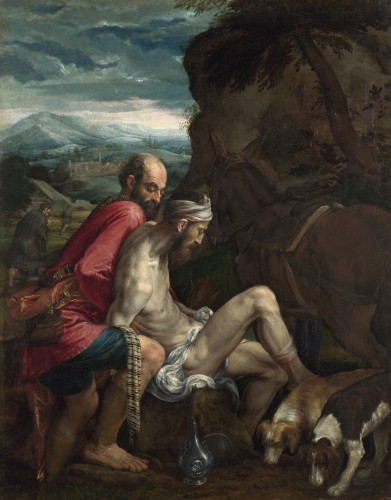 Jesus, whose glorious blessing in the river Jordan took him to an inglorious cross on Calvary, understood a lot about interruptions and revisions in plans. He emphasized the need to trust in the kindness of strangers, and to become generous to strangers. He asked us to love strangers, for God’s sake, as if they were ourselves, our neighbors.
The Letter to the Hebrews urges us to be kind to strangers, for thereby some have entertained angels unawares.
And there is an ancient Scots Celtic prayer:
I saw a stranger yesterday.
I put food in the eating place,
drink in the drinking place,
music in the listening place.
And the stranger blessed me,
my house, my cattle and my dear ones.
Ah, as the lark says in her song,
often, often, often, goes the Christ
in a stranger’s guise.
_______________________________________________
Illustrations:
1. Good Samaritan, by Vincent van Gogh, 1890, Otterlo, Netherlands*.* Vanderbilt Divinity School Library Collection, Art in the Christian Tradition.
2. Good Samaritan, by Rembrandt von Rijn, 1630, London, Wallace Collection. Vanderbilt Divinity School Library Collection, Art in the Christian Tradition.
3. Good Samaritan Window, 1882, Trinity Church, Boston, MA. Vanderbilt Divinity School Library Collection, Art in the Christian Tradition.
4. Good Samaritan, Unknown Artist, 1537, Rijksmuseum, Amsterdam, Netherlands. Vanderbilt Divinity School Library Collection, Art in the Christian Tradition.
5. Good Samaritan, by Jacopo Bassano, 1518- 1592, London, National Gallery.
Vanderbilt Divinity School Library Collection, Art in the Christian Tradition.
The Scots Celtic prayer is from The Carmina Gadelica, collected by Andrew Carmichael.
Previous Post

June 30, 2013
Lambs in the Midst of Wolves
Next Post
July 14, 2013 A Woman’s Right to Choose
Browse Our Archives
Select a Category Bites Uncategorized
Select a Month December 2017 November 2017 October 2017 September 2017 August 2017 July 2017 June 2017 May 2017 April 2017 March 2017 February 2017 January 2017 December 2016 November 2016 October 2016 September 2016 August 2016 July 2016 June 2016 May 2016 April 2016 March 2016 February 2016 January 2016 December 2015 November 2015 October 2015 September 2015 August 2015 July 2015 June 2015 May 2015 April 2015 March 2015 February 2015 January 2015 December 2014 November 2014 October 2014 September 2014 August 2014 July 2014 June 2014 May 2014 April 2014 March 2014 February 2014 January 2014 December 2013 November 2013 October 2013 September 2013 August 2013 July 2013 June 2013 May 2013 April 2013 March 2013 February 2013 January 2013 December 2012
Follow Us!
TAKE THE
Religious Wisdom Quiz
What did God create on the first day?
Select your answer to see how you score.
Light Water Animals Plants
Related posts from The Bite in the Apple




TRENDING AT PATHEOS Progressive Christian

Why Christians Have a Sacred Duty to Vote:...
The Bible offers strong support for the sacred duty to vote. Here...

What Being a Modern-Day Apostle Means to Me
In my last column, I discussed the ins and outs of modern-day...

Did Ancient China Once Worship the God of...
Across human history, a common thread weaves through the origins of the...

Love Your Neighbor – Including Earth-Kin: Lev. 19,...
God’s command to love your neighbor means acting in an ethical and...

Lead a Church Study of “Jesus and Lao...
Guest writer Jack Thomas (The Irreverent Reverend) reflects on leading his church...

Principles for Understanding the Apostolic Ministry Today
Whenever people discover that my formal ministry title is "apostle," as in...
view all Progressive Christian blogs
Ad-Free & Subscriber Log-In Subscription Support
- About Us
- 2026 Calendar
- Videos
- Podcasts
- Library of World Religions
- Faith In Media Tracker
- Advertise With Us
- Write for Us
- Privacy Policy
- Terms of Service
- Do Not Sell My Data
- Contact Us
- Radiant Digital
- Manage Newsletter Subscriptions
- Unsubscribe From Notifications
- Sitemap
Copyright 2008-2026, Patheos. All rights reserved.
Subscription Support Ad-Free & Subscriber Log-In
Follow Patheos