
BuddhistCatholicContemplativeEvangelicalGeneral ChristianHinduJewishLatter-day SaintMuslimNew VisionsProgressive Christian
Beliefs
- Buddhist
- Catholic
- Contemplative
- Evangelical
- General Christian
- Hindu
- Jewish
- Latter-day Saint
- More Voices
- Muslim
- New Visions
- Pagan
- Progressive Christian
Topics
- Religion News
- Food and Religion
- Sports and Religion
- Religious Art
- Religious Music and Entertainment
- Religious Events
- History and Religion
- Style and Religion
- Politics and Religion
- Women in Religion
- Recreation Outdoors and Religion
- Business Finance and Religion
- Careers Workplace and Religion
- Education and Religion
- Family Parenting and Religion
- Health Fitness and Religion
- Home and Religion
- Relationships and Religion
- Technology and Religion
- Travel and Religion
Columnists
- Buddhist Columnists
- Business Finance and Religion Columnists
- Careers Workplace and Religion Columnists
- Catholic Columnists
- Contemplative Columnists
- Education and Religion Columnists
- Evangelists Columnists
- Family Parenting and Religion Columnists
- General Christian Columnists
- Health Fitness and Religion Columnists
- Hindu Columnists
- History and Religion Columnists
- Home and Religion Columnists
- Jewish Columnists
- More Voices Columnists
- Latter Day Columnists
- Muslim Columnists
- New Visions Columnists
- Nonreligious Columnists
- Pagan Columnists
- Politics and Religion Columnists
- Progressive Columnists
- Recreation Outdoors and Religion Columnists
- Relationships and Religion Columnists
- Religion News Columnists
- Religious Art Columnists
- Religious Events Columnists
- Religious Music and Entertainment Columnists
- Sports and Religion Columnists
- Style and Religion Columnists
- Technology and Religion Columnists
- Travel and Religion Columnists
- Women in Religion Columnists
Resource Library
- 2026 Calendar
- Library of World Religions
- The 100 Most Holy Places on Earth
- Patheos Answers
- Podcasts
- Videos
- Faith Leaders Database
- Anglican Episcopalian
- Bahai
- Baptist
- Buddhism
- Christianity
- Confucianism
- Eastern Orthodoxy
- Hinduism
- Holiness and Pentecostal
- ISKCON
- Islam
- Judaism
- Lutheran
- Methodist
- The Church of Jesus Christ of Latter-day Saints
- New Age
- Paganism
- Presbytarian and Reformed
- Protestantism
- Religion Behind the Scenes
- Roman Catholic
- Scientology
- Shia Islam
- Sikhism
- Sufism
- Sunni Islam
- Taoism
- Zen
- See all religions
Research Tools
 Ad-Free & Subscriber Log-In Subscription Support
Ad-Free & Subscriber Log-In Subscription Support
Follow Patheos 

- Trending:
- Forgiveness
- |
- Marriage
- |
- Consciousness
- |
- Death Penalty
- |
- Election
- |
- Halloween
 The Bite in the Apple
- Home
- Progressive Christian
- The Spirit in Trinity
The Spirit in Trinity
Last updated on: June 7, 2014 at 11:00 pm by Nancy Rockwell
The Spirit in Trinity 2014-06-07T23:00:15-04:00 Nancy Rockwell
Patheos Explore the world's faith through different perspectives on religion and spirituality! Patheos has the views of the prevalent religions and spiritualities of the world.
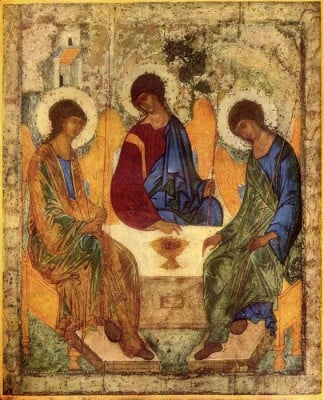 Trinity.
St. Patrick’s hymn to it, written on his death bed, sings of images of earth and heaven, sea and wind, Christ in all:
I bind unto myself today the strong name of the Trinity, by invocation of the same, the Three in One, the One in Three.
I bind unto myself today, the virtues of the starlit heaven, the glorious sun’s life-giving ray, the whiteness of the moon at even, the flashing of the lightning free, the whirling wind’s tempestuous shocks, the stable earth, the deep salt sea, around the old appointed rocks.
Christ beneath me, Christ above me, Christ in quiet, Christ in danger, Christ in hearts of all that love me, Christ in mouth of friend and stranger. (words from St. Patrick’s Breastplate)
Emily Dickinson invoked the Bee, the Butterfly and the Breeze. The ancient Celts invoked a trinity of birds: Wren, Raven, and Wild Goose, each known for different qualities of compassion, courage, character.
The Celts also invoked a female trinity, virgin, bride, and crone, each with powers for regeneration and fertility, and they were beseeched in the blessings of fields, hearths, marriage beds.
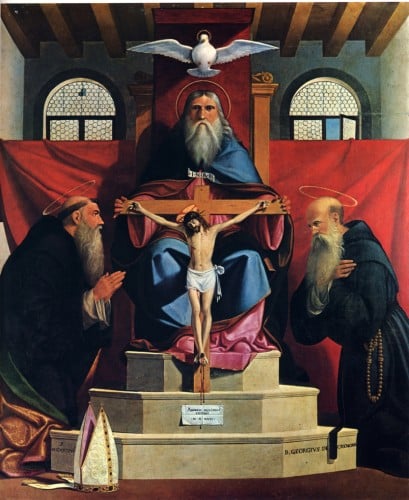 The male Christian Trinity is so repeatedly invoked liturgically that it loses its resonance, its sense of wonder or invitation in its names, its relations. It has become a salute, all about marshalling obedience, and not at all about walking in mystery.
Trinity intends to convey a dynamic relationship, full of the flashing lightning, whirling wind, deep salt sea that St. Patrick named, elemental wonders Jesus also cherished and used descriptively for the relationship of God and people: sheltering tree, wild sower, extravagant giver offering tangible love. None of these qualities is essentially male, nor essentially female. And Jesus, who was male, is fully identified with the feminine Sophia tradition in Judaism, and with women he dearly loved in his life.
The Nicene Creed, that 4th century pledge of allegiance, makes Trinity into a hierarchy: Father, begotten Son, and Holy Ghost begotten of them both. Or not.
Theological wars have been fought, and churches divided, over whether the Spirit proceeds from the Father alone, or from the Father and the Son, whether you should say ‘and the son’ when reciting the creed, or not.
 My Episcopalian grandmother, who was a Congregational missionary teacher before her marriage into the Episcopal world, had the custom of omitting the first two words (I believe) when saying the creed, and she taught us all to do the same, leaving her husband rolling his eyes and leaving our consciences free to become familiar with concepts we might or might not own, while at the same time, participating. And I owe to her cheerful dissent-with-support, that I’ve kept on thinking about the family differences and connections between generations of people and the entire generative garden of life in which we live.
 The first reading for Trinity Sunday is the Genesis account of creation, in which the Spirit precedes the Father, and of course also the Son. The Spirit hovers over the face of the waters, Genesis says, even before the first Word of Creation is spoken. And so the Spirit precedes the division of sexes, and, like God, is both male and female.
And so, the Creator proceeds in the companionship of the Spirit, in fact, God becomes the Creator with the Spirit’s aid, and is therefore younger, at least in that role, than the Spirit. The ladder turns upside down . . . and yet, Jesus promises we will know the Spirit after he departs, and it is written that he has known the Spirit since before he was born. So he proceeds from the Spirit, and precedes the Creation and its division into male and female.
We, too, will know the Spirit, Jesus promises, who will be sent to us by God, and Spirit, all the gospels say, was already here blessing Jesus at his baptism. We, too, are born of the Spirit, in our baptisms, with each swallow of the cup of forgiveness and the bread of life, and in each unexpected raising of our hearts from brokenness. And Jesus has promised and Paul repeats that we, too, will enter eternal life in which there is neither male nor female.
 Paul, whose words often become the bedrock of authoritarian theology, in fact preached eloquently on the primacy of the Spirit, and the life-giving dynamic possible in the relationship of people and God:
The God who made the world and everything in it, does not live in shrines made by human hands, (but) gives to all mortals life and breath and all things. He made all nations to inhabit the whole earth, so that they would search for God and perhaps grope for him and find him—though indeed he is not far from each one of us. For ‘In him we live and move and have our being’; as even some of your own poets have said, ‘For we too are his offspring.’ Since we are God’s offspring, we ought not to think that the deity is like gold, or silver, or stone, an image formed by the art and imagination of mortals.(Acts 17)
The Nicene Creed is an image carved in words of stone, that are far from most of our hearts. Yet the relationship of the Spirit, the great Gate into the green pasture of life with God, remains the power of Trinity, inviting us into a place where we may live and move and have our being in a mystical time and an eternal truth that can be named and renamed as we immerse ourselves in the deep waters, the fresh winds, the stable rocks, the burgeoning life that offers us, even in death, a new beginning.
Morning, noon, and night – above, below and within – in birth, life, and death – the grace, mercy and peace – of God who is never either-or, but always for us, with us, and in us, enfold us in blessing.
_________________________________________________________
Illustrations:
1. Trinity. Rublev, Andrei (Saint). 1400. Moscow, Russia. Vanderbilt Divinity School Library, Art in the Christian Tradition.
2. Trinity with Worshippers. Previtali, Andrea, 1517. Santa Maria de la Conzolazione. Vanderbilt Divinity School Library, Art in the Christian Tradition.
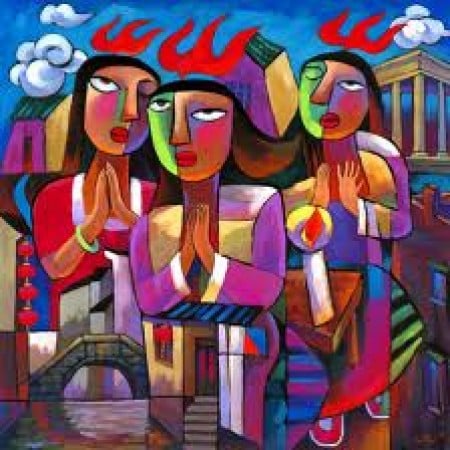
3. Pentecost. He Qi. Nanjing, China. Vanderbilt Divinity School Library, Art in the Christian Tradition.
4. Creation – Day 1. Mid 12th c. Cappella Palatina di Palermo. Palermo, Italy. Vanderbilt Divinity School Library, Art in the Christian Tradition.
5. Three Angel Visitors and Abraham. Cathedral di san Vitale. Ravenna, Italy.
Vanderbilt Divinity School Library, Art in the Christian Tradition.
Previous Post

June 1, 2014
Voices of God
Next Post
June 15, 2014 Many Sparrows
Browse Our Archives
Select a Category Bites Uncategorized
Select a Month December 2017 November 2017 October 2017 September 2017 August 2017 July 2017 June 2017 May 2017 April 2017 March 2017 February 2017 January 2017 December 2016 November 2016 October 2016 September 2016 August 2016 July 2016 June 2016 May 2016 April 2016 March 2016 February 2016 January 2016 December 2015 November 2015 October 2015 September 2015 August 2015 July 2015 June 2015 May 2015 April 2015 March 2015 February 2015 January 2015 December 2014 November 2014 October 2014 September 2014 August 2014 July 2014 June 2014 May 2014 April 2014 March 2014 February 2014 January 2014 December 2013 November 2013 October 2013 September 2013 August 2013 July 2013 June 2013 May 2013 April 2013 March 2013 February 2013 January 2013 December 2012
Follow Us!
TAKE THE
Religious Wisdom Quiz
What happened when Jesus broke five loaves and two fish for a crowd?
Select your answer to see how you score.
Only five were fed People went hungry There were leftovers A rainstorm started
Related posts from The Bite in the Apple




TRENDING AT PATHEOS Progressive Christian

Why Christians Have a Sacred Duty to Vote:...
The Bible offers strong support for the sacred duty to vote. Here...

What Being a Modern-Day Apostle Means to Me
In my last column, I discussed the ins and outs of modern-day...

Did Ancient China Once Worship the God of...
Across human history, a common thread weaves through the origins of the...

Love Your Neighbor – Including Earth-Kin: Lev. 19,...
God’s command to love your neighbor means acting in an ethical and...

Lead a Church Study of “Jesus and Lao...
Guest writer Jack Thomas (The Irreverent Reverend) reflects on leading his church...

Principles for Understanding the Apostolic Ministry Today
Whenever people discover that my formal ministry title is "apostle," as in...
view all Progressive Christian blogs
Ad-Free & Subscriber Log-In Subscription Support
- About Us
- 2026 Calendar
- Videos
- Podcasts
- Library of World Religions
- Faith In Media Tracker
- Advertise With Us
- Write for Us
- Privacy Policy
- Terms of Service
- Do Not Sell My Data
- Contact Us
- Radiant Digital
- Manage Newsletter Subscriptions
- Unsubscribe From Notifications
- Sitemap
Copyright 2008-2026, Patheos. All rights reserved.
Subscription Support Ad-Free & Subscriber Log-In
Follow Patheos