
BuddhistCatholicContemplativeEvangelicalGeneral ChristianHinduJewishLatter-day SaintMuslimNew VisionsProgressive Christian
Beliefs
- Buddhist
- Catholic
- Contemplative
- Evangelical
- General Christian
- Hindu
- Jewish
- Latter-day Saint
- More Voices
- Muslim
- New Visions
- Pagan
- Progressive Christian
Topics
- Religion News
- Food and Religion
- Sports and Religion
- Religious Art
- Religious Music and Entertainment
- Religious Events
- History and Religion
- Style and Religion
- Politics and Religion
- Women in Religion
- Recreation Outdoors and Religion
- Business Finance and Religion
- Careers Workplace and Religion
- Education and Religion
- Family Parenting and Religion
- Health Fitness and Religion
- Home and Religion
- Relationships and Religion
- Technology and Religion
- Travel and Religion
Columnists
- Buddhist Columnists
- Business Finance and Religion Columnists
- Careers Workplace and Religion Columnists
- Catholic Columnists
- Contemplative Columnists
- Education and Religion Columnists
- Evangelists Columnists
- Family Parenting and Religion Columnists
- General Christian Columnists
- Health Fitness and Religion Columnists
- Hindu Columnists
- History and Religion Columnists
- Home and Religion Columnists
- Jewish Columnists
- More Voices Columnists
- Latter Day Columnists
- Muslim Columnists
- New Visions Columnists
- Nonreligious Columnists
- Pagan Columnists
- Politics and Religion Columnists
- Progressive Columnists
- Recreation Outdoors and Religion Columnists
- Relationships and Religion Columnists
- Religion News Columnists
- Religious Art Columnists
- Religious Events Columnists
- Religious Music and Entertainment Columnists
- Sports and Religion Columnists
- Style and Religion Columnists
- Technology and Religion Columnists
- Travel and Religion Columnists
- Women in Religion Columnists
Resource Library
- 2026 Calendar
- Library of World Religions
- The 100 Most Holy Places on Earth
- Patheos Answers
- Podcasts
- Videos
- Faith Leaders Database
- Anglican Episcopalian
- Bahai
- Baptist
- Buddhism
- Christianity
- Confucianism
- Eastern Orthodoxy
- Hinduism
- Holiness and Pentecostal
- ISKCON
- Islam
- Judaism
- Lutheran
- Methodist
- The Church of Jesus Christ of Latter-day Saints
- New Age
- Paganism
- Presbytarian and Reformed
- Protestantism
- Religion Behind the Scenes
- Roman Catholic
- Scientology
- Shia Islam
- Sikhism
- Sufism
- Sunni Islam
- Taoism
- Zen
- See all religions
Research Tools
 Ad-Free & Subscriber Log-In Subscription Support
Ad-Free & Subscriber Log-In Subscription Support
Follow Patheos 

- Trending:
- Forgiveness
- |
- Marriage
- |
- Consciousness
- |
- Death Penalty
- |
- Election
- |
- Halloween
 The Bite in the Apple
- Home
- Progressive Christian
- The Scandalous Woman
The Scandalous Woman
Last updated on: March 15, 2014 at 11:01 pm by Nancy Rockwell
The Scandalous Woman 2014-03-15T23:01:38-04:00 Nancy Rockwell
Patheos Explore the world's faith through different perspectives on religion and spirituality! Patheos has the views of the prevalent religions and spiritualities of the world.
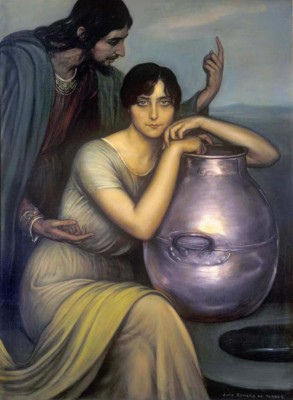 “How is it that you ask a drink of me?”
John tells this story: Jesus is preaching among the Samaritans, in their land, north of Judea and south of Galilee.
He has walked a long way. It’s noon, it’s hot and he’s thirsty. He stops at Jacob’s well, an ancient sacred spot and a public well. He has no cup. And he asks a Samaritan woman to give him a drink.
She is justly suspicious. He’s alone and so is she. His sort doesn’t make small talk with her sort, let alone drink from her cup. And she’s knows she is alluring, she’s lived with five men already and her current bedfellow is married to someone else. What is this Galilean up to, anyway, she wants to know. Jesus knows all this about her, and tells her so. And then he offers her the first Cup of Eternal Life.
This is no chance encounter. This Cup is nowhere more precious than it is in the gospel of John, whose careful writer would never have Jesus idly hand off something so sacred to a passing woman. Nor would John, who has constructed his book symbolically, using signs and wonders, include anything offhand or by chance.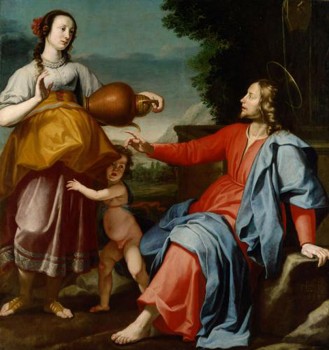
According to John, this Cup, the Grail Cup, is first given not to the men who are named as disciples, not to Galileans and not to Temple Jews, but to a woman of tarnished repute, a daring woman and a Samaritan at that.
Samaritans did not read the prophets, but the other gospels attribute many a saying or deed of the prophets as proof of Jesus’ holiness, over the years. The one prophet never mentioned is Hosea, who dearly loved and married a prostitute, Gomer, who ran off and had sex with another man, then came back home when Hosea sought her. Their marriage, by the custom of the time, was arranged between Hosea and Gomer’s father, and was not the result of wooing. He was older than she. There were children, a daughter, named Not Pitied, and a son, Not My People. Hosea’s love for Gomer was deep, and his forgiveness endless, and at last she did return his love, and as a sign, the names of the children were changed. Some see Hosea’s marriage as an allegory of the love between God and Israel, a people tempted to love many false idols.
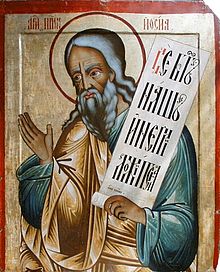 Is John drawing a picture of Jesus as Hosea here, and telling us the same truth about God’s deep love, and in particular about the Cup we share? Is the woman at the well Jesus’ Gomer, and by extension, all of us?
Does she receive the first Cup of Life to show that it is not a trickle-down cup given by the virtuous, or by ecclesiastical higher-ups, or by those who love Jesus more, to the abashed rest of us? Pope Francis said recently that the eucharist is not a reward for good behavior, but given to us for healing. Surely this story in John, and the placement of this first Cup in the hand of this woman, is substantive proof of Pope Francis’ teaching.
Jesus does not reprove her. We know this, because in her excitement she runs into town and tells everyone to come and see this man who knew all about her life. No one, having been reproached, would rush off in glee to spread the news of a scolding around town. She has been set free from all shame by Jesus’ acceptance.
 The story does not stand alone. There are many tales of Jesus’ affirmation for women who are seen as unrighteous by others.
And there are no tales of Jesus praising marriage, virginity, or family life. It may be that he values in this woman that she, like Gomer, longed to love and be loved, and would not settle for less. Jesus found a way to reach her spirit, through the integrity of her desire.
Family is a far, far, older tradition than Jesus, one that has evolved and is still evolving in its customs, and in its culturally attributed virtues and taboos. In many cultures virginity still has monetary value, and that value does not belong to the virgin, but to her elders. That value transfers to her husband, who pays a bride price for her, and then to her son, whose sonship comes from her. Jesus’ blessing and friendship are continually given to women who no longer have value, as virgins, as wives, or as mothers. These are women no one ‘owns.’ Their vulnerability appeals to him, where propriety, in neither men nor women, elicits any tenderness from him. The woman at the well, who belongs to no one, is free to give herself to God.
 How does the church, which has for so long insisted that the basis of Christian virtue lies in sexual propriety and duty (something Jesus never taught) begin to hear Jesus’ teaching, that the essence of being Christian is not about our sexuality, not about being abstinent before marriage, not about being married or divorced or married again or not married, not even about being virtuous within marriage, in fact, is not about avoiding sin, but is about a generosity of spirit that does not define itself by being owned, that understands each marriage will mean what the couple makes it mean, not what others say it means.
We receive the Cup from her scandalous hand, and she shares it with us in her joy at being loved.
___________________________________________________________
Illustrations:
1. Christ and the Woman at the Well, Romero de Torres, 1874 – 1905, Cordoba, Spain. Vanderbilt Divinity Library, Art in the Christian Tradition.
2. Christ and the Woman at the Well, Lorenzo Lippi, 1806-1865, Kunsthistorisches-Museum Wien, Vienna, Austria. Vanderbilt Divinity School Library, Art in the Christian Tradition.
3. Hosea Icon, 18th c. Russian Icon, Kizi Monastery, Korelia, Russia. Wikipedia.
4. Hosea Bringing Gomer Home. Haag, 1372, Manuscript known as Bible Historiale from The Hague. Vanderbilt Divinity School Library, Art in the Christian Tradition.
5. Woman at the Well. Stone Sculpture, Czech Republic, Town of Cesky-Krumlov. Vanderbilt Divinity School Library, Art in the Christian Tradition.
6. Reredos Panel, 1445, Catedral de Salamanco, by Fiorentino, Niccoló**.** Vanderbilt Divinity School Library, Art in the Christian Tradition.
Previous Post

March 9, 2014
Nicodemus
Next Post
March 22, 2014 The Man Born Blind
Browse Our Archives
Select a Category Bites Uncategorized
Select a Month December 2017 November 2017 October 2017 September 2017 August 2017 July 2017 June 2017 May 2017 April 2017 March 2017 February 2017 January 2017 December 2016 November 2016 October 2016 September 2016 August 2016 July 2016 June 2016 May 2016 April 2016 March 2016 February 2016 January 2016 December 2015 November 2015 October 2015 September 2015 August 2015 July 2015 June 2015 May 2015 April 2015 March 2015 February 2015 January 2015 December 2014 November 2014 October 2014 September 2014 August 2014 July 2014 June 2014 May 2014 April 2014 March 2014 February 2014 January 2014 December 2013 November 2013 October 2013 September 2013 August 2013 July 2013 June 2013 May 2013 April 2013 March 2013 February 2013 January 2013 December 2012
Follow Us!
TAKE THE
Religious Wisdom Quiz
What does "Tabernacle" mean?
Select your answer to see how you score.
Holy altar Cupboard Dwelling place Sacrifice
Related posts from The Bite in the Apple




TRENDING AT PATHEOS Progressive Christian

Why Christians Have a Sacred Duty to Vote:...
The Bible offers strong support for the sacred duty to vote. Here...

What Being a Modern-Day Apostle Means to Me
In my last column, I discussed the ins and outs of modern-day...

Did Ancient China Once Worship the God of...
Across human history, a common thread weaves through the origins of the...

Love Your Neighbor – Including Earth-Kin: Lev. 19,...
God’s command to love your neighbor means acting in an ethical and...

Lead a Church Study of “Jesus and Lao...
Guest writer Jack Thomas (The Irreverent Reverend) reflects on leading his church...

Principles for Understanding the Apostolic Ministry Today
Whenever people discover that my formal ministry title is "apostle," as in...
view all Progressive Christian blogs
Ad-Free & Subscriber Log-In Subscription Support
- About Us
- 2026 Calendar
- Videos
- Podcasts
- Library of World Religions
- Faith In Media Tracker
- Advertise With Us
- Write for Us
- Privacy Policy
- Terms of Service
- Do Not Sell My Data
- Contact Us
- Radiant Digital
- Manage Newsletter Subscriptions
- Unsubscribe From Notifications
- Sitemap
Copyright 2008-2026, Patheos. All rights reserved.
Subscription Support Ad-Free & Subscriber Log-In
Follow Patheos