
BuddhistCatholicContemplativeEvangelicalGeneral ChristianHinduJewishLatter-day SaintMuslimNew VisionsProgressive Christian
Beliefs
- Buddhist
- Catholic
- Contemplative
- Evangelical
- General Christian
- Hindu
- Jewish
- Latter-day Saint
- More Voices
- Muslim
- New Visions
- Pagan
- Progressive Christian
Topics
- Religion News
- Food and Religion
- Sports and Religion
- Religious Art
- Religious Music and Entertainment
- Religious Events
- History and Religion
- Style and Religion
- Politics and Religion
- Women in Religion
- Recreation Outdoors and Religion
- Business Finance and Religion
- Careers Workplace and Religion
- Education and Religion
- Family Parenting and Religion
- Health Fitness and Religion
- Home and Religion
- Relationships and Religion
- Technology and Religion
- Travel and Religion
Columnists
- Buddhist Columnists
- Business Finance and Religion Columnists
- Careers Workplace and Religion Columnists
- Catholic Columnists
- Contemplative Columnists
- Education and Religion Columnists
- Evangelists Columnists
- Family Parenting and Religion Columnists
- General Christian Columnists
- Health Fitness and Religion Columnists
- Hindu Columnists
- History and Religion Columnists
- Home and Religion Columnists
- Jewish Columnists
- More Voices Columnists
- Latter Day Columnists
- Muslim Columnists
- New Visions Columnists
- Nonreligious Columnists
- Pagan Columnists
- Politics and Religion Columnists
- Progressive Columnists
- Recreation Outdoors and Religion Columnists
- Relationships and Religion Columnists
- Religion News Columnists
- Religious Art Columnists
- Religious Events Columnists
- Religious Music and Entertainment Columnists
- Sports and Religion Columnists
- Style and Religion Columnists
- Technology and Religion Columnists
- Travel and Religion Columnists
- Women in Religion Columnists
Resource Library
- 2026 Calendar
- Library of World Religions
- The 100 Most Holy Places on Earth
- Patheos Answers
- Podcasts
- Videos
- Faith Leaders Database
- Anglican Episcopalian
- Bahai
- Baptist
- Buddhism
- Christianity
- Confucianism
- Eastern Orthodoxy
- Hinduism
- Holiness and Pentecostal
- ISKCON
- Islam
- Judaism
- Lutheran
- Methodist
- The Church of Jesus Christ of Latter-day Saints
- New Age
- Paganism
- Presbytarian and Reformed
- Protestantism
- Religion Behind the Scenes
- Roman Catholic
- Scientology
- Shia Islam
- Sikhism
- Sufism
- Sunni Islam
- Taoism
- Zen
- See all religions
Research Tools
 Ad-Free & Subscriber Log-In Subscription Support
Ad-Free & Subscriber Log-In Subscription Support
Follow Patheos 

- Trending:
- Forgiveness
- |
- Marriage
- |
- Consciousness
- |
- Death Penalty
- |
- Election
- |
- Halloween
 The Bite in the Apple
- Home
- Progressive Christian
- The Easter of Our Senses
The Easter of Our Senses
Last updated on: April 5, 2015 at 4:01 pm by Nancy Rockwell
The Easter of Our Senses 2015-04-05T16:01:36-04:00 Nancy Rockwell
Patheos Explore the world's faith through different perspectives on religion and spirituality! Patheos has the views of the prevalent religions and spiritualities of the world.
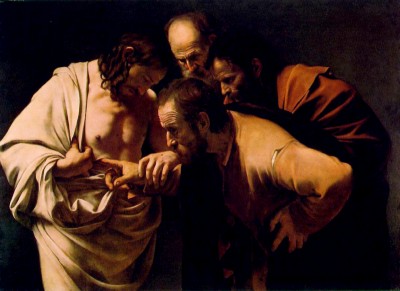 Alone in the gospels, and in the whole of the Bible, Thomas is eternally remembered for the wrong distinction. He doubted, and that has become his moniker, down through the ages: Doubting Thomas. But his doubt is far from unique, in fact it is universal among the disciples. All of them doubted, every one hard pressed to recognize a reality different from the The End sign written over the death they had witnessed.
The agony that took them from Jesus’ final hour on Friday to the various hours on Sunday when each of them realized his Easter risenness, was born of doubt and of more than doubt: of disbelief. 
Easter did not make sense. It boggled their minds. It became real to them through a series of sensations that could only slowly alter their minds. For those who went to the tomb, the initial sensation of the emptiness was a loss, so convinced were they that death should be present, the death they had witnessed and were expecting to see again.
Next, for Mary, was sight, in which she could not recognize him, even chatted with him a bit, until the sound of his voice, saying her name, became convincing. To recap her Easter journey then: an absence of death; a presence, the voice, none broke through her conviction of death, her disbelief of Easter, until she heard him say her name: a dear word.
For those in the upper room, and on the Emmaus Road, and in the fishing boat, sight was the sense that next befuddled them, confounding their minds with a confusing appearance, and with familiar words in an unfamiliar voice, his authority speaking to them, but they could not discern him in it. The confirming action came through food, its smell, its taste, the sight of it in his hand, him eating, him inviting them to eat, him breaking bread.
For Thomas, alone, the convincing sense was touch. And he was the only one in all the gospels who touched Jesus ever, after Friday, after he had been laid in the tomb. The reality Thomas sought came through his fingers, more than through his eyes or ears. Thomas the Toucher should be his moniker, in truth.
Perhaps he is not Touching Thomas because of what Jesus said: at the moment of Thomas’ touch and rejoicing, Jesus said, Blessed are those who have not seen, and yet believe. So for Jesus the issue at hand was not the sensory road by which Easter is received, but where the focus of the senses lay. His death wounds were what Thomas touched, what Thomas expressly said he needed to touch to know Easter.
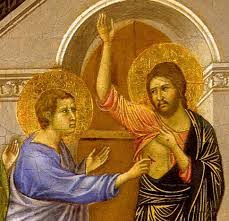 Blessed are you who have not seen and have believed. It is not death that gives Christ’s Easter life its power. Nor is it death that authenticates Jesus’ journey onto the cross or into Easter. Love’s redeeming work is the focus upon which we are to be fixed – the cooking of breakfasts, the sharing of anguishing news along the road, the moment of greeting in the garden.
For many, his wounds remain a fixation. In our doubt, they are questioned as non-lethal, or a fiction. As if violent wounds were a fiction in human experience rather than a routinely common occurrence born of human hate. In our belief, they are sometimes worshipped with a fixation that insists on a superlative degree of torture detail here, a unique reality which denies the gospels’ claim that Jesus died a routinely common death administered to slaves and the very poor.
 How much of each night’s news is fixation upon the gory details – the power of death. And survival, never detailed very much, is greeted as an escape from death’s power rather than the power of love’s redemptive work. Love’s work is nice, in our estimation, but does not have the fascinating power of death. Thomas, whose name means twin, stands alone in the gospel. Perhaps we are his twin, each of us standing in his shoes, asking to touch the wounds in which life became unsustainable, more inclined toward knowing the power that fascinates us, than the power that liberates us.
Lord, help our unbelief! ______________________________________________________________ Illustrations:
1. The Incredulity of St. Thomas, by Caravaggio, Neues Palais in Sanssouci, Potsdam, Germany. Vanderbilt Divinity School Library, Art in the Christian Tradition.
2. The Incredulity of St. Thomas, Duccio di Buoninsegna, Museo dell’Opera del Duomo, Siena, Italy. Vanderbilt Divinity School Library, Art in the Christian Tradition.
4. The Good Unbelief of St. Thomas, detail. Icon in the Iconostasis of the Monastery of St. Cyril. Google Images.
5. Doubting Thomas, 16th c. Greek Orthodox Icon. Google Images.
Previous Post

March 28, 2015
The Moveable Feast
Next Post
April 12, 2015 Scared Sick
Browse Our Archives
Select a Category Bites Uncategorized
Select a Month December 2017 November 2017 October 2017 September 2017 August 2017 July 2017 June 2017 May 2017 April 2017 March 2017 February 2017 January 2017 December 2016 November 2016 October 2016 September 2016 August 2016 July 2016 June 2016 May 2016 April 2016 March 2016 February 2016 January 2016 December 2015 November 2015 October 2015 September 2015 August 2015 July 2015 June 2015 May 2015 April 2015 March 2015 February 2015 January 2015 December 2014 November 2014 October 2014 September 2014 August 2014 July 2014 June 2014 May 2014 April 2014 March 2014 February 2014 January 2014 December 2013 November 2013 October 2013 September 2013 August 2013 July 2013 June 2013 May 2013 April 2013 March 2013 February 2013 January 2013 December 2012
Follow Us!
TAKE THE
Religious Wisdom Quiz
Who miraculously made an iron axe head float?
Select your answer to see how you score.
Hosea Elisha Elijah Jonah
Related posts from The Bite in the Apple




TRENDING AT PATHEOS Progressive Christian

Why Christians Have a Sacred Duty to Vote:...
The Bible offers strong support for the sacred duty to vote. Here...

What Being a Modern-Day Apostle Means to Me
In my last column, I discussed the ins and outs of modern-day...

Did Ancient China Once Worship the God of...
Across human history, a common thread weaves through the origins of the...

Love Your Neighbor – Including Earth-Kin: Lev. 19,...
God’s command to love your neighbor means acting in an ethical and...

Lead a Church Study of “Jesus and Lao...
Guest writer Jack Thomas (The Irreverent Reverend) reflects on leading his church...

Principles for Understanding the Apostolic Ministry Today
Whenever people discover that my formal ministry title is "apostle," as in...
view all Progressive Christian blogs
Ad-Free & Subscriber Log-In Subscription Support
- About Us
- 2026 Calendar
- Videos
- Podcasts
- Library of World Religions
- Faith In Media Tracker
- Advertise With Us
- Write for Us
- Privacy Policy
- Terms of Service
- Do Not Sell My Data
- Contact Us
- Radiant Digital
- Manage Newsletter Subscriptions
- Unsubscribe From Notifications
- Sitemap
Copyright 2008-2026, Patheos. All rights reserved.
Subscription Support Ad-Free & Subscriber Log-In
Follow Patheos