
BuddhistCatholicContemplativeEvangelicalGeneral ChristianHinduJewishLatter-day SaintMuslimNew VisionsProgressive Christian
Beliefs
- Buddhist
- Catholic
- Contemplative
- Evangelical
- General Christian
- Hindu
- Jewish
- Latter-day Saint
- More Voices
- Muslim
- New Visions
- Pagan
- Progressive Christian
Topics
- Religion News
- Food and Religion
- Sports and Religion
- Religious Art
- Religious Music and Entertainment
- Religious Events
- History and Religion
- Style and Religion
- Politics and Religion
- Women in Religion
- Recreation Outdoors and Religion
- Business Finance and Religion
- Careers Workplace and Religion
- Education and Religion
- Family Parenting and Religion
- Health Fitness and Religion
- Home and Religion
- Relationships and Religion
- Technology and Religion
- Travel and Religion
Columnists
- Buddhist Columnists
- Business Finance and Religion Columnists
- Careers Workplace and Religion Columnists
- Catholic Columnists
- Contemplative Columnists
- Education and Religion Columnists
- Evangelists Columnists
- Family Parenting and Religion Columnists
- General Christian Columnists
- Health Fitness and Religion Columnists
- Hindu Columnists
- History and Religion Columnists
- Home and Religion Columnists
- Jewish Columnists
- More Voices Columnists
- Latter Day Columnists
- Muslim Columnists
- New Visions Columnists
- Nonreligious Columnists
- Pagan Columnists
- Politics and Religion Columnists
- Progressive Columnists
- Recreation Outdoors and Religion Columnists
- Relationships and Religion Columnists
- Religion News Columnists
- Religious Art Columnists
- Religious Events Columnists
- Religious Music and Entertainment Columnists
- Sports and Religion Columnists
- Style and Religion Columnists
- Technology and Religion Columnists
- Travel and Religion Columnists
- Women in Religion Columnists
Resource Library
- 2026 Calendar
- Library of World Religions
- The 100 Most Holy Places on Earth
- Patheos Answers
- Podcasts
- Videos
- Faith Leaders Database
- Anglican Episcopalian
- Bahai
- Baptist
- Buddhism
- Christianity
- Confucianism
- Eastern Orthodoxy
- Hinduism
- Holiness and Pentecostal
- ISKCON
- Islam
- Judaism
- Lutheran
- Methodist
- The Church of Jesus Christ of Latter-day Saints
- New Age
- Paganism
- Presbytarian and Reformed
- Protestantism
- Religion Behind the Scenes
- Roman Catholic
- Scientology
- Shia Islam
- Sikhism
- Sufism
- Sunni Islam
- Taoism
- Zen
- See all religions
Research Tools
 Ad-Free & Subscriber Log-In Subscription Support
Ad-Free & Subscriber Log-In Subscription Support
Follow Patheos 

- Trending:
- Forgiveness
- |
- Marriage
- |
- Consciousness
- |
- Death Penalty
- |
- Election
- |
- Halloween
 The Bite in the Apple
- Home
- Progressive Christian
- The Barren Woman at the Edge of Eternity
The Barren Woman at the Edge of Eternity
Last updated on: November 4, 2013 at 10:58 am by Nancy Rockwell
The Barren Woman at the Edge of Eternity 2013-11-04T10:58:23-04:00 Nancy Rockwell
Patheos Explore the world's faith through different perspectives on religion and spirituality! Patheos has the views of the prevalent religions and spiritualities of the world.
 There are more violent stories about women in the Bible – the rapes of Tamar and Dinah, for instance, and Hagar and her child being cast out into the desert to die – but the barren woman’s story has an icy wind in it, a deep chill that lives in the hearts of the group of decent men from which it springs. It is because they are decent men that the story is ice cold. They bring her forward as their trump card against eternal life, and they give her to us as lasting evidence of how you can be civilized and cruel at the same time.
They want to debate Jesus on the preposterous notion of resurrection. They present the barren woman to him as a conundrum, arguing that eternal life would be an eternal mess, a social confusion of subjugation and subservience, things which in mortal life are sorted.
In their imaginations, the barren woman has been widowed seven times, and had been married to seven brothers. According to the law of the time, a decent man would marry his brother’s widow if there were no sons to support her. The barren woman had no children. In their story, all the world had seen her barrenness exposed seven times over.
The men want to know, in Jesus’ resurrection, whose servant will this worthless woman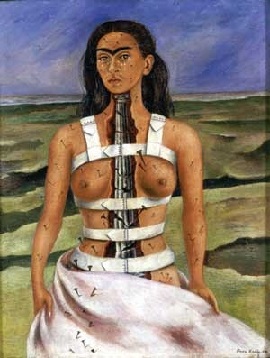 be? For them it is academic: if she had borne sons, then in an eternal world she would belong to the father of her sons. For in their thought women are born to serve men, as long as there is life. In this world and the next, they reason, fruitfulness and fecundity are part of faithfulness. And this barren woman is unimaginable in eternity. She is as shocking as (childless painter) Frida Kahlo’s self-portrait, The Broken Column.
Worthless? Is the word unfair here? After all, she is in heaven, they imagine. But – no she is not – for they imagine her as the refutation of the possibility of heavenly experience. And the proof of their attitude is among us still: women parishioners, in their 80s and 90s, have shared 60 year old stories, with fresh tears, of being forbidden to go to college when their brothers were being sent because, their fathers declared, No man will want to marry you if you get so much education. One woman, whose mother had died when she was young, told this tale: her father agreed to college and even paid a deposit, but the men in his office argued him out of it, and instead he sent his unhappy daughter on a European tour, to keep her marriageable. Near the turn of the last century there had been articles by educated men, arguing that too much education would divert blood from a woman’s womb to her brain, rendering her barren.
Well, we no longer think this way . . . . and yet, the Christian church has so venerated women as childbearers that it has been unable to imagine other roles for women, even though Jesus never praised childbearing or motherhood, and did imagine other roles for women: Mary has chosen the good portion and it will not be taken away from her, he said, when Mary chose to sit among the disciples and learn, rather than work in the kitchen. And perhaps most importantly, in this argument with the Sadducees over the barren woman, Jesus opened the gates of heaven to her, saying that in the resurrection, life is not as we know it here on earth, there is no owning or belonging to one another, for in eternity all are children of God. Thanks to Jesus, the barren woman does what is unthinkable: she steps into heaven on her own.
 But entering church as a childless woman is harder, much harder. The culture is still so tilted toward fertility as fecundity, toward children as the fruit of the spiritual life, that other work, other interests, and other visions of church are treated as odd, if not as unwelcome. Catholic tradition has made an space for childless women as nuns, but insists on an absence of sexual identity, and an ‘otherness’ from childbearing women that is visual, cultural, and social.
A recent NPR report detailed the data that show American women are increasingly choosing childlessness. Nearly 25 % of women are childless now, and the data skews higher among educated women, white women, younger women, who are saying, this is not the most important thing about me, and, there are other things I want to do with my life. An anomaly? Likely not, as for over twenty years now the census data has shown that, on the east coast, 73% of the population is no longer living in a nuclear family lifestyle. There is a stubborn resistance to this in large numbers of Christian churches, who claim Jesus as their standard of value. But Jesus made it clear, over and over again, that he embraces barren women, promiscuous women, fallen women, prostitutes – women who suffer social stigma still, and women who are not defined by belonging to a husband. And unlike earlier prophets, there is no story of Jesus inducing fertility in a barren woman.
 The new Nigerian –American film, Mother of George, tells a story of infertility set in Brooklyn, among immigrant Nigerians. As the infertile woman suffers more and more rejection by her husband and mother-in-law (who has already named the son she has not borne George), she is moved to a desperate decision. And she reminds us that the meaning of fertility, the meaning of family, and the meaning of fecundity, alter with time, culture, possibility, and suffering.
We need a new imagination: for human intimacy, its purpose and our need for it; for fecundity, which brings forth from us, in Christian wisdom, kindness, acceptance, community; for work, which raises us up not only in generations but in ideas, art, works of peace; and for life itself, which by God’s design is endlessly evolving. We have, as a permanent legacy, John the Baptist’s warning: God does not need us to raise up children for God. Essential for understanding eternal life is understanding this, according to Jesus. And we have Jesus’ own words, when he got the message that his mother and brothers were at the door and wanted to take him home: All who hear my words and do them are my family.
_______________________________________________________
Illustrations:
1. Silent Sorority, Book Cover. Google Images.
2. The Broken Column, by Frida Kahlo. Image from Wikipedia page for The Broken Column
3. Roots, by Frida Kahlo. 1943. Image: Famous Mexican Artists website and blog.
4. Christina’s World, by Andrew Wyeth. 1948. Image from Wikipedia page for Christina’s World.
5. Mother of George Poster. Google Images
Previous Post

October 27, 2013
A Short Story About Saints and Bullies
Next Post
November 9, 2013 By Your Endurance
Browse Our Archives
Select a Category Bites Uncategorized
Select a Month December 2017 November 2017 October 2017 September 2017 August 2017 July 2017 June 2017 May 2017 April 2017 March 2017 February 2017 January 2017 December 2016 November 2016 October 2016 September 2016 August 2016 July 2016 June 2016 May 2016 April 2016 March 2016 February 2016 January 2016 December 2015 November 2015 October 2015 September 2015 August 2015 July 2015 June 2015 May 2015 April 2015 March 2015 February 2015 January 2015 December 2014 November 2014 October 2014 September 2014 August 2014 July 2014 June 2014 May 2014 April 2014 March 2014 February 2014 January 2014 December 2013 November 2013 October 2013 September 2013 August 2013 July 2013 June 2013 May 2013 April 2013 March 2013 February 2013 January 2013 December 2012
Follow Us!
TAKE THE
Religious Wisdom Quiz
Who dreamed of a ladder reaching to heaven?
Select your answer to see how you score.
Isaac Joseph Jacob Simeon
Related posts from The Bite in the Apple




TRENDING AT PATHEOS Progressive Christian

Why Christians Have a Sacred Duty to Vote:...
The Bible offers strong support for the sacred duty to vote. Here...

What Being a Modern-Day Apostle Means to Me
In my last column, I discussed the ins and outs of modern-day...

Did Ancient China Once Worship the God of...
Across human history, a common thread weaves through the origins of the...

Love Your Neighbor – Including Earth-Kin: Lev. 19,...
God’s command to love your neighbor means acting in an ethical and...

Lead a Church Study of “Jesus and Lao...
Guest writer Jack Thomas (The Irreverent Reverend) reflects on leading his church...

Principles for Understanding the Apostolic Ministry Today
Whenever people discover that my formal ministry title is "apostle," as in...
view all Progressive Christian blogs
Ad-Free & Subscriber Log-In Subscription Support
- About Us
- 2026 Calendar
- Videos
- Podcasts
- Library of World Religions
- Faith In Media Tracker
- Advertise With Us
- Write for Us
- Privacy Policy
- Terms of Service
- Do Not Sell My Data
- Contact Us
- Radiant Digital
- Manage Newsletter Subscriptions
- Unsubscribe From Notifications
- Sitemap
Copyright 2008-2026, Patheos. All rights reserved.
Subscription Support Ad-Free & Subscriber Log-In
Follow Patheos