
BuddhistCatholicContemplativeEvangelicalGeneral ChristianHinduJewishLatter-day SaintMuslimNew VisionsProgressive Christian
Beliefs
- Buddhist
- Catholic
- Contemplative
- Evangelical
- General Christian
- Hindu
- Jewish
- Latter-day Saint
- More Voices
- Muslim
- New Visions
- Pagan
- Progressive Christian
Topics
- Religion News
- Food and Religion
- Sports and Religion
- Religious Art
- Religious Music and Entertainment
- Religious Events
- History and Religion
- Style and Religion
- Politics and Religion
- Women in Religion
- Recreation Outdoors and Religion
- Business Finance and Religion
- Careers Workplace and Religion
- Education and Religion
- Family Parenting and Religion
- Health Fitness and Religion
- Home and Religion
- Relationships and Religion
- Technology and Religion
- Travel and Religion
Columnists
- Buddhist Columnists
- Business Finance and Religion Columnists
- Careers Workplace and Religion Columnists
- Catholic Columnists
- Contemplative Columnists
- Education and Religion Columnists
- Evangelists Columnists
- Family Parenting and Religion Columnists
- General Christian Columnists
- Health Fitness and Religion Columnists
- Hindu Columnists
- History and Religion Columnists
- Home and Religion Columnists
- Jewish Columnists
- More Voices Columnists
- Latter Day Columnists
- Muslim Columnists
- New Visions Columnists
- Nonreligious Columnists
- Pagan Columnists
- Politics and Religion Columnists
- Progressive Columnists
- Recreation Outdoors and Religion Columnists
- Relationships and Religion Columnists
- Religion News Columnists
- Religious Art Columnists
- Religious Events Columnists
- Religious Music and Entertainment Columnists
- Sports and Religion Columnists
- Style and Religion Columnists
- Technology and Religion Columnists
- Travel and Religion Columnists
- Women in Religion Columnists
Resource Library
- 2026 Calendar
- Library of World Religions
- The 100 Most Holy Places on Earth
- Patheos Answers
- Podcasts
- Videos
- Faith Leaders Database
- Anglican Episcopalian
- Bahai
- Baptist
- Buddhism
- Christianity
- Confucianism
- Eastern Orthodoxy
- Hinduism
- Holiness and Pentecostal
- ISKCON
- Islam
- Judaism
- Lutheran
- Methodist
- The Church of Jesus Christ of Latter-day Saints
- New Age
- Paganism
- Presbytarian and Reformed
- Protestantism
- Religion Behind the Scenes
- Roman Catholic
- Scientology
- Shia Islam
- Sikhism
- Sufism
- Sunni Islam
- Taoism
- Zen
- See all religions
Research Tools
 Ad-Free & Subscriber Log-In Subscription Support
Ad-Free & Subscriber Log-In Subscription Support
Follow Patheos 

- Trending:
- Forgiveness
- |
- Marriage
- |
- Consciousness
- |
- Death Penalty
- |
- Election
- |
- Halloween
 The Bite in the Apple
- Home
- Progressive Christian
- Siloam and the Fig Tree
Siloam and the Fig Tree
Last updated on: February 24, 2013 at 2:23 pm by Nancy Rockwell
Siloam and the Fig Tree 2013-02-24T14:23:43-04:00 Nancy Rockwell
Patheos Explore the world's faith through different perspectives on religion and spirituality! Patheos has the views of the prevalent religions and spiritualities of the world.
Everyone knows the great energies running amok cast
terrible shadows, that each of the so-called
senseless acts has its thread looping
back through the world and into a human heart.
-Mary Oliver, in Shadows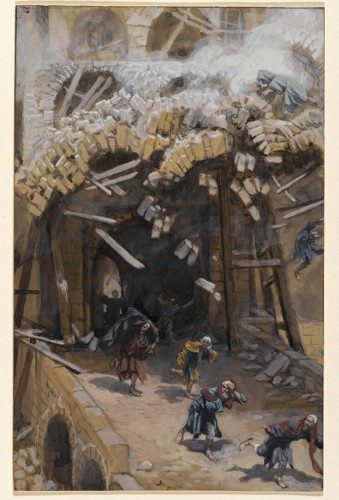
Jesus was teaching, as he always did, in the streets, teaching ordinary folks who had never seen the inside of a school to hope in a world they had not seen, a world not run by street bosses, price fixers, Herod with his huge building program, Caesar on a pedestal, the tyrants of this life. Then someone told him what Pilate had done. Pilate had killed people from Jesus’ home province, Galilee, who were at worship in the old Temple near the Tower of Siloam in Jerusalem, and in the disaster, their blood was mingled with the sacrifices on the altar.
The spinal shiver went through Jerusalem in a heartbeat. People knew the desecration was a warning. Strong, holy things had been violated: the altar in the high temple; the ritual practices held there; the sacred place reserved for priestly anointed hands; the animals, made holy by prayers, and making them holy in their offered lives; the murdered Galileans who had been standing at that altar. In a single stroke Pilate humiliated the nation and its culture, and the very presence of God.
Who’s the man?
Pilate, in this act of desecration,
says he is.
Jesus names the place: the Tower of Siloam. Eighteen men had been praying there, deliberately there, at the old temple built by King David in the old city, now somewhat removed from Romanized Jerusalem with its newly expanded temple, Herod’s work.* David’s temple, G.W. Buchanan suggests*, was built very near, perhaps only yards away from the circular Siloam Tower, which was its protection. The temple was next to the spring of Siloam. Buchanan notes the many biblical prophets who detail the stairs that went down to the spring from the temple, and the ruins of the footing of the Tower that have been found in our current century.
Pilate engineered the collapse of that Tower onto those worshipping Galileans, who were resistant to the new and improved temple. Or was it an act of God?
Who’s the man? I know that spinal shiver. Sikhs at their worship, near Milwaukee, WI. The Old Order Amish school children in their classroom in Lancaster County, PA. 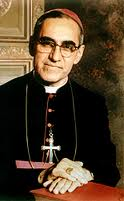 Archbishop Oscar Romero shot dead while saying mass at the chapel in La Divina Providencia Hospital in San Salvador.** Newtown. Aurora. Columbine. Rwanda. I cannot begin to name the desecrations that have happened in my own lifetime. In all these hours, the Joker has ruled. Lunacy looms larger than life itself. And where was God? Are these altars devoid of the powers they praise?
And then there are the natural disasters. Sandy. Katrina. The Japanese tsunami. Joplin, MO. The cataloguing does not end.
And the temptation to give up on God has pulled at my heart time after time. What is the point of the church, if the church insists only on serving itself? What is the value of the nation, if the flag is wrapped around corruption and torture? Where is the justice in a system that cannot set us free of these terrors? What is the point of our worship, if things do not change?
In Jerusalem then, and among us everywhere, the unending temptation is to disbelieve in the powers of truth, in justice or wisdom, or the hand of God at work or the love of God in this world.
Jesus knows this temptation is at work in us, and he presses for turning, turning, turning, away from the bleakness of despair. Turn, he urges, toward the warm altar of hope. No, life is not fair, but you can be fair. No, life is not beautiful, but you can be beautiful in your living. No, life is not faithful, but you can be faithful. The Man may be powerful in hate, but that does not make him God. And you can be powerful in love, which will step your feet into the kingdom of heaven, here and now.
Whether our lives and our deaths
were for peace and a new hope
or for nothing
we cannot say,
it is you who must say this.
We leave you our deaths.
Give them their meaning.
The words, from Archibald MacLeish’s poem, The Young Dead Soldiers, echo Jesus’ wisdom, as he urges them to choose the life of fruitful trees:
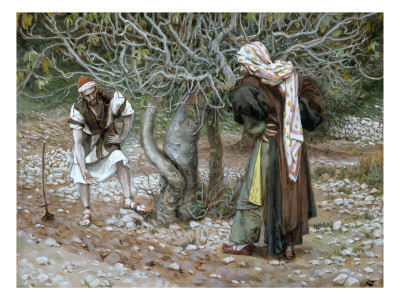 He turns the conversation to a tale about a fig tree, the icon of Israel. He is talking about them now, about their own lives. A man had a fig tree that bore no fruit. He complains to the gardener, Three years, and nothing! Cut it down! And the gardener pleads for the tree, saying, let me try one more year, I’ll dig around it and see if I can bring forth something.
God, too, feels this temptation, this despair. And argues about that feeling with the gardener, who is a mingled image, part God and also plenty of us, who work to sustain life in so many ways, mothers, farmers, fishermen, teachers and priests, those who always work to see things in more than one way. We are all the gardener. As is God, who not only creates but also works at sustaining life in this world. God is the gardener, and the tree, the fruit and the bare waiting branches, the one with empty hands and the one who owns it all. And God is always arguing for a little extra time, for our sakes.
And here we are, not cut down. We have a little more time. Fruitfulness is ours to choose, an act of faith, an act of beauty, a work of justice, extending time into another season. And this is our choice, not how it makes us feel, but the meaning we choose to give it. It requires a turning, of the soul/the soil.
_________________________________________
*from an article by George Wesley Buchanan, Wesley Theological Seminary, in The Expository Times, 2003, published by Associates for Scriptural Knowledge.
**a newly-made Canadian video about Archbishop Romero can be seen at www.themartyrsproject.com and has much to say about the fruitfulness that has come from that terrible event.
Illustrations:
1. The Tower of Siloam, by Tissot, James Jacques Joseph, 1836-1902, Brooklyn Art Museum. from Art in the Christian Tradition, Vanderbilt Divinity School Library.
2. Archbishop Oscar Romero, wikipedia.
3. The Barren Fig Tree. by Tissot, James Jacques Joseph, 1876, illustration for The Life of Christ.
Previous Post

February 17, 2013
That Fox
Browse Our Archives
Select a Category Bites Uncategorized
Select a Month December 2017 November 2017 October 2017 September 2017 August 2017 July 2017 June 2017 May 2017 April 2017 March 2017 February 2017 January 2017 December 2016 November 2016 October 2016 September 2016 August 2016 July 2016 June 2016 May 2016 April 2016 March 2016 February 2016 January 2016 December 2015 November 2015 October 2015 September 2015 August 2015 July 2015 June 2015 May 2015 April 2015 March 2015 February 2015 January 2015 December 2014 November 2014 October 2014 September 2014 August 2014 July 2014 June 2014 May 2014 April 2014 March 2014 February 2014 January 2014 December 2013 November 2013 October 2013 September 2013 August 2013 July 2013 June 2013 May 2013 April 2013 March 2013 February 2013 January 2013 December 2012
Follow Us!
TAKE THE
Religious Wisdom Quiz
Which Christian group is known for door-to-door evangelism and "Watchtower" magazine?
Select your answer to see how you score.
Mennonites Methodists Lutherans Jehovah's Witnesses
Related posts from The Bite in the Apple




TRENDING AT PATHEOS Progressive Christian

Why Christians Have a Sacred Duty to Vote:...
The Bible offers strong support for the sacred duty to vote. Here...

What Being a Modern-Day Apostle Means to Me
In my last column, I discussed the ins and outs of modern-day...

Did Ancient China Once Worship the God of...
Across human history, a common thread weaves through the origins of the...

Love Your Neighbor – Including Earth-Kin: Lev. 19,...
God’s command to love your neighbor means acting in an ethical and...

Lead a Church Study of “Jesus and Lao...
Guest writer Jack Thomas (The Irreverent Reverend) reflects on leading his church...

Principles for Understanding the Apostolic Ministry Today
Whenever people discover that my formal ministry title is "apostle," as in...
view all Progressive Christian blogs
Ad-Free & Subscriber Log-In Subscription Support
- About Us
- 2026 Calendar
- Videos
- Podcasts
- Library of World Religions
- Faith In Media Tracker
- Advertise With Us
- Write for Us
- Privacy Policy
- Terms of Service
- Do Not Sell My Data
- Contact Us
- Radiant Digital
- Manage Newsletter Subscriptions
- Unsubscribe From Notifications
- Sitemap
Copyright 2008-2026, Patheos. All rights reserved.
Subscription Support Ad-Free & Subscriber Log-In
Follow Patheos