
BuddhistCatholicContemplativeEvangelicalGeneral ChristianHinduJewishLatter-day SaintMuslimNew VisionsProgressive Christian
Beliefs
- Buddhist
- Catholic
- Contemplative
- Evangelical
- General Christian
- Hindu
- Jewish
- Latter-day Saint
- More Voices
- Muslim
- New Visions
- Pagan
- Progressive Christian
Topics
- Religion News
- Food and Religion
- Sports and Religion
- Religious Art
- Religious Music and Entertainment
- Religious Events
- History and Religion
- Style and Religion
- Politics and Religion
- Women in Religion
- Recreation Outdoors and Religion
- Business Finance and Religion
- Careers Workplace and Religion
- Education and Religion
- Family Parenting and Religion
- Health Fitness and Religion
- Home and Religion
- Relationships and Religion
- Technology and Religion
- Travel and Religion
Columnists
- Buddhist Columnists
- Business Finance and Religion Columnists
- Careers Workplace and Religion Columnists
- Catholic Columnists
- Contemplative Columnists
- Education and Religion Columnists
- Evangelists Columnists
- Family Parenting and Religion Columnists
- General Christian Columnists
- Health Fitness and Religion Columnists
- Hindu Columnists
- History and Religion Columnists
- Home and Religion Columnists
- Jewish Columnists
- More Voices Columnists
- Latter Day Columnists
- Muslim Columnists
- New Visions Columnists
- Nonreligious Columnists
- Pagan Columnists
- Politics and Religion Columnists
- Progressive Columnists
- Recreation Outdoors and Religion Columnists
- Relationships and Religion Columnists
- Religion News Columnists
- Religious Art Columnists
- Religious Events Columnists
- Religious Music and Entertainment Columnists
- Sports and Religion Columnists
- Style and Religion Columnists
- Technology and Religion Columnists
- Travel and Religion Columnists
- Women in Religion Columnists
Resource Library
- 2026 Calendar
- Library of World Religions
- The 100 Most Holy Places on Earth
- Patheos Answers
- Podcasts
- Videos
- Faith Leaders Database
- Anglican Episcopalian
- Bahai
- Baptist
- Buddhism
- Christianity
- Confucianism
- Eastern Orthodoxy
- Hinduism
- Holiness and Pentecostal
- ISKCON
- Islam
- Judaism
- Lutheran
- Methodist
- The Church of Jesus Christ of Latter-day Saints
- New Age
- Paganism
- Presbytarian and Reformed
- Protestantism
- Religion Behind the Scenes
- Roman Catholic
- Scientology
- Shia Islam
- Sikhism
- Sufism
- Sunni Islam
- Taoism
- Zen
- See all religions
Research Tools
 Ad-Free & Subscriber Log-In Subscription Support
Ad-Free & Subscriber Log-In Subscription Support
Follow Patheos 

- Trending:
- Forgiveness
- |
- Marriage
- |
- Consciousness
- |
- Death Penalty
- |
- Election
- |
- Halloween
 The Bite in the Apple
- Home
- Progressive Christian
- Sense Where None Seems Possible
Sense Where None Seems Possible
Last updated on: May 12, 2013 at 8:08 am by Nancy Rockwell
Sense Where None Seems Possible 2013-05-12T08:08:15-04:00 Nancy Rockwell
Patheos Explore the world's faith through different perspectives on religion and spirituality! Patheos has the views of the prevalent religions and spiritualities of the world.
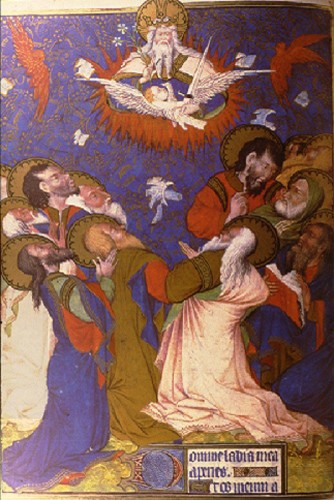 Religion and terror – inseparable in Jesus’ time, explosive in our own. Their combustible fusion led to his death and has been a lit fuse — in Ireland between Catholics and Protestants, in Jerusalem between Israelis and Palestinians, in the American south between white Christians and black Christians, in India between Hindus and Moslems, in the Balkans between Christians and Moslems, and in sporadic acts of violence in recent years in European and American cities.
In the sensationalism of hate, the response that has defused these situations has been works of nonviolence.
We make much of the joy of Pentecost, the Day of the Spirit, often treating it as a public gala, forgetting that the central gift was peace-filled understanding in a time of unspeakable public atrocities. Pentecost was a phenomenon that occurred between people separated by custom, culture, cult, and lack of common language. And we easily overlook the disapproval voiced by critics who were there, who scoffed at the sudden unity of spirit in the crowd and called them drunks, not filled with hope but high on the substances that dim the mind.
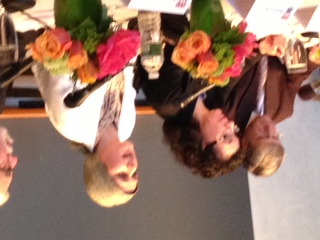 In a conversation born of deep faith and agonizing experiences, a man who lived through the troubles in Ireland, two Moslem women, one of whom had lived through the war in Bosnia, the other working now with Moslem communities in America, a rabbi, and a veteran of the Civil Rights struggles in the American south talked about ways in which people united by shared faith were able, in these terrifying situations, to act nonviolently and in doing that, to transform the fires of wrath into the fire of the Spirit, which burns without consuming, creating light in darkness rather than ash and rubble.
Jocelyne Cesari, a Harvard Divinity School lecturer on Islamic studies, said mosques in America are intolerant of radicalism, and participating in the community life of the mosque is a good way to prevent terrorism. Cesari continued, that those who have not been socialized in Islamic teaching or lifestyle, such as the accused bombers, “tend to be much more vulnerable to the radical speech online because they have no point of reference. In the West, we need more Islam in terms of religion,” said Cesari, “and much, much less the ideological positions on Islam.”
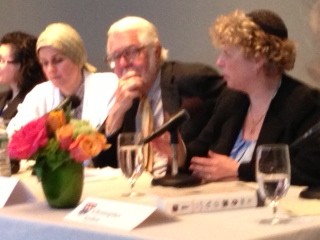 As someone who lived through the Bosnian war, Zilka Spahic Siljak, a visiting lecturer on women’s and Islamic studies, said she still finds it impossible to understand how such violence could have erupted in her homeland almost overnight between people who had been peaceful neighbors. The war was driven by politics and economics, but eventually religion became a way of pitting people against one another, she said. Yet in the war’s aftermath, religion became key to reconciliation. Interfaith dialogue with those who were ready to change “was very important for us in the Balkans.
HDS Dean David Hempton spent his college years surrounded by the sectarian violence in Northern Ireland’s capital, Belfast, where he said religion was only one contributing factor to the fighting. The multilayered conflict also involved competing nationalities, cultural traditions, access to economic opportunities, policing, and security forces. Watching the conflict unfold, Hempton said, he began to understand that violence radicalizes people, that there is danger in stereotyping, and that it is important to check one’s own moral choices and views constantly to try “to see events from the other side.”
Harvey Cox, a veteran of the American struggles for Civil Rights in the era of legal segregation, spoke of the importance of placing actions of faith in the context of violence: that prayer and peaceful presence in the midst of hate-filled objectors became the flame of the Spirit that triumphed in peace; that it is not religion apart, but religion practiced in the midst of hate that unmasks and disempowers false religion. Rabbi Finestone echoed his thought in her statement that God is best found in the deeds of kindness that are done in times of terribly evil deeds.
This unusual conversation happened last week, at Harvard Divinity School. When it ended, the world had not changed in a notable way, but each of us there carried away some new words and new concepts, and the power to connect them to other conversations. And this sowing of the Spirit, whose seeds will rise to become a new day, is in fact quite like the first Pentecost.
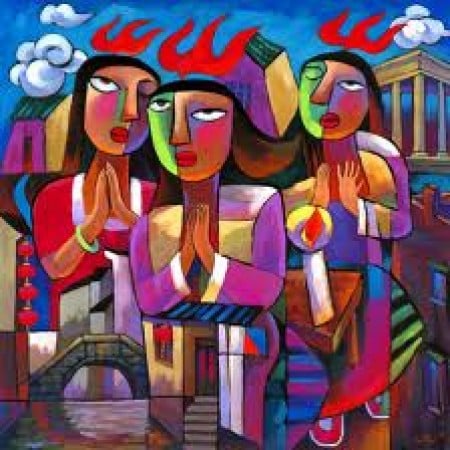 We were a few hundred folk, far smaller than the first Pentecost, but just as diverse, many from other nations, speaking a number of languages into cell phones or typing on Ipads, women wearing hijabs sitting near men who were pastors, some black, some white, some Hispanic, some in their 20s, a few in their 80s, and most in between.
Though there was wine after the talk, no one called us drunk, but the gruff chorus of Americans who trust only in military power would have called us foolish and this a waste of time.
The vital force of such conversations, seeking to find sense where none seems possible, has its own amazing historical trail: from Gandhi to Martin Luther King to Nelson Mandela, from William Lloyd Garrison and the abolitionists to Elizabeth Cady Stanton and the suffragettes, from Yad Vashem to Stonewall to environmentalists hugging the fence around the White House, from people running toward the bombs to help the victims to Amanda Barry being strengthened in her captivity by seeing rallies of people who remembered her though they had no idea into what abyss she had fallen: in all of these conversations, the power of the Spirit brings peace, joy, and understanding. It may take years, generations, to reach the goal of a new beginning. Still, in each conversation the hearts and minds of those who participate are buoyed for the endurance that lies ahead. The power of the Spirit, and the speech the Spirit gives, carry people toward freedom, in every age.
This is the promise of Pentecost: now we no longer depend solely on Jesus to be the one who understands. Now we, too, understand. And now we, too, can speak and our voices can spread the Spirit of understanding.
______________________________________________
Illustrations:
1. Pentecost, Rohan Master 1430 – 1435, Bibliotheque Nationale de France, Paris.
Vanderbilt Divinity School, Art in the Christian Tradition.
2. HDS Panel, Dean David Hempton, Jocelyne Cesari, Zilka Spahic-Siljak, Harvey Cox. photo taken by Nancy Rockwell.
3. HDS Panel, Zilka Spahic-Siljak, Harvey Cox, Rabbi Sally Finestone.
Photo by Nancy Rockwell
4. Pentecost, by He Qi, China. Google Image. vanderbilt Divinity school Library, Art in the Christian Tradition.
Quotations taken from the May 2013 HDS Current, an online publication.
Next Post

May 20, 2013 Trinity
Browse Our Archives
Select a Category Bites Uncategorized
Select a Month December 2017 November 2017 October 2017 September 2017 August 2017 July 2017 June 2017 May 2017 April 2017 March 2017 February 2017 January 2017 December 2016 November 2016 October 2016 September 2016 August 2016 July 2016 June 2016 May 2016 April 2016 March 2016 February 2016 January 2016 December 2015 November 2015 October 2015 September 2015 August 2015 July 2015 June 2015 May 2015 April 2015 March 2015 February 2015 January 2015 December 2014 November 2014 October 2014 September 2014 August 2014 July 2014 June 2014 May 2014 April 2014 March 2014 February 2014 January 2014 December 2013 November 2013 October 2013 September 2013 August 2013 July 2013 June 2013 May 2013 April 2013 March 2013 February 2013 January 2013 December 2012
Follow Us!
TAKE THE
Religious Wisdom Quiz
What does Paul offer to do if Onesimus owes Philemon anything?
Select your answer to see how you score.
Pray for resolution Forgive the debt Have the church pay it Pay it back himself
Related posts from The Bite in the Apple




TRENDING AT PATHEOS Progressive Christian

Why Christians Have a Sacred Duty to Vote:...
The Bible offers strong support for the sacred duty to vote. Here...

What Being a Modern-Day Apostle Means to Me
In my last column, I discussed the ins and outs of modern-day...

Did Ancient China Once Worship the God of...
Across human history, a common thread weaves through the origins of the...

Love Your Neighbor – Including Earth-Kin: Lev. 19,...
God’s command to love your neighbor means acting in an ethical and...

Lead a Church Study of “Jesus and Lao...
Guest writer Jack Thomas (The Irreverent Reverend) reflects on leading his church...

Principles for Understanding the Apostolic Ministry Today
Whenever people discover that my formal ministry title is "apostle," as in...
view all Progressive Christian blogs
Ad-Free & Subscriber Log-In Subscription Support
- About Us
- 2026 Calendar
- Videos
- Podcasts
- Library of World Religions
- Faith In Media Tracker
- Advertise With Us
- Write for Us
- Privacy Policy
- Terms of Service
- Do Not Sell My Data
- Contact Us
- Radiant Digital
- Manage Newsletter Subscriptions
- Unsubscribe From Notifications
- Sitemap
Copyright 2008-2026, Patheos. All rights reserved.
Subscription Support Ad-Free & Subscriber Log-In
Follow Patheos