
BuddhistCatholicContemplativeEvangelicalGeneral ChristianHinduJewishLatter-day SaintMuslimNew VisionsProgressive Christian
Beliefs
- Buddhist
- Catholic
- Contemplative
- Evangelical
- General Christian
- Hindu
- Jewish
- Latter-day Saint
- More Voices
- Muslim
- New Visions
- Pagan
- Progressive Christian
Topics
- Religion News
- Food and Religion
- Sports and Religion
- Religious Art
- Religious Music and Entertainment
- Religious Events
- History and Religion
- Style and Religion
- Politics and Religion
- Women in Religion
- Recreation Outdoors and Religion
- Business Finance and Religion
- Careers Workplace and Religion
- Education and Religion
- Family Parenting and Religion
- Health Fitness and Religion
- Home and Religion
- Relationships and Religion
- Technology and Religion
- Travel and Religion
Columnists
- Buddhist Columnists
- Business Finance and Religion Columnists
- Careers Workplace and Religion Columnists
- Catholic Columnists
- Contemplative Columnists
- Education and Religion Columnists
- Evangelists Columnists
- Family Parenting and Religion Columnists
- General Christian Columnists
- Health Fitness and Religion Columnists
- Hindu Columnists
- History and Religion Columnists
- Home and Religion Columnists
- Jewish Columnists
- More Voices Columnists
- Latter Day Columnists
- Muslim Columnists
- New Visions Columnists
- Nonreligious Columnists
- Pagan Columnists
- Politics and Religion Columnists
- Progressive Columnists
- Recreation Outdoors and Religion Columnists
- Relationships and Religion Columnists
- Religion News Columnists
- Religious Art Columnists
- Religious Events Columnists
- Religious Music and Entertainment Columnists
- Sports and Religion Columnists
- Style and Religion Columnists
- Technology and Religion Columnists
- Travel and Religion Columnists
- Women in Religion Columnists
Resource Library
- 2026 Calendar
- Library of World Religions
- The 100 Most Holy Places on Earth
- Patheos Answers
- Podcasts
- Videos
- Faith Leaders Database
- Anglican Episcopalian
- Bahai
- Baptist
- Buddhism
- Christianity
- Confucianism
- Eastern Orthodoxy
- Hinduism
- Holiness and Pentecostal
- ISKCON
- Islam
- Judaism
- Lutheran
- Methodist
- The Church of Jesus Christ of Latter-day Saints
- New Age
- Paganism
- Presbytarian and Reformed
- Protestantism
- Religion Behind the Scenes
- Roman Catholic
- Scientology
- Shia Islam
- Sikhism
- Sufism
- Sunni Islam
- Taoism
- Zen
- See all religions
Research Tools
 Ad-Free & Subscriber Log-In Subscription Support
Ad-Free & Subscriber Log-In Subscription Support
Follow Patheos 

- Trending:
- Forgiveness
- |
- Marriage
- |
- Consciousness
- |
- Death Penalty
- |
- Election
- |
- Halloween
 The Bite in the Apple
- Home
- Progressive Christian
- Seeing in this World
Seeing in this World
Last updated on: November 13, 2015 at 6:28 pm by Nancy Rockwell
Seeing in this World 2015-11-13T18:28:57-04:00 Nancy Rockwell
Patheos Explore the world's faith through different perspectives on religion and spirituality! Patheos has the views of the prevalent religions and spiritualities of the world.
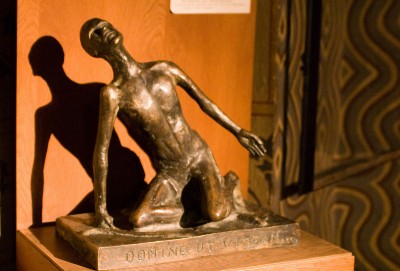 At the main gate into Jericho, where the crowds gathered in expectation of the great deeds of Jesus, the blind man Bartimaeus sat in his customary place, begging cup in hand.
He wasn’t born there. He’d been assigned to that spot by the powers that be, or perhaps by public concensus. In their eyes, that was where he belonged, a helpless young man who had to depend on charity.
Jesus changed all that – despite the protests of those who thought Bartimaeus didn’t deserve Jesus’ attention, those who thought there were far more deserving citizens around.
Jesus responded to Bartimaeus’ vision. Sightless Bartimaeus had the gifts ancients have long ascribed to the blind – insight, perceptiveness, and wisdom.
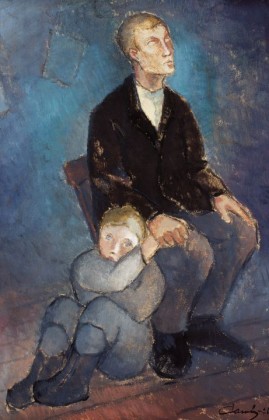 Jesus called these gifts Bartimaeus‘ faithfulness. We might also say Bartimaeus had political skilfulness. When Jesus asked him, ‘What is it that you want to see?’ Bartimaeus replied, ‘Your face.’ And it is a faithful response, for a man who had been living cross –legged in the street begging, who might have chosen a snarky reply: I want to see the bastards who’ve thrown in a stone and taken a shekel, the fellows who pelt me with insults. . . . But he didn’t.
For some months now, Christians have been facing this very scene on the borders of Europe, where hundreds of thousands of desperate Syrians, Turks, Africans, Iraqis, Afghanis and others, fleeing situations they are powerless to change and in which they are unable to earn a penny, are sitting at the gates, begging. Begging for food, shelter. Begging to come in. Begging to be allowed to find their relatives in northern Europe, or to find a place somewhere to begin again.
The arguments over aiding refugees are passionate and sometimes vicious. Moral and immoral. Those against aid argue for cultural preservation and religious homogeneity, and they warn of the danger of mixing races, faiths and customs. And there is fear of terrorists moving in. But it seems there is more fear of normal people arriving whose presence will change everything from the supplies the corner grocer carries to the price of rents and cars, normal people who will carry the seeds of change within them and begin the transformation of what is, into what may be.
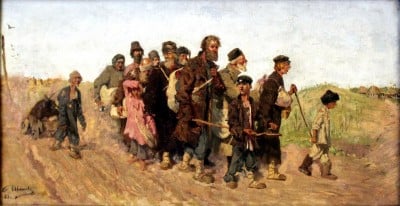 Americans, a bit removed at the moment but very afraid of terrorists, are arguing behind closed doors to limit the influx of Moslem refugees.
At the New Yorker Festival, in Jelani Cobb’s rich discussion about race in America now (The Fire This Time), Ta-Nehisi Coates at one point introduced the topic of population change in America, a change which is already well underway and does not require immigration to keep on happening – the change from a nation with a majority white Protestant citizens to a nation with a majority of non-white citizens, speaking a variety of languages with English as their secondary tongue at best, and becoming increasingly secular, with pockets of various orthodoxies among them. Whites will soon be a plurality, but never a majority in America again.
In other words, a legion of transformed Bartimaeuses are already here. They have already come through the US gate and changed from penniless, unskilled workers into a competent, hard-working immigrant workforce who remember what their achievement has cost them and also know how this nation depends on them.
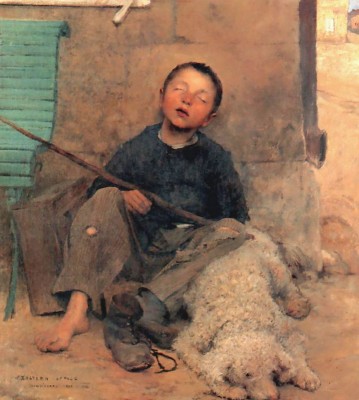 In a country whose railroads and cars, planes and computers, have been built by newly arrived immigrants for two hundred years, and whose agriculture has been planted for two hundred years before that by refugees from Europe and the British Isles – and by imported slaves – and whose crops are today harvested by migrant Latinos — in this America, the candidates for President, almost all of whom claim to ‘know Jesus’, are talking about building a border wall, to keep Bartimaeus out of the economy.
Ta-Nehisi Coates postulated that white America will either learn to function as a non-dominant voice in a swiftly changing culture, or withdraw into gated communities and cease to participate in public life and public conversation.
My sense is that the process of change will be rougher than these two choices make it seem. Competition will not be simply between whites and everyone else, but will continue to follow older American patterns, of whites accepting some groups, who are allowed to become ‘white’ in their acceptance, and excluding other groups, and by this managing to maintain a semblance of dominance, though with a shifting coalition of partners, for a very long time. The dominant donors to conservative candidates in this election are American Jews who have moved from being social pariahs to mainstream participation, and who no longer identify with other ethnic minorities, but rather with the moneyed class of the white world.
 This, it seems to me, is what the public conversation about the border wall is about. And within it, whites are not monolithic. Practically everyone eats Mexican food now, yet, tacos in hand, many will move against allowing Spanish to be spoken in public school rooms, and will vote for the border wall.
Still, the tide of change cannot be stopped. And the tide is global, not national, and is sweeping away the borders of ethnic nationalisms and political divisions, with an intention to make all things new.
Making all things new is a fundamental promise of God, in creation and in every time of desperation. It is a promise of Jesus in his kingdom teaching, and of the Holy Spirit in the gift of Pentecostal hospitality across barriers of language and culture.
It is this vision Bartimaeus saw in Jesus, and Jesus loved in him. This vision, which every refugee on rubber boats and walking along train tracks in Hungary, is clinging to. It is Godly sight, and it is the will of God that all of us recognize it in the needy of the world, who hold in their hearts and wills our mutual future, the tomorrow we cannot yet see.
__________________________________________________________
Illustrations:
1. Blind Bartimaeus. Freestanding metal sculpture, 1970, Matyas Church, Budapest, Hungary. Vanderbilt Divinity School Library, Art in the Christian Tradition.
2. Blind. Cawen, Alvar. 1926. Kadrioru Kunstimuuseum, Tallinn, Estonia. Vanderbilt Divinity School Library, Art in the Christian Tradition.
3. Procession of Blind Men. Ivanov, Sergey. 1883. Yekaterinburg Museum of Fine Arts, Yekaterinburg, Russia. Vanderbilt Divinity School Library, Art in the Christian Tradition.
4. The Blind Beggar. Jules Bastien Lepage, Musee de Beaux Arts, Tournai, France. Vanderbilt Divinity School Library, Art in the Christian Tradition.
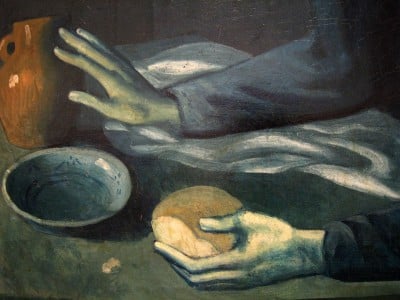
5. The Blind Man’s Meal, 1903, Pablo Picasso Museum of Art, New York City. Vanderbilt Divinity School Library, Art in the Christian Tradition.
Previous Post

October 11, 2015
The Fire This Time
Next Post

October 26, 2015 Open Source
Browse Our Archives
Select a Category Bites Uncategorized
Select a Month December 2017 November 2017 October 2017 September 2017 August 2017 July 2017 June 2017 May 2017 April 2017 March 2017 February 2017 January 2017 December 2016 November 2016 October 2016 September 2016 August 2016 July 2016 June 2016 May 2016 April 2016 March 2016 February 2016 January 2016 December 2015 November 2015 October 2015 September 2015 August 2015 July 2015 June 2015 May 2015 April 2015 March 2015 February 2015 January 2015 December 2014 November 2014 October 2014 September 2014 August 2014 July 2014 June 2014 May 2014 April 2014 March 2014 February 2014 January 2014 December 2013 November 2013 October 2013 September 2013 August 2013 July 2013 June 2013 May 2013 April 2013 March 2013 February 2013 January 2013 December 2012
Follow Us!
TAKE THE
Religious Wisdom Quiz
Who was the king that the angel of the Lord struck because he did not give God glory, but received the worship of the people, and who was eaten by worms?
Select your answer to see how you score.
Herod Haddam Saul Hezekiah
Related posts from The Bite in the Apple


Kim Davis and the Quest for Eternal Life
TRENDING AT PATHEOS Progressive Christian

Why Christians Have a Sacred Duty to Vote:...
The Bible offers strong support for the sacred duty to vote. Here...

What Being a Modern-Day Apostle Means to Me
In my last column, I discussed the ins and outs of modern-day...

Did Ancient China Once Worship the God of...
Across human history, a common thread weaves through the origins of the...

Love Your Neighbor – Including Earth-Kin: Lev. 19,...
God’s command to love your neighbor means acting in an ethical and...

Lead a Church Study of “Jesus and Lao...
Guest writer Jack Thomas (The Irreverent Reverend) reflects on leading his church...

Principles for Understanding the Apostolic Ministry Today
Whenever people discover that my formal ministry title is "apostle," as in...
view all Progressive Christian blogs
Ad-Free & Subscriber Log-In Subscription Support
- About Us
- 2026 Calendar
- Videos
- Podcasts
- Library of World Religions
- Faith In Media Tracker
- Advertise With Us
- Write for Us
- Privacy Policy
- Terms of Service
- Do Not Sell My Data
- Contact Us
- Radiant Digital
- Manage Newsletter Subscriptions
- Unsubscribe From Notifications
- Sitemap
Copyright 2008-2026, Patheos. All rights reserved.
Subscription Support Ad-Free & Subscriber Log-In
Follow Patheos