
BuddhistCatholicContemplativeEvangelicalGeneral ChristianHinduJewishLatter-day SaintMuslimNew VisionsProgressive Christian
Beliefs
- Buddhist
- Catholic
- Contemplative
- Evangelical
- General Christian
- Hindu
- Jewish
- Latter-day Saint
- More Voices
- Muslim
- New Visions
- Pagan
- Progressive Christian
Topics
- Religion News
- Food and Religion
- Sports and Religion
- Religious Art
- Religious Music and Entertainment
- Religious Events
- History and Religion
- Style and Religion
- Politics and Religion
- Women in Religion
- Recreation Outdoors and Religion
- Business Finance and Religion
- Careers Workplace and Religion
- Education and Religion
- Family Parenting and Religion
- Health Fitness and Religion
- Home and Religion
- Relationships and Religion
- Technology and Religion
- Travel and Religion
Columnists
- Buddhist Columnists
- Business Finance and Religion Columnists
- Careers Workplace and Religion Columnists
- Catholic Columnists
- Contemplative Columnists
- Education and Religion Columnists
- Evangelists Columnists
- Family Parenting and Religion Columnists
- General Christian Columnists
- Health Fitness and Religion Columnists
- Hindu Columnists
- History and Religion Columnists
- Home and Religion Columnists
- Jewish Columnists
- More Voices Columnists
- Latter Day Columnists
- Muslim Columnists
- New Visions Columnists
- Nonreligious Columnists
- Pagan Columnists
- Politics and Religion Columnists
- Progressive Columnists
- Recreation Outdoors and Religion Columnists
- Relationships and Religion Columnists
- Religion News Columnists
- Religious Art Columnists
- Religious Events Columnists
- Religious Music and Entertainment Columnists
- Sports and Religion Columnists
- Style and Religion Columnists
- Technology and Religion Columnists
- Travel and Religion Columnists
- Women in Religion Columnists
Resource Library
- 2026 Calendar
- Library of World Religions
- The 100 Most Holy Places on Earth
- Patheos Answers
- Podcasts
- Videos
- Faith Leaders Database
- Anglican Episcopalian
- Bahai
- Baptist
- Buddhism
- Christianity
- Confucianism
- Eastern Orthodoxy
- Hinduism
- Holiness and Pentecostal
- ISKCON
- Islam
- Judaism
- Lutheran
- Methodist
- The Church of Jesus Christ of Latter-day Saints
- New Age
- Paganism
- Presbytarian and Reformed
- Protestantism
- Religion Behind the Scenes
- Roman Catholic
- Scientology
- Shia Islam
- Sikhism
- Sufism
- Sunni Islam
- Taoism
- Zen
- See all religions
Research Tools
 Ad-Free & Subscriber Log-In Subscription Support
Ad-Free & Subscriber Log-In Subscription Support
Follow Patheos 

- Trending:
- Forgiveness
- |
- Marriage
- |
- Consciousness
- |
- Death Penalty
- |
- Election
- |
- Halloween
 The Bite in the Apple
- Home
- Progressive Christian
- Pure Hearts
Pure Hearts
Last updated on: June 22, 2014 at 4:36 pm by Nancy Rockwell
Pure Hearts 2014-06-22T16:36:38-04:00 Nancy Rockwell
Patheos Explore the world's faith through different perspectives on religion and spirituality! Patheos has the views of the prevalent religions and spiritualities of the world.
 ‘Purity of heart is to will one thing,’ wrote the melancholy Danish theologian, Soren Kierkegaard. And his wisdom is importantly different from that other idea of purity: sin-free; unsullied; guiltless; perfect.
Perhaps we are able, at times, to will only one thing. But it seems to be impossible for most of us to maintain a single-minded focus for even one year, let alone all our years.
Jesus, according to Matthew, insists on this kind of pure will, this heart that puts him above all others and all else. Matthew’s gospel is insistent to the point of harshness at times, and this passage from Chapter 10 is one of those times, softened only by the inclusion of welcoming – a welcome for God, for justice and its preachers, and for the little ones – as part of pure will.
 I struggle with all this, though. What mother or father would ever say they loved God more than their child? And despite Jesus’ chastisement of Peter, who wanted to go home to take care of his elderly father, my heart still aches that I could not leave my obligations to others, to the church, to take care of my elderly parents uninterruptedly at the end of their lives. In so many ways I moved away from their minds, their opinions, their habits, their daily routines, the education of their generation. But did they diminish in their place in my heart? Not so.
Jesus’ teaching, hard as it is, does underscore what troubles me in so much church teaching: that the Church uses Jesus to affirm the primacy of family, and of nuclear families at that, as the most important thing about being human – when Jesus made no mention of family life at all, ever – and, in this and other teachable moments (when he slipped away from his parents in Jerusalem; and when he spurned his mother and brothers who sought to take him home, and called his listeners his family; and when he argued with the Pharisees that heaven wasn’t about marriage relations), Jesus makes it clear that family life and family love are not his model of kingdom life.
I can make arguments for and against single-minded purposefulness. Without it, there would be no insulin for diabetics (go read that noble story of the researcher who was driven by love of a diabetic child, to work himself to the bone till he found out how to save her), no polio vaccine, no Requiem by Mozart, no Symphony by Beethoven written as his hearing failed. I could go on.
 But single-mindedness can be a terrible thing, too. The beautiful Indie film, The Railway Man, (with Colin Firth and Nicole Kidman) tells the true story of a Scottish WW2 veteran, Eric Lomax, whose soul is haunted by memories of the years he and his friends spent as Japanese captives, being tortured and humiliated in every way, and used as slaves to build a railroad in Burma. He is unable to control vivid nightmares from which there is no waking, and in which he relives, re-suffers, is spiritually devastated. Love, which came to him all unexpected, begins the journey that sets him free, by dividing his heart and his mind, so that he now wills life for himself and life with her. In this first step away from single-mindedness, Lomax finds the courage to confront his enemy, and in the second step, when his mind – and heart – open to the complex humanity of his dreaded enemy, and he no longer has a single-minded focus on him, he finds the courage to forgive.
He does know, and at last comes to use, the wisdom of the cup of cold water he can give to his enemy, who is the least of little ones. In this, he finds a way out of hell.
 Another film reflects on this theme, as well: The Fault in Our Stars, a film about adolescents with cancer, whose experience of cruel fate, and of bodily suffering, overwhelms their lives. A support group, held in a church around a hooked rug with the heart of Jesus, plus his face, on it, makes plain the foolishness of the words used by churches to address their suffering. And also the way in which impending death relentlessly focuses their minds. And yet that support group becomes the place where they find one another, and where love begins to kindle between them. In its extraordinary richness, its wondrous offering of the shared cup of understanding and commitment to each other’s pain, love transforms their young lives, and even their deaths.
This week the Congressional Medal of Honor was given to William ‘Kyle’ Carpenter, who, at age 21, threw himself on a grenade in Iraq in order to save the life of his comrade in arms. He suffered dreadful wounds, losing an eye, his jaw, and mangling his arms badly. And spent 2 ½ years in hospital, and more time still at home, recovering. His single-minded No to death, in an action taken in split-second timing, was among the bravest our nation has known. His action did not involve the killing of anyone, but did involve the laying down of his own life, which is taking up the cross, and which required him to put all the others he loved aside, for the moment. He said he thought he was going  to die, and how hard that would be for his parents.
It’s given him a lot to think about. As it did the cancer-stricken teens, and the WW2 vet. As did Jesus, who, according to Matthew, understood himself to be walking on dangerous ground.
The reward Kyle Carpenter, and Eric Lomax, and the dying teens discovered and treasured was that people they loved, loved them back, and shared their suffering in so many ways.
Life, wrote Kierkegaard, can only be understood backwards. But it must be lived forwards. And that’s where the heart finds its pure hour, and its holy day.
_____________________________________________________
Illustrations:
1. Soren Kierkegaard, unfinished sketch by his cousin, Niels Christian Kierkegaard, c. 1840, Wikipedia page image.
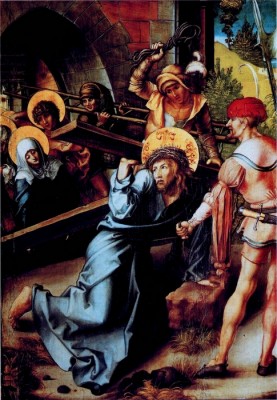
2. Christ Carrying the Cross, Albrecht Durer, 1494***,*** Gemaldegalerie, Dresden, Germany. Vanderbilt Divinity School Library, Art in the Christian Tradition.
3. The real Eric Lomax and Takashi Nagase, in Thailand, 1993. Unidentifiable image.
4. The Fault in Our Stars, film poster, Google Images.
5. The Fault in Our Stars, freeze frame of support group with rug of Jesus’ heart.
Previous Post

June 15, 2014
Many Sparrows
Next Post
June 29, 2014 Rest for Your Souls
Browse Our Archives
Select a Category Bites Uncategorized
Select a Month December 2017 November 2017 October 2017 September 2017 August 2017 July 2017 June 2017 May 2017 April 2017 March 2017 February 2017 January 2017 December 2016 November 2016 October 2016 September 2016 August 2016 July 2016 June 2016 May 2016 April 2016 March 2016 February 2016 January 2016 December 2015 November 2015 October 2015 September 2015 August 2015 July 2015 June 2015 May 2015 April 2015 March 2015 February 2015 January 2015 December 2014 November 2014 October 2014 September 2014 August 2014 July 2014 June 2014 May 2014 April 2014 March 2014 February 2014 January 2014 December 2013 November 2013 October 2013 September 2013 August 2013 July 2013 June 2013 May 2013 April 2013 March 2013 February 2013 January 2013 December 2012
Follow Us!
TAKE THE
Religious Wisdom Quiz
Who became David's closest friend, even though he was Saul's son?
Select your answer to see how you score.
Shimei Abner Jonathan Ish-bosheth
Related posts from The Bite in the Apple




TRENDING AT PATHEOS Progressive Christian

Why Christians Have a Sacred Duty to Vote:...
The Bible offers strong support for the sacred duty to vote. Here...

What Being a Modern-Day Apostle Means to Me
In my last column, I discussed the ins and outs of modern-day...

Did Ancient China Once Worship the God of...
Across human history, a common thread weaves through the origins of the...

Love Your Neighbor – Including Earth-Kin: Lev. 19,...
God’s command to love your neighbor means acting in an ethical and...

Lead a Church Study of “Jesus and Lao...
Guest writer Jack Thomas (The Irreverent Reverend) reflects on leading his church...

Principles for Understanding the Apostolic Ministry Today
Whenever people discover that my formal ministry title is "apostle," as in...
view all Progressive Christian blogs
Ad-Free & Subscriber Log-In Subscription Support
- About Us
- 2026 Calendar
- Videos
- Podcasts
- Library of World Religions
- Faith In Media Tracker
- Advertise With Us
- Write for Us
- Privacy Policy
- Terms of Service
- Do Not Sell My Data
- Contact Us
- Radiant Digital
- Manage Newsletter Subscriptions
- Unsubscribe From Notifications
- Sitemap
Copyright 2008-2026, Patheos. All rights reserved.
Subscription Support Ad-Free & Subscriber Log-In
Follow Patheos