
BuddhistCatholicContemplativeEvangelicalGeneral ChristianHinduJewishLatter-day SaintMuslimNew VisionsProgressive Christian
Beliefs
- Buddhist
- Catholic
- Contemplative
- Evangelical
- General Christian
- Hindu
- Jewish
- Latter-day Saint
- More Voices
- Muslim
- New Visions
- Pagan
- Progressive Christian
Topics
- Religion News
- Food and Religion
- Sports and Religion
- Religious Art
- Religious Music and Entertainment
- Religious Events
- History and Religion
- Style and Religion
- Politics and Religion
- Women in Religion
- Recreation Outdoors and Religion
- Business Finance and Religion
- Careers Workplace and Religion
- Education and Religion
- Family Parenting and Religion
- Health Fitness and Religion
- Home and Religion
- Relationships and Religion
- Technology and Religion
- Travel and Religion
Columnists
- Buddhist Columnists
- Business Finance and Religion Columnists
- Careers Workplace and Religion Columnists
- Catholic Columnists
- Contemplative Columnists
- Education and Religion Columnists
- Evangelists Columnists
- Family Parenting and Religion Columnists
- General Christian Columnists
- Health Fitness and Religion Columnists
- Hindu Columnists
- History and Religion Columnists
- Home and Religion Columnists
- Jewish Columnists
- More Voices Columnists
- Latter Day Columnists
- Muslim Columnists
- New Visions Columnists
- Nonreligious Columnists
- Pagan Columnists
- Politics and Religion Columnists
- Progressive Columnists
- Recreation Outdoors and Religion Columnists
- Relationships and Religion Columnists
- Religion News Columnists
- Religious Art Columnists
- Religious Events Columnists
- Religious Music and Entertainment Columnists
- Sports and Religion Columnists
- Style and Religion Columnists
- Technology and Religion Columnists
- Travel and Religion Columnists
- Women in Religion Columnists
Resource Library
- 2026 Calendar
- Library of World Religions
- The 100 Most Holy Places on Earth
- Patheos Answers
- Podcasts
- Videos
- Faith Leaders Database
- Anglican Episcopalian
- Bahai
- Baptist
- Buddhism
- Christianity
- Confucianism
- Eastern Orthodoxy
- Hinduism
- Holiness and Pentecostal
- ISKCON
- Islam
- Judaism
- Lutheran
- Methodist
- The Church of Jesus Christ of Latter-day Saints
- New Age
- Paganism
- Presbytarian and Reformed
- Protestantism
- Religion Behind the Scenes
- Roman Catholic
- Scientology
- Shia Islam
- Sikhism
- Sufism
- Sunni Islam
- Taoism
- Zen
- See all religions
Research Tools
 Ad-Free & Subscriber Log-In Subscription Support
Ad-Free & Subscriber Log-In Subscription Support
Follow Patheos 

- Trending:
- Forgiveness
- |
- Marriage
- |
- Consciousness
- |
- Death Penalty
- |
- Election
- |
- Halloween
 The Bite in the Apple
- Home
- Progressive Christian
- It’s Pentecost – and Something Is Not Right
It’s Pentecost – and Something Is Not Right
Last updated on: May 28, 2017 at 2:10 pm by Nancy Rockwell
It’s Pentecost – and Something Is Not Right 2017-05-28T14:10:48-04:00 Nancy Rockwell
Patheos Explore the world's faith through different perspectives on religion and spirituality! Patheos has the views of the prevalent religions and spiritualities of the world.
 There’s a disconnect between Jesus’ invocations of the Spirit in John’s gospel, and the way we’ve always understood them. And the disconnect has taken on a neon glare in the world right now.
And the thing is, the world right now is very much like the world Jesus walked around in, the first century world where fumbling the political football was causing a lot of unrest, and yes, even terrorist acts. The first century world, where the expected replacement for Emperor Tiberius in Rome was unexpectedly charged with treason and executed, and throughout the imperial world a new wave of conservatism took hold.
So the unrest, the anxiety, the factionalism, the maneuvering, the leaks, the betrayals, even among the disciples, were occurring at an alarming rate. As they are now.
But we don’t think about all this when we read the Spirit passages in John’s gospel. We think, or at least I do, of the Pentecost stories in Luke and Acts: Ascension comes, Jesus departs. Pentecost comes, the Spirit descends on the crowd in Jerusalem, and in a spectacular act, the power of understanding spreads out across nationalities and classes, men and women, old and young. The Church begins to conquer the world.
And, at least if you’re Protestant, fifteen hundred years of history pass uneventfully and you fast forward to the Reformation, when important conflicts return.
Only, that’s now what happened, of course. And even more important, that is not what was happening at Pentecost.
In the tense, strained petitions of Jesus, imploring God to send the Spirit to bring unity, and assuring God, over and over (which seems to belie the truth of these words) that his followers are one, that they all understand his teachings, that they are ready for the spirit that will make them all one, the conflict that is happening in the Roman Empire and that is argued over by his disciples as much as by the everyone else, is there.
Conventional theology takes these assurances literally. That the disciples were of one mind. That to follow Jesus is to be of one mind.
This literalism has led us to creeds, catechisms, discourses on heresy, promises of conformity of thought at baptisms, communion and weddings. This literalism leads to the imposition of rigid rules of conduct and causes Christians to punish those to whom Jesus unfailingly showed mercy*.*
The thing is, we know that Jesus’ followers did not understand him, much of the time. He expressed exasperation with Peter, even to the point of calling him Satan, because Peter would end up drawing the wrong conclusions, often.
The thing is, we know that Jesus’ followers, even in John’s gospel, don’t get it. Thomas, known as doubting, cried out after Easter that they certainly did not know the way to the kingdom of heaven, despite all Jesus’ teachings.
The thing is, Pentecost took place in a world of divided opinions and endless arguments. Just like the world we are in. But with this difference: the disciples did share an attitude of goodwill, even for what they did not understand, and even for the times they lived in, and feared.
And here we are, then, muddling through times we cannot fathom, with leaders whom we do not trust, leaders who disappoint, and fears that do not abate. Into this, comes our celebration of the Spirit.
Ruth Marcus, a Washington Post columnist, quotes Defense Secretary James Mattis, in Dexter Filkins profile of Mattis in the New Yorker, when he was asked what worries him most about his new role:
Mattis: “The lack of a fundamental friendliness. It seems like an awful lot of people in America and around the world feel spiritually and personally alienated, whether it be from organized religion or from local community school districts or from their governments.”
Something is not right, Ruth Marcus says, and she uses this for the title of her op ed piece. If anything, Mattis’s diagnosis seems understated. This national distemper, the sour, angry mood infecting the body politic, was evident before Montana congressional candidate Greg Gianforte body-slammed a reporter (from the British magazine, The Guardian) for daring to ask a question (he did not want to answer).
Not only is Gianforte’s abusive behavior not right, the muted, muffled, non-condemning response from Congressional Republicans is as shockingly not right as Gianforte’s attack.
Democracy is, in fact, an endless argument, and an often raucous one. Does it seem loud this year? FDR, who was president in the heyday of newspapers, when most cities had several and there were morning and evening editions, was pilloried in many, called names glib enough to have come from Donald Trump, and cartooned for his cigarette holder, his dog, his teeth, his clothes, though, touchingly, not for his crutches.
Something is not right when the President is not forthcoming and the nation has to rely on leaks for information. Something is not right when we aren’t sure whether the leaks come from concerned citizens who love their country or are deliberately planted disinformation by, say, a Russian double-agent.
Many issue calls for impeachment, and many others believe the whole investigation process is baseless and politically motivated.
Some compare Trump’s administration to Nixon’s. But the differences are many: we are a different nation now than we were then. There were no terrorist bombings, and immigration was not an issue.
No one really liked Nixon, so when he resigned, there was no fuss about it. He never made a comeback of any sort, and had no popular base.
His Vice President had resigned a year or so before, for personal corruption. So Nixon was replaced in office by the Speaker of the House, Gerald Ford, who had been ‘appointed Vice President four months before Nixon resigned, when the hand-writing was on the wall. Ford was a man with whom the country was familiar, a man everyone liked, even if they disagreed with his politics.
Trump, though, has a fan base of 35 to 40% of the population. And his fan base includes alt-right folks who are anti-government and armed. Were he to be expelled from the Presidency, they would not likely accept it quietly. Nor would Trump, who would likely keep holding rallies and keep venting his anger openly.
It is into this disarray, this anguish of spirits, this argument of chicanery and corruption, this reliance upon whispers for finding out truth, that Pentecost comes. “Out of the hearts of believers will come rivers of living water,” Jesus promises. And he invokes his peace upon them.
His Peace. It will not bring the babble of opinions to a halt. It will never, not even for one day or one moment, produce unity of thought. And, as with the disciples in the Upper Room, we will each have our own experience of his presence, of what it means, of what confuses us about it, of how our fears are being addressed.
But we will be able, if we breathe deeply, to recognize in one another the Goodwill of Christ’s Peace.
And that will make it possible, as the stories in Luke and Acts tell, for us to understand each other, despite the difference in the way we see this world, the differences in our expectations of the future, and even the differences in our hopes.
Because we recognize that the God to whom we turn loves us all, and comprehends the truth that each of us holds dear. Because we can, in the power of the Spirit, offer one another our Goodwill.
____________________________________________________________________________________
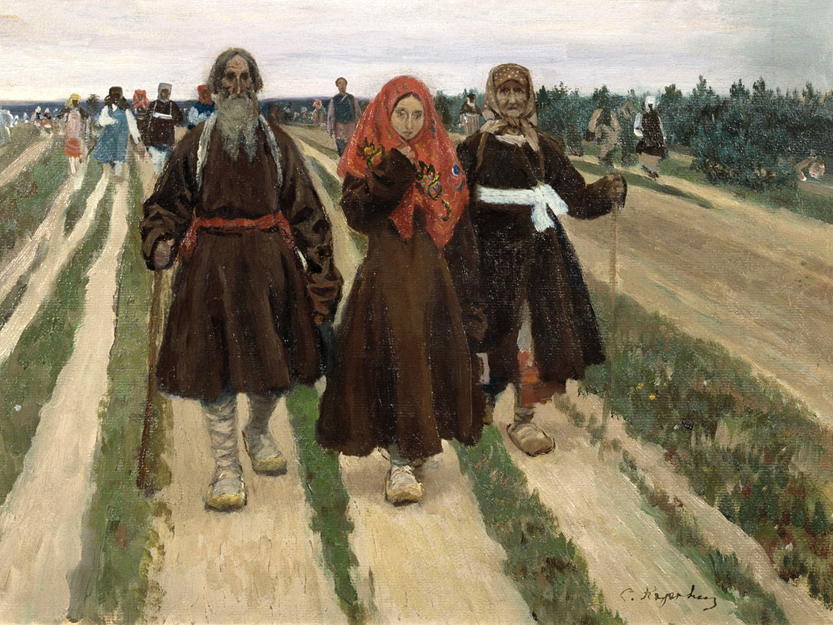
Image: To the Pentecost, 1902 painting by Sergei Alekseevich Korovin, Tretiakov Gallery, Moscow, Russia. Vanderbilt Divinity School Library, Art in the Christian Tradition.
Previous Post

May 20, 2017
Trump in Saudi Arabia - What Could Possibly Go Wrong?
Next Post

June 5, 2017 Trinity, God’s Embracing Globalism
Browse Our Archives
Select a Category Bites Uncategorized
Select a Month December 2017 November 2017 October 2017 September 2017 August 2017 July 2017 June 2017 May 2017 April 2017 March 2017 February 2017 January 2017 December 2016 November 2016 October 2016 September 2016 August 2016 July 2016 June 2016 May 2016 April 2016 March 2016 February 2016 January 2016 December 2015 November 2015 October 2015 September 2015 August 2015 July 2015 June 2015 May 2015 April 2015 March 2015 February 2015 January 2015 December 2014 November 2014 October 2014 September 2014 August 2014 July 2014 June 2014 May 2014 April 2014 March 2014 February 2014 January 2014 December 2013 November 2013 October 2013 September 2013 August 2013 July 2013 June 2013 May 2013 April 2013 March 2013 February 2013 January 2013 December 2012
Follow Us!
TAKE THE
Religious Wisdom Quiz
Who said, "For unto us a child is born, unto us a son is given"?
Select your answer to see how you score.
Isaiah Micah Zechariah David
Related posts from The Bite in the Apple



TRENDING AT PATHEOS Progressive Christian

What Being a Modern-Day Apostle Means to Me
In my last column, I discussed the ins and outs of modern-day...

Did Ancient China Once Worship the God of...
Across human history, a common thread weaves through the origins of the...

Love Your Neighbor – Including Earth-Kin: Lev. 19,...
God’s command to love your neighbor means acting in an ethical and...

Lead a Church Study of “Jesus and Lao...
Guest writer Jack Thomas (The Irreverent Reverend) reflects on leading his church...

Pastoral Wisdom for Responding to Sermon Pushback
Getting sermon pushback on your social justice sermon? Learn practical, Proverbs-based strategies...

Principles for Understanding the Apostolic Ministry Today
Whenever people discover that my formal ministry title is "apostle," as in...
view all Progressive Christian blogs
Ad-Free & Subscriber Log-In Subscription Support
- About Us
- 2026 Calendar
- Videos
- Podcasts
- Library of World Religions
- Faith In Media Tracker
- Advertise With Us
- Write for Us
- Privacy Policy
- Terms of Service
- Do Not Sell My Data
- Contact Us
- Radiant Digital
- Manage Newsletter Subscriptions
- Unsubscribe From Notifications
- Sitemap
Copyright 2008-2026, Patheos. All rights reserved.
Subscription Support Ad-Free & Subscriber Log-In
Follow Patheos