
BuddhistCatholicContemplativeEvangelicalGeneral ChristianHinduJewishLatter-day SaintMuslimNew VisionsProgressive Christian
Beliefs
- Buddhist
- Catholic
- Contemplative
- Evangelical
- General Christian
- Hindu
- Jewish
- Latter-day Saint
- More Voices
- Muslim
- New Visions
- Pagan
- Progressive Christian
Topics
- Religion News
- Food and Religion
- Sports and Religion
- Religious Art
- Religious Music and Entertainment
- Religious Events
- History and Religion
- Style and Religion
- Politics and Religion
- Women in Religion
- Recreation Outdoors and Religion
- Business Finance and Religion
- Careers Workplace and Religion
- Education and Religion
- Family Parenting and Religion
- Health Fitness and Religion
- Home and Religion
- Relationships and Religion
- Technology and Religion
- Travel and Religion
Columnists
- Buddhist Columnists
- Business Finance and Religion Columnists
- Careers Workplace and Religion Columnists
- Catholic Columnists
- Contemplative Columnists
- Education and Religion Columnists
- Evangelists Columnists
- Family Parenting and Religion Columnists
- General Christian Columnists
- Health Fitness and Religion Columnists
- Hindu Columnists
- History and Religion Columnists
- Home and Religion Columnists
- Jewish Columnists
- More Voices Columnists
- Latter Day Columnists
- Muslim Columnists
- New Visions Columnists
- Nonreligious Columnists
- Pagan Columnists
- Politics and Religion Columnists
- Progressive Columnists
- Recreation Outdoors and Religion Columnists
- Relationships and Religion Columnists
- Religion News Columnists
- Religious Art Columnists
- Religious Events Columnists
- Religious Music and Entertainment Columnists
- Sports and Religion Columnists
- Style and Religion Columnists
- Technology and Religion Columnists
- Travel and Religion Columnists
- Women in Religion Columnists
Resource Library
- 2026 Calendar
- Library of World Religions
- The 100 Most Holy Places on Earth
- Patheos Answers
- Podcasts
- Videos
- Faith Leaders Database
- Anglican Episcopalian
- Bahai
- Baptist
- Buddhism
- Christianity
- Confucianism
- Eastern Orthodoxy
- Hinduism
- Holiness and Pentecostal
- ISKCON
- Islam
- Judaism
- Lutheran
- Methodist
- The Church of Jesus Christ of Latter-day Saints
- New Age
- Paganism
- Presbytarian and Reformed
- Protestantism
- Religion Behind the Scenes
- Roman Catholic
- Scientology
- Shia Islam
- Sikhism
- Sufism
- Sunni Islam
- Taoism
- Zen
- See all religions
Research Tools
 Ad-Free & Subscriber Log-In Subscription Support
Ad-Free & Subscriber Log-In Subscription Support
Follow Patheos 

- Trending:
- Forgiveness
- |
- Marriage
- |
- Consciousness
- |
- Death Penalty
- |
- Election
- |
- Halloween
 The Bite in the Apple
- Home
- Progressive Christian
- On the Emmaus Road
On the Emmaus Road
Last updated on: April 26, 2014 at 9:35 pm by Nancy Rockwell
On the Emmaus Road 2014-04-26T21:35:12-04:00 Nancy Rockwell
Patheos Explore the world's faith through different perspectives on religion and spirituality! Patheos has the views of the prevalent religions and spiritualities of the world.
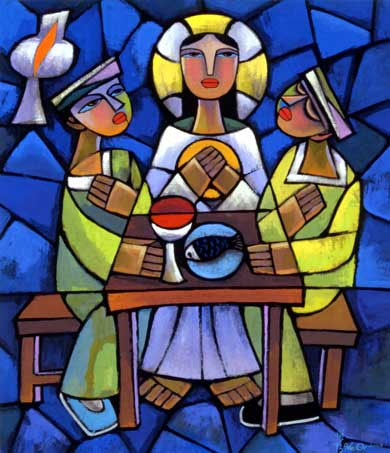
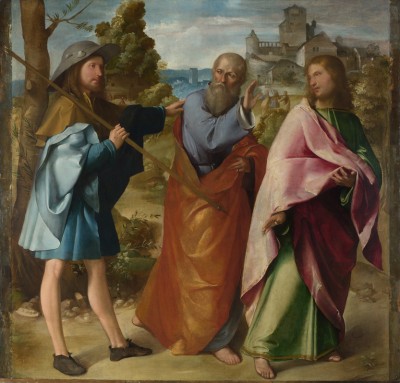 The Easter stranger appeared to three broken-hearted disciples who were getting out of Dodge. Jesus was dead. Everything in them was defiled by what they had seen, heard, done, left undone. For three days in the Upper Room they’d been holed up with the others, unable to agree what to do next. All their words, monotonous with defeat, were stale on their tongues. Even their grief was stagnant now. On Easter, these three went for a walk. They left town, on the Emmaus Road.
The stranger, who insisted on walking with them, was upbeat. Good Lord, was he totally unaware what had happened? He asked, and they told him. It took hours, because he kept arguing with them about what it all meant.
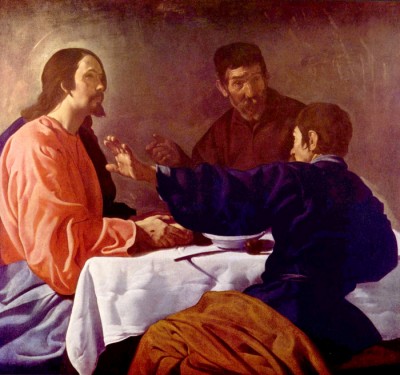 Despite that, they liked him. At the end of the day, when they found he was stopping at the same Inn, they asked him to dine with them. Then, in a wordless gesture, breaking bread, they saw in him – Jesus – alive – God with them still.
Suddenly nothing could keep them from running back to Jerusalem, to the others, to the Upper Room, which had become a green pasture again. No longer stale, the air in it was fragrant with Easter.
The Emmaus Road had been their Ark. It bore them over the wild tides of their own emotions, through the storm of days about which they argued, revealing the rainbow love of God at the day’s end. And then it delivered them safely back to Jerusalem, now the place where life for them could begin anew. Jesus, the helmsman of their journey, kept them on course in the sea of conversation.
Life ever since, for Christians, has been an Emmaus Road, a scary journey, extraordinary, arduous, full of argument and strangers, a conversation that reveals, transforms, prepares, and goes way beyond words.
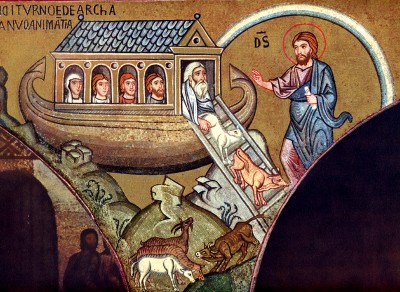 The Ark should be a model for our understanding of church. But in the new movie, Noah, it is anything but that. The movie tells an unbiblical story in which the entire argument is inside the helmsman, Noah, who makes everyone else miserable in God’s name, while the animals, who should be part of this strange conversational voyage, are drugged in stupor.
The biblical tale says Noah and his sons and their wives and families were on board. No unmarried son whose sweetie is rejected by Noah is mentioned. And there is no stowaway heathen psychopath. And no mention of drugged animals. Part of the wonder of the biblical tale is how those forty days went, how they all got along, who said what to whom. Forty days is what the Bible says it took.
 Part of the horror of the movie is that the journey is more than nine months, long enough for a pregnancy and delivery of twins, the only children on the Ark. But the real horror of the film is that Noah believes God wants to destroy humankind.
The biblical Noah, like Jesus on to road to Emmaus, is intent on cherishing the lives and souls of those he accompanies, intent on delivering them safely, in body and in spirit, to the green pastures of new life. The biblical Noah is upset about social corruption, and he does make his views known, but he is not out to destroy the world.
The movie hauls up the ideology of the old eugenics movement, champions of racial purity and physical ideals which gave us Hitler and the Ku Klux Klan. The movie claims Noah and his sons are the last remaining children of Seth, the ‘pure’ son of Adam and Eve, and that all other humans are children of Cain, who murdered Abel. The movie Noah intends to destroy his own grandchildren because his son’s wife is of impure blood.
For Christians, this is morally intolerable thinking, obscene thinking. The Bible does not identify Noah as of purer blood than anyone else, and in fact tells us he had brothers and sisters, nieces and nephews who didn’t come along. The rest of the people in his community thought he was nuts to build this boat, and disbelieved a flood was coming. Noah did not forbid them to enter the Ark. They stayed away from the old fool.
 In the Bible, Helmsman Noah preserves the world, so that it will not perish, but have everlasting life. Jesus, Helmsman on the Emmaus Road, did this too, in a corrupt time.
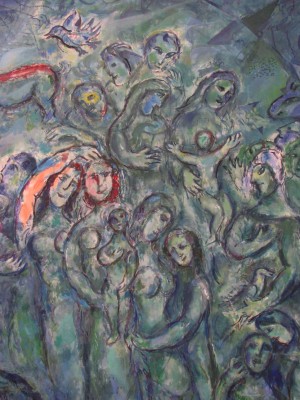
The Jewish Scriptures say Noah brought trees and seeds as well as animals on the Ark. French Jewish painter Marc Chagall painted a large community of people on the Ark, Noah’s family being numerous in his view.
It is the community of strangers journeying together that makes the Ark a home, a cradle, and a deliverance. And this is true of the Emmaus Road as well. On this road, strangers find one another, cradle one another’s pain, share stories and what they may mean, deliver one another by finding the presence of God together. And so they do in the Ark, finding the rainbow of God. In the Bible, the Ark is a ship of hope, a community of the awakened.
On the Emmaus Road the disciples were brought back to life. Their hearts, drugged with the poison of despair, were wakened by the Stranger who accompanied them. We hope for as much, and that the journey will take us, at last, to the rainbow.
__________________________________________________
Illustrations:
1. On the Emmaus Road, by Melone, Altobello, 1483 – 1565, National Gallery, London. Vanderbilt Divinity School Library, Art in the Christian Tradition.
2. The Inn at Emmaus, by Diego Velasquez, 1618, Metropolitan Museum of Art, New York. Vanderbilt Divinity School Library, Art in the Christian Tradition.
3. God Orders Noah to Leave the Ark. Capella Palatina di Palermo, Italy. Vanderbilt Divinity Library, Art in the Christian Tradition.
4. Noah’s Ark, by Marc Chagall, 1893 – 1985. Musee du Message Biblique, Nice, France. Vanderbilt Divinity School Library, Art in the Christian Tradition.
5. Supper at Emmaus. He Qi, China. 2001. Vanderbilt Divinity School Library, Art in the Christian Tradition.
Previous Post

April 19, 2014
Doubting Easter
Next Post
May 4, 2014 The Good Shepherd
Browse Our Archives
Select a Category Bites Uncategorized
Select a Month December 2017 November 2017 October 2017 September 2017 August 2017 July 2017 June 2017 May 2017 April 2017 March 2017 February 2017 January 2017 December 2016 November 2016 October 2016 September 2016 August 2016 July 2016 June 2016 May 2016 April 2016 March 2016 February 2016 January 2016 December 2015 November 2015 October 2015 September 2015 August 2015 July 2015 June 2015 May 2015 April 2015 March 2015 February 2015 January 2015 December 2014 November 2014 October 2014 September 2014 August 2014 July 2014 June 2014 May 2014 April 2014 March 2014 February 2014 January 2014 December 2013 November 2013 October 2013 September 2013 August 2013 July 2013 June 2013 May 2013 April 2013 March 2013 February 2013 January 2013 December 2012
Follow Us!
TAKE THE
Religious Wisdom Quiz
Who was Abraham's brother?
Select your answer to see how you score.
Isaac Lot Nahor Jacob
Related posts from The Bite in the Apple




TRENDING AT PATHEOS Progressive Christian

Why Christians Have a Sacred Duty to Vote:...
The Bible offers strong support for the sacred duty to vote. Here...

What Being a Modern-Day Apostle Means to Me
In my last column, I discussed the ins and outs of modern-day...

Did Ancient China Once Worship the God of...
Across human history, a common thread weaves through the origins of the...

Love Your Neighbor – Including Earth-Kin: Lev. 19,...
God’s command to love your neighbor means acting in an ethical and...

Lead a Church Study of “Jesus and Lao...
Guest writer Jack Thomas (The Irreverent Reverend) reflects on leading his church...

Principles for Understanding the Apostolic Ministry Today
Whenever people discover that my formal ministry title is "apostle," as in...
view all Progressive Christian blogs
Ad-Free & Subscriber Log-In Subscription Support
- About Us
- 2026 Calendar
- Videos
- Podcasts
- Library of World Religions
- Faith In Media Tracker
- Advertise With Us
- Write for Us
- Privacy Policy
- Terms of Service
- Do Not Sell My Data
- Contact Us
- Radiant Digital
- Manage Newsletter Subscriptions
- Unsubscribe From Notifications
- Sitemap
Copyright 2008-2026, Patheos. All rights reserved.
Subscription Support Ad-Free & Subscriber Log-In
Follow Patheos