
BuddhistCatholicContemplativeEvangelicalGeneral ChristianHinduJewishLatter-day SaintMuslimNew VisionsProgressive Christian
Beliefs
- Buddhist
- Catholic
- Contemplative
- Evangelical
- General Christian
- Hindu
- Jewish
- Latter-day Saint
- More Voices
- Muslim
- New Visions
- Pagan
- Progressive Christian
Topics
- Religion News
- Food and Religion
- Sports and Religion
- Religious Art
- Religious Music and Entertainment
- Religious Events
- History and Religion
- Style and Religion
- Politics and Religion
- Women in Religion
- Recreation Outdoors and Religion
- Business Finance and Religion
- Careers Workplace and Religion
- Education and Religion
- Family Parenting and Religion
- Health Fitness and Religion
- Home and Religion
- Relationships and Religion
- Technology and Religion
- Travel and Religion
Columnists
- Buddhist Columnists
- Business Finance and Religion Columnists
- Careers Workplace and Religion Columnists
- Catholic Columnists
- Contemplative Columnists
- Education and Religion Columnists
- Evangelists Columnists
- Family Parenting and Religion Columnists
- General Christian Columnists
- Health Fitness and Religion Columnists
- Hindu Columnists
- History and Religion Columnists
- Home and Religion Columnists
- Jewish Columnists
- More Voices Columnists
- Latter Day Columnists
- Muslim Columnists
- New Visions Columnists
- Nonreligious Columnists
- Pagan Columnists
- Politics and Religion Columnists
- Progressive Columnists
- Recreation Outdoors and Religion Columnists
- Relationships and Religion Columnists
- Religion News Columnists
- Religious Art Columnists
- Religious Events Columnists
- Religious Music and Entertainment Columnists
- Sports and Religion Columnists
- Style and Religion Columnists
- Technology and Religion Columnists
- Travel and Religion Columnists
- Women in Religion Columnists
Resource Library
- 2026 Calendar
- Library of World Religions
- The 100 Most Holy Places on Earth
- Patheos Answers
- Podcasts
- Videos
- Faith Leaders Database
- Anglican Episcopalian
- Bahai
- Baptist
- Buddhism
- Christianity
- Confucianism
- Eastern Orthodoxy
- Hinduism
- Holiness and Pentecostal
- ISKCON
- Islam
- Judaism
- Lutheran
- Methodist
- The Church of Jesus Christ of Latter-day Saints
- New Age
- Paganism
- Presbytarian and Reformed
- Protestantism
- Religion Behind the Scenes
- Roman Catholic
- Scientology
- Shia Islam
- Sikhism
- Sufism
- Sunni Islam
- Taoism
- Zen
- See all religions
Research Tools
 Ad-Free & Subscriber Log-In Subscription Support
Ad-Free & Subscriber Log-In Subscription Support
Follow Patheos 

- Trending:
- Forgiveness
- |
- Marriage
- |
- Consciousness
- |
- Death Penalty
- |
- Election
- |
- Halloween
 The Bite in the Apple
- Home
- Progressive Christian
- Morgan Freeman – Who Is God?
Morgan Freeman – Who Is God?
Last updated on: April 14, 2016 at 10:13 am by Nancy Rockwell
Morgan Freeman – Who Is God? 2016-04-14T10:13:20-04:00 Nancy Rockwell
Patheos Explore the world's faith through different perspectives on religion and spirituality! Patheos has the views of the prevalent religions and spiritualities of the world.
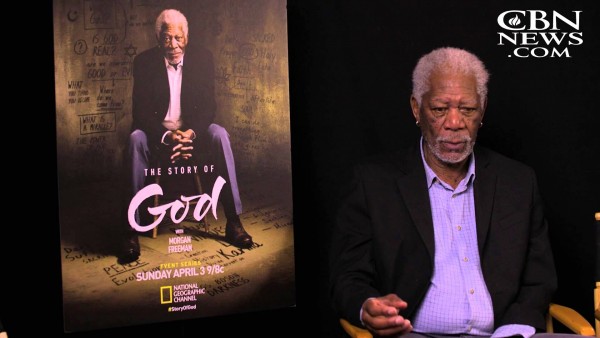 Like the rocking of the ocean, like the thrumming of peepers in spring evenings, the question Who Is God? is a bass note rhythm in the midst of life, a note that becomes insistent in times when our need to know is great.
Christian theology answers by calling God the tremendous and fascinating mystery, echoing biblical assertions that God is beyond our knowing. When pressed by Moses for a name, God answers, I am Who I am Becoming (Exodus 3:14).
But the list of actual names given to God in the Bible is huge. Just a few are: Rock, Judge, Father, King, Counselor, Creator, Redeemer, Fortress, Wellspring, Everlasting, Watcher, Presence, Peace, Shepherd.
Morgan Freeman begins his journey into the question in India, where there are perhaps three hundred million names for God, and images and stories to go with them.
Some of the images are human, some animal, some combine both, like the tremendously popular Ganesh, a boy with an elephant head. Male and female, with blue, pink, gold and green flesh as well as brown and white, all these deities are manifestations of the one true God Brahma, who is always hidden.
The manifestations, according to Freeman’s guide, help people to feel more intimate with God, help them bring prayers from their hearts that address their immediate needs. Freeman gasps in amazement at temples tucked into market streets, wall shrines on public paths, images in railway stations.
Saints meet similar needs for many Christians, and in Catholic and Orthodox cultures images can be everywhere displayed, but the emotional range is not as broad as in Hinduism, which includes whimsy and gaiety in its divinities, some of whom like to be honored with parties.
Freeman asks, where did the idea of One God begin? And scholarship takes him to Stonehenge, where thousands of years ago, before the pyramids of Egypt and long before Abraham, people without machines raised huge stones in a pattern that honored the sun on its longest and shortest days and in its rising and setting.
One God, they had come to believe, is pure energy, and is the source of life. The ancients, in cold wintry climates, knew they and their animals depended on the sun for food.
The 18th Egyptian Pharoah, Akhenaten (1300 BCE) also believed in one god, Horus, the Sun God. He closed down all other temples, but polytheism returned after his death.
The idea of one god took hold in Judaism, with the story of Abraham, who left a culture of polytheism and went into the wilderness to live with One God. The idea spread, and now half the world practices religions that are centered in Abraham as their ancestor, and in Jerusalem, where a number of sites are tied to his life.
Freeman’s Jewish guide says polytheism offers a god for anything you want, anything you need. The price will differ, from parties to blood sacrifices, but whatever you want is available. I think his distinction is biased, for polytheistic people suffer as many losses and disappointments in their lives as montheists do. But it is true that the one God of Judaism survives sweeping changes in the world, and wants us to survive obstacles and perils in our lives. We will not always get what we want. I think all people know that.
Jerusalem holds holy sites: the Dome of the Rock, where Abraham almost killed Isaac and learned, from God, there was never again to be sacrificing of children. The Mount of Olives and Gethsemane, the Western Wall, each a testimony to love and sacrifice, to evil and survival. These are shrines, but they are not representations of God, whose offers us law, order, and power, also holy teachers, but no image.
So how do we connect to a god without a body? Freeman explores this question in Islam, the least imagistic faith that follows Abraham’s way.
In Islam, the Muezzin’s call to prayer, offered in public five times a day, is considered a manifestation of God. It arises from a vision a friend of Mohammed’s had while he slept, and has been in practice ever since. Islam centers in prayer, which is where the faithful meet God. Islam sees God in all things beautiful, but knows God is always more, and is best known in prayer.
Freeman moves to a Navajo reservation, where a young girl is undergoing a rite of becoming a woman, through a ceremony that joins Changing Woman, the god who infuses the entire landscape, to her, infusing her with holiness and fertility. And then Freeman is off to Chicago, where a neuroscientist studies the brains of people at prayer, and finds physical manifestations in them, while they pray.
In us. All monotheistic religions connect to God internally. Freeman turns to Joel Osteen, a Christian whose TV audience numbers in the hundreds of millions, and who offers personal, approachable, hopeful connections to God, in music, words, and prayer.
There’s a bit of God in all of us, Freeman opines at the end. And my heart turns to an ancient Celtic prayer from the Scottish highlands:
Thou art the joy of all joyous things,
Thou art the light of the beam of the sun,
Thou art the first door of hospitality,
Thou art the surpassing star of guidance,
Thou art the step of the deer on the hill,
Thou art the grace of the swan swimming,
Thou art the loveliness of all lovely desires.
__________________________________________________________________________________________
Image: Morgan Freeman, youtube image with poster for The Story of God.
Prayer: from The Carmina Gadelica, edited by Alexander Carmichael.
Previous Post

April 9, 2016
What Do You Think the Messiah Should Be Doing?
Next Post

April 17, 2016 Earth Day - The Last Supper?
Browse Our Archives
Select a Category Bites Uncategorized
Select a Month December 2017 November 2017 October 2017 September 2017 August 2017 July 2017 June 2017 May 2017 April 2017 March 2017 February 2017 January 2017 December 2016 November 2016 October 2016 September 2016 August 2016 July 2016 June 2016 May 2016 April 2016 March 2016 February 2016 January 2016 December 2015 November 2015 October 2015 September 2015 August 2015 July 2015 June 2015 May 2015 April 2015 March 2015 February 2015 January 2015 December 2014 November 2014 October 2014 September 2014 August 2014 July 2014 June 2014 May 2014 April 2014 March 2014 February 2014 January 2014 December 2013 November 2013 October 2013 September 2013 August 2013 July 2013 June 2013 May 2013 April 2013 March 2013 February 2013 January 2013 December 2012
Follow Us!
TAKE THE
Religious Wisdom Quiz
Who was healed by touching the hem of Jesus’ garment?
Select your answer to see how you score.
A blind man A leper A woman with an issue of blood A centurion
Related posts from The Bite in the Apple



TRENDING AT PATHEOS Progressive Christian

Why Christians Have a Sacred Duty to Vote:...
The Bible offers strong support for the sacred duty to vote. Here...

What Being a Modern-Day Apostle Means to Me
In my last column, I discussed the ins and outs of modern-day...

Did Ancient China Once Worship the God of...
Across human history, a common thread weaves through the origins of the...

Love Your Neighbor – Including Earth-Kin: Lev. 19,...
God’s command to love your neighbor means acting in an ethical and...

Lead a Church Study of “Jesus and Lao...
Guest writer Jack Thomas (The Irreverent Reverend) reflects on leading his church...

Principles for Understanding the Apostolic Ministry Today
Whenever people discover that my formal ministry title is "apostle," as in...
view all Progressive Christian blogs
Ad-Free & Subscriber Log-In Subscription Support
- About Us
- 2026 Calendar
- Videos
- Podcasts
- Library of World Religions
- Faith In Media Tracker
- Advertise With Us
- Write for Us
- Privacy Policy
- Terms of Service
- Do Not Sell My Data
- Contact Us
- Radiant Digital
- Manage Newsletter Subscriptions
- Unsubscribe From Notifications
- Sitemap
Copyright 2008-2026, Patheos. All rights reserved.
Subscription Support Ad-Free & Subscriber Log-In
Follow Patheos