
BuddhistCatholicContemplativeEvangelicalGeneral ChristianHinduJewishLatter-day SaintMuslimNew VisionsProgressive Christian
Beliefs
- Buddhist
- Catholic
- Contemplative
- Evangelical
- General Christian
- Hindu
- Jewish
- Latter-day Saint
- More Voices
- Muslim
- New Visions
- Pagan
- Progressive Christian
Topics
- Religion News
- Food and Religion
- Sports and Religion
- Religious Art
- Religious Music and Entertainment
- Religious Events
- History and Religion
- Style and Religion
- Politics and Religion
- Women in Religion
- Recreation Outdoors and Religion
- Business Finance and Religion
- Careers Workplace and Religion
- Education and Religion
- Family Parenting and Religion
- Health Fitness and Religion
- Home and Religion
- Relationships and Religion
- Technology and Religion
- Travel and Religion
Columnists
- Buddhist Columnists
- Business Finance and Religion Columnists
- Careers Workplace and Religion Columnists
- Catholic Columnists
- Contemplative Columnists
- Education and Religion Columnists
- Evangelists Columnists
- Family Parenting and Religion Columnists
- General Christian Columnists
- Health Fitness and Religion Columnists
- Hindu Columnists
- History and Religion Columnists
- Home and Religion Columnists
- Jewish Columnists
- More Voices Columnists
- Latter Day Columnists
- Muslim Columnists
- New Visions Columnists
- Nonreligious Columnists
- Pagan Columnists
- Politics and Religion Columnists
- Progressive Columnists
- Recreation Outdoors and Religion Columnists
- Relationships and Religion Columnists
- Religion News Columnists
- Religious Art Columnists
- Religious Events Columnists
- Religious Music and Entertainment Columnists
- Sports and Religion Columnists
- Style and Religion Columnists
- Technology and Religion Columnists
- Travel and Religion Columnists
- Women in Religion Columnists
Resource Library
- 2026 Calendar
- Library of World Religions
- The 100 Most Holy Places on Earth
- Patheos Answers
- Podcasts
- Videos
- Faith Leaders Database
- Anglican Episcopalian
- Bahai
- Baptist
- Buddhism
- Christianity
- Confucianism
- Eastern Orthodoxy
- Hinduism
- Holiness and Pentecostal
- ISKCON
- Islam
- Judaism
- Lutheran
- Methodist
- The Church of Jesus Christ of Latter-day Saints
- New Age
- Paganism
- Presbytarian and Reformed
- Protestantism
- Religion Behind the Scenes
- Roman Catholic
- Scientology
- Shia Islam
- Sikhism
- Sufism
- Sunni Islam
- Taoism
- Zen
- See all religions
Research Tools
 Ad-Free & Subscriber Log-In Subscription Support
Ad-Free & Subscriber Log-In Subscription Support
Follow Patheos 

- Trending:
- Forgiveness
- |
- Marriage
- |
- Consciousness
- |
- Death Penalty
- |
- Election
- |
- Halloween
 The Bite in the Apple
- Home
- Progressive Christian
- Morgan Freeman on Apocalypse
Morgan Freeman on Apocalypse
Last updated on: April 6, 2016 at 1:36 pm by Nancy Rockwell
Morgan Freeman on Apocalypse 2016-04-06T13:36:01-04:00 Nancy Rockwell
Patheos Explore the world's faith through different perspectives on religion and spirituality! Patheos has the views of the prevalent religions and spiritualities of the world.
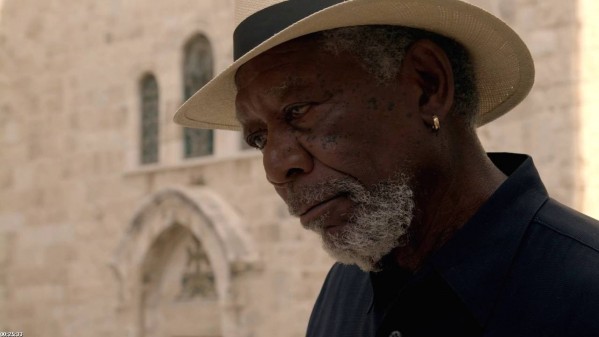
The second hour of Freeman’s Story of God opens with him sitting at his breakfast table, reading the newspaper and glancing at TV news.
He narrates his own scene, the common American morning. We gird ourselves to walk out into a world where alarming things are happening.
In this, he demonstrates our fixation on the possibility of annihilation. We may think of Apocalyptic ideas as the stuff of crazy religious zealots, but the news is about this possibility, the world around.
Is it all in our minds, Freeman asks? Or is it real.
Freeman then explores the roots of Judgment Day in Christianity, and also in Judaism and Islam.
It all begins in Jerusalem, the epicenter of the monotheistic world. The ancient Temple, built in 37 BC by Herod the Great, was seven stories high. In 70 AD, the Romans demolished it, systematically pulling it down, leaving only the western wall, which remains the holiest place in Jerusalem and a pilgrimage site for Jews all over the world.
The Jewish Messiah is tied to these ruins. He will do three things: rebuild the temple; rule justly; and build peace with all neighbors.
Legends proliferated of the great battle the Messiah will win, a war between the sons of light and the sons of darkness. The enemy takes on many forms and names: the Beast; the number 666.
In Rome, at the Biblioteca Casanotensi, Freeman shows us fragments of the manuscript of the Book of Revelation, in which this battle is described. The librarian walks us through deciphering the numerical values of Greek letters, and we learn that Nero is the likely suspect for the Beast, that the Greek letters of Caesar Neron have a numerical value of 666. And so does the word Beast.
I remember learning years ago how Nero enjoyed cruelty. One of his penchants was using Christians as torches to light his garden parties – a burning martyr on a stake in each corner of his lawn, and a gala in the midst of it all. Of course Nero would be the dreaded Beast of Revelation, and who wouldn’t long for an Apocalyptic battle to overthrow him.
The idea of apocalypse faded in Christianity, but then spread into Islam. Now we, America, are their Beast. Freeman interviews a well-spoken Moslem, formerly a fighter against the west, then imprisoned, where he learned from Imams to think more deeply. Now he, a Moslem, works to free other young men from ISIS.
I was struck by his observation: When you are poor and powerless, and have no future to shape for yourself, it is very tempting to feel you could shape the destiny of the world.
Freeman interviews an American professor, Stuart Shenkman, who studies fear in the human brain. He thinks apocalyptic ideas may be hard-wired into us, and shows experiments in which human reactions to unpredicted pain are worse than to predicted pain, Predicting pain can quell our fear response. Shenkman thinks Doomsday Cults may function in this way.
Freeman’s next journey, to Tikal, the land of the Mayas, explores the Mayan idea of time, which sparked a fear of the end of the world in December, 2012, supposedly based on a Mayan calendar. Archeologists show us stone carvings on their calendar, proof they did not believe in an end of time, but in endless cycles of time, and each end (one was in 2012) brings a new beginning.
In Judaism, Christianity and Islam, the end of days is when God intervenes and rights all wrongs, establishing justice and peace. But most of the world – Buddhists, Hindus – does not think this way. Like the Mayas, most of the world believes that every ending is a new beginning.
Christians, too, believe in new beginnings emerging from dark, end times, and Freeman demonstrates this in New Orleans, where survivors of Hurricane Katrina point to the hope that was born from that darkness.
This brilliant and fascinating hour ends with Freeman reminding us that the word Apocalypse, a Greek word, means ‘lifting the veil’. It is not about death. It is about enlightenment.
I’m still working at understanding darkness, and especially, endings. There is so much pain in loss, especially when cultures, cities, dreams, die. The Mayans are gone, though their calendar did not predict it. Time may be endless, but we are mortal, and we all live through cataclysmic times. As Jesus did. What then?- remains a question, more important to us than When?
I was deeply moved by this hour. Freeman moved into our present time, into what terrifies us, and deeply into our human past, in ways that made this discussion eye-opening. I’m ready to watch this again. And, ready to move on in the Story.
______________________________________________________________________________________
Image: Morgan Freeman in Jerusalem making the program, The Story of God, National Geographic Channel
Previous Post

April 4, 2016
Morgan Freeman’s Story of God
Next Post

April 9, 2016 What Do You Think the Messiah Should Be Doing?
Browse Our Archives
Select a Category Bites Uncategorized
Select a Month December 2017 November 2017 October 2017 September 2017 August 2017 July 2017 June 2017 May 2017 April 2017 March 2017 February 2017 January 2017 December 2016 November 2016 October 2016 September 2016 August 2016 July 2016 June 2016 May 2016 April 2016 March 2016 February 2016 January 2016 December 2015 November 2015 October 2015 September 2015 August 2015 July 2015 June 2015 May 2015 April 2015 March 2015 February 2015 January 2015 December 2014 November 2014 October 2014 September 2014 August 2014 July 2014 June 2014 May 2014 April 2014 March 2014 February 2014 January 2014 December 2013 November 2013 October 2013 September 2013 August 2013 July 2013 June 2013 May 2013 April 2013 March 2013 February 2013 January 2013 December 2012
Follow Us!
TAKE THE
Religious Wisdom Quiz
I gleaned in fields behind reapers and caught the eye of a wealthy landowner. Who am I?
Select your answer to see how you score.
Hannah Orpah Naomi Ruth
Related posts from The Bite in the Apple



TRENDING AT PATHEOS Progressive Christian

Why Christians Have a Sacred Duty to Vote:...
The Bible offers strong support for the sacred duty to vote. Here...

What Being a Modern-Day Apostle Means to Me
In my last column, I discussed the ins and outs of modern-day...

Did Ancient China Once Worship the God of...
Across human history, a common thread weaves through the origins of the...

Love Your Neighbor – Including Earth-Kin: Lev. 19,...
God’s command to love your neighbor means acting in an ethical and...

Lead a Church Study of “Jesus and Lao...
Guest writer Jack Thomas (The Irreverent Reverend) reflects on leading his church...

Principles for Understanding the Apostolic Ministry Today
Whenever people discover that my formal ministry title is "apostle," as in...
view all Progressive Christian blogs
Ad-Free & Subscriber Log-In Subscription Support
- About Us
- 2026 Calendar
- Videos
- Podcasts
- Library of World Religions
- Faith In Media Tracker
- Advertise With Us
- Write for Us
- Privacy Policy
- Terms of Service
- Do Not Sell My Data
- Contact Us
- Radiant Digital
- Manage Newsletter Subscriptions
- Unsubscribe From Notifications
- Sitemap
Copyright 2008-2026, Patheos. All rights reserved.
Subscription Support Ad-Free & Subscriber Log-In
Follow Patheos