
BuddhistCatholicContemplativeEvangelicalGeneral ChristianHinduJewishLatter-day SaintMuslimNew VisionsProgressive Christian
Beliefs
- Buddhist
- Catholic
- Contemplative
- Evangelical
- General Christian
- Hindu
- Jewish
- Latter-day Saint
- More Voices
- Muslim
- New Visions
- Pagan
- Progressive Christian
Topics
- Religion News
- Food and Religion
- Sports and Religion
- Religious Art
- Religious Music and Entertainment
- Religious Events
- History and Religion
- Style and Religion
- Politics and Religion
- Women in Religion
- Recreation Outdoors and Religion
- Business Finance and Religion
- Careers Workplace and Religion
- Education and Religion
- Family Parenting and Religion
- Health Fitness and Religion
- Home and Religion
- Relationships and Religion
- Technology and Religion
- Travel and Religion
Columnists
- Buddhist Columnists
- Business Finance and Religion Columnists
- Careers Workplace and Religion Columnists
- Catholic Columnists
- Contemplative Columnists
- Education and Religion Columnists
- Evangelists Columnists
- Family Parenting and Religion Columnists
- General Christian Columnists
- Health Fitness and Religion Columnists
- Hindu Columnists
- History and Religion Columnists
- Home and Religion Columnists
- Jewish Columnists
- More Voices Columnists
- Latter Day Columnists
- Muslim Columnists
- New Visions Columnists
- Nonreligious Columnists
- Pagan Columnists
- Politics and Religion Columnists
- Progressive Columnists
- Recreation Outdoors and Religion Columnists
- Relationships and Religion Columnists
- Religion News Columnists
- Religious Art Columnists
- Religious Events Columnists
- Religious Music and Entertainment Columnists
- Sports and Religion Columnists
- Style and Religion Columnists
- Technology and Religion Columnists
- Travel and Religion Columnists
- Women in Religion Columnists
Resource Library
- 2026 Calendar
- Library of World Religions
- The 100 Most Holy Places on Earth
- Patheos Answers
- Podcasts
- Videos
- Faith Leaders Database
- Anglican Episcopalian
- Bahai
- Baptist
- Buddhism
- Christianity
- Confucianism
- Eastern Orthodoxy
- Hinduism
- Holiness and Pentecostal
- ISKCON
- Islam
- Judaism
- Lutheran
- Methodist
- The Church of Jesus Christ of Latter-day Saints
- New Age
- Paganism
- Presbytarian and Reformed
- Protestantism
- Religion Behind the Scenes
- Roman Catholic
- Scientology
- Shia Islam
- Sikhism
- Sufism
- Sunni Islam
- Taoism
- Zen
- See all religions
Research Tools
 Ad-Free & Subscriber Log-In Subscription Support
Ad-Free & Subscriber Log-In Subscription Support
Follow Patheos 

- Trending:
- Forgiveness
- |
- Marriage
- |
- Consciousness
- |
- Death Penalty
- |
- Election
- |
- Halloween
 The Bite in the Apple
- Home
- Progressive Christian
- Mary, the Trinity’s Plus One
Mary, the Trinity’s Plus One
Last updated on: May 15, 2016 at 2:57 pm by Nancy Rockwell
Mary, the Trinity’s Plus One 2016-05-15T14:57:01-04:00 Nancy Rockwell
Patheos Explore the world's faith through different perspectives on religion and spirituality! Patheos has the views of the prevalent religions and spiritualities of the world.
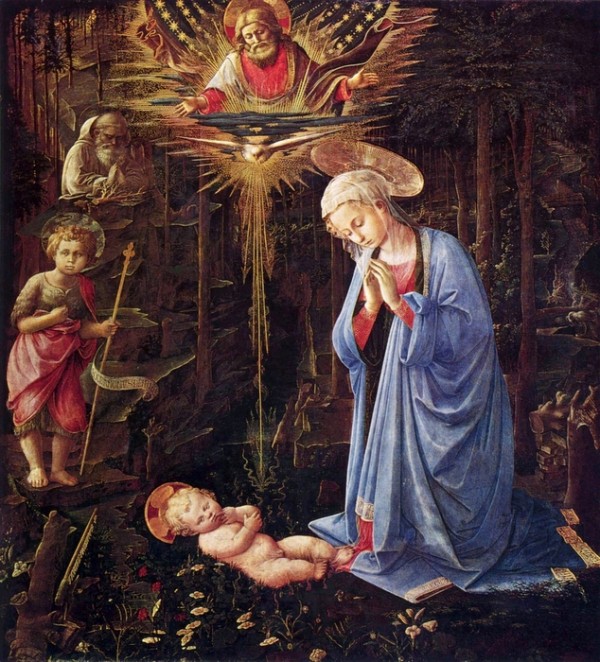 What would the Trinity be without Mary?
The oldest Christian traditions in the world don’t even try to separate them. Catholics. The Orthodox: Russian, Greek, Serbian, Ethiopian, Armenian, Coptic, the beleaguered Syrian, and probably a dozen more varieties. In all of these, and they are the majority of Christians, Mary is the Trinity’s partner. Mary is the Trinity’s Plus One.
The Protestant world, mainline and evangelical, and the Pentecostal world, have produced mind-numbing tomes on the nature of the Trinity without any mention of Mary, and without much reverential effect.
Most Protestants take God, Jesus, and the Spirit separately, in their discernment and in their prayer. The power and the point of Trinitarian relationship is not something anyone retells in personal experiences. Or even thinks about, despite endless Sunday recitations of the Glory Be’s.
But in the Catholic and Orthodox world, there is a wholeness that is never separated: the Trinity Plus Mary.
In Mary, the Trinity is evident, experienced, remembered and desired. And this plays out in every story we have about her. Who but she could possibly be the source of these stories?
The Annunciation: she receives the message that God has chosen her for the fullness of her grace; and the Spirit descends upon her, and she conceives the Child Jesus.
At the Child’s Birth, where she is protectively hidden in a stable, the glory of God reveals her and her child to the shepherds, and the Spirit guides the Magi to them.
When Jesus is twelve and Mary finds he is missing, she and Joseph discover him in the Great Temple – the actual House of God in Jerusalem – where the Rabbis are awed by the palpable presence of the Spirit in him.
At Cana, where the Presence of God is invoked over a marriage, she prods him to invoke the Spirit as well, changing water to wine.
Later, in fear for his life she comes with his brothers to stop his preaching and take him home. But he rebuffs her by invoking the Spirit over all who are listening to him, declaring them his family, making all of them children of his Belovedness, which God has declared over him.
In all of these events, the Presence of God has hallowed a moment in which the Spirit creates something new that is in and of Jesus. And Mary is the catalytic, the change agent who participates in all that is happening.
Only she would have known all these details, only she could have told these stories. They happened to her in private, or were recounted after Jesus’ death, when Joseph is no longer with her.
And importantly: they are not the stories of a beaming and proud mother. Her presence in them is neither beaming nor proud. She is skeptical and suspicious at the Annunciation. Worried and exhausted at the birth. Frantic and scolding at the Temple. Argumentative and insistent at Cana. Fearful and sharp at his public meeting. These are not stories proud mothers tell.
So this is the work of Mary, after Jesus: to tell stories that bring the uniquely special work of Trinity into human focus, displaying the force field that has been at work in creation and is at work now in all people, and she was the first into which the Spirit entered, at God’s behest.
Theologian Mary Luti has recently quoted the late Harvard Chaplain, Peter Gomes: we aren’t here to own anything, but to receive everything; not to finish anything, but to participate in something. And if it seems unfair not to see the fruits of our labor, it is likewise an undeserved privilege that we get to labor at all. This could be Mary’s personal credo. It could also be the best-ever description of the Trinity.
Trinity is not a flag to be saluted. Nor is it an altar object to be worshipped. Nor, in fact, is Trinity a power multiplier. In Trinity there is an energy that allows possibility to enter impossible situations, a strangeness that hallows the familiar, a love that binds people to the purposes of God.
After Jesus, it is written that Mary lived with the community of John, from which, in about the year 100, the Gospel of John emerged. Her presence among them is mentioned a few times, but that is all. None of her stories, save Cana, are written in this gospel.
Yet it would make much sense that she was sought out by many who wanted to hear her stories of Jesus, and who did write them down, and they eventually came to us through Matthew and Luke.
It also makes sense that her own emphasis on the interwoven signs and wonders of God, the Spirit and her son would have helped to shape her community’s theology into a gospel of signs and wonders.
Whatever sense we may want to make of the Trinity, leaving her out of the story muddles it up. Trinity meets, makes flesh, and works as One, in her.
_______________________________________________________________________________________________
Image: Adoration of the Child, Fra Filippo Lippi, 1459, Berlin, Germany. Vanderbilt Divinity School Library, Art in the Christian Tradition.
Previous Post

May 13, 2016
George Zimmerman’s Gun
Next Post

May 21, 2016 Memory – Faith We Carry into the Future
Browse Our Archives
Select a Category Bites Uncategorized
Select a Month December 2017 November 2017 October 2017 September 2017 August 2017 July 2017 June 2017 May 2017 April 2017 March 2017 February 2017 January 2017 December 2016 November 2016 October 2016 September 2016 August 2016 July 2016 June 2016 May 2016 April 2016 March 2016 February 2016 January 2016 December 2015 November 2015 October 2015 September 2015 August 2015 July 2015 June 2015 May 2015 April 2015 March 2015 February 2015 January 2015 December 2014 November 2014 October 2014 September 2014 August 2014 July 2014 June 2014 May 2014 April 2014 March 2014 February 2014 January 2014 December 2013 November 2013 October 2013 September 2013 August 2013 July 2013 June 2013 May 2013 April 2013 March 2013 February 2013 January 2013 December 2012
Follow Us!
TAKE THE
Religious Wisdom Quiz
I am an offering without defect, completely burned on the altar as a pleasing aroma to the Lord. What am I?
Select your answer to see how you score.
A grain offering A sin offering A peace offering A burnt offering
Related posts from The Bite in the Apple



TRENDING AT PATHEOS Progressive Christian

Why Christians Have a Sacred Duty to Vote:...
The Bible offers strong support for the sacred duty to vote. Here...

What Being a Modern-Day Apostle Means to Me
In my last column, I discussed the ins and outs of modern-day...

Did Ancient China Once Worship the God of...
Across human history, a common thread weaves through the origins of the...

Love Your Neighbor – Including Earth-Kin: Lev. 19,...
God’s command to love your neighbor means acting in an ethical and...

Lead a Church Study of “Jesus and Lao...
Guest writer Jack Thomas (The Irreverent Reverend) reflects on leading his church...

Principles for Understanding the Apostolic Ministry Today
Whenever people discover that my formal ministry title is "apostle," as in...
view all Progressive Christian blogs
Ad-Free & Subscriber Log-In Subscription Support
- About Us
- 2026 Calendar
- Videos
- Podcasts
- Library of World Religions
- Faith In Media Tracker
- Advertise With Us
- Write for Us
- Privacy Policy
- Terms of Service
- Do Not Sell My Data
- Contact Us
- Radiant Digital
- Manage Newsletter Subscriptions
- Unsubscribe From Notifications
- Sitemap
Copyright 2008-2026, Patheos. All rights reserved.
Subscription Support Ad-Free & Subscriber Log-In
Follow Patheos