
BuddhistCatholicContemplativeEvangelicalGeneral ChristianHinduJewishLatter-day SaintMuslimNew VisionsProgressive Christian
Beliefs
- Buddhist
- Catholic
- Contemplative
- Evangelical
- General Christian
- Hindu
- Jewish
- Latter-day Saint
- More Voices
- Muslim
- New Visions
- Pagan
- Progressive Christian
Topics
- Religion News
- Food and Religion
- Sports and Religion
- Religious Art
- Religious Music and Entertainment
- Religious Events
- History and Religion
- Style and Religion
- Politics and Religion
- Women in Religion
- Recreation Outdoors and Religion
- Business Finance and Religion
- Careers Workplace and Religion
- Education and Religion
- Family Parenting and Religion
- Health Fitness and Religion
- Home and Religion
- Relationships and Religion
- Technology and Religion
- Travel and Religion
Columnists
- Buddhist Columnists
- Business Finance and Religion Columnists
- Careers Workplace and Religion Columnists
- Catholic Columnists
- Contemplative Columnists
- Education and Religion Columnists
- Evangelists Columnists
- Family Parenting and Religion Columnists
- General Christian Columnists
- Health Fitness and Religion Columnists
- Hindu Columnists
- History and Religion Columnists
- Home and Religion Columnists
- Jewish Columnists
- More Voices Columnists
- Latter Day Columnists
- Muslim Columnists
- New Visions Columnists
- Nonreligious Columnists
- Pagan Columnists
- Politics and Religion Columnists
- Progressive Columnists
- Recreation Outdoors and Religion Columnists
- Relationships and Religion Columnists
- Religion News Columnists
- Religious Art Columnists
- Religious Events Columnists
- Religious Music and Entertainment Columnists
- Sports and Religion Columnists
- Style and Religion Columnists
- Technology and Religion Columnists
- Travel and Religion Columnists
- Women in Religion Columnists
Resource Library
- 2026 Calendar
- Library of World Religions
- The 100 Most Holy Places on Earth
- Patheos Answers
- Podcasts
- Videos
- Faith Leaders Database
- Anglican Episcopalian
- Bahai
- Baptist
- Buddhism
- Christianity
- Confucianism
- Eastern Orthodoxy
- Hinduism
- Holiness and Pentecostal
- ISKCON
- Islam
- Judaism
- Lutheran
- Methodist
- The Church of Jesus Christ of Latter-day Saints
- New Age
- Paganism
- Presbytarian and Reformed
- Protestantism
- Religion Behind the Scenes
- Roman Catholic
- Scientology
- Shia Islam
- Sikhism
- Sufism
- Sunni Islam
- Taoism
- Zen
- See all religions
Research Tools
 Ad-Free & Subscriber Log-In Subscription Support
Ad-Free & Subscriber Log-In Subscription Support
Follow Patheos 

- Trending:
- Forgiveness
- |
- Marriage
- |
- Consciousness
- |
- Death Penalty
- |
- Election
- |
- Halloween
 The Bite in the Apple
- Home
- Progressive Christian
- Lost
Lost
Last updated on: March 3, 2013 at 10:26 am by Nancy Rockwell
Lost 2013-03-03T10:26:51-04:00 Nancy Rockwell
Patheos Explore the world's faith through different perspectives on religion and spirituality! Patheos has the views of the prevalent religions and spiritualities of the world.
 My Lord God,
I have no idea where I am going.
I do not see the road ahead of me,
I cannot know for certain where it will end.
Nor do I really know myself. . .
–Thomas Merton
Lost is unforgettably lonely, a vale of confusion, dense with thickets of regret. Lost is a wilderness.
The Oxford English Dictionary: wilderness is a neglected or abandoned place, inhospitable and uncultivated. Jesus was led by the Spirit in a wilderness and accosted by the Devil there. He was lost and he found himself. His stories are about the ways we all get lost. And are found.
I’ve been lost in foreign countries, and right here, on public transportation; also in my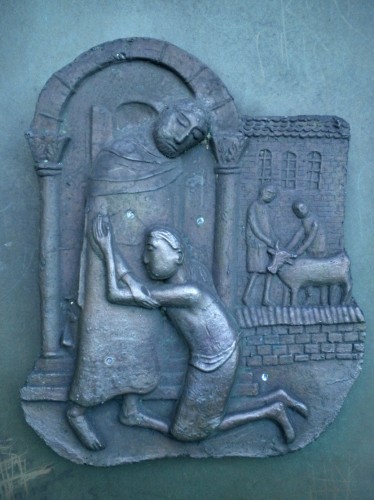 own car, on uninhabited roads and huge highways. At times I’ve been desperately lost in my personal economy. The roadless wilderness of lost loves, lost opportunities, lost generations is a desolation I have shivered in. The shadows of Lost are so frightening I have run from them.
Part of being lost is knowing my own bad sense of direction, my poor choices, took me there. Lost is within as well as around, a devouring of the heart.
In Luke 15 Jesus tells parables about a lost sheep, a lost coin, and a lost son. Each is found by the one who longs for each. The sheep and the son experience all the terrors of being lost. But the shepherd, the housewife (who lost a coin), and the father are also lost. They are bereft in the wilderness of regrets. They have lost precious things. And they are found when what they lost has been found.
Once, years ago, in Scotland, I was walking on a country road past a sheep field, when one ewe, for who-knows-what-urge-of-delight, took a running start and jumped the fence. In less than a minute elation turned to panic in the poor animal, whose only safety lay inside the fence among the rest. The road was a dirt path, too narrow to afford the run needed for jumping back. Frantic bleating and pacing replaced the joy of the jump, and the rest of the flock turned toward the road, facing the lost one. The whole flock shared her anxiety.
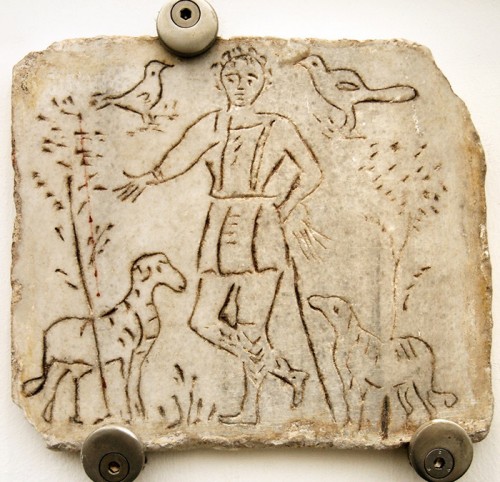 Clearly, I had to do something. In anxiety of my own, and wishing hard for a shepherd to appear, I opened the sheepgate, a huge thing, wide as a barn door and about half as high. Nothing happened. I opened it more. Not until I took the risk of opening it wide, wide enough for the rest to rush out, did the jumper feel safe enough to go in. And when she did, the whole flock bleated and looked up at me.
Lost is a threaded experience of isolation and discovery, anxiety and clearness. None of us can be at home until we all are. That is what Jesus’ shepherd knew. Home happens when the lost are found.
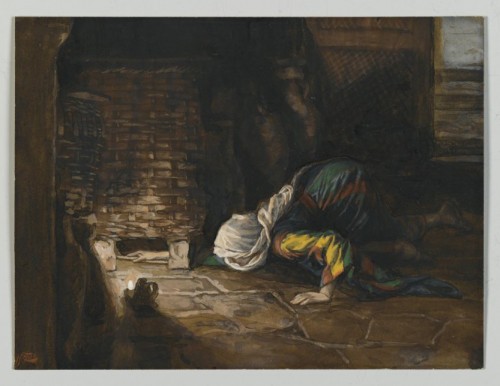 Each Lost story is economic in an important way, and requires an economic risk. That’s what the worried mother knows about the coin she cannot find. The coin is vital to the livelihood of those who depend on her. A coin seems so trivial, but it represents the power to feed her family, to heat her house, to buy medicine. My parents cherished a story from their early married days, of going to the store with just enough money to buy dinner, they had counted the pennies. And somehow my father dropped a quarter as he got out of the car. The two of them got down on their hands and knees and felt around under the car in the gathering dark for twenty minutes or more until they found that coin.
I’ve groped in the dark, for car keys, eyeglasses, return receipts, my license, phone, wallet, appointment book — with the same groaning prayer for help on my lips, the same self-whipping in my heart, the same tense desperation. If the lost, crucial thing cannot be found there will be a cost I dread to pay. That’s what the housewife knows, the price of her carelessness.
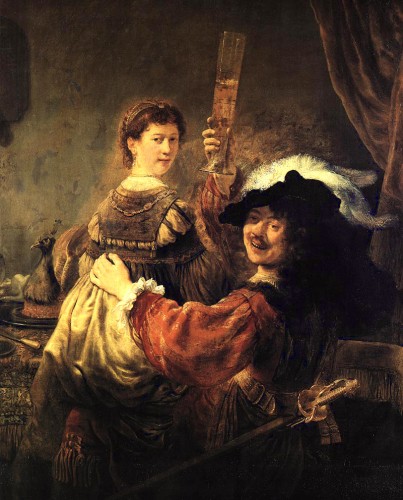 The father of the lost son knows that his elder boy is bitter about the money. He knows the younger boy wanted to taste forbidden pleasures, but also wanted to get away from being second, being less. The father’s heart aches every day. Nothing will restore the family, or gladden his heart, except the boy’s return. And nothing else can break through the superior smugness of the older son except that younger boy. We are all part of one another, disabled without each other. That’s what the father knows.
Lost. The temptation is to stay lost. You get used to the ache of it. It becomes your identity, the wilderness is your weedy field now. You tell yourself, you can’t go home again.
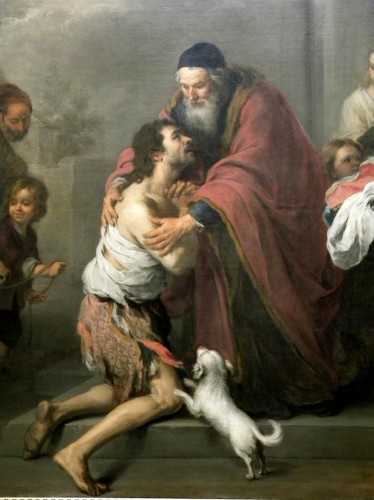 Found. This is a play in three acts, for Found requires economic risk (faith) and rejoicing (mercy).
The shepherd leaves the flock to find the lost. Is it a reckless bet?
The housewife leaves the day’s labors to search for the coin. Money may not change hands, but you can bet there is value at risk here. The father welcomes his prodigal back into the economy of the household, assuming the difficult work of reconciliation. And these things alone are not enough.
Found is an experience that requires rejoicing. The sheep know this, and do it. The woman brings all her neighbors in, sharing food and drink, which are some of her wealth, with them, in her joy. In her joy she says, Lost is what happened, and it is human, and thank God that Found is also part of being human! And a Nobel prize has been given to the man who figured out how to give third world women micro-loans of five and ten dollars, with which they have transformed their families’ lives. The father prepares a fatted-calf feast to celebrate the boy who wasted everything he had been given, and found what his elder brother has not yet discovered: that what makes a home is love.
Found can’t occur without a real economic risk, according to Jesus. And Found requires some rejoicing to be complete. An essential step in this movement is the blunder into the wilderness, our getting lost. Lost is the run-up leap into Found, Lost is what moves us to drop everything and search with prayers on our lips, Lost is what opens our hearts to home. More than we care to admit, Lost is the life of the Way.
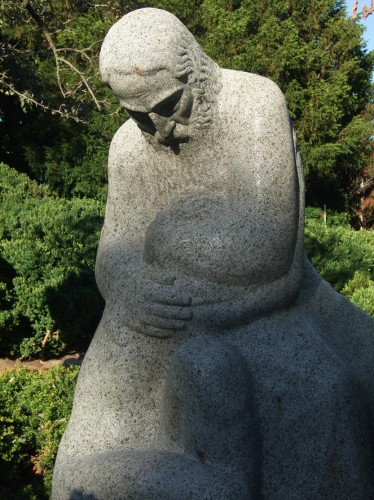 Why, then, do we preach a faith that metes out rules and bounds? Why do we emphasize not getting lost? And why do our churches war over embracing prodigals? Our churches will not be the green pastures we want until Lost and Found become the desires of our hearts rather than experiences to avoid.
In the household of God I have stumbled in recitation,
and in my mind I have wandered.
I have interrupted worship with discussion.
But never held the cup to my mouth lagging in gratitude.
The Lord forgives many things,
So I have heard.
— Mary Oliver, in Thirst
________________________________
Illustrations
1. Sheep in Paradise,**** Mosaic in Sant’ Apollinaire de Classe, Ravena, Italy, AD 549. Vanderbilt Divinity School, Art in the Christian Tradition
2. Galway Cathedral relief, Return of the Prodigal. Vanderbilt Divinity School, Art in the Christian Tradition
3. Good Shepherd epigraph, 2nd Century, Museo Epigrafico, Rome, Italy. Vanderbilt Divinity School, Art in the Christian Tradition
4. Lost Coin, Tissot, James Jacques Joseph, Brooklyn Museum. Vanderbilt Divinity School, Art in the Christian Tradition
5. The Prodigal Son, Rembrandt van Rijn, c. 1634, Gemaldegalerie Alte Meister, Dresden, Germany. Vanderbilt Divinity School, Art in the Christian Tradition
6. The Return of the Prodigal Son, Murillo, Esteban, 1667-70,
National Gallery of Art, US. Vanderbilt Divinity School, Art in the Christian Tradition
7. Prodigal Son, Bishop’s Garden, National Cathedral, Washington DC. Vanderbilt Divinity School, Art in the Christian Tradition
Previous Post

February 24, 2013
Siloam and the Fig Tree
Next Post
March 10, 2013 A Beautiful Thing
Browse Our Archives
Select a Category Bites Uncategorized
Select a Month December 2017 November 2017 October 2017 September 2017 August 2017 July 2017 June 2017 May 2017 April 2017 March 2017 February 2017 January 2017 December 2016 November 2016 October 2016 September 2016 August 2016 July 2016 June 2016 May 2016 April 2016 March 2016 February 2016 January 2016 December 2015 November 2015 October 2015 September 2015 August 2015 July 2015 June 2015 May 2015 April 2015 March 2015 February 2015 January 2015 December 2014 November 2014 October 2014 September 2014 August 2014 July 2014 June 2014 May 2014 April 2014 March 2014 February 2014 January 2014 December 2013 November 2013 October 2013 September 2013 August 2013 July 2013 June 2013 May 2013 April 2013 March 2013 February 2013 January 2013 December 2012
Follow Us!
TAKE THE
Religious Wisdom Quiz
What was the rider of the Red Horse in Revelation given?
Select your answer to see how you score.
A balance scale A crown A large sword A bow
Related posts from The Bite in the Apple




TRENDING AT PATHEOS Progressive Christian

Why Christians Have a Sacred Duty to Vote:...
The Bible offers strong support for the sacred duty to vote. Here...

What Being a Modern-Day Apostle Means to Me
In my last column, I discussed the ins and outs of modern-day...

Did Ancient China Once Worship the God of...
Across human history, a common thread weaves through the origins of the...

Love Your Neighbor – Including Earth-Kin: Lev. 19,...
God’s command to love your neighbor means acting in an ethical and...

Lead a Church Study of “Jesus and Lao...
Guest writer Jack Thomas (The Irreverent Reverend) reflects on leading his church...

Principles for Understanding the Apostolic Ministry Today
Whenever people discover that my formal ministry title is "apostle," as in...
view all Progressive Christian blogs
Ad-Free & Subscriber Log-In Subscription Support
- About Us
- 2026 Calendar
- Videos
- Podcasts
- Library of World Religions
- Faith In Media Tracker
- Advertise With Us
- Write for Us
- Privacy Policy
- Terms of Service
- Do Not Sell My Data
- Contact Us
- Radiant Digital
- Manage Newsletter Subscriptions
- Unsubscribe From Notifications
- Sitemap
Copyright 2008-2026, Patheos. All rights reserved.
Subscription Support Ad-Free & Subscriber Log-In
Follow Patheos