
BuddhistCatholicContemplativeEvangelicalGeneral ChristianHinduJewishLatter-day SaintMuslimNew VisionsProgressive Christian
Beliefs
- Buddhist
- Catholic
- Contemplative
- Evangelical
- General Christian
- Hindu
- Jewish
- Latter-day Saint
- More Voices
- Muslim
- New Visions
- Pagan
- Progressive Christian
Topics
- Religion News
- Food and Religion
- Sports and Religion
- Religious Art
- Religious Music and Entertainment
- Religious Events
- History and Religion
- Style and Religion
- Politics and Religion
- Women in Religion
- Recreation Outdoors and Religion
- Business Finance and Religion
- Careers Workplace and Religion
- Education and Religion
- Family Parenting and Religion
- Health Fitness and Religion
- Home and Religion
- Relationships and Religion
- Technology and Religion
- Travel and Religion
Columnists
- Buddhist Columnists
- Business Finance and Religion Columnists
- Careers Workplace and Religion Columnists
- Catholic Columnists
- Contemplative Columnists
- Education and Religion Columnists
- Evangelists Columnists
- Family Parenting and Religion Columnists
- General Christian Columnists
- Health Fitness and Religion Columnists
- Hindu Columnists
- History and Religion Columnists
- Home and Religion Columnists
- Jewish Columnists
- More Voices Columnists
- Latter Day Columnists
- Muslim Columnists
- New Visions Columnists
- Nonreligious Columnists
- Pagan Columnists
- Politics and Religion Columnists
- Progressive Columnists
- Recreation Outdoors and Religion Columnists
- Relationships and Religion Columnists
- Religion News Columnists
- Religious Art Columnists
- Religious Events Columnists
- Religious Music and Entertainment Columnists
- Sports and Religion Columnists
- Style and Religion Columnists
- Technology and Religion Columnists
- Travel and Religion Columnists
- Women in Religion Columnists
Resource Library
- 2026 Calendar
- Library of World Religions
- The 100 Most Holy Places on Earth
- Patheos Answers
- Podcasts
- Videos
- Faith Leaders Database
- Anglican Episcopalian
- Bahai
- Baptist
- Buddhism
- Christianity
- Confucianism
- Eastern Orthodoxy
- Hinduism
- Holiness and Pentecostal
- ISKCON
- Islam
- Judaism
- Lutheran
- Methodist
- The Church of Jesus Christ of Latter-day Saints
- New Age
- Paganism
- Presbytarian and Reformed
- Protestantism
- Religion Behind the Scenes
- Roman Catholic
- Scientology
- Shia Islam
- Sikhism
- Sufism
- Sunni Islam
- Taoism
- Zen
- See all religions
Research Tools
 Ad-Free & Subscriber Log-In Subscription Support
Ad-Free & Subscriber Log-In Subscription Support
Follow Patheos 

- Trending:
- Forgiveness
- |
- Marriage
- |
- Consciousness
- |
- Death Penalty
- |
- Election
- |
- Halloween
 The Bite in the Apple
- Home
- Progressive Christian
- Jesus and the Young Madman
Jesus and the Young Madman
Last updated on: June 17, 2013 at 12:00 am by Nancy Rockwell
Jesus and the Young Madman 2013-06-17T00:00:14-04:00 Nancy Rockwell
Patheos Explore the world's faith through different perspectives on religion and spirituality! Patheos has the views of the prevalent religions and spiritualities of the world.
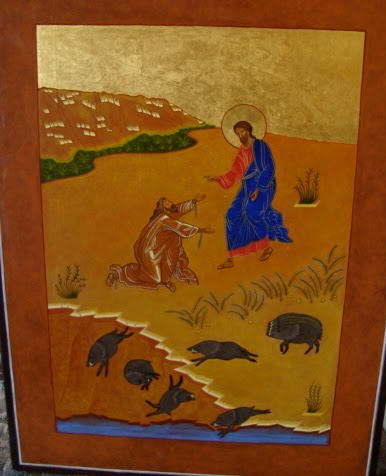 A slave, then a dead man, next a prostitute, and now a madman – Luke piles one story on top of another showing how Jesus widens the circle of the people of God to include those who have been seen as contaminated and corrupting – the unclean. Two thousand years later, the mentally ill are the group we still fear, and shun.
Luke has placed this mad young man in an unclean town, a town on the far side of the Sea of Galilee, in which Jewish people made their living by herding pigs. By Jewish law the pig is an unclean animal, but the town has found it profitable to raise them and sell to neighbors of other faiths who are pork eaters. At least this. Perhaps more.
The madman is also untouchable by religious law. The town, Gerasea, has decided that the young madman is good for nothing. His uncontrollable rages have brought them to drastic measures. They have put him in chains and chained him among the dead, in the town cemetery, where his roaring will bother the living less. Even so, he manages to escape now and then and takes off into the woods. Why does he return? Because there is nowhere else to go. Because hunger brings him back to the food they will supply. Because they go after him. Who knows?
When Jesus arrives by boat from across the Sea, there is no crowd waiting to greet him. His advance team has not been able to roust folks out – curiosity, hope for miracles, and longing for good preaching, the three sure-fire lures, have failed in Gerasea. But Jesus and the disciples can hear the fellow in the cemetery. And they go to him. By the end of Jesus’ time with him, the young man has been restored to sanity, is calm and rejoices in his acceptance by them all.
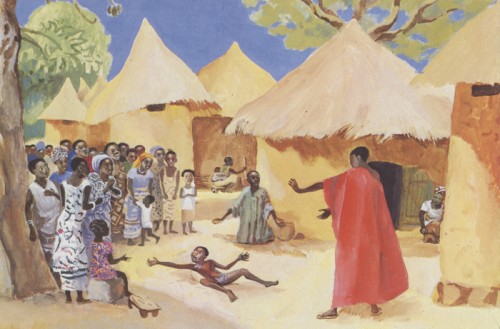
But something else has happened. The demons and the madness have gone out of the young man and, at Jesus’ direction, into a large herd of swine. The swine, in horror at their own corruption by unclean spirits, run to the edge of the cliff, jump into the Sea and are drowned. Now the townspeople come running, crowding around, horrified at the loss of their valuable swine. And they are terrified of Jesus – so terrified they ask him to leave town.
Jesus has changed the town, from a place in which everyone was corrupt and a young man’s soul had been lost, to a place where everyone was set free from corruption and madness. But the cost has been high, financially. And the town does not want to pay it, nor to live in freedom without that income.
And who can blame them, economies being what they are? New livelihoods are not easy to come by, and this village needs to salvage its hogtending, pronto. Besides, it is foolish to declare one animal unclean when we can see others eating it and not dying. In a way Jesus has shown the pig to be a clean creature, for it, unlike the humans, did not consent to live when polluted by the demons. Jesus has shown that pigs were corrupted by the spirits of people, instead of the other way around.
 Mental illness is no stranger in America. And the confusion and corruption of American life may push many young people who are fragile, over the edge. The agony of families with members afflicted by devouring anxieties, and the anguish of being in such a state, are tragedies beyond words.
In America, social pressures seem to contribute to such illnesses. We have a significant economic market in manufacture and sale of guns. And it is fueled by another successful industry, films and fantasy cyber games that celebrate gun violence. The widespread availability of semi-automatic repeating rifles is one of our cultural corruptions. Another is the fantasy world that feeds it, and still another is the interpretation of the second amendment as enshrining anti-social rage and the right to a personal arsenal.
Many, speaking in the name of Jesus’ values, especially since the Sandy Hook shootings, have urged the curtailing of guns sales and the setting of limits on movies and games about violence. But the counter argument has so far won the day, that the right to own such guns and play such games is sacred. Instead, the mentally ill have become scapegoats for the perils we face, all across the nation.
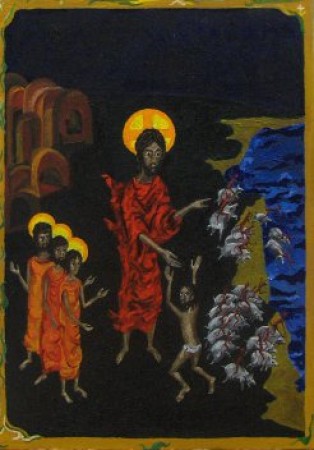 It was not the mad young man who endangered Geresea, it was the collaboration in corruption in which the town was engaged. And the sanest of men, Jesus, knew that and remedied it. The town turned that remedy down.
Statistically, the mentally ill are no more prone to violence than anyone else. Spiritually, it would be true to say that any shooter is, at the time of shooting, insane. But whatever we say, it seems that, then and now, money always wins the day.
Jesus told the now-sane young man, who wanted to stay with him as a disciple, to stay instead in Geresea and keep on telling people how his cure had come about. That story would be about Jesus, but also about the swine. And about money.
In America, the mentally ill need to keep on telling us all that, sick or well, they are not the root cause of violence here. And that doing something to curtail the violence in America could be very helpful in their healing.
Even more helpful would be ceasing to scapegoat the mentally ill, ceasing to see them as lurking monsters who need to be kept in chains. Mental illness is part of the spectrum of the human condition. It has always been present, and will always be. And like the rest of us, the mentally ill need to be safe in our communities. Jesus, who had such compassion for this young man, knew the community could afford to restore him to health. They just needed to care enough to be willing to pay for his wellness. And they needed to understand that his health was a symbol of theirs.
____________________________________________________
Illustrations
1. Healing at Geresea – personal icon of Rev. Brian McHugh.
2. Healing the Possessed, JESUS MAFA, 1973, Cameroon,
Vanderbilt Divinity School Library, Art in the Christian Tradition.
3. Jesus Heals the Gerasene, Alexander Master, 1430, The Hague, Kinoinikliijike Bibliotheek. Vanderbilt Divinity School Library, Art in the Christian Tradition.
4. Geresene Demoniac, unidentifiable icon.
Previous Post

June 9, 2013
The Woman on the Floor
Next Post
June 23, 2013 Midsummer Wisdom
Browse Our Archives
Select a Category Bites Uncategorized
Select a Month December 2017 November 2017 October 2017 September 2017 August 2017 July 2017 June 2017 May 2017 April 2017 March 2017 February 2017 January 2017 December 2016 November 2016 October 2016 September 2016 August 2016 July 2016 June 2016 May 2016 April 2016 March 2016 February 2016 January 2016 December 2015 November 2015 October 2015 September 2015 August 2015 July 2015 June 2015 May 2015 April 2015 March 2015 February 2015 January 2015 December 2014 November 2014 October 2014 September 2014 August 2014 July 2014 June 2014 May 2014 April 2014 March 2014 February 2014 January 2014 December 2013 November 2013 October 2013 September 2013 August 2013 July 2013 June 2013 May 2013 April 2013 March 2013 February 2013 January 2013 December 2012
Follow Us!
TAKE THE
Religious Wisdom Quiz
How many chapters are in Proverbs?
Select your answer to see how you score.
50 40 31 28
Related posts from The Bite in the Apple




TRENDING AT PATHEOS Progressive Christian

Why Christians Have a Sacred Duty to Vote:...
The Bible offers strong support for the sacred duty to vote. Here...

What Being a Modern-Day Apostle Means to Me
In my last column, I discussed the ins and outs of modern-day...

Did Ancient China Once Worship the God of...
Across human history, a common thread weaves through the origins of the...

Love Your Neighbor – Including Earth-Kin: Lev. 19,...
God’s command to love your neighbor means acting in an ethical and...

Lead a Church Study of “Jesus and Lao...
Guest writer Jack Thomas (The Irreverent Reverend) reflects on leading his church...

Principles for Understanding the Apostolic Ministry Today
Whenever people discover that my formal ministry title is "apostle," as in...
view all Progressive Christian blogs
Ad-Free & Subscriber Log-In Subscription Support
- About Us
- 2026 Calendar
- Videos
- Podcasts
- Library of World Religions
- Faith In Media Tracker
- Advertise With Us
- Write for Us
- Privacy Policy
- Terms of Service
- Do Not Sell My Data
- Contact Us
- Radiant Digital
- Manage Newsletter Subscriptions
- Unsubscribe From Notifications
- Sitemap
Copyright 2008-2026, Patheos. All rights reserved.
Subscription Support Ad-Free & Subscriber Log-In
Follow Patheos