
BuddhistCatholicContemplativeEvangelicalGeneral ChristianHinduJewishLatter-day SaintMuslimNew VisionsProgressive Christian
Beliefs
- Buddhist
- Catholic
- Contemplative
- Evangelical
- General Christian
- Hindu
- Jewish
- Latter-day Saint
- More Voices
- Muslim
- New Visions
- Pagan
- Progressive Christian
Topics
- Religion News
- Food and Religion
- Sports and Religion
- Religious Art
- Religious Music and Entertainment
- Religious Events
- History and Religion
- Style and Religion
- Politics and Religion
- Women in Religion
- Recreation Outdoors and Religion
- Business Finance and Religion
- Careers Workplace and Religion
- Education and Religion
- Family Parenting and Religion
- Health Fitness and Religion
- Home and Religion
- Relationships and Religion
- Technology and Religion
- Travel and Religion
Columnists
- Buddhist Columnists
- Business Finance and Religion Columnists
- Careers Workplace and Religion Columnists
- Catholic Columnists
- Contemplative Columnists
- Education and Religion Columnists
- Evangelists Columnists
- Family Parenting and Religion Columnists
- General Christian Columnists
- Health Fitness and Religion Columnists
- Hindu Columnists
- History and Religion Columnists
- Home and Religion Columnists
- Jewish Columnists
- More Voices Columnists
- Latter Day Columnists
- Muslim Columnists
- New Visions Columnists
- Nonreligious Columnists
- Pagan Columnists
- Politics and Religion Columnists
- Progressive Columnists
- Recreation Outdoors and Religion Columnists
- Relationships and Religion Columnists
- Religion News Columnists
- Religious Art Columnists
- Religious Events Columnists
- Religious Music and Entertainment Columnists
- Sports and Religion Columnists
- Style and Religion Columnists
- Technology and Religion Columnists
- Travel and Religion Columnists
- Women in Religion Columnists
Resource Library
- 2026 Calendar
- Library of World Religions
- The 100 Most Holy Places on Earth
- Patheos Answers
- Podcasts
- Videos
- Faith Leaders Database
- Anglican Episcopalian
- Bahai
- Baptist
- Buddhism
- Christianity
- Confucianism
- Eastern Orthodoxy
- Hinduism
- Holiness and Pentecostal
- ISKCON
- Islam
- Judaism
- Lutheran
- Methodist
- The Church of Jesus Christ of Latter-day Saints
- New Age
- Paganism
- Presbytarian and Reformed
- Protestantism
- Religion Behind the Scenes
- Roman Catholic
- Scientology
- Shia Islam
- Sikhism
- Sufism
- Sunni Islam
- Taoism
- Zen
- See all religions
Research Tools
 Ad-Free & Subscriber Log-In Subscription Support
Ad-Free & Subscriber Log-In Subscription Support
Follow Patheos 

- Trending:
- Forgiveness
- |
- Marriage
- |
- Consciousness
- |
- Death Penalty
- |
- Election
- |
- Halloween
 The Bite in the Apple
- Home
- Progressive Christian
- Icons
Icons
Last updated on: March 16, 2015 at 11:30 am by Nancy Rockwell
Icons 2015-03-16T11:30:01-04:00 Nancy Rockwell
Patheos Explore the world's faith through different perspectives on religion and spirituality! Patheos has the views of the prevalent religions and spiritualities of the world.
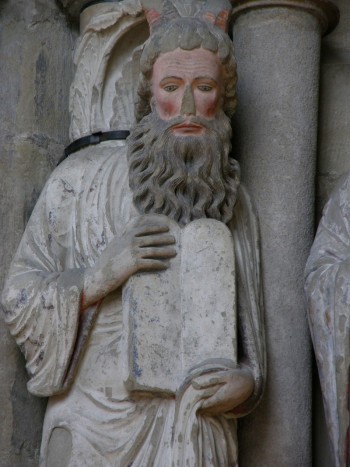 And I, when I am lifted up from the earth, will draw all people to myself. (John 12:32)
Ominous, strange, magical, mysterious, mind-boggling is the older tale from which this idea comes. It’s the tale of the bronze poisonous serpent, lifted up, that saved the people Israel in their long walk from Egypt to the Promised Land. The tale, in the Book of Numbers, is one to which Jesus made reference as he walked the dangerous streets of Jerusalem.
The tale tells how the people, struggling to stay hopeful in the arduous journey around the Red Sea, found themselves in a desperate state, as poisonous snakes appeared in their path and bit them. Many died from their venom. Before this, there had been plenty of complaining and discouragement, hunger, and discomfort. Now, they were deeply afraid, and they felt ashamed, as if their complaining had earned them these deaths. Moses praye for them, asking God to lift the curse of death. And God told Moses: make a poisonous serpent and put it upon a pole, and whenever a serpent bites someone, if that person gazes at the serpent of bronze, he will live.
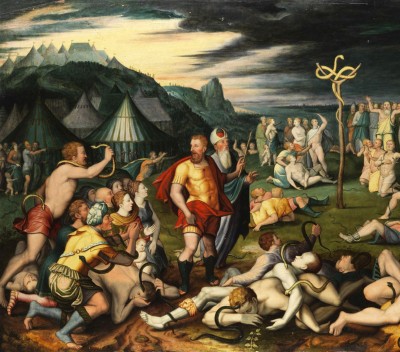 And so it was. Gazing on the serpent on the pole revived the stricken, became an antivenom. But what on earth does it mean, what does it tell us about God, about Moses. And for that matter, what does the cross, on which Jesus is lifted up, tell us about God, about Jesus, about the journey his friends have made?
When I first began to learn the devotional use of icons, I remember Tilden Edwards offering us this distinction between seeing and gazing. Seeing, he said, was reaching out with your sight and taking hold of what you see, making it yours, part of the world your mind is making sense of. Gazing, he said, was opening your mind, your soul, in your unwavering stillness, allowing the icon to come into you and take hold of your sight, transforming your understanding of the world with its mystery.
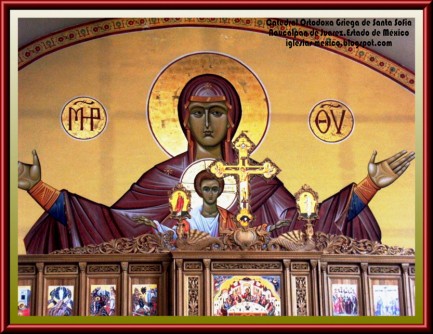
As I grew to be able to spend an hour, or even more, gazing at an icon, I came to know that, as I became still, the icon developed motion, vibrancy, and the power to knock me into a state of wonder, from which I emerged exhausted and amazed. In the Orthodox traditions, icons are called windows or portals into mystery, because of these experiences, and in Orthodox churches they are treated as living beings because of this, much as Jews treat their Torah with the same honor.
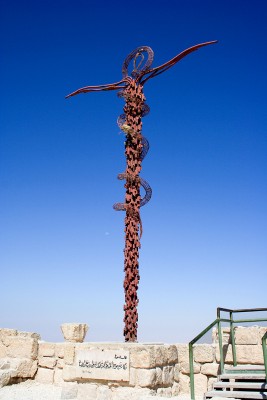 Something like this must have happened to the people Moses led, who were stricken with snake bite and constricted with terror of death. Looking long and deeply into the face of Moses’ poisonous serpent of bronze, set upon a pole, offered them a reordering of their reality, and a transformation of their knowledge of death – and life. And this allowed them to find their way past poison, past fear and to renewed life. In this devotional mysticism they made a journey past death, into eternal life, and back again.
John associates the cross with this, saying as Moses lifted up the serpent in the wilderness, so must the Son of Man be lifted up, that whoever believes (gazes on) in him may have eternal life. It’s about as clear as mud, what this means. Jesus is far more Moses than he is the poisonous snake, and he is not made of bronze, he suffers and dies on that pole, despite all the prayerful gazing into God he has done. But there is a similarity in the dire circumstances in Jerusalem and the cruelty in Egypt, the oppressive cruelty of the Romans, the crucified slaves there as there had been in Egypt, and the cruelty in both places has been a poisonous serpent, striking at the hope and courage of the people.
 Jesus himself, makes reference to this (according to John) when he is informed during this ominous week that some Greeks want to see him. Greeks. Not Jews. A larger circle of the world, and another people. The time has come, Jesus says, for those who love their life to lose it, and he reminds them how a single grain of wheat, if it dies, bears much fruit.
He does not pray to be saved from death, instead he prays for the glory of God. And a response comes from heaven, which was heard in diverse ways, as a promise, as thunder, as an angel. And he continues: And I, when I am lifted up from the earth, will draw all people unto myself.
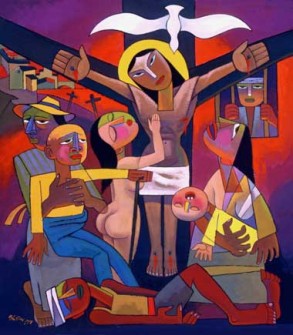 His promise is not that our deaths will be individually reversed, but that we will become part of all people. All people. The thief beside him. The soldiers around him. The enemy and the ally. The unforgiveable and the unforgiving. Dzhokhar Tsarnaev and all his mutilated victims. Arab Moslems, western Christians, Israeli Jews. And western Moslems, Arab Christians, Parisian Jews. This is not an argument over diplomacy, it is the forging of a new way out for the desperate, who are trapped and at the point of death in the blood feuds of the powerful, and whose certain victory will be confounded by their own instruments of torture, which, in the gazing contemplation of a dying world, will metamorphose into a Way to new life.
_______________________________________________________
Illustrations:
1. Moses – Cathedrale Notre-Dame, Lausanne, Switzerland, 1250. Vanderbilt Divinity School Library, Art in the Christian Tradition.
2. Moses and the Brass Serpent, Flemish, 17th century, unidentified artist. Vanderbilt Divinity School Library, Art in the Christian Tradition.
3. Brazen Serpent, Fantoni, Giovanni. 20th c. Atop Mount Nebo, Jordan. Vanderbilt Divinity School Library, Art in the Christian Tradition.
4. Iglesia Ortodoxa Griega, Greek Orthodox Church, Naucalpan, Mexico. Vanderbilt Divinity School Library, Art in the Christian Tradition.
5. Crucifixion Icon, Pietro Lorenzetti, 1340s. Metropolitan Museum of Art. Google Images.
6. Crucifixion, He Qi (Nanjing, China) Church of St. Mary, NY. Google Image.
Previous Post

March 7, 2015
Eternal Life and Selma
Next Post
March 21, 2015 Holy Week - Holding Up the Kingdom Vision
Browse Our Archives
Select a Category Bites Uncategorized
Select a Month December 2017 November 2017 October 2017 September 2017 August 2017 July 2017 June 2017 May 2017 April 2017 March 2017 February 2017 January 2017 December 2016 November 2016 October 2016 September 2016 August 2016 July 2016 June 2016 May 2016 April 2016 March 2016 February 2016 January 2016 December 2015 November 2015 October 2015 September 2015 August 2015 July 2015 June 2015 May 2015 April 2015 March 2015 February 2015 January 2015 December 2014 November 2014 October 2014 September 2014 August 2014 July 2014 June 2014 May 2014 April 2014 March 2014 February 2014 January 2014 December 2013 November 2013 October 2013 September 2013 August 2013 July 2013 June 2013 May 2013 April 2013 March 2013 February 2013 January 2013 December 2012
Follow Us!
TAKE THE
Religious Wisdom Quiz
Who was the wise woman who saved her city from Joab by throwing a man's head over the wall?
Select your answer to see how you score.
Bathsheba Michal A woman of Abel Abigail
Related posts from The Bite in the Apple




TRENDING AT PATHEOS Progressive Christian

Why Christians Have a Sacred Duty to Vote:...
The Bible offers strong support for the sacred duty to vote. Here...

What Being a Modern-Day Apostle Means to Me
In my last column, I discussed the ins and outs of modern-day...

Did Ancient China Once Worship the God of...
Across human history, a common thread weaves through the origins of the...

Love Your Neighbor – Including Earth-Kin: Lev. 19,...
God’s command to love your neighbor means acting in an ethical and...

Lead a Church Study of “Jesus and Lao...
Guest writer Jack Thomas (The Irreverent Reverend) reflects on leading his church...

Principles for Understanding the Apostolic Ministry Today
Whenever people discover that my formal ministry title is "apostle," as in...
view all Progressive Christian blogs
Ad-Free & Subscriber Log-In Subscription Support
- About Us
- 2026 Calendar
- Videos
- Podcasts
- Library of World Religions
- Faith In Media Tracker
- Advertise With Us
- Write for Us
- Privacy Policy
- Terms of Service
- Do Not Sell My Data
- Contact Us
- Radiant Digital
- Manage Newsletter Subscriptions
- Unsubscribe From Notifications
- Sitemap
Copyright 2008-2026, Patheos. All rights reserved.
Subscription Support Ad-Free & Subscriber Log-In
Follow Patheos