
BuddhistCatholicContemplativeEvangelicalGeneral ChristianHinduJewishLatter-day SaintMuslimNew VisionsProgressive Christian
Beliefs
- Buddhist
- Catholic
- Contemplative
- Evangelical
- General Christian
- Hindu
- Jewish
- Latter-day Saint
- More Voices
- Muslim
- New Visions
- Pagan
- Progressive Christian
Topics
- Religion News
- Food and Religion
- Sports and Religion
- Religious Art
- Religious Music and Entertainment
- Religious Events
- History and Religion
- Style and Religion
- Politics and Religion
- Women in Religion
- Recreation Outdoors and Religion
- Business Finance and Religion
- Careers Workplace and Religion
- Education and Religion
- Family Parenting and Religion
- Health Fitness and Religion
- Home and Religion
- Relationships and Religion
- Technology and Religion
- Travel and Religion
Columnists
- Buddhist Columnists
- Business Finance and Religion Columnists
- Careers Workplace and Religion Columnists
- Catholic Columnists
- Contemplative Columnists
- Education and Religion Columnists
- Evangelists Columnists
- Family Parenting and Religion Columnists
- General Christian Columnists
- Health Fitness and Religion Columnists
- Hindu Columnists
- History and Religion Columnists
- Home and Religion Columnists
- Jewish Columnists
- More Voices Columnists
- Latter Day Columnists
- Muslim Columnists
- New Visions Columnists
- Nonreligious Columnists
- Pagan Columnists
- Politics and Religion Columnists
- Progressive Columnists
- Recreation Outdoors and Religion Columnists
- Relationships and Religion Columnists
- Religion News Columnists
- Religious Art Columnists
- Religious Events Columnists
- Religious Music and Entertainment Columnists
- Sports and Religion Columnists
- Style and Religion Columnists
- Technology and Religion Columnists
- Travel and Religion Columnists
- Women in Religion Columnists
Resource Library
- 2026 Calendar
- Library of World Religions
- The 100 Most Holy Places on Earth
- Patheos Answers
- Podcasts
- Videos
- Faith Leaders Database
- Anglican Episcopalian
- Bahai
- Baptist
- Buddhism
- Christianity
- Confucianism
- Eastern Orthodoxy
- Hinduism
- Holiness and Pentecostal
- ISKCON
- Islam
- Judaism
- Lutheran
- Methodist
- The Church of Jesus Christ of Latter-day Saints
- New Age
- Paganism
- Presbytarian and Reformed
- Protestantism
- Religion Behind the Scenes
- Roman Catholic
- Scientology
- Shia Islam
- Sikhism
- Sufism
- Sunni Islam
- Taoism
- Zen
- See all religions
Research Tools
 Ad-Free & Subscriber Log-In Subscription Support
Ad-Free & Subscriber Log-In Subscription Support
Follow Patheos 

- Trending:
- Forgiveness
- |
- Marriage
- |
- Consciousness
- |
- Death Penalty
- |
- Election
- |
- Halloween
 The Bite in the Apple
- Home
- Progressive Christian
- How Does the Creature Say Thanks
How Does the Creature Say Thanks
Last updated on: October 5, 2013 at 3:17 am by Nancy Rockwell
How Does the Creature Say Thanks 2013-10-05T03:17:18-04:00 Nancy Rockwell
Patheos Explore the world's faith through different perspectives on religion and spirituality! Patheos has the views of the prevalent religions and spiritualities of the world.
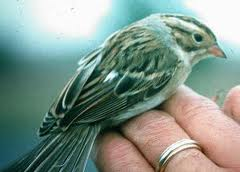
God of the sparrow
God of the whale
God of the swirling stars
How does the creature say Awe
How does the creature say Praise
God of the rainbow
God of the cross
God of the empty grave
How does the creature say Grace
How does the creature say Thanks
Jaroslav Vajda’s hymn, from which these words come, is loved for its inclusion of the creatures of earth and heaven in the spiritual life we humans share. And he raises in these verses the question Jesus raised: when, and why, do we say Thanks? What is the grace that is in us, or is absent from us, when mercy touches us?
Luke tells the story of ten lepers who beseech Jesus for mercy, mercy, keeping their distance, as by law they must. They are objects of fear and loathing. Not just their health, but their homes, their lives, friends, work, family, are gone because of this sickness that has grasped them.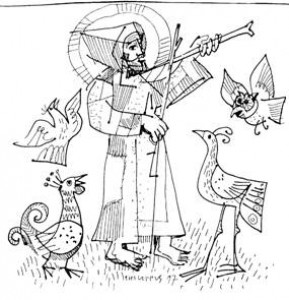
Jesus says, Go and show yourselves to a priest. (Who has the power to pronounce them clean.) They walk on. As they walk, they realize they are healed. One turns back to give praise and say thanks. The others keep on going.
Jesus asks the question: why do nine rush away without giving thanks, and why is this foreigner the only one who does? And, to that one who came back, he says: Your faith has made you well.
So Jesus makes a distinction between being healed and being well. And between being healed and having faith. He also distinguishes between this foreigner, who is outside the church, and the nine who are of the faith. And perhaps the answer to his question can be found within these distinctions.
The curse of leprosy has made the ten a community, joined in suffering and misfortune. They need one another. And because of their misfortune they have no others. Their prayer is a single voice with many echoes. Mercy! But healing will divide them, for it means different things to them. The mercy they long for is not just the restoration of their flesh, but restoration of their lives. They long to go home. And the steps that will take them there include the pronouncement of the priest that they are clean. Their joy is unreal without that. And so they rush onward, running away from their prayer to the next desired thing.
But joy will alwa ys elude them, for they only believe their healing when others believe it, they seek its confirmation from others, and so they will be forever subject to the joy-snatching comments Anne Lamott calls ‘drive-by shootings of the mouth’: Hey, aren’t you the guy who had leprosy?
They’ll be held at arms’ length by some, maybe even by some in the family. Recovering alcoholics, clean addicts, ex-cons, the disabled, all know about this kind of life. You can go home, but belonging at home is something else, when in someone else’s opinion you are still unclean, still unacceptable. And that seems to be where Jesus brought wellness in. Giving thanks is the beginning, because thanks is an act of accepting yourself as the be-gifted, the be-loved.
Thank you notes are such perfunctory cultural acts, nice to get, even nice to write, but more often ritual than blessing. Years ago my little niece, then eight, wrote after Christmas, with her habitual enthusiasm, “Thank you for the candles, we really needed them.” She underlined really twice, and put stars over it. She made me laugh, and so I kept her note around, but then, when she died suddenly a few months later, I read it over and over in tears, and ever since it has held her voice, her child’s spirit of joy, her infectious enthusiasm for the possibilities in gifts given. I give thanks for the words that keep her alive in my heart.
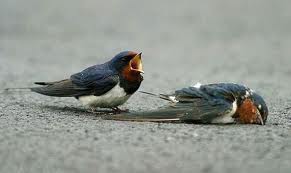 Communities of shared loss: parents who have lost a child; recovering addicts; cancer survivors; Parkinson’s sufferers; refugees: like the ten lepers, share a single prayer. Those who belong to them are forever changed by these communities. The memory of misery, its taste, feel, sorrow and grief, are ever part of those who heal, part of the survivors who love them, too. In the community of misery, they are home, even if not healed.
The one healed leper who could never belong in Israel because of being foreign, knew this. He understood that his home was now with the man who understood his misery in grace, who heard his prayer. The unkindness of the world cannot touch him, for he is not seeking a return to life before leprosy. He is walking forward into the unknown world of wellness, where what is foreign is no longer of importance, nor is what has been unclean, nor are there distinctions between the spirits of the living and the dead.
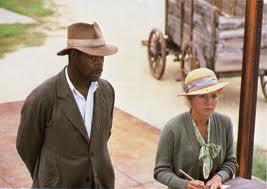 There is an old movie, Places in the Heart, a tale of depression era life in the American south. Murders, lynchings, and betrayals occur in it, and the bond between a white woman and a black man save a family. But they are eventually torn apart by racial bigots. The final scene takes place in a small country church, where communion is being passed among the pews. The dead are there, sharing pews and bread and wine with the living, shooter and shot, betrayer and betrayed, husband and cuckold, bigot and black man. It is a sacrament of surpassing joy. A thanks-giving to remember. An amazing grace.
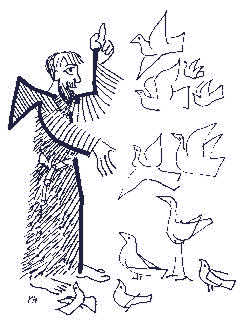 Saint Francis of Assisi, whose Feast was celebrated by the blessing of animals in many churches last week, understood himself as one who had received mercy, and because of it, become unable to distinguish himself from those who lived in misery. His prayer, which has been on the lips of millions, asks for these mercies:
where there is hatred, let me sow love;
where there is injury, pardon;
where there is error, truth;
where there is doubt, faith;
where there is despair, hope;
where there is darkness, light;
and where there is sadness, joy.
Such are the works of faith, and they make the world well.
_______________________________________________
Illustrations:
1. Sparrow. Sole image on Google is the TAT Forum, Spiritual Foundation site, tatfoundation.org, where it is used without attribution.
2. St. Francis and the Birds. Clip Art, used by Scott Breslin on his blog, scottbreslin.org
3. Beaten Man. Rijksmuseum. Amsterdam, Netherlands Unknown artist. 1537 Centraal Museum, Utrecht, Netherlands. Image from Wikipedia page for Centraal Museum.
5. The Grieving Sparrow. Google Images.
6. Places in the Heart. Freeze frame image.
7. St. Francis Preaches to the Birds clip art, unidentifiable except for its presence on a small number of blogs***.***
Previous Post

September 28, 2013
Faith - an Unslaked Thirst
Next Post
October 12, 2013 The Persistent Widow and the Heartless Judge
Browse Our Archives
Select a Category Bites Uncategorized
Select a Month December 2017 November 2017 October 2017 September 2017 August 2017 July 2017 June 2017 May 2017 April 2017 March 2017 February 2017 January 2017 December 2016 November 2016 October 2016 September 2016 August 2016 July 2016 June 2016 May 2016 April 2016 March 2016 February 2016 January 2016 December 2015 November 2015 October 2015 September 2015 August 2015 July 2015 June 2015 May 2015 April 2015 March 2015 February 2015 January 2015 December 2014 November 2014 October 2014 September 2014 August 2014 July 2014 June 2014 May 2014 April 2014 March 2014 February 2014 January 2014 December 2013 November 2013 October 2013 September 2013 August 2013 July 2013 June 2013 May 2013 April 2013 March 2013 February 2013 January 2013 December 2012
Follow Us!
TAKE THE
Religious Wisdom Quiz
Where was Paul headed when he encountered the risen Christ?
Select your answer to see how you score.
Jerusalem Rome Damascus Antioch
Related posts from The Bite in the Apple




TRENDING AT PATHEOS Progressive Christian

Why Christians Have a Sacred Duty to Vote:...
The Bible offers strong support for the sacred duty to vote. Here...

What Being a Modern-Day Apostle Means to Me
In my last column, I discussed the ins and outs of modern-day...

Did Ancient China Once Worship the God of...
Across human history, a common thread weaves through the origins of the...

Love Your Neighbor – Including Earth-Kin: Lev. 19,...
God’s command to love your neighbor means acting in an ethical and...

Lead a Church Study of “Jesus and Lao...
Guest writer Jack Thomas (The Irreverent Reverend) reflects on leading his church...

Principles for Understanding the Apostolic Ministry Today
Whenever people discover that my formal ministry title is "apostle," as in...
view all Progressive Christian blogs
Ad-Free & Subscriber Log-In Subscription Support
- About Us
- 2026 Calendar
- Videos
- Podcasts
- Library of World Religions
- Faith In Media Tracker
- Advertise With Us
- Write for Us
- Privacy Policy
- Terms of Service
- Do Not Sell My Data
- Contact Us
- Radiant Digital
- Manage Newsletter Subscriptions
- Unsubscribe From Notifications
- Sitemap
Copyright 2008-2026, Patheos. All rights reserved.
Subscription Support Ad-Free & Subscriber Log-In
Follow Patheos