
BuddhistCatholicContemplativeEvangelicalGeneral ChristianHinduJewishLatter-day SaintMuslimNew VisionsProgressive Christian
Beliefs
- Buddhist
- Catholic
- Contemplative
- Evangelical
- General Christian
- Hindu
- Jewish
- Latter-day Saint
- More Voices
- Muslim
- New Visions
- Pagan
- Progressive Christian
Topics
- Religion News
- Food and Religion
- Sports and Religion
- Religious Art
- Religious Music and Entertainment
- Religious Events
- History and Religion
- Style and Religion
- Politics and Religion
- Women in Religion
- Recreation Outdoors and Religion
- Business Finance and Religion
- Careers Workplace and Religion
- Education and Religion
- Family Parenting and Religion
- Health Fitness and Religion
- Home and Religion
- Relationships and Religion
- Technology and Religion
- Travel and Religion
Columnists
- Buddhist Columnists
- Business Finance and Religion Columnists
- Careers Workplace and Religion Columnists
- Catholic Columnists
- Contemplative Columnists
- Education and Religion Columnists
- Evangelists Columnists
- Family Parenting and Religion Columnists
- General Christian Columnists
- Health Fitness and Religion Columnists
- Hindu Columnists
- History and Religion Columnists
- Home and Religion Columnists
- Jewish Columnists
- More Voices Columnists
- Latter Day Columnists
- Muslim Columnists
- New Visions Columnists
- Nonreligious Columnists
- Pagan Columnists
- Politics and Religion Columnists
- Progressive Columnists
- Recreation Outdoors and Religion Columnists
- Relationships and Religion Columnists
- Religion News Columnists
- Religious Art Columnists
- Religious Events Columnists
- Religious Music and Entertainment Columnists
- Sports and Religion Columnists
- Style and Religion Columnists
- Technology and Religion Columnists
- Travel and Religion Columnists
- Women in Religion Columnists
Resource Library
- 2026 Calendar
- Library of World Religions
- The 100 Most Holy Places on Earth
- Patheos Answers
- Podcasts
- Videos
- Faith Leaders Database
- Anglican Episcopalian
- Bahai
- Baptist
- Buddhism
- Christianity
- Confucianism
- Eastern Orthodoxy
- Hinduism
- Holiness and Pentecostal
- ISKCON
- Islam
- Judaism
- Lutheran
- Methodist
- The Church of Jesus Christ of Latter-day Saints
- New Age
- Paganism
- Presbytarian and Reformed
- Protestantism
- Religion Behind the Scenes
- Roman Catholic
- Scientology
- Shia Islam
- Sikhism
- Sufism
- Sunni Islam
- Taoism
- Zen
- See all religions
Research Tools
 Ad-Free & Subscriber Log-In Subscription Support
Ad-Free & Subscriber Log-In Subscription Support
Follow Patheos 

- Trending:
- Forgiveness
- |
- Marriage
- |
- Consciousness
- |
- Death Penalty
- |
- Election
- |
- Halloween
 The Bite in the Apple
- Home
- Progressive Christian
- Holding Up the Kingdom Vision
Holding Up the Kingdom Vision
Last updated on: March 16, 2016 at 1:09 pm by Nancy Rockwell
Holding Up the Kingdom Vision 2016-03-16T13:09:39-04:00 Nancy Rockwell
Patheos Explore the world's faith through different perspectives on religion and spirituality! Patheos has the views of the prevalent religions and spiritualities of the world.
March 21, 2015 by Nancy Rockwell 2 Comments
 The Kingdom of God: Jesus challenged the kingdoms of this world ceaselessly with his provocative What Ifs about our world. Don’t like the powers that be? What if God were the ruler here? Tired of news about murder, hopelessness, angry young men choosing to be terrorists? What if this were God’s kingdom? Angry about your taxes? What if God, not Caesar, were asking you to cough up – what would it cost you then?
What if a man were lying, beaten, by the side of the road, and you came along . . .What if a sheep were lost . . . or a coin? What if a guy who hadn’t gone to church in donkey’s years, and whose work was pretty shady, went to synagogue one day to pray? What ifsomeone took good seed and scattered it everywhere?
God, Jesus could make you think about everything! And he could stop you from thinking about your resentments, could stop all the complaining all of us do, the ceaseless whining of grown-ups about how the world is going to hell. His What Ifs were about the world becoming heaven: God’s kingdom*.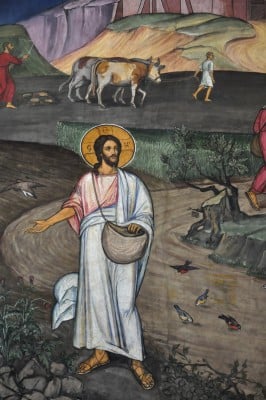 *
*
He didn’t start a protest movement, he started a here- on-earth- God-with-us movement. He didn’t start a political movement. But everything he said and did had political implications. He deliberately used kingdom language, knowing he was challenging the other kingdoms, Caesar and Pilate’s, Herod’s, the class system of the Temple, provoking anger and delight.
If Jesus had wanted to avoid the political connotations of kingdom language, he could have. He could have spoken about the family of God, or the people of God, or the community of God, or the kinship of God. But he didn’t, he talked about what life on earth would be like if God were King rather than the rulers people knew. (Marcus Borg, in Convictions).
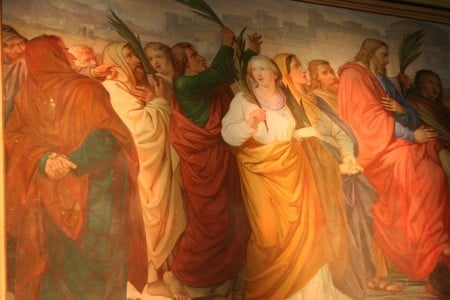
On Palm Sunday Jesus sharpened the contrast: he staged a Kingdom of Heaven entry into Jerusalem, in direct contrast to the frequent processional entries into the city by the battalions of Rome.
A few days later, he overthrew the tables of the money-changers and sellers of substitutionary offerings (animals to be sacrificed) in the temple.
The authorities had had enough. They tried to discredit him in public debate, but he was too skillful for that. Shall we pay taxes to Caesar, they asked, and it was a trap, for if he said No, they would arrest him right there, and if he said Yes he would be sanctioning their oppression. His asked them whose image was on the money. And of course it was Caesar’s. And they all knew the Ten Commandments, that God wants no graven images. Jesus tells them to give those images to Caesar. But what is God’s (their images, their lives) belongs to God. What is key here is that Jesus eluded their snare. He did not tell them to pay Caesar. Instead, he talked about images and loyalty.
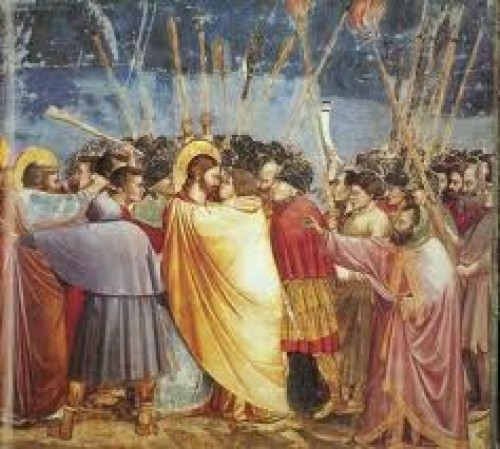 Then a betrayer told the authorities where he was staying. They arrested him at night, without a public outcry. All the ensuing details, the trial by the city councillors, the conversation with Herod, the scourging and the crown of thorns, the conversation with Pilate, the cross, all show how these authorities, whose power was publicly vested in God’s name, are unholy, for all of them are saying No, saying No over and over, saying No singly and collectively, to the kingdom of God.
Good Friday is the loudest No to God in the Bible. It is not the only No to God in scripture, but it is the most deafening, door-slamming No. It is a public No to God said by the principalities and powers of this world, a No that lives forever in human history.
Some say Jesus chose this and some say God chose it for him. Some say Jesus suffered and died as a kind of payment (an atonement, a redeeming) for all our unholy Nos to God. Some say Jesus was born to die this death, it was his main purpose. All these are familiar ideas. But not all serve the idea of the Kingdom of God here on earth.
Marcus Borg notes that all the gospels anticipate Jesus’ execution early in their narratives, but none of them teaches that his death was payment for sin. And neither does Paul say this , though the cross and Christ crucified are central in his writings. The gospels are an anti-imperial vision of what the world should look like. As are Paul’s letters. The cross is an accusation against the imperial powers.
Calling Jesus’ crucifixion a choice is a misunderstanding. When we look at some Christians who have incurred death through teac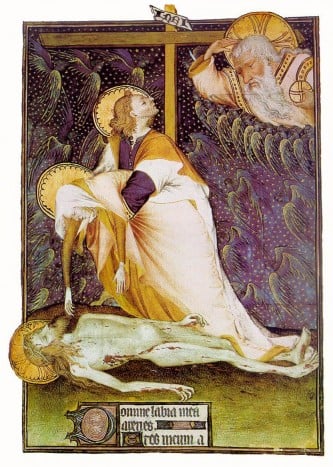 hing and acting as Christ did, Dietrich Bonhoeffer, Martin Luther King Jr., and Oscar Romero, we can see that they did not want to die, but they did understand they were taking risks that could lead to death.
The importance of their proclamation of a different vision of the world led them to believe taking those risks was worthwhile. Bonhoeffer opposed the Third Reich and Hitler with the vision of the kingdom of God. King opposed racism and segregation in America with the same vision. And Romero opposed the brutally violent dictatorship of El Salvador with that vision. Each of them was transformed in their understanding of what their own life meant by internalizing Jesus’ vision of a world that was for all, a vision that can transform everyone’s life. It is not death they chose, it is not death that Jesus chose, but life, with God, here on earth.
Thank God, the story does not end with crucifixion.
__________________________________________________________
Illustrations:
1. Jesus Entering Jerusalem – detail. Parish Church of Zirl, Austria. Mural. Vanderbilt Divinity School Library, Art in the Christian Tradition.
2. A Sower Went Out to Sow, mosaic in Brasov, Romania. Vanderbilt Divinity School Library, Art in the Christian Tradition.
3. The Arrest of Jesus (Judas’ Kiss) by Giotto. Vanderbilt Divinity School Library, Art in the Christian Tradition.
7. John and Mary in Lamention After the Crucifixion. c.1430, from Heures de Rohan, by The Rohan Master, Bibliotheque Nationale de France, Paris. Vanderbilt Divinity School Library, Art in the Christian Tradition
Previous Post

March 13, 2016
The Trail of Tears That Leads to Easter
Next Post

March 20, 2016 What’s Up?
Browse Our Archives
Select a Category Bites Uncategorized
Select a Month December 2017 November 2017 October 2017 September 2017 August 2017 July 2017 June 2017 May 2017 April 2017 March 2017 February 2017 January 2017 December 2016 November 2016 October 2016 September 2016 August 2016 July 2016 June 2016 May 2016 April 2016 March 2016 February 2016 January 2016 December 2015 November 2015 October 2015 September 2015 August 2015 July 2015 June 2015 May 2015 April 2015 March 2015 February 2015 January 2015 December 2014 November 2014 October 2014 September 2014 August 2014 July 2014 June 2014 May 2014 April 2014 March 2014 February 2014 January 2014 December 2013 November 2013 October 2013 September 2013 August 2013 July 2013 June 2013 May 2013 April 2013 March 2013 February 2013 January 2013 December 2012
Follow Us!
TAKE THE
Religious Wisdom Quiz
Which sea did God part for the Israelites to escape Egypt?
Select your answer to see how you score.
Jordan River Red Sea Sea of Galilee Dead Sea
Related posts from The Bite in the Apple



TRENDING AT PATHEOS Progressive Christian

Why Christians Have a Sacred Duty to Vote:...
The Bible offers strong support for the sacred duty to vote. Here...

What Being a Modern-Day Apostle Means to Me
In my last column, I discussed the ins and outs of modern-day...

Did Ancient China Once Worship the God of...
Across human history, a common thread weaves through the origins of the...

Love Your Neighbor – Including Earth-Kin: Lev. 19,...
God’s command to love your neighbor means acting in an ethical and...

Lead a Church Study of “Jesus and Lao...
Guest writer Jack Thomas (The Irreverent Reverend) reflects on leading his church...

Principles for Understanding the Apostolic Ministry Today
Whenever people discover that my formal ministry title is "apostle," as in...
view all Progressive Christian blogs
Ad-Free & Subscriber Log-In Subscription Support
- About Us
- 2026 Calendar
- Videos
- Podcasts
- Library of World Religions
- Faith In Media Tracker
- Advertise With Us
- Write for Us
- Privacy Policy
- Terms of Service
- Do Not Sell My Data
- Contact Us
- Radiant Digital
- Manage Newsletter Subscriptions
- Unsubscribe From Notifications
- Sitemap
Copyright 2008-2026, Patheos. All rights reserved.
Subscription Support Ad-Free & Subscriber Log-In
Follow Patheos