
BuddhistCatholicContemplativeEvangelicalGeneral ChristianHinduJewishLatter-day SaintMuslimNew VisionsProgressive Christian
Beliefs
- Buddhist
- Catholic
- Contemplative
- Evangelical
- General Christian
- Hindu
- Jewish
- Latter-day Saint
- More Voices
- Muslim
- New Visions
- Pagan
- Progressive Christian
Topics
- Religion News
- Food and Religion
- Sports and Religion
- Religious Art
- Religious Music and Entertainment
- Religious Events
- History and Religion
- Style and Religion
- Politics and Religion
- Women in Religion
- Recreation Outdoors and Religion
- Business Finance and Religion
- Careers Workplace and Religion
- Education and Religion
- Family Parenting and Religion
- Health Fitness and Religion
- Home and Religion
- Relationships and Religion
- Technology and Religion
- Travel and Religion
Columnists
- Buddhist Columnists
- Business Finance and Religion Columnists
- Careers Workplace and Religion Columnists
- Catholic Columnists
- Contemplative Columnists
- Education and Religion Columnists
- Evangelists Columnists
- Family Parenting and Religion Columnists
- General Christian Columnists
- Health Fitness and Religion Columnists
- Hindu Columnists
- History and Religion Columnists
- Home and Religion Columnists
- Jewish Columnists
- More Voices Columnists
- Latter Day Columnists
- Muslim Columnists
- New Visions Columnists
- Nonreligious Columnists
- Pagan Columnists
- Politics and Religion Columnists
- Progressive Columnists
- Recreation Outdoors and Religion Columnists
- Relationships and Religion Columnists
- Religion News Columnists
- Religious Art Columnists
- Religious Events Columnists
- Religious Music and Entertainment Columnists
- Sports and Religion Columnists
- Style and Religion Columnists
- Technology and Religion Columnists
- Travel and Religion Columnists
- Women in Religion Columnists
Resource Library
- 2026 Calendar
- Library of World Religions
- The 100 Most Holy Places on Earth
- Patheos Answers
- Podcasts
- Videos
- Faith Leaders Database
- Anglican Episcopalian
- Bahai
- Baptist
- Buddhism
- Christianity
- Confucianism
- Eastern Orthodoxy
- Hinduism
- Holiness and Pentecostal
- ISKCON
- Islam
- Judaism
- Lutheran
- Methodist
- The Church of Jesus Christ of Latter-day Saints
- New Age
- Paganism
- Presbytarian and Reformed
- Protestantism
- Religion Behind the Scenes
- Roman Catholic
- Scientology
- Shia Islam
- Sikhism
- Sufism
- Sunni Islam
- Taoism
- Zen
- See all religions
Research Tools
 Ad-Free & Subscriber Log-In Subscription Support
Ad-Free & Subscriber Log-In Subscription Support
Follow Patheos 

- Trending:
- Forgiveness
- |
- Marriage
- |
- Consciousness
- |
- Death Penalty
- |
- Election
- |
- Halloween
 The Bite in the Apple
- Home
- Progressive Christian
- Godbearer
Godbearer
Last updated on: December 16, 2012 at 8:00 am by Nancy Rockwell
Godbearer 2012-12-16T08:00:04-04:00 Nancy Rockwell
Patheos Explore the world's faith through different perspectives on religion and spirituality! Patheos has the views of the prevalent religions and spiritualities of the world.
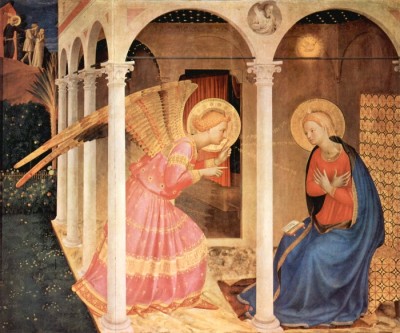
We are all called to be mothers of God, for God is always waiting to be born.
— Meister Eckart, 1260 – 1327
She enters our Decembers with an angel, gloriously winged, who honors her. The moment is spellbinding: we are entranced by the arrival of this woman, Mary, on the stage of Christmas and in the story of God.
And the angel honors her: Hail Mary, full of grace . . . . Is the angel bowing – kneeling – looking down – while speaking? So very many images say yes, but Luke’s words don’t tell us the posture, only the words the angel says. The poses in the paintings are our awe.
The grace the angel honors is already hers, though she is not yet ‘with child’. It is her grace that has brought the angel, and the invitation. She reflects. She questions: angel-who-are-you, and how can this be? The angel explains: it is your spirit God seeks as Godbearer, and it is God’s spirit that will enter you.
For two thousand years we have chattered, endlessly, about her womb. Yet the angel did not honor her virginity, or her abstinence, or ask for her submission. The honor was for her grace. And by the angel’s persuading her with answers, we know she did not submit: she consented.
The chatter, our chatter, has rendered her a freak of nature. And this has become doctrine. Alone of all her sex, historian Marina Warner calls her. But this is not what the angel honored, not what the angel sought. Nor is it what she consented to become.
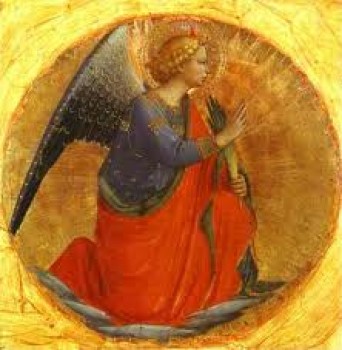 Mary, the first woman called as a prophetic servant of God, became the only woman in the prophetic lineage, and one who speaks to Gentiles as well as Jews.
Her call occurs in the pattern by which Jewish prophets are recognizably called: angels come to them. To Gideon in the winepress, to Isaiah in the temple vision, to Ezekiel in a vision in the sky, to Jonah in dreams in a strange land, angels came asking, will you serve God in this terrible, murderous time?
Each prophet decides, as Mary decides: with questions, some reflection, and a deep understanding of the hope and hardness of what is being asked. They answer with the grace that is in them.
After she says Yes to the angel, Mary sets out on a journey. Alone. And she stays away for months, we are told. Elijah, Isaiah, Ezekiel, Jeremiah, Samuel, Jonah, all set forth on journeys, alone, at the inauguration of their calling as servants. Each bears the word of God to someone who is unlikely to receive it well. Kings, mostly. Mary travels to the home of a prominent temple priest, Zechariah, who has been struck dumb for refusing to believe angelic hope brought to his wife, Mary’s cousin. Upon arriving at Zechariah’s home, Mary delivers her Magnificat, with all the authority and clarity of Elijah speaking to King Ahab.
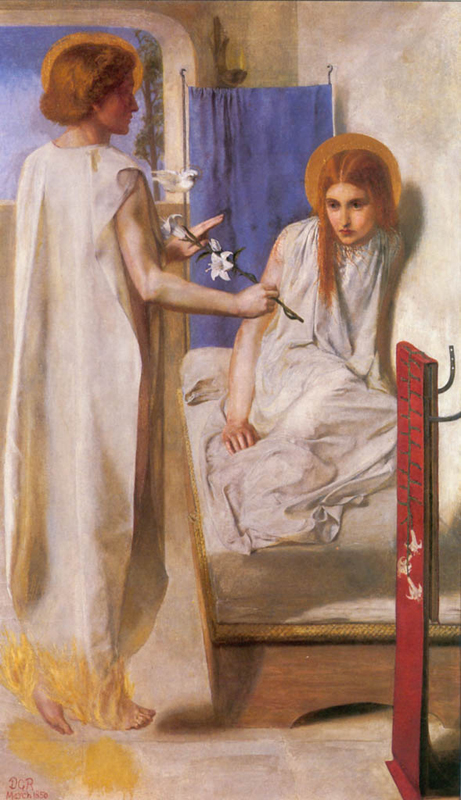 In the gospels (unlike the paintings), Mary is never shown at home. Most biblical women are shown in domestic scenes, but not Mary: she does not bake cakes as Sarah and the widow of Zarephath do, as Hannah longs to do. Her child is born in a stable, not a house. She then flees to exile in Egypt.
After that, she is seen at the Temple when Jesus is twelve, at a wedding in Cana, outside the door of a place where he is speaking, at the foot of the cross and at his grave. Likewise, the prophets are never shown in their homes, places they leave to bear God’s word to places where they are sent.
Mary’s words, like Jeremiah’s, Elijah’s, Isaiah’s, ring with life. There is wildness in them, and immense faith. She says her soul is enlarging God. Not her womb: her soul.
Some compare her song to Hannah’s, who indeed does sing a hymn of praise, but Hannah’s song is full of prayer and longing. Mary’s song is prophetic, bold in its assertion of history-changing life, and her service in that. There is nothing domestic about Mary. And everything domestic about Hannah, who longs for a child so she will be more at home.
Hannah’s child is God’s gift to her; the Child in Mary’s womb is her service to God: deeply physical service which is deeply spiritual. Physical service is true for all major prophets: Isaiah endures hot coals on his tongue. Elijah endures famine, and hides from death threats in the wild for years, and then in the home of the impoverished widow of Zarephath, with whom he shares their only food, flour and oil, for months. Ezekiel suffers exile in Babylon, where he weeps and has visions. Jeremiah, naked except for a loin cloth, runs a marathon for God’s sake, then goes into exile, where he writes the Lamentations. The work of prophecy is physical work: bearing God into a weary and unwelcoming world. Mary bears her child in the most dangerous possible place, a place strewn with the bodies of slaughtered children. In that place she lies down among animals, gives birth, gets up, and flees. And in this she claims that town for God.
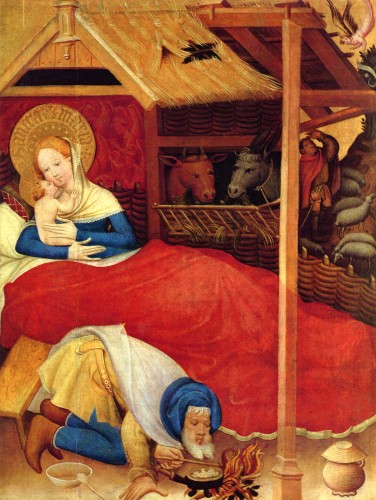 Mary sings stunning words: the fruitfulness of the reign of God will be increased through her child.
Luke knows that in Greek, and Roman cultures, prevailing cultures in his time, kings receive their sovereignty from goddess-women who become their wives. Their lands, their crops, their wars, as well as their lineage, in sum, their sovereignty, depend upon these women for fruitfulness.
Catholic tradition has long understood Mary as the Queen of Heaven, sovereign of fruitfulness in the reign of God. But Luke, a Greek citizen and a Jew, surely understood that in Judaism the prophets have these powers and this role. Kings need prophetic blessing and anointing in order to reign. Samuel takes his anointing away from Saul, whose kingship withers, and passes it to David. Elijah takes the rain away from the land and curses Ahab’s throne. Jeremiah preserves the claim of God to Israel even as the people are driven out of the land, by solemnly buying land and burying a deed. Mary withdraws the blessing of God from the rich, the proud and the mighty, and gives it to the hungry. She bears a child among the slaughtered, and in this, defines Bethlehem.
Like her European sisters, she has power rooted in nature itself. Her tears, in folkloric tradition, become roses, flowers spring up in her footsteps. She bears her Child among animals, shows him only to shepherds, and outruns an army to protect him from a King whose reign is fruitless. Christmas comes to us through Mary: she is Bethlehem.
All this magic is worked within
the earthy Mary, where the Child
is filled with grace and born with marvelous
capacity, alive and kicking, growing,
laughing, breathing, speaking, waxing wise.
Knitting the eternal into dust,
Mary makes a life that can outlast a lifetime –
mortal, with tired eyes and weary feet,
and immortal, shining, sustaining
even a body broken.
The earth, too, within her deep storehouse,
mothers strength to grow beyond winter,
ponders possibility and providence,
contemplates fruitfulness,
Mary-ing another springtime for this world.
In gathering shadows December cloaks
the cold ground with everlasting light.
We wander among miracles as
the hopes and fears of all the years are met in us.
And it is Christmas, once again.
–from December Light by Nancy Rockwell
______________________________________________________________
Illustrations:
1. Annunciation. Fra Angelico. 1434. Cortona, Italy. Vanderbilt Divinity School Library, Art in the Christian Tradition.
2. Annunciation. Fra Angelico. 1417. Perugia, Italy. Image from Wikimedia Commons.
3. Ecce Ancilla Domini! (Behold the Lord’s Servant!) Rosetti, Dante Gabriel. 1849-50. Tate Gallery, London. Vanderbilt Divinity School Library, Art in the Christian Tradition.
4. Christ’s Birth. Conrad von Soest. 1403. Bad Wildungen, Germany. Vanderbilt Divinity School Library, Art in the Christian Tradition.
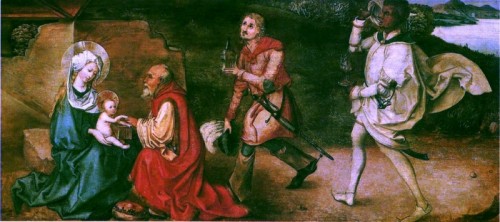
5. Adoration of the Christ Child by the Three Wise Men. Albrecht. Durer. 1490-93. Basel, Switzerland. Vanderbilt Divinity School Library, Art in the Christian Tradition.
.
Previous Post

December 9, 2012
Every Stone Shall Cry
Next Post
December 17, 2012 The Innocents
Browse Our Archives
Select a Category Bites Uncategorized
Select a Month December 2017 November 2017 October 2017 September 2017 August 2017 July 2017 June 2017 May 2017 April 2017 March 2017 February 2017 January 2017 December 2016 November 2016 October 2016 September 2016 August 2016 July 2016 June 2016 May 2016 April 2016 March 2016 February 2016 January 2016 December 2015 November 2015 October 2015 September 2015 August 2015 July 2015 June 2015 May 2015 April 2015 March 2015 February 2015 January 2015 December 2014 November 2014 October 2014 September 2014 August 2014 July 2014 June 2014 May 2014 April 2014 March 2014 February 2014 January 2014 December 2013 November 2013 October 2013 September 2013 August 2013 July 2013 June 2013 May 2013 April 2013 March 2013 February 2013 January 2013 December 2012
Follow Us!
TAKE THE
Religious Wisdom Quiz
What did Hannah bring annually for Samuel when he lived at the Tabernacle?
Select your answer to see how you score.
A crown A robe A staff A candle
Related posts from The Bite in the Apple




TRENDING AT PATHEOS Progressive Christian

Why Christians Have a Sacred Duty to Vote:...
The Bible offers strong support for the sacred duty to vote. Here...

What Being a Modern-Day Apostle Means to Me
In my last column, I discussed the ins and outs of modern-day...

Did Ancient China Once Worship the God of...
Across human history, a common thread weaves through the origins of the...

Love Your Neighbor – Including Earth-Kin: Lev. 19,...
God’s command to love your neighbor means acting in an ethical and...

Lead a Church Study of “Jesus and Lao...
Guest writer Jack Thomas (The Irreverent Reverend) reflects on leading his church...

Principles for Understanding the Apostolic Ministry Today
Whenever people discover that my formal ministry title is "apostle," as in...
view all Progressive Christian blogs
Ad-Free & Subscriber Log-In Subscription Support
- About Us
- 2026 Calendar
- Videos
- Podcasts
- Library of World Religions
- Faith In Media Tracker
- Advertise With Us
- Write for Us
- Privacy Policy
- Terms of Service
- Do Not Sell My Data
- Contact Us
- Radiant Digital
- Manage Newsletter Subscriptions
- Unsubscribe From Notifications
- Sitemap
Copyright 2008-2026, Patheos. All rights reserved.
Subscription Support Ad-Free & Subscriber Log-In
Follow Patheos