
BuddhistCatholicContemplativeEvangelicalGeneral ChristianHinduJewishLatter-day SaintMuslimNew VisionsProgressive Christian
Beliefs
- Buddhist
- Catholic
- Contemplative
- Evangelical
- General Christian
- Hindu
- Jewish
- Latter-day Saint
- More Voices
- Muslim
- New Visions
- Pagan
- Progressive Christian
Topics
- Religion News
- Food and Religion
- Sports and Religion
- Religious Art
- Religious Music and Entertainment
- Religious Events
- History and Religion
- Style and Religion
- Politics and Religion
- Women in Religion
- Recreation Outdoors and Religion
- Business Finance and Religion
- Careers Workplace and Religion
- Education and Religion
- Family Parenting and Religion
- Health Fitness and Religion
- Home and Religion
- Relationships and Religion
- Technology and Religion
- Travel and Religion
Columnists
- Buddhist Columnists
- Business Finance and Religion Columnists
- Careers Workplace and Religion Columnists
- Catholic Columnists
- Contemplative Columnists
- Education and Religion Columnists
- Evangelists Columnists
- Family Parenting and Religion Columnists
- General Christian Columnists
- Health Fitness and Religion Columnists
- Hindu Columnists
- History and Religion Columnists
- Home and Religion Columnists
- Jewish Columnists
- More Voices Columnists
- Latter Day Columnists
- Muslim Columnists
- New Visions Columnists
- Nonreligious Columnists
- Pagan Columnists
- Politics and Religion Columnists
- Progressive Columnists
- Recreation Outdoors and Religion Columnists
- Relationships and Religion Columnists
- Religion News Columnists
- Religious Art Columnists
- Religious Events Columnists
- Religious Music and Entertainment Columnists
- Sports and Religion Columnists
- Style and Religion Columnists
- Technology and Religion Columnists
- Travel and Religion Columnists
- Women in Religion Columnists
Resource Library
- 2026 Calendar
- Library of World Religions
- The 100 Most Holy Places on Earth
- Patheos Answers
- Podcasts
- Videos
- Faith Leaders Database
- Anglican Episcopalian
- Bahai
- Baptist
- Buddhism
- Christianity
- Confucianism
- Eastern Orthodoxy
- Hinduism
- Holiness and Pentecostal
- ISKCON
- Islam
- Judaism
- Lutheran
- Methodist
- The Church of Jesus Christ of Latter-day Saints
- New Age
- Paganism
- Presbytarian and Reformed
- Protestantism
- Religion Behind the Scenes
- Roman Catholic
- Scientology
- Shia Islam
- Sikhism
- Sufism
- Sunni Islam
- Taoism
- Zen
- See all religions
Research Tools
 Ad-Free & Subscriber Log-In Subscription Support
Ad-Free & Subscriber Log-In Subscription Support
Follow Patheos 

- Trending:
- Forgiveness
- |
- Marriage
- |
- Consciousness
- |
- Death Penalty
- |
- Election
- |
- Halloween
 The Bite in the Apple
- Home
- Progressive Christian
- Flesh and the Miracle of Fine Wine
Flesh and the Miracle of Fine Wine
Last updated on: January 15, 2016 at 12:07 pm by Nancy Rockwell
Flesh and the Miracle of Fine Wine 2016-01-15T12:07:34-04:00 Nancy Rockwell
Patheos Explore the world's faith through different perspectives on religion and spirituality! Patheos has the views of the prevalent religions and spiritualities of the world.
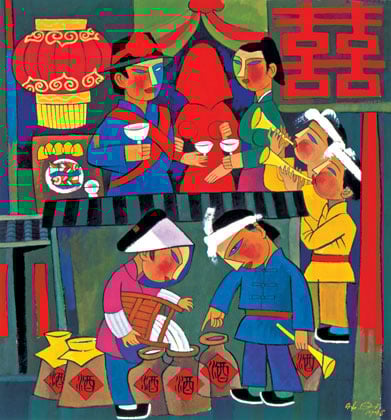 Jesus was not a Marrying Parson. He left us no sermons about marriage and family life, paid no house calls on couples with kids and gave no advice about handling the toddler temper, the unruly adolescent, or each other, as the years go by. At Cana, he does not offer a formal blessing to the bride and groom, nor does he offer a few words about love.
When the wine runs out, his mother holds him responsible. Why, I wonder?
Did she think his disciples had drunk too much, and the wine shortage is their fault? Heavens! Is it Jesus fault? Someone here has drunk far more than anticipated, that’s clear.
Was she so impatient for him to dazzle the general public with his divinity? To get on with it, and be the Messiah? But surely this couldn’t be the public unveiling of him she had dreamed of. She, who had sung about him pulling the mighty from their thrones, filling the hungry with good things and sending the rich empty away, would she want to settle for a mere magic trick — making more wine?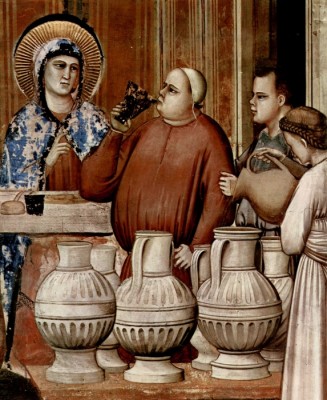
Whatever the reason, she presses him, and he growls in displeasure at her prodding, and then finally does this thing, that John calls ‘the first of the signs that reveal his glory.’ He changes six stone jars of water, twenty to thirty gallons each, into wine. ‘The best wine’, the steward pronounces, chiding the bridegroom now for having kept the best till last, when a minute ago he was wringing his hands about no wine at all.
The water in those stone jars had been set aside for the Jewish rites of purification, John tells us. And now, because of Jesus, there is no water for purification. John, so deft with symbols, leaves this one for us to deal with: it will not be possible to wash away your sins after this marriage. And — it will not be necessary. Six jars – six days of creation – the creation does not need to be purified – the creation is deliciously good.
And now, because of Jesus, it will be possible to savor the pleasures of the flesh in an unbridled celebration of wine-infused dancing, lifting them up on Jewish chairs, shivaree-shouting the bride and groom off to their marriage bed and falling into licit or illicit pleasures in your own.
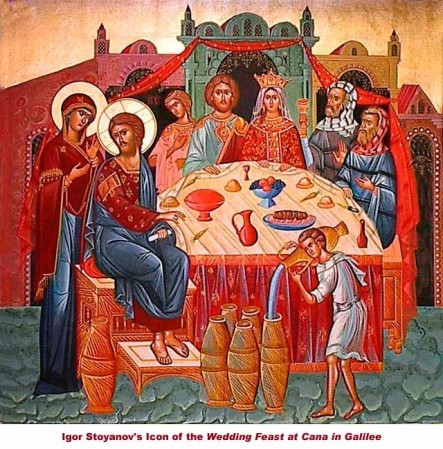 And this scene, this wild and joyous, somewhat raucous, slightly drunken scene, does fit with all four gospels’ portrayal of Jesus as a man who disdains the pieties that mark purity, such as the Sabbath laws, as a man who enfolds the unclean in what he calls a greater purity, the faithful longing of the heart for love: hearts he finds in prostitutes, lepers, a very short tax collector, and the poor.
Protestants, in general, have flipped these symbols: still caught in the temperance traditions that became the country’s greatest legislative mistake, Prohibition, many Protestants continue to use the language of ‘new wine’, meaning they think Jesus drank grape juice. They would much prefer a Jesus who changes wine into water, and who concentrates on purification rather than fueling desire. Protestant church halls are havens for coffee-drinking AA meetings. Church boards solemnly debate requests to serve wine at wedding receptions held on their grounds – and there are precious few weddings held on their grounds these days, and the need to debate, the imposing of a common limit of one toast, is part of the reasons people prefer to celebrate their weddings elsewhere nowadays– so they can celebrate marriage as Jesus did.
Catholics have turned the Cana tale into a catechism for marriage, exercises to prepare brides and groom to live in mutual respect and stay married, complete with injunctions against birth control and abortion, as if Jesus’ sacrosanct presence had made Cana a model of Christian marriage. Church frescoes and paintings over the centuries have portrayed Jesus and Mary wearing halos and seated as special guests. You really don’t need to perform miracles when you arriving wearing haloes, people already know you are holy/weird/not-like-anybody-else, Mary is often dressed as a nun in these portraits, Jesus is always very solemn, and both of them are often larger than the other people at the wedding. John offers us none of this in either of them – he shows us people who love a party.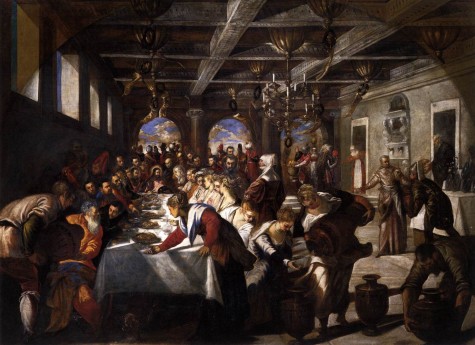
Maybe Mary did, in fact, want Jesus to start his self-revealing at a wedding. Maybe she did want him to begin his mighty deeds with an act of filling the hungry with good wine – at the beginning, as at the supper, wine! Maybe the delights of the flesh are important enough to her – and to all the hungry of the earth – to make their celebration with wine a great symbol indeed. Flesh, and its desires, are given to all of us, not meted out by priests as sacraments but inborn. Flesh and desire have the power to grow us into adulthood through adventures that are baptisms of spirit and fire.
Maybe the inviting of friends and family to witness the joy two have found together, and the hopeful future they dare to embark upon, is the best of occasions – outside of a manger – for Jesus to offer us a miracle that changes no-more into more-than-enough and even into the-very-best-of-all-good-things. We take Jesus’ weeping seriously. Perhaps we do him an injustice by ignoring his love of parties, his love of the life of the flesh. We assume in him an asceticism and a celibacy that may not, in fact, be the case. At Cana, we learn, at the very least, that he loved good wine.
Love him in the world of the flesh, and at your marriage, all its occasions shall dance for joy. – W.H. Auden, in For the Time Being: A Christmas Oratorio.
_______________________________________________________________________________________
Illustrations:
1. Wedding at Cana. by He Qi. Nanjing, China. 2001. Vanderbilt Divinity School Library, Art in the Christian Tradition*.*
2. Wedding at Cana. by Giotto di Bondone, Scrovegni Chapel, Padua, Italy. 1304. Vanderbilt Divinity School Library, Art in the Christian Tradition.
3. Icon-of-the-Wedding-Feast-at-Cana-in-Galilee, by Igor-Stoyanovs. Wikimedia commons.
4.Marriage at Cana, by Jacopo Tintoretto, 1561. en-wikipedia.org.
Previous Post

January 8, 2016
Abiding Grace in Downton Abbey
Next Post
January 14, 2016 Rights and Wrongs: Thinking About Race in Our Time
Browse Our Archives
Select a Category Bites Uncategorized
Select a Month December 2017 November 2017 October 2017 September 2017 August 2017 July 2017 June 2017 May 2017 April 2017 March 2017 February 2017 January 2017 December 2016 November 2016 October 2016 September 2016 August 2016 July 2016 June 2016 May 2016 April 2016 March 2016 February 2016 January 2016 December 2015 November 2015 October 2015 September 2015 August 2015 July 2015 June 2015 May 2015 April 2015 March 2015 February 2015 January 2015 December 2014 November 2014 October 2014 September 2014 August 2014 July 2014 June 2014 May 2014 April 2014 March 2014 February 2014 January 2014 December 2013 November 2013 October 2013 September 2013 August 2013 July 2013 June 2013 May 2013 April 2013 March 2013 February 2013 January 2013 December 2012
Follow Us!
TAKE THE
Religious Wisdom Quiz
What does "Amen" originally mean?
Select your answer to see how you score.
So be it Praise God Let it happen Be true
Related posts from The Bite in the Apple



TRENDING AT PATHEOS Progressive Christian

Why Christians Have a Sacred Duty to Vote:...
The Bible offers strong support for the sacred duty to vote. Here...

What Being a Modern-Day Apostle Means to Me
In my last column, I discussed the ins and outs of modern-day...

Did Ancient China Once Worship the God of...
Across human history, a common thread weaves through the origins of the...

Love Your Neighbor – Including Earth-Kin: Lev. 19,...
God’s command to love your neighbor means acting in an ethical and...

Lead a Church Study of “Jesus and Lao...
Guest writer Jack Thomas (The Irreverent Reverend) reflects on leading his church...

Principles for Understanding the Apostolic Ministry Today
Whenever people discover that my formal ministry title is "apostle," as in...
view all Progressive Christian blogs
Ad-Free & Subscriber Log-In Subscription Support
- About Us
- 2026 Calendar
- Videos
- Podcasts
- Library of World Religions
- Faith In Media Tracker
- Advertise With Us
- Write for Us
- Privacy Policy
- Terms of Service
- Do Not Sell My Data
- Contact Us
- Radiant Digital
- Manage Newsletter Subscriptions
- Unsubscribe From Notifications
- Sitemap
Copyright 2008-2026, Patheos. All rights reserved.
Subscription Support Ad-Free & Subscriber Log-In
Follow Patheos