
BuddhistCatholicContemplativeEvangelicalGeneral ChristianHinduJewishLatter-day SaintMuslimNew VisionsProgressive Christian
Beliefs
- Buddhist
- Catholic
- Contemplative
- Evangelical
- General Christian
- Hindu
- Jewish
- Latter-day Saint
- More Voices
- Muslim
- New Visions
- Pagan
- Progressive Christian
Topics
- Religion News
- Food and Religion
- Sports and Religion
- Religious Art
- Religious Music and Entertainment
- Religious Events
- History and Religion
- Style and Religion
- Politics and Religion
- Women in Religion
- Recreation Outdoors and Religion
- Business Finance and Religion
- Careers Workplace and Religion
- Education and Religion
- Family Parenting and Religion
- Health Fitness and Religion
- Home and Religion
- Relationships and Religion
- Technology and Religion
- Travel and Religion
Columnists
- Buddhist Columnists
- Business Finance and Religion Columnists
- Careers Workplace and Religion Columnists
- Catholic Columnists
- Contemplative Columnists
- Education and Religion Columnists
- Evangelists Columnists
- Family Parenting and Religion Columnists
- General Christian Columnists
- Health Fitness and Religion Columnists
- Hindu Columnists
- History and Religion Columnists
- Home and Religion Columnists
- Jewish Columnists
- More Voices Columnists
- Latter Day Columnists
- Muslim Columnists
- New Visions Columnists
- Nonreligious Columnists
- Pagan Columnists
- Politics and Religion Columnists
- Progressive Columnists
- Recreation Outdoors and Religion Columnists
- Relationships and Religion Columnists
- Religion News Columnists
- Religious Art Columnists
- Religious Events Columnists
- Religious Music and Entertainment Columnists
- Sports and Religion Columnists
- Style and Religion Columnists
- Technology and Religion Columnists
- Travel and Religion Columnists
- Women in Religion Columnists
Resource Library
- 2026 Calendar
- Library of World Religions
- The 100 Most Holy Places on Earth
- Patheos Answers
- Podcasts
- Videos
- Faith Leaders Database
- Anglican Episcopalian
- Bahai
- Baptist
- Buddhism
- Christianity
- Confucianism
- Eastern Orthodoxy
- Hinduism
- Holiness and Pentecostal
- ISKCON
- Islam
- Judaism
- Lutheran
- Methodist
- The Church of Jesus Christ of Latter-day Saints
- New Age
- Paganism
- Presbytarian and Reformed
- Protestantism
- Religion Behind the Scenes
- Roman Catholic
- Scientology
- Shia Islam
- Sikhism
- Sufism
- Sunni Islam
- Taoism
- Zen
- See all religions
Research Tools
 Ad-Free & Subscriber Log-In Subscription Support
Ad-Free & Subscriber Log-In Subscription Support
Follow Patheos 

- Trending:
- Forgiveness
- |
- Marriage
- |
- Consciousness
- |
- Death Penalty
- |
- Election
- |
- Halloween
 The Bite in the Apple
- Home
- Progressive Christian
- Fearlessness
Fearlessness
Last updated on: December 15, 2014 at 11:38 am by Nancy Rockwell
Fearlessness 2014-12-15T11:38:31-04:00 Nancy Rockwell
Patheos Explore the world's faith through different perspectives on religion and spirituality! Patheos has the views of the prevalent religions and spiritualities of the world.
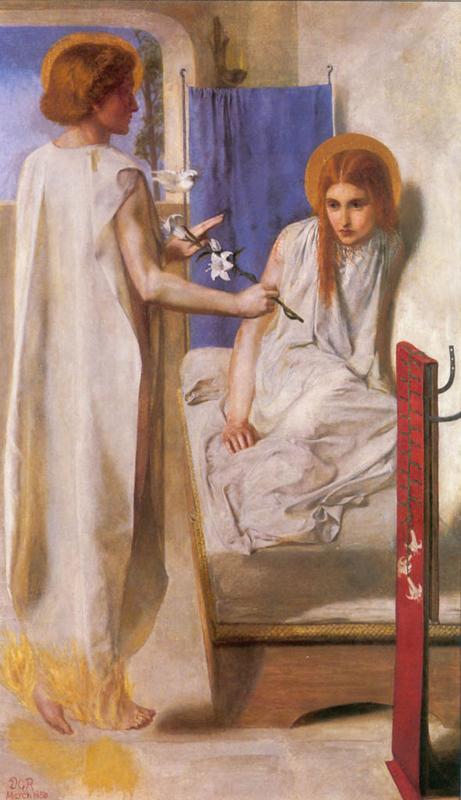 We are all called to be mothers of God – for God is always waiting to be born. – Meister Eckhart, 13th c. German mystic
It is only Luke who includes the conversation between the Archangel Gabriel and Mary, a conversation of questions, explanations, and then consent to bear a Child who will change the world. According to Matthew, the issue at hand, the how-shall-this-happen question that follows the Child to this day, was Joseph’s issue, and it was to Joseph that the angel spoke, it was Joseph’s questions that the angel answered, and it was Joseph’s consent to this pregnancy that Matthew remembers.
The other gospels do not deal with Jesus’ birth. Mark manifests his divinity at his baptism. John threads it into the cosmos, before the world began.But according to Luke, Mary is not a passive vessel, she is spiritually integral to the creation of this child. The angel acknowledges her as full of grace before their conversation, and before her consent, and before she becomes pregnant. Luke then tells us of her journey and her speech, both made in response to her pregnancy, and in response to her conversation with the angel. Both her journey and her speech are prophetic; passionate; determined; full of the grace the angel had named as particular to her, in the first moment of their meeting.
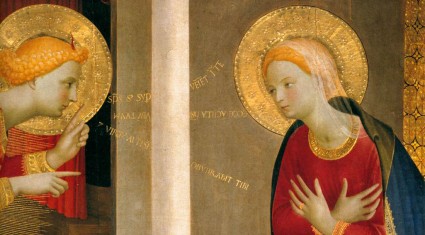 The interactions between angels and women in biblical literature are rare, and indirect. Angels converse with Abraham, asking about Sarah, and relaying a message to her, through him, about a child. They are at last answering her prayer, long years after her beseeching had begun. And though they make the point to Abraham that it is her prayer, not his, that is being answered, they do not converse with her. In similar fashion the prayer for survival for herself and her son prayed by the widow of Zarephath, whose hope is almost gone, is answered indirectly by an angel who sends Elijah to her as emissary. Later, Elijah intercedes for a childless woman, as the prophet Eli also did for Hannah, whose passionate prayers drew his attention. Beyond these four, the concerns of women attract no noted divine attention.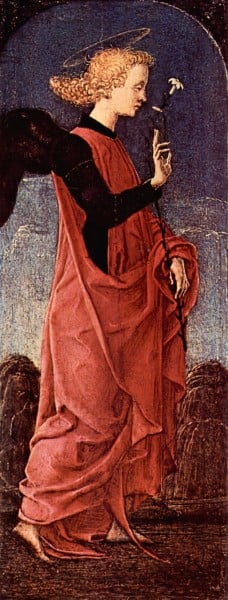
Until Mary. Luke, raised in Greece and educated in Greek culture, knew the iconography for divine heroes that ran through the related Greek. Celtic, and Hindu cultures, knew that the mothers of divine heroes all experienced a ‘triple birth’, which is to say, three possible fathers, one mystical, one a magical creature, and one human. As Luke tells the story, Mary’s pregnancy involved all these: the Spirit of God, an archangel, and Joseph. As well, divine heroes in these cultures are often born among animals, and poor shepherds or fishermen offer the endangered mother shelter. Mary’s baby had these blessings and protections, too.
But Luke adds something more: her grace-filled spirit, which the angel honors in greeting, and which she manifests in her vision for the child. Where an ordinary woman would dream of a child who would elevate her in this world, Mary dreams of a child who will liberate all the lowly. Where it might be commonplace to dream of a child whose glory would extend to Mom, Mary dreams of a child who will fill all the hungry with good things. Where any mother might dream of a child who will grow up and be Somebody, Mary imagines a child who will knock all the Somebodies of this world off their thrones, who will scatter them in their false imaginations and raise the lowly in his new, true world.
In Greek and Celtic legends, the women whose sons become divine heroes are silent in their encounters with magical creatures, and even their husbands. I, who have always been articulate, am often taciturn before authorities, doctors, even technicians. Before an archangel, I imagine myself speechless. Obedient for lack of the ability to demur. But Mary opens a discussion, and turns the angel from an authoritarian proclaimer into a small-print explainer. 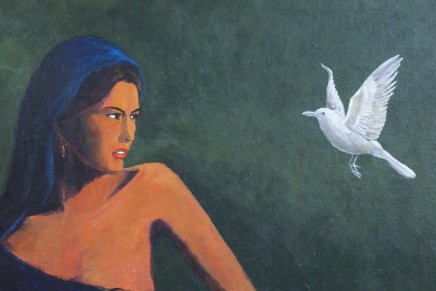
Her grace, then, is in part her strong center, her sense of who she is – her soul, which sings and sighs but also signals and sounds the depths of all that reaches her. Even God. Whom, she says, she is enlarging in her soul.
In her soul. Not, as is mostly assumed, in her womb. My soul enlarges God and my spirit rejoices in God my Savior, she sings, and from this day forth all generations will call me blessed. It is she herself in whom God is magnified, a concept the Orthodox, more deeply aware of the tradition in which Luke is writing, have grasped in their Mary Theotokos elevation of her. 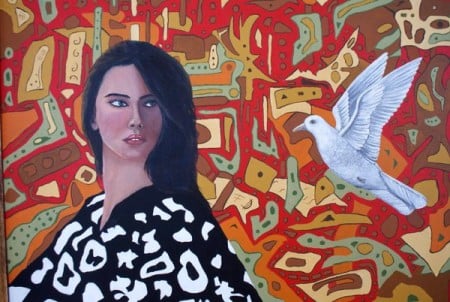
Western Christians, conflicted by unyielding traditions of femininity as spiritually less than masculinity, of the purity and impurity of flesh, and of wisdom as exclusively male, find Mary enigmatic. The assumption of her youthfulness, her teen or preteen age, is fundamental in the west, though neither Luke nor Matthew every mention her age. Most of all in the West, though we do not talk about it, we are unable to imagine her as free from fear. Her boldness at Cana startles us, and we have a canon of explanations for her courage there. 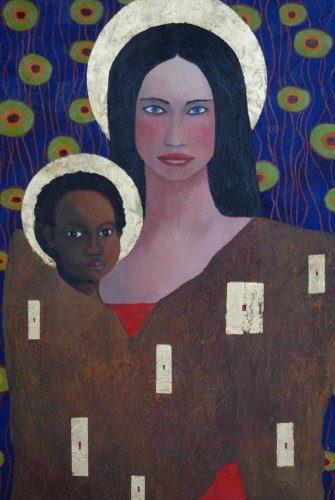
But from the first, Luke presents her as free from fear. In the presence of an angel, on her solo journey to the home of Zechariah, a temple priest, in her consideration of the power and the future of the world, she is fearless. In a stable in a strange city, in labor and surrounded by strangers post-partum, she is fearless. Fleeing from an army hunting for her Child, she is fearless, as she is in Egypt, for Luke tells us the Child flourished and was full of grace and favor. She carries her Child through centuries still, and everywhere she goes, people honor the fearlessness in her. ____________________________________________________________ Illustrations:
1. Annunciation, by Dante Gabriel Rossetti. 1849-50. Tate, London. Vanderbilt Divinity School Library, Art in the Christian Tradition.
2. Detail, Annunciation, by Fra Angelico. 1418. Vanderbilt Divinity School Library, Art in the Christian Tradition.
3. Archangel, by Cosme Tura. 1469. Vanderbilt Divinity School Library, Art in the Christian Tradition.
4. Annunciation by Esmond Lyons. Contemporary. Google Images.
5. Annunciation by Esmond Lyons. Contemporary. Google Images.
6. Modern Mary by Esmond Lyons. Contemporary. Google Images.
Previous Post

December 7, 2014
The Light of the World
Next Post
December 22, 2014 Christmas Creatures
Browse Our Archives
Select a Category Bites Uncategorized
Select a Month December 2017 November 2017 October 2017 September 2017 August 2017 July 2017 June 2017 May 2017 April 2017 March 2017 February 2017 January 2017 December 2016 November 2016 October 2016 September 2016 August 2016 July 2016 June 2016 May 2016 April 2016 March 2016 February 2016 January 2016 December 2015 November 2015 October 2015 September 2015 August 2015 July 2015 June 2015 May 2015 April 2015 March 2015 February 2015 January 2015 December 2014 November 2014 October 2014 September 2014 August 2014 July 2014 June 2014 May 2014 April 2014 March 2014 February 2014 January 2014 December 2013 November 2013 October 2013 September 2013 August 2013 July 2013 June 2013 May 2013 April 2013 March 2013 February 2013 January 2013 December 2012
Follow Us!
TAKE THE
Religious Wisdom Quiz
Who is known for his wisdom and built a temple?
Select your answer to see how you score.
David Solomon Moses Paul
Related posts from The Bite in the Apple




TRENDING AT PATHEOS Progressive Christian

Why Christians Have a Sacred Duty to Vote:...
The Bible offers strong support for the sacred duty to vote. Here...

What Being a Modern-Day Apostle Means to Me
In my last column, I discussed the ins and outs of modern-day...

Did Ancient China Once Worship the God of...
Across human history, a common thread weaves through the origins of the...

Love Your Neighbor – Including Earth-Kin: Lev. 19,...
God’s command to love your neighbor means acting in an ethical and...

Lead a Church Study of “Jesus and Lao...
Guest writer Jack Thomas (The Irreverent Reverend) reflects on leading his church...

Principles for Understanding the Apostolic Ministry Today
Whenever people discover that my formal ministry title is "apostle," as in...
view all Progressive Christian blogs
Ad-Free & Subscriber Log-In Subscription Support
- About Us
- 2026 Calendar
- Videos
- Podcasts
- Library of World Religions
- Faith In Media Tracker
- Advertise With Us
- Write for Us
- Privacy Policy
- Terms of Service
- Do Not Sell My Data
- Contact Us
- Radiant Digital
- Manage Newsletter Subscriptions
- Unsubscribe From Notifications
- Sitemap
Copyright 2008-2026, Patheos. All rights reserved.
Subscription Support Ad-Free & Subscriber Log-In
Follow Patheos