
BuddhistCatholicContemplativeEvangelicalGeneral ChristianHinduJewishLatter-day SaintMuslimNew VisionsProgressive Christian
Beliefs
- Buddhist
- Catholic
- Contemplative
- Evangelical
- General Christian
- Hindu
- Jewish
- Latter-day Saint
- More Voices
- Muslim
- New Visions
- Pagan
- Progressive Christian
Topics
- Religion News
- Food and Religion
- Sports and Religion
- Religious Art
- Religious Music and Entertainment
- Religious Events
- History and Religion
- Style and Religion
- Politics and Religion
- Women in Religion
- Recreation Outdoors and Religion
- Business Finance and Religion
- Careers Workplace and Religion
- Education and Religion
- Family Parenting and Religion
- Health Fitness and Religion
- Home and Religion
- Relationships and Religion
- Technology and Religion
- Travel and Religion
Columnists
- Buddhist Columnists
- Business Finance and Religion Columnists
- Careers Workplace and Religion Columnists
- Catholic Columnists
- Contemplative Columnists
- Education and Religion Columnists
- Evangelists Columnists
- Family Parenting and Religion Columnists
- General Christian Columnists
- Health Fitness and Religion Columnists
- Hindu Columnists
- History and Religion Columnists
- Home and Religion Columnists
- Jewish Columnists
- More Voices Columnists
- Latter Day Columnists
- Muslim Columnists
- New Visions Columnists
- Nonreligious Columnists
- Pagan Columnists
- Politics and Religion Columnists
- Progressive Columnists
- Recreation Outdoors and Religion Columnists
- Relationships and Religion Columnists
- Religion News Columnists
- Religious Art Columnists
- Religious Events Columnists
- Religious Music and Entertainment Columnists
- Sports and Religion Columnists
- Style and Religion Columnists
- Technology and Religion Columnists
- Travel and Religion Columnists
- Women in Religion Columnists
Resource Library
- 2026 Calendar
- Library of World Religions
- The 100 Most Holy Places on Earth
- Patheos Answers
- Podcasts
- Videos
- Faith Leaders Database
- Anglican Episcopalian
- Bahai
- Baptist
- Buddhism
- Christianity
- Confucianism
- Eastern Orthodoxy
- Hinduism
- Holiness and Pentecostal
- ISKCON
- Islam
- Judaism
- Lutheran
- Methodist
- The Church of Jesus Christ of Latter-day Saints
- New Age
- Paganism
- Presbytarian and Reformed
- Protestantism
- Religion Behind the Scenes
- Roman Catholic
- Scientology
- Shia Islam
- Sikhism
- Sufism
- Sunni Islam
- Taoism
- Zen
- See all religions
Research Tools
 Ad-Free & Subscriber Log-In Subscription Support
Ad-Free & Subscriber Log-In Subscription Support
Follow Patheos 

- Trending:
- Forgiveness
- |
- Marriage
- |
- Consciousness
- |
- Death Penalty
- |
- Election
- |
- Halloween
 The Bite in the Apple
- Home
- Progressive Christian
- Everything That Rises Must Converge
Everything That Rises Must Converge
Last updated on: May 25, 2014 at 6:25 pm by Nancy Rockwell
Everything That Rises Must Converge 2014-05-25T18:25:11-04:00 Nancy Rockwell
Patheos Explore the world's faith through different perspectives on religion and spirituality! Patheos has the views of the prevalent religions and spiritualities of the world.
 “Remain true to yourself, but move ever upward toward greater consciousness and greater love! At the summit you will find yourselves united with all those who, from every direction, have made the same ascent. For everything that rises must converge.” – Pierre Teilhard de Chardin, French Jesuit and paleontologist.
The rising of Jesus occurs in stages, so the gospels say. Easter is the first step in the journey, the step in which Jesus rises from death and into the astonishment of his friends. The stepping stones of their amazement are marked in the series of readings from Easter to Pentecost Day, in stories of struggle and disbelief, stories in which fear and heartache play a major role in groping minds and hearts of the survivors, and wisdom becomes a door to freedom. The third step, into the life of the Spirit, is now being shaped and named by Jesus: the Spirit of Truth, is one name he gives, and Advocate is another.
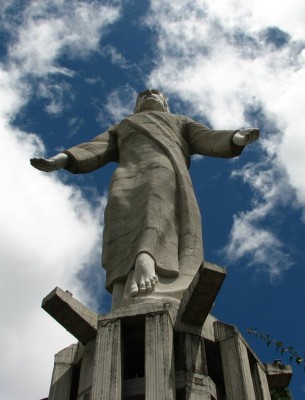
Statue of Christ ascending to heaven, El Picacho, Tegucigalpa
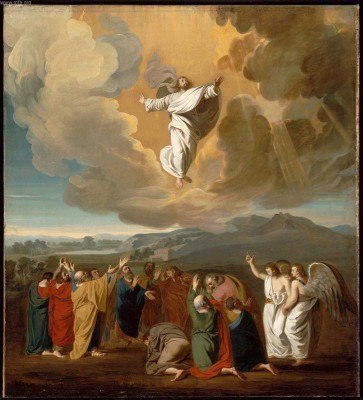
The second step is our focus on this last Sunday of Eastertide – Jesus rises beyond the immediate lives of his friends, and into what he has often described: as ‘the house of many rooms’, or as his oneness with ‘my Father and your Father’, as the place where he will always be bending towards those who love him, as the Great Feast, as the priceless pearl, as the sheltering tree, as the everlasting arms of the Good Shepherd. The Book of Acts calls it ‘the great cloud of witnesses’. All these are other words for Teilhard’s convergence.
The miraculous story of Jesus departing heavenwards is poignant in the circle of those left behind, those whom he has assured he will not leave, yet they are experiencing the anguish of being left, left behind. And the poignancy is described fully by Jesus in John’s gospel, at the end of the Last Supper, just before he goes out to the Garden, where his arrest will happen, when he prays, that they may be one as we are one. It is Teilhard’s convergence, again.
Years ago, in York cathedral, craning my neck and looking through borrowed binoculars, I was moved to tearfulness by a ceiling boss (as the brass decorations are called) of a ring of bare feet of twelve disciples, and floating just above them, Jesus’ bare feet and the hem of his robe – all that could be seen by them of him– and all of them, (the disciples), that we seekers could see from the distance of time and space in which we stand.
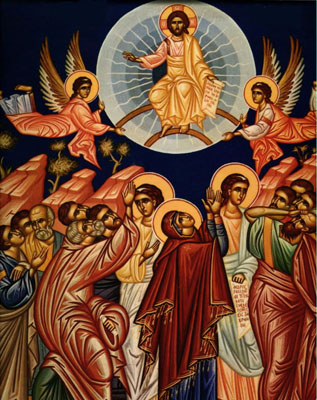 And in the Book of Acts, two angels walk up to the gobsmacked disciples and ask, why are you looking up? This Jesus will return the same way he went . . . which seems to mean, he will rise again from the bottom of the world, born in some unnoticed stable, not the opposite, that he will one day come back down via a cloud.
The science to be applied here is not: what goes up must come down, but is: everything that rises must converge.
Hasn’t convergence been his theme, always, from the Sermon on the Mount till now?
Everything That Rises Must Converge. Flannery O’Connor, writer of stories of grace and the Spirit, took Teihard’s rule as the title for a book of short stories, and for one story in particular, a tale in which a mother and her grown son, he a struggling college graduate with enlightened sensibilities and she a believing woman of old fashioned prejudices who wants to take a yoga class and asks him to accompany her on the trip because of her racial fears. They ride a bus on which there are a number of disparate people, and some of them are black. They converge in the bus and in the many works by which they are struggling to rise. Neither faith nor rising are ever easy, O’Connor writes, and we believe her, because all her details are true.
 This week, on Nature, PBS told the story of swarming, in which creatures of all sorts: ants, bees, butterflies, starlings, budgerigars, wildebeests and zebras, Penguins in nesting huddles, certain fish even, rise to move from one resting place to another, sometimes travelling thousands of miles, able to accomplish a journey none could make alone because they enter a larger intelligence, a greater wisdom, in their swarming, an intelligence into which they give themselves completely, and by which their lives are saved over and again. A distinction is made by scientists between the reactions in crisis of the wildebeest and the zebra, who migrate together: in a crisis, the zebra will fall into individual decision-making, but the wildebeest will continue in the rhythm of the group. And an instance was shown in which the whole herd of wildebeests survived but the zebras lost a confused member. And another instance was shown in which the zebras fared best.
 Isn’t this the wisdom of Pentecost, the wisdom of a swarming transcendent intelligence in which human beings, too, can find a power beyond their own? Isn’t this the strength of barn-raisings, the productivity of quilting bees, the lifting of hearts in the sung orisons of massed congregations, the necessary Jewish minyan, all of which help us to rise from a place where we are alone and overwhelmed, and travel to a place where we are secure and provided for? Isn’t this human swarming the power that Martin Luther King invoked?
Isn’t Jesus teaching us that God is not a being set apart, not a being far from us, but, when we take the second step, into the swarm, together we are enveloped in and we become the enveloping presence of God, for everything that rises must converge. Our longing to reach a higher, greater power can is realized when we enter the human swarm, and become what none of us, alone, can be. And yes, mob violence is a swarm. A swarm not for rising and new life, but for its opposite, for destruction of life.
If we explore this, will it not alter our understanding of human thought, inspiration and wisdom itself? Pentecost falls upon the heads and hearts of a human swarm . . . .
_______________________________________________________________
Illustrations:
1. Mural of Christ Ascending, 2003, graffiti wall, Bristol, England. Vanderbilt Divinity School Library, Art in the Christian Tradition.
2. Christ Ascending, statue in El Pichaco Park, Tegucigalpa, Honduras. Vanderbilt Divinity school Library, Art in the Christian Tradition.
3. The Ascension, Anglican Icon, from the 104th Archbishop of Canterbury, Rowan Williams, site, Ascension Day sermon illuatration.
4. Monarch Butterfly Swarm at Start of Migration, University of Milwaukee Field Station image.
5. The Ascension of Christ, John Singleton Copley, 1738-1815, Museum of Fine Arts, Boston. Vanderbilt Divinity School Library, Art in the Christian Tradition.
Previous Post

May 18, 2014
The Spirit of Truth
Next Post
June 1, 2014 Voices of God
Browse Our Archives
Select a Category Bites Uncategorized
Select a Month December 2017 November 2017 October 2017 September 2017 August 2017 July 2017 June 2017 May 2017 April 2017 March 2017 February 2017 January 2017 December 2016 November 2016 October 2016 September 2016 August 2016 July 2016 June 2016 May 2016 April 2016 March 2016 February 2016 January 2016 December 2015 November 2015 October 2015 September 2015 August 2015 July 2015 June 2015 May 2015 April 2015 March 2015 February 2015 January 2015 December 2014 November 2014 October 2014 September 2014 August 2014 July 2014 June 2014 May 2014 April 2014 March 2014 February 2014 January 2014 December 2013 November 2013 October 2013 September 2013 August 2013 July 2013 June 2013 May 2013 April 2013 March 2013 February 2013 January 2013 December 2012
Follow Us!
TAKE THE
Religious Wisdom Quiz
Which Christian tradition is known for ornate mosaics and icons in their churches?
Select your answer to see how you score.
Presbyterian Adventist Orthodox Baptist
Related posts from The Bite in the Apple




TRENDING AT PATHEOS Progressive Christian

Why Christians Have a Sacred Duty to Vote:...
The Bible offers strong support for the sacred duty to vote. Here...

What Being a Modern-Day Apostle Means to Me
In my last column, I discussed the ins and outs of modern-day...

Did Ancient China Once Worship the God of...
Across human history, a common thread weaves through the origins of the...

Love Your Neighbor – Including Earth-Kin: Lev. 19,...
God’s command to love your neighbor means acting in an ethical and...

Lead a Church Study of “Jesus and Lao...
Guest writer Jack Thomas (The Irreverent Reverend) reflects on leading his church...

Principles for Understanding the Apostolic Ministry Today
Whenever people discover that my formal ministry title is "apostle," as in...
view all Progressive Christian blogs
Ad-Free & Subscriber Log-In Subscription Support
- About Us
- 2026 Calendar
- Videos
- Podcasts
- Library of World Religions
- Faith In Media Tracker
- Advertise With Us
- Write for Us
- Privacy Policy
- Terms of Service
- Do Not Sell My Data
- Contact Us
- Radiant Digital
- Manage Newsletter Subscriptions
- Unsubscribe From Notifications
- Sitemap
Copyright 2008-2026, Patheos. All rights reserved.
Subscription Support Ad-Free & Subscriber Log-In
Follow Patheos