
BuddhistCatholicContemplativeEvangelicalGeneral ChristianHinduJewishLatter-day SaintMuslimNew VisionsProgressive Christian
Beliefs
- Buddhist
- Catholic
- Contemplative
- Evangelical
- General Christian
- Hindu
- Jewish
- Latter-day Saint
- More Voices
- Muslim
- New Visions
- Pagan
- Progressive Christian
Topics
- Religion News
- Food and Religion
- Sports and Religion
- Religious Art
- Religious Music and Entertainment
- Religious Events
- History and Religion
- Style and Religion
- Politics and Religion
- Women in Religion
- Recreation Outdoors and Religion
- Business Finance and Religion
- Careers Workplace and Religion
- Education and Religion
- Family Parenting and Religion
- Health Fitness and Religion
- Home and Religion
- Relationships and Religion
- Technology and Religion
- Travel and Religion
Columnists
- Buddhist Columnists
- Business Finance and Religion Columnists
- Careers Workplace and Religion Columnists
- Catholic Columnists
- Contemplative Columnists
- Education and Religion Columnists
- Evangelists Columnists
- Family Parenting and Religion Columnists
- General Christian Columnists
- Health Fitness and Religion Columnists
- Hindu Columnists
- History and Religion Columnists
- Home and Religion Columnists
- Jewish Columnists
- More Voices Columnists
- Latter Day Columnists
- Muslim Columnists
- New Visions Columnists
- Nonreligious Columnists
- Pagan Columnists
- Politics and Religion Columnists
- Progressive Columnists
- Recreation Outdoors and Religion Columnists
- Relationships and Religion Columnists
- Religion News Columnists
- Religious Art Columnists
- Religious Events Columnists
- Religious Music and Entertainment Columnists
- Sports and Religion Columnists
- Style and Religion Columnists
- Technology and Religion Columnists
- Travel and Religion Columnists
- Women in Religion Columnists
Resource Library
- 2026 Calendar
- Library of World Religions
- The 100 Most Holy Places on Earth
- Patheos Answers
- Podcasts
- Videos
- Faith Leaders Database
- Anglican Episcopalian
- Bahai
- Baptist
- Buddhism
- Christianity
- Confucianism
- Eastern Orthodoxy
- Hinduism
- Holiness and Pentecostal
- ISKCON
- Islam
- Judaism
- Lutheran
- Methodist
- The Church of Jesus Christ of Latter-day Saints
- New Age
- Paganism
- Presbytarian and Reformed
- Protestantism
- Religion Behind the Scenes
- Roman Catholic
- Scientology
- Shia Islam
- Sikhism
- Sufism
- Sunni Islam
- Taoism
- Zen
- See all religions
Research Tools
 Ad-Free & Subscriber Log-In Subscription Support
Ad-Free & Subscriber Log-In Subscription Support
Follow Patheos 

- Trending:
- Forgiveness
- |
- Marriage
- |
- Consciousness
- |
- Death Penalty
- |
- Election
- |
- Halloween
 The Bite in the Apple
- Home
- Progressive Christian
- Eternal Life and Selma
Eternal Life and Selma
Last updated on: March 7, 2015 at 12:12 pm by Nancy Rockwell
Eternal Life and Selma 2015-03-07T12:12:24-04:00 Nancy Rockwell
Patheos Explore the world's faith through different perspectives on religion and spirituality! Patheos has the views of the prevalent religions and spiritualities of the world.
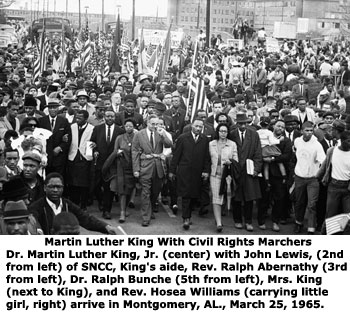 The light has come into the world, and people loved darkness more – John 3:19
The best known sentence in the gospels is just before these words: For God so loved the world that he gave his only begotten Son that those who believe in him will not perish but have everlasting life. It rolls easily off the tongues of many. But NT theologian Marcus Borg* warns that, taken literally, this sentence turns Christianity into a religion of requirements and rewards. The reward is heaven. The requirements, of belief or behavior or both, are a means of reaping the reward. Christianity, understood this way, becomes contractual. And many of us take for granted this is the way things are.
 Borg points out this understanding is reinforced in worship in the words of absolution, which usually proclaim that those who believe will be saved. But this contradicts the ancient teaching, the biblical teaching, the Reformation teaching, that salvation is unmerited, God-given, not a reward, not a contract.
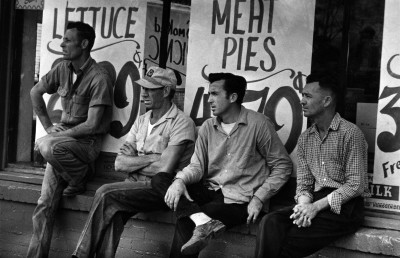
March 1965: Four white men watching a black voting rights march from Selma, Alabama, to the state capital in Montgomery. (Photo by William Lovelace/Getty Images)
Borg goes on: a second problem in emphasizing the afterlife is that it turns Christianity into a religion of self-preservation. How can I make sure I will live forever? And a third problem arises: people are divided into saved and unsaved. All non-Christians, even many Christians, are suspected of being unsaved.
Emphasis on the afterlife changes the attention paid to this life, making changes relatively unimportant, and obedience very important. Borg notes, in the Bible salvation is about transformation in this life, not about going to heaven. In the Bible the roots of the word salvation are in rescue and deliverance in this life, not the next.
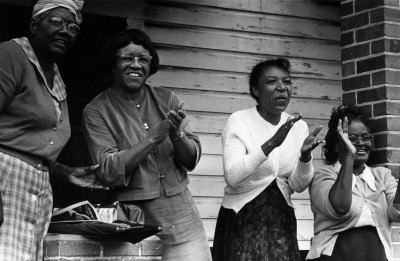
March 1965: Four black women applauding while watching a civil rights march from Selma, Alabama, to the state capital in Montgomery. (Photo by William Lovelace/Getty Images)
Borg offers these biblical images of salvation:
Salvation as Liberation from Bondage – the Exodus; Salvation as Return from Exile, the return of ancient Israel from Babylon and slavery.
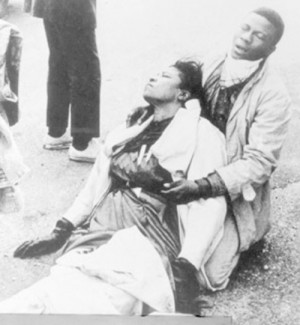 Salvation as Light in Darkness and Sight to the Blind. People walk in deep darkness, and many who have sight, cannot see – Jesus urges those who have eyes, to see anew.
Salvation as Life to the Dead. Just as some sighted people are blind, some living people are dead. There is a way of living that amounts to being dead, Jesus teaches.
Salvation as Food and Drink, which is about everyone having enough, and also about our hunger and thirst for more than a material life.
Salvation as Being Saved from Sin. Forgiveness means our misdeeds and betrayals are not the last word about us, or to us from God.
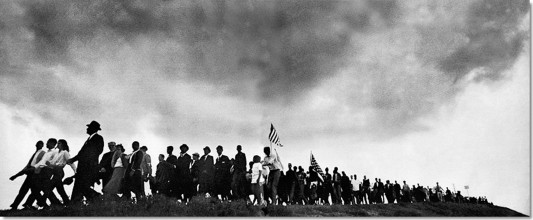
This week America is observing the 50th anniversary of the Selma March, which was really a series of three events: Bloody Sunday, when the marchers were beaten and tear-gassed and not allowed to leave Selma; Turn Around Tuesday, when Martin Luther King led the already-bruised and highly anxious marchers to the crest of the bridge, sensed that the police below might again attack the marchers, knelt, prayed, and turned back, now calling on the nation to come and march with him the following weekend. Thousands rallied, including celebrities, and together they marched the whole way to Montgomery, protesting the denial of voting rights to black Americans in Alabama and in most of the South.
 All of this was based on some courageous theology, in which people dared to say they were not saved, they were living in bondage, they were outcasts and exiles, they were in deep darkness, and this was not God’s doing, and not God’s will.
They lived surrounded by white people who were blind to their suffering, who were spiritually dead. And black people were willing to say this, to say they longed for life in this world, and were dead to hope unless they marched as they did. They marched for food and drink, and for the right to vote to end poverty, and they dared to understand this marching as sacramental. And for the days in which they marched, women gathered in church kitchens and churned out thousands of sandwiches and vats of coffee to sustain them. In all of this, they dared to hope that they were being saved; from the dreadful sins of their nation, and the personal sins, of despair, addiction, misery of soul, into which many of them had fallen.
 Those who opposed them and supported violent police repression of these marches, also cited the Bible, using passages about slaves obeying their masters, about the sons of Ham being condemned to lesser life, and about accepting their rulers. These were the old and cruel understandings of a contractual god.
What was new was the theology of the Civil Rights Movement, that dared to articulate the meaning of salvation as transformation from fear to courage, from blindness to new sight, from hunger and thirst to satisfaction in spirit, from bondage to liberation. The courage of black America, and their theology, has given life and sight to gays, to women, to immigrants, to the disabled, to the poor around the world. We owe them a huge debt for setting all our sight on freedom and a gracious God.
 Knowing a number of marchers who made that walk has been a significant grace in my life: Alvin Levin, a lawyer and parishioner in MA, a man who had polio in his thirties and made the four day march in a wheelchair; Elliott Hubbard, a patrician Bostonian and parishioner, who spent decades helping small businessmen in Roxbury, MA; my uncle, a Unitarian minister in NYC, who marched between two other New Yorkers, a Jewish theologian and an Orthodox priest; and a friend, Judy Kotze, then a college senior in Ohio, who with four other classmates made the journey, driving through white hostility and rage to reach Selma, and to march for freedom, human dignity, and the grace of God.
* Convictions, by Morcus Borg, 2014, Harper One. Chapter 4: Salvation is More About This Life than an After Life
___________________________________________________________
Illustrations:
1.Selma March, 1965 newsphoto, Google Images.
2. Selma March, Brittanica. com image, Google Images.
3. White Men Watching at Selma, 1965. National Journal History slideshow, Nov. 5, 2015.
4. Four Black Women Applauding Selma March, 1965. National Journal Historical slideshow, Nov. 5, 2015. Google Images.
5. Bloody Sunday, Selma March, 1965. Google Images.
6. Bloody Sunday, Selma March, 1965. Google Images.
7. Young black man with VOTE on his forehead, marching, Selma. Google Images.
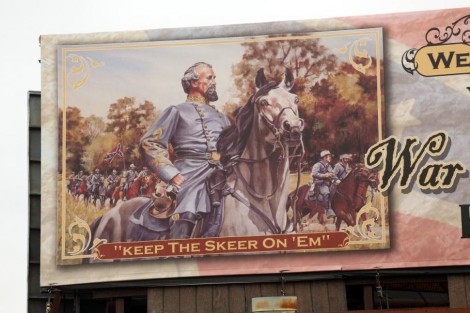
8. New Sign Board (2015) near the Edmund Pettus Bridge, honoring the Founder of the Ki Klux Klan and the War Between the States. Google Images.
9. Selma March, on the road to Montgomery. Google Images.
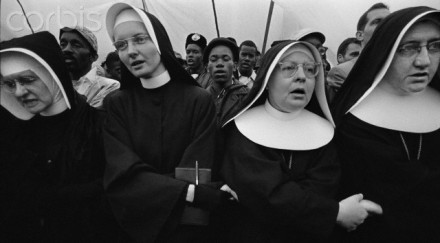
10. Nuns, marching in Selma. Google Images.
Previous Post

February 28, 2015
The Things We Do for Love
Next Post
March 16, 2015 Icons
Browse Our Archives
Select a Category Bites Uncategorized
Select a Month December 2017 November 2017 October 2017 September 2017 August 2017 July 2017 June 2017 May 2017 April 2017 March 2017 February 2017 January 2017 December 2016 November 2016 October 2016 September 2016 August 2016 July 2016 June 2016 May 2016 April 2016 March 2016 February 2016 January 2016 December 2015 November 2015 October 2015 September 2015 August 2015 July 2015 June 2015 May 2015 April 2015 March 2015 February 2015 January 2015 December 2014 November 2014 October 2014 September 2014 August 2014 July 2014 June 2014 May 2014 April 2014 March 2014 February 2014 January 2014 December 2013 November 2013 October 2013 September 2013 August 2013 July 2013 June 2013 May 2013 April 2013 March 2013 February 2013 January 2013 December 2012
Follow Us!
TAKE THE
Religious Wisdom Quiz
What is the name of the lake into which the beast and false prophet are thrown?
Select your answer to see how you score.
The outer darkness Gehenna The abyss The lake of burning sulfur (lake of fire)
Related posts from The Bite in the Apple




TRENDING AT PATHEOS Progressive Christian

Why Christians Have a Sacred Duty to Vote:...
The Bible offers strong support for the sacred duty to vote. Here...

What Being a Modern-Day Apostle Means to Me
In my last column, I discussed the ins and outs of modern-day...

Did Ancient China Once Worship the God of...
Across human history, a common thread weaves through the origins of the...

Love Your Neighbor – Including Earth-Kin: Lev. 19,...
God’s command to love your neighbor means acting in an ethical and...

Lead a Church Study of “Jesus and Lao...
Guest writer Jack Thomas (The Irreverent Reverend) reflects on leading his church...

Principles for Understanding the Apostolic Ministry Today
Whenever people discover that my formal ministry title is "apostle," as in...
view all Progressive Christian blogs
Ad-Free & Subscriber Log-In Subscription Support
- About Us
- 2026 Calendar
- Videos
- Podcasts
- Library of World Religions
- Faith In Media Tracker
- Advertise With Us
- Write for Us
- Privacy Policy
- Terms of Service
- Do Not Sell My Data
- Contact Us
- Radiant Digital
- Manage Newsletter Subscriptions
- Unsubscribe From Notifications
- Sitemap
Copyright 2008-2026, Patheos. All rights reserved.
Subscription Support Ad-Free & Subscriber Log-In
Follow Patheos