
BuddhistCatholicContemplativeEvangelicalGeneral ChristianHinduJewishLatter-day SaintMuslimNew VisionsProgressive Christian
Beliefs
- Buddhist
- Catholic
- Contemplative
- Evangelical
- General Christian
- Hindu
- Jewish
- Latter-day Saint
- More Voices
- Muslim
- New Visions
- Pagan
- Progressive Christian
Topics
- Religion News
- Food and Religion
- Sports and Religion
- Religious Art
- Religious Music and Entertainment
- Religious Events
- History and Religion
- Style and Religion
- Politics and Religion
- Women in Religion
- Recreation Outdoors and Religion
- Business Finance and Religion
- Careers Workplace and Religion
- Education and Religion
- Family Parenting and Religion
- Health Fitness and Religion
- Home and Religion
- Relationships and Religion
- Technology and Religion
- Travel and Religion
Columnists
- Buddhist Columnists
- Business Finance and Religion Columnists
- Careers Workplace and Religion Columnists
- Catholic Columnists
- Contemplative Columnists
- Education and Religion Columnists
- Evangelists Columnists
- Family Parenting and Religion Columnists
- General Christian Columnists
- Health Fitness and Religion Columnists
- Hindu Columnists
- History and Religion Columnists
- Home and Religion Columnists
- Jewish Columnists
- More Voices Columnists
- Latter Day Columnists
- Muslim Columnists
- New Visions Columnists
- Nonreligious Columnists
- Pagan Columnists
- Politics and Religion Columnists
- Progressive Columnists
- Recreation Outdoors and Religion Columnists
- Relationships and Religion Columnists
- Religion News Columnists
- Religious Art Columnists
- Religious Events Columnists
- Religious Music and Entertainment Columnists
- Sports and Religion Columnists
- Style and Religion Columnists
- Technology and Religion Columnists
- Travel and Religion Columnists
- Women in Religion Columnists
Resource Library
- 2026 Calendar
- Library of World Religions
- The 100 Most Holy Places on Earth
- Patheos Answers
- Podcasts
- Videos
- Faith Leaders Database
- Anglican Episcopalian
- Bahai
- Baptist
- Buddhism
- Christianity
- Confucianism
- Eastern Orthodoxy
- Hinduism
- Holiness and Pentecostal
- ISKCON
- Islam
- Judaism
- Lutheran
- Methodist
- The Church of Jesus Christ of Latter-day Saints
- New Age
- Paganism
- Presbytarian and Reformed
- Protestantism
- Religion Behind the Scenes
- Roman Catholic
- Scientology
- Shia Islam
- Sikhism
- Sufism
- Sunni Islam
- Taoism
- Zen
- See all religions
Research Tools
 Ad-Free & Subscriber Log-In Subscription Support
Ad-Free & Subscriber Log-In Subscription Support
Follow Patheos 

- Trending:
- Forgiveness
- |
- Marriage
- |
- Consciousness
- |
- Death Penalty
- |
- Election
- |
- Halloween
 The Bite in the Apple
- Home
- Progressive Christian
- Easter’s Alleluias Belong to Jesus’ Kingdom Vision
Easter’s Alleluias Belong to Jesus’ Kingdom Vision
Last updated on: April 10, 2017 at 9:04 am by Nancy Rockwell
Easter’s Alleluias Belong to Jesus’ Kingdom Vision 2017-04-10T09:04:57-04:00 Nancy Rockwell
Patheos Explore the world's faith through different perspectives on religion and spirituality! Patheos has the views of the prevalent religions and spiritualities of the world.
 The Last Days of Jesus, a two-part series PBS is showing now, tells a new and detailed account of the shifting politics between Rome and Israel in Jesus’ time.
Scholars from Britain, the US, Canada, and Israel, tell this story from the historical views of two faiths, Christianity and Judaism.
And they are in agreement that there is a lot to be known that we haven’t known till now.
A network of ambitions and intrigue unite the Prefects (in Israel, Pilate) the would-be king Herod who has married a legitimate Jewish noblewoman but has violated his own former marriage and hers in so doing, and Jesus and John, whose devotion is to the kingdom and renewal of the Temple.
The scholars are persuasive in their conviction that Jesus was both well-known and financially well supported, even by people high in Herod’s court. Why would Jesus cooperate in this, with Herod, or with Pilate? Because they promised him a revolution without bloodshed, political change that would help many without killing any.
They believe Jesus’ arrival in Jerusalem, where he confronts the corruption in the Temple, was approved by Herod and by Pilate, as in keeping with the plans of Lucius Sejanus, a confidant of Emperor Tiberius who was likely to become the next Emperor. Herod hoped to become the legitimate king through Jesus’ revolution in the Temple government, and Pilate knew he would get more support from Herod as a real king instead of a puppet king. Sejanus knew the Messianic tradition called for a Messiah to lead the Temple and a new King to rule the nation, and as long as the King was friendly to him he was for it.
Scholars also believe Jesus was in Jerusalem for six months, not seven days, and that he was in prison for perhaps as long as two months, not one day.
And that Jesus’ crucifixion was caused by the sudden downfall of Sejanus, who was executed for treason by Tiberius, and the subsequent edict Tiberius issued, ordering all prefects to cooperate with existing religious authorities.
The great popularity of Jesus among the people who hated the Temple priesthood, which had become rich on their money and indifferent to their suffering, had been Jesus’ strength. Now it became his downfall, as both Herod and Pilate scrambled to survive the wrath that extended to all former allies of Sejanus.
Jesus’ new kingdom, in which the hungry would be filled with good things, the rich sent empty away, the mighty pulled from their thrones and the proud scattered in their imaginations, was not the proclamation of the Temple priesthood.
And Tiberius’ new edict made their overthrow impossible.
Jesus, according to this new scholarship, had plenty of time to leave Jerusalem and save his own skin. But he chose to stay the course, believing God would rescue him, even if he had to suffer first.
And what this means for our understanding of Easter has hardly begun to unfold.
It means what we have always known: that hope triumphs over the grave. That love outlives death, visibly in the disciples, and tangibly in the early churches, who proclaimed resurrection as their gospel.
But no longer can we interpret Easter as a spiritual reality alone, apart from the political reality of his kingdom vision which belongs in the world now, not in some other world after death.
And no longer can we equate the resurrection of Jesus with eggs and flowers, with chocolate and springtime, without remembering that Jesus was calling for a revolutionary new government that would embrace all people as God’s beloved.
Now the charges of blasphemy and kingship are no longer false rumors and folly. For Jesus’ condemnation of the Temple, so popular when he overturned the moneychangers’ tables in the Temple and was not arrested for it, became blasphemy after the fall of Sejanus.
Now Easter becomes the resurrection of Jesus’ vision, values and hope, his reign over the lives of a movement that grew into a church. A spiritual and political resurrection. Sadly, Jesus’ church became corrupt, in the Vatican where money was stockpiled and law applied without mercy, in Lambeth, where kings were holy above all others and the church owned land where the poor could not, in the Southern Baptist church that sanctioned slavery, in New England churches that condemned bars and the ordinary imbibing of immigrant peoples. But the church also engages in endless reformations, inside these large traditions and outside as new ones arise. And in each reformation, more schools, hospitals, homes, are built, and more people are embraced.
Easter beckons us as a standard, Easter is a flag calling us to gather in the traditions of freedom that are critical in our time. Easter is Black Lives Matter, Easter is embracing transgender people, Easter is depriving the rich of their endless financial benefits, Easter is committing our souls to the struggles that set women free, struggles for publicly funded Daycare and Equal Pay, and the continuation of Roe. V. Wade’s landmark freedom for women in their own bodies.
We follow the road to Easter as did the colt, the foal of the donkey who carried Jesus into Jerusalem, not knowing where the road will lead, but faithful to journey.
Easter stands for the sweet kiss of mercy and the embrace of righteousness, for which Jesus suffered and in which he rose. Creeds, doctrines, dogmas aside. Monastic rules aside. Easter stands for none of these.
There will always be a price to pay for Easter. Alleluias are not cheap decorations you can get at the dollar store. Alleluias emerge from the courage of the broken heart to remain faithful to its hope.
Lisel Muller wrote it beautifully:
Hope is the singular gift
we cannot destroy in ourselves,
the argument that refutes death,
the genius that invents the future,
all we know of God.
____________________________________________________________________________
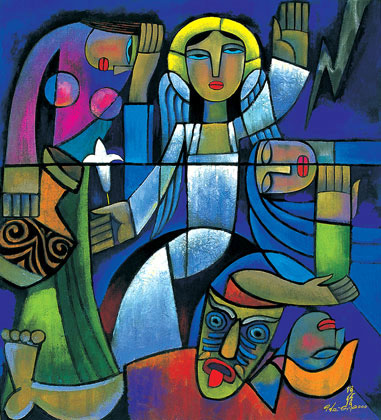
Image: Easter Morning, by He Qi, 2001, Nanjing Theological Union Seminary, China. Vanderbilt Divinity school Library, Art in the Christian Tradition.
Previous Post
April 8, 2017
The Rich and Holy Eves
Next Post
April 13, 2017 Hell Is Empty, All the Devils Are Here
Browse Our Archives
Select a Category Bites Uncategorized
Select a Month December 2017 November 2017 October 2017 September 2017 August 2017 July 2017 June 2017 May 2017 April 2017 March 2017 February 2017 January 2017 December 2016 November 2016 October 2016 September 2016 August 2016 July 2016 June 2016 May 2016 April 2016 March 2016 February 2016 January 2016 December 2015 November 2015 October 2015 September 2015 August 2015 July 2015 June 2015 May 2015 April 2015 March 2015 February 2015 January 2015 December 2014 November 2014 October 2014 September 2014 August 2014 July 2014 June 2014 May 2014 April 2014 March 2014 February 2014 January 2014 December 2013 November 2013 October 2013 September 2013 August 2013 July 2013 June 2013 May 2013 April 2013 March 2013 February 2013 January 2013 December 2012
Follow Us!
TAKE THE
Religious Wisdom Quiz
According to Romans, what can separate us from the love of Christ?
Select your answer to see how you score.
Nothing Sin Disobedience Unbelief
Related posts from The Bite in the Apple



TRENDING AT PATHEOS Progressive Christian

Why Christians Have a Sacred Duty to Vote:...
The Bible offers strong support for the sacred duty to vote. Here...

What Being a Modern-Day Apostle Means to Me
In my last column, I discussed the ins and outs of modern-day...

Did Ancient China Once Worship the God of...
Across human history, a common thread weaves through the origins of the...

Love Your Neighbor – Including Earth-Kin: Lev. 19,...
God’s command to love your neighbor means acting in an ethical and...

Lead a Church Study of “Jesus and Lao...
Guest writer Jack Thomas (The Irreverent Reverend) reflects on leading his church...

Principles for Understanding the Apostolic Ministry Today
Whenever people discover that my formal ministry title is "apostle," as in...
view all Progressive Christian blogs
Ad-Free & Subscriber Log-In Subscription Support
- About Us
- 2026 Calendar
- Videos
- Podcasts
- Library of World Religions
- Faith In Media Tracker
- Advertise With Us
- Write for Us
- Privacy Policy
- Terms of Service
- Do Not Sell My Data
- Contact Us
- Radiant Digital
- Manage Newsletter Subscriptions
- Unsubscribe From Notifications
- Sitemap
Copyright 2008-2026, Patheos. All rights reserved.
Subscription Support Ad-Free & Subscriber Log-In
Follow Patheos