
BuddhistCatholicContemplativeEvangelicalGeneral ChristianHinduJewishLatter-day SaintMuslimNew VisionsProgressive Christian
Beliefs
- Buddhist
- Catholic
- Contemplative
- Evangelical
- General Christian
- Hindu
- Jewish
- Latter-day Saint
- More Voices
- Muslim
- New Visions
- Pagan
- Progressive Christian
Topics
- Religion News
- Food and Religion
- Sports and Religion
- Religious Art
- Religious Music and Entertainment
- Religious Events
- History and Religion
- Style and Religion
- Politics and Religion
- Women in Religion
- Recreation Outdoors and Religion
- Business Finance and Religion
- Careers Workplace and Religion
- Education and Religion
- Family Parenting and Religion
- Health Fitness and Religion
- Home and Religion
- Relationships and Religion
- Technology and Religion
- Travel and Religion
Columnists
- Buddhist Columnists
- Business Finance and Religion Columnists
- Careers Workplace and Religion Columnists
- Catholic Columnists
- Contemplative Columnists
- Education and Religion Columnists
- Evangelists Columnists
- Family Parenting and Religion Columnists
- General Christian Columnists
- Health Fitness and Religion Columnists
- Hindu Columnists
- History and Religion Columnists
- Home and Religion Columnists
- Jewish Columnists
- More Voices Columnists
- Latter Day Columnists
- Muslim Columnists
- New Visions Columnists
- Nonreligious Columnists
- Pagan Columnists
- Politics and Religion Columnists
- Progressive Columnists
- Recreation Outdoors and Religion Columnists
- Relationships and Religion Columnists
- Religion News Columnists
- Religious Art Columnists
- Religious Events Columnists
- Religious Music and Entertainment Columnists
- Sports and Religion Columnists
- Style and Religion Columnists
- Technology and Religion Columnists
- Travel and Religion Columnists
- Women in Religion Columnists
Resource Library
- 2026 Calendar
- Library of World Religions
- The 100 Most Holy Places on Earth
- Patheos Answers
- Podcasts
- Videos
- Faith Leaders Database
- Anglican Episcopalian
- Bahai
- Baptist
- Buddhism
- Christianity
- Confucianism
- Eastern Orthodoxy
- Hinduism
- Holiness and Pentecostal
- ISKCON
- Islam
- Judaism
- Lutheran
- Methodist
- The Church of Jesus Christ of Latter-day Saints
- New Age
- Paganism
- Presbytarian and Reformed
- Protestantism
- Religion Behind the Scenes
- Roman Catholic
- Scientology
- Shia Islam
- Sikhism
- Sufism
- Sunni Islam
- Taoism
- Zen
- See all religions
Research Tools
 Ad-Free & Subscriber Log-In Subscription Support
Ad-Free & Subscriber Log-In Subscription Support
Follow Patheos 

- Trending:
- Forgiveness
- |
- Marriage
- |
- Consciousness
- |
- Death Penalty
- |
- Election
- |
- Halloween
 The Bite in the Apple
- Home
- Progressive Christian
- Easter Rising
Easter Rising
Last updated on: March 23, 2013 at 11:32 pm by Nancy Rockwell
Easter Rising 2013-03-23T23:32:32-04:00 Nancy Rockwell
Patheos Explore the world's faith through different perspectives on religion and spirituality! Patheos has the views of the prevalent religions and spiritualities of the world.
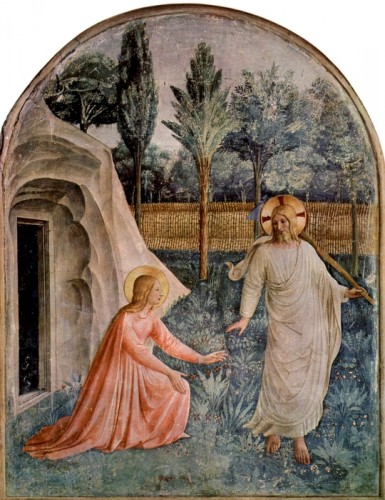 Truly, we live with mysteries too marvelous to be understood.
How grass can be nourishing in the mouths of lambs.
How rivers and stones are forever in allegiance
with gravity while we ourselves dream of rising.
How two hands touch, and the bonds will never be broken.
—Mary Oliver,
in Mysteries, Yes.
There’s a Russian Easter tale, how it was that the wonder of Easter entered the heart of the world: Mary, Jesus’ mother, stood weeping at the foot of the cross on Good Friday, and Jesus wept for her, too, as he died. And every one of her tears became a beautiful blue and yellow Russian Easter egg as it touched the ground, and everyone of his tears became a deep red egg. At the end of the day Mary picked up all those eggs and put them in her apron, but as she was carrying them away she tripped, and the eggs spilled out of her apron and rolled down the hill of Golgotha, and into the streets of Jerusalem, and they kept on rolling, even to the far corners of the earth, and on Easter the children of the world found them, and they instantly knew about the tears, the love, the suffering, and the life within it all.
Tony Kushner, who wrote the script for the movie Lincoln, also wrote a play called Angels in America, with an old woman quite like the Russian Easter Mary. In the play Rabbi Isidor Chemelwitz speaks about her journey from Russia through the Holocaust, with great reverence. “She was not a person but a whole kind of person,  the ones who crossed the ocean. She carried the old world on her back, in a boat, and she put it down in Flatbush, and she worked that earth into your bones, and you pass it to your children: home. You can never make the crossing that she made, for such Great Voyages in this world do not any more exist. But every day of your lives the miles of that voyage between that place and this one you cross. Every day. You understand me? In you that journey is.”
In the Easter tales, the woman who carries them and works them into the world is Mary Magdalene. Across seas and centuries and cultures she has worked that Easter garden into our bones: her weeping, what the gardener said, what the angels said to her. And her story has become home. Every day we cross the miles between that place and where we are.
She lived in a terrible time. The man she loved more than anyone in the world was suddenly, shockingly, dead. In a murderous time the heart breaks and breaks, and lives by breaking, wrote New England poet Stanley Kunitz, and this is how Mary Magdalene lives. It was into her heartbreak that the angels came, and told her that the death she was sure of cannot be found, and the life she is sure she has lost is not, in fact, over.
In the welter of Easter’s details — Mary saw a gardener, Thomas touched a wound, Peter and James talked to a stranger on the Emmaus road — we come to know about survivors, and in them we see an image of ourselves: their fears and quarrels, the ways in which they disbelieve each other, how they run off in different directions only to discover a truth they cannot escape. Each one has a different version of the story.
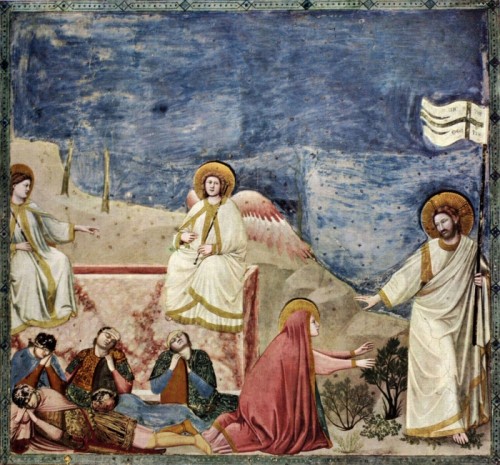 Circling, wary, tense, the survivors and Jesus stalk each other down the hours of Easter day, accusing each other in doubt, and disbelieving, even in joy.
It’s hard to say, after all, who took hold of whom in a way that wouldn’t let go. It’s hard to say how, in their terror and their need, Easter came. But that earth, the stories of Easter, came with us, over centuries, through wars, on boats, and it has been worked into our bones. For all our doubts, it’s home.
Home is, of course, as much a mystery as Easter. And mystery is anything you can’t understand: quantum physics, the heart of someone you love, your own doubts and fears, why an old woman from a Russian shtetl, or Mary Magdalene, hang on to us as fiercely as they do. The miles of that voyage we cross every day. In us their journey is.
The essential thing about mystery is not the solution, but choosing your approach: suspicion or love. Suspicion is not without its uses, especially in a murderous time, which is every time, of course. 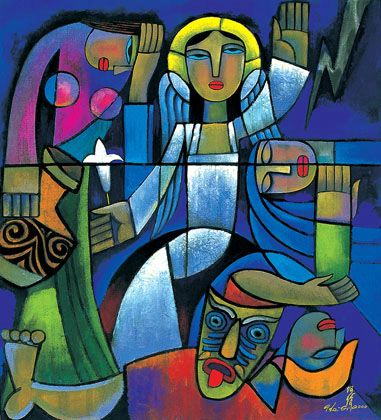 Still, each one of us could testify from our experience that, on the whole, what is mysterious is best interpreted by love. It was in the fields of Mary’s heart that Jesus rose. Without her love, what story, what life, would there be?
And that is the shimmering truth in the emptiness of Easter: the egg of Easter, brimful of tears and torture, blood and death, screams of pain, insults, hate, shattered lives and broken hearts, is now empty: all of it has risen. God’s hand is in this emptiness, showing us that even the most horrible death moves toward life, because God is good, even when we have been evil.
It will be wise and well for us to grasp this mystery tenaciously and not to let it go, to let it take our life into itself. Then death, where you and I are going no matter how we choose to live, will raise us from the fields where we fall, in heart, body, and mind, and carry us lightly, thoughtlessly, as high as eagles soar. (The miles of this voyage you cross every day. You understand me? In you this journey is.)
Well, we will all find out, each of us.
And what would we be, beyond the yardstick
beyond supper and dollars,
if we were not filled with such wondering?
–Mary Oliver, in Evidence
___________________________________________
Illustrations:
1.Noli Me Tangere, Fra Angelico, San Marco, Florence, Italy 1450. Vanderbilt Divinity School Library, Art in the Christian Tradition
2. Mary Magdalene at the Tomb, 1904, Albert von Keller, Munich, Germany
3. Noli Me Tangere, Giotto di Bonodone, 1304-06, Cappella degli Scrovegni, Padua, Italy. Vanderbilt Divinity School Library, Art in the Christian Tradition
4. Magdalene at Easter, He Qi, Nanqing, China. Vanderbilt Divinity School Library, Art in the Christian Tradition
Previous Post

March 17, 2013
Judas
Next Post
April 2, 2013 Doubting Thomas
Browse Our Archives
Select a Category Bites Uncategorized
Select a Month December 2017 November 2017 October 2017 September 2017 August 2017 July 2017 June 2017 May 2017 April 2017 March 2017 February 2017 January 2017 December 2016 November 2016 October 2016 September 2016 August 2016 July 2016 June 2016 May 2016 April 2016 March 2016 February 2016 January 2016 December 2015 November 2015 October 2015 September 2015 August 2015 July 2015 June 2015 May 2015 April 2015 March 2015 February 2015 January 2015 December 2014 November 2014 October 2014 September 2014 August 2014 July 2014 June 2014 May 2014 April 2014 March 2014 February 2014 January 2014 December 2013 November 2013 October 2013 September 2013 August 2013 July 2013 June 2013 May 2013 April 2013 March 2013 February 2013 January 2013 December 2012
Follow Us!
TAKE THE
Religious Wisdom Quiz
Which tribe of Israel did NOT receive a land inheritance?
Select your answer to see how you score.
Gad Benjamin Levi Judah
Related posts from The Bite in the Apple




TRENDING AT PATHEOS Progressive Christian

Why Christians Have a Sacred Duty to Vote:...
The Bible offers strong support for the sacred duty to vote. Here...

What Being a Modern-Day Apostle Means to Me
In my last column, I discussed the ins and outs of modern-day...

Did Ancient China Once Worship the God of...
Across human history, a common thread weaves through the origins of the...

Love Your Neighbor – Including Earth-Kin: Lev. 19,...
God’s command to love your neighbor means acting in an ethical and...

Lead a Church Study of “Jesus and Lao...
Guest writer Jack Thomas (The Irreverent Reverend) reflects on leading his church...

Principles for Understanding the Apostolic Ministry Today
Whenever people discover that my formal ministry title is "apostle," as in...
view all Progressive Christian blogs
Ad-Free & Subscriber Log-In Subscription Support
- About Us
- 2026 Calendar
- Videos
- Podcasts
- Library of World Religions
- Faith In Media Tracker
- Advertise With Us
- Write for Us
- Privacy Policy
- Terms of Service
- Do Not Sell My Data
- Contact Us
- Radiant Digital
- Manage Newsletter Subscriptions
- Unsubscribe From Notifications
- Sitemap
Copyright 2008-2026, Patheos. All rights reserved.
Subscription Support Ad-Free & Subscriber Log-In
Follow Patheos