
BuddhistCatholicContemplativeEvangelicalGeneral ChristianHinduJewishLatter-day SaintMuslimNew VisionsProgressive Christian
Beliefs
- Buddhist
- Catholic
- Contemplative
- Evangelical
- General Christian
- Hindu
- Jewish
- Latter-day Saint
- More Voices
- Muslim
- New Visions
- Pagan
- Progressive Christian
Topics
- Religion News
- Food and Religion
- Sports and Religion
- Religious Art
- Religious Music and Entertainment
- Religious Events
- History and Religion
- Style and Religion
- Politics and Religion
- Women in Religion
- Recreation Outdoors and Religion
- Business Finance and Religion
- Careers Workplace and Religion
- Education and Religion
- Family Parenting and Religion
- Health Fitness and Religion
- Home and Religion
- Relationships and Religion
- Technology and Religion
- Travel and Religion
Columnists
- Buddhist Columnists
- Business Finance and Religion Columnists
- Careers Workplace and Religion Columnists
- Catholic Columnists
- Contemplative Columnists
- Education and Religion Columnists
- Evangelists Columnists
- Family Parenting and Religion Columnists
- General Christian Columnists
- Health Fitness and Religion Columnists
- Hindu Columnists
- History and Religion Columnists
- Home and Religion Columnists
- Jewish Columnists
- More Voices Columnists
- Latter Day Columnists
- Muslim Columnists
- New Visions Columnists
- Nonreligious Columnists
- Pagan Columnists
- Politics and Religion Columnists
- Progressive Columnists
- Recreation Outdoors and Religion Columnists
- Relationships and Religion Columnists
- Religion News Columnists
- Religious Art Columnists
- Religious Events Columnists
- Religious Music and Entertainment Columnists
- Sports and Religion Columnists
- Style and Religion Columnists
- Technology and Religion Columnists
- Travel and Religion Columnists
- Women in Religion Columnists
Resource Library
- 2026 Calendar
- Library of World Religions
- The 100 Most Holy Places on Earth
- Patheos Answers
- Podcasts
- Videos
- Faith Leaders Database
- Anglican Episcopalian
- Bahai
- Baptist
- Buddhism
- Christianity
- Confucianism
- Eastern Orthodoxy
- Hinduism
- Holiness and Pentecostal
- ISKCON
- Islam
- Judaism
- Lutheran
- Methodist
- The Church of Jesus Christ of Latter-day Saints
- New Age
- Paganism
- Presbytarian and Reformed
- Protestantism
- Religion Behind the Scenes
- Roman Catholic
- Scientology
- Shia Islam
- Sikhism
- Sufism
- Sunni Islam
- Taoism
- Zen
- See all religions
Research Tools
 Ad-Free & Subscriber Log-In Subscription Support
Ad-Free & Subscriber Log-In Subscription Support
Follow Patheos 

- Trending:
- Forgiveness
- |
- Marriage
- |
- Consciousness
- |
- Death Penalty
- |
- Election
- |
- Halloween
 The Bite in the Apple
- Home
- Progressive Christian
- Easter Bread
Easter Bread
Last updated on: April 7, 2013 at 8:50 pm by Nancy Rockwell
Easter Bread 2013-04-07T20:50:55-04:00 Nancy Rockwell
Patheos Explore the world's faith through different perspectives on religion and spirituality! Patheos has the views of the prevalent religions and spiritualities of the world.
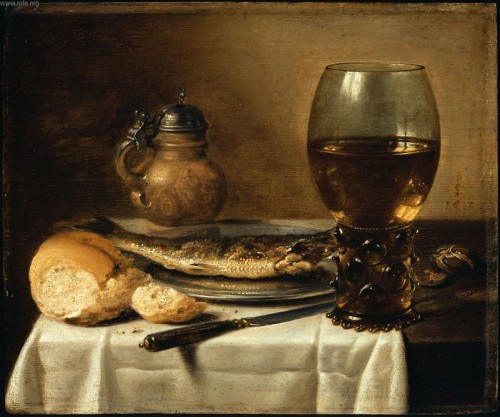 There isn’t much to tell,
tomorrow
when I
go down to Goodmorning and
How are you
what I really need is this bread of the stories, of the songs . . .
–Pablo Neruda, in The Sea and the Bells
Bread is so much a part of the stories of Easter we hardly notice it. There are so many extravagant details, after all, and bread is ordinary. Yet when Jesus appears to people, bread is there . And his final request was that we think of him as the bread that sustains us in our journey to freedom and the promised land.
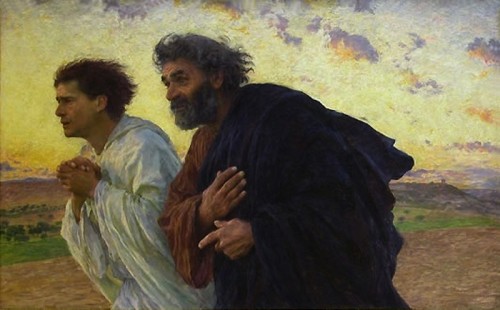 This story in John, the breakfast-on-the-beach story, is in some ways the loveliest Easter tale. Breakfast on the beach is such a delightful thing, and there’s a charcoal fire, roasted fish, warm bread . . . and Jesus, feeding his friends. Peter adds to our delight by being so overcome with joy when he sees Jesus on the shore — he has been doing the hard work of hauling trawler nets for hours, in fact, the whole night, and he stripped down for the sweaty work. In his excitement, he puts his clothes on, then plunges from the boat into the water, to get to the shore and to Jesus.
All night the nets had been empty. Their arms, backs, and hearts all ached. And then a stranger called to them to try the other side of the boat. As if that could make a difference. As if they hadn’t tried everything already. As if a stranger knew better than they how to fish these waters. As if the emptiness were not their lot. As if their hunger could be filled.
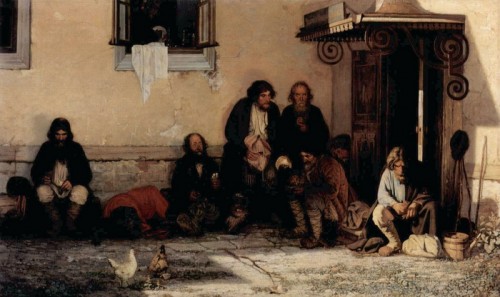 Easter comes, not as an answer, but far more humanly than that. Easter comes to our hunger, to the hunger of the heart and of the stomach. At the inn at Emmaus, bread is broken, and Easter comes. In the upper room, when some think he is a ghost, Jesus eats a fish. And on this beach, at dawn, Jesus is cooking fish. And there is bread.
From his birth in a town whose name, Bethlehem, means ‘house where bread is baked’ to his last supper, where he gives them bread and says it is his life he is sharing, bread and their hunger have been part of everything he has said and done. In his human life, he sometimes fed bread to 5000 at a time. And in his Easter life, he has fed billions. This does not stop: their hunger and his feeding. This will go on. He calls them to it: Feed my lambs.
In Orthodox churches, bread is central to Easter celebrations. There are Easter breads woven with colored eggs baked into them, and Easter breads shaped into crosses and doves, and Easter breads decorated with flowers. In Italy bread is eaten with chocolate. And in Russia and Greece even the Eucharistic bread, the wafers and small loaves, have honey added to them in celebration.
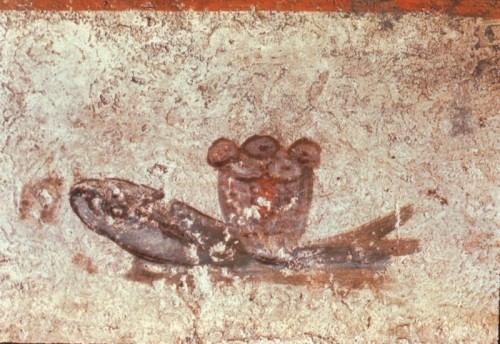 The work of feeding the hungers of the world awaits us as Easter winds down, and as we gather for the gift of Spirit that will fuel our energy for feeding the emptiness of the long nights of the human soul.
Years ago now, in a church in Massachusetts, a man gave me a recipe for Eucharistic bread, a recipe he had received in his two years as a volunteer with the Jesuits in the third world. A committed Catholic, he had returned to the US and fallen in love with a Protestant woman. When I met him, they had three children, one with Down syndrome, and they lived in a house full of conversation about faith and life, and attended both mass and morning worship.
 The recipe became a staple for my Protestant church, made for our communions by families who baked it together, a chance for parents and children to talk about communion. The children decorated the unbaked dough with fish or crosses or doves or their handprints. We liked it that this bread was being shared around the world, and on any given Sunday, we knew that Christians were sharing it in outdoor churches and in home churches, on altars, tables, anywhere where there was a hunger that had not been filled . . .
Here, then, is the recipe, for Jesuit Volunteer Corps Communion Bread:
1 ½ cups wheat flour
½ cup white flour
¾ tsp salt
¾ tsp baking soda
2 heaping Tbsp margarine or butter
¾ cup cold water
3 Tbsp honey
Mix dry ingredients. Add margarine or butter. Blend well. Add water and honey. Knead until the mixture is a good texture. Shape into a round, flat loaf. Score with a cross, fish, dove, etc. (Or all of them!) Bake at 350 degrees for 20-24 minutes, or longer if needed, till bread isn’t doughy. I like to make two loaves, one to break up, and one for the minister to break in the service.
The place God calls you to is the place where your deep gladness and the world’s deep hunger meet, wrote Frederick Buechner. That place is an Easter beach, where day is breaking in your life, and there is bread, waiting for you.
_________________________________________________
Illustrations:
1. Still Life with Wine, Bread, Fish, Claesz, Peter, 1642, Museum of Fine Arts, Boston. Vanderbilt Divinity Library, Art in the Christian Tradition
2. James and John on Easter Morning, Burnand, Eugene, 1898, Musee d”Orsay, Paris. Vanderbilt Divinity Library, Art in the Christian Tradition
3. The Bread Line, 1872, Moscow, Mjassojedow, Grigorij Grigorjewitsch. Vanderbilt Divinity Library, Art in the Christian Tradition
4. Eucharistic Bread and Fish, Catacombs, 3rd c. Rome, Italy. Vanderbilt Divinity Library, Art in the Christian Tradition
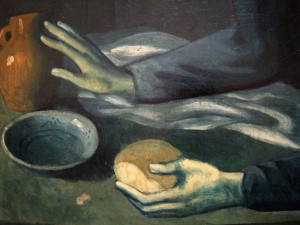
5. The Blind Man’s Bread, Pablo Picasso, 1903. Metropolitan Museum of Art, NY. Vanderbilt Divinity School Library, Art in the Christian Tradition.
Previous Post

April 2, 2013
Doubting Thomas
Next Post
April 14, 2013 Assimilation
Browse Our Archives
Select a Category Bites Uncategorized
Select a Month December 2017 November 2017 October 2017 September 2017 August 2017 July 2017 June 2017 May 2017 April 2017 March 2017 February 2017 January 2017 December 2016 November 2016 October 2016 September 2016 August 2016 July 2016 June 2016 May 2016 April 2016 March 2016 February 2016 January 2016 December 2015 November 2015 October 2015 September 2015 August 2015 July 2015 June 2015 May 2015 April 2015 March 2015 February 2015 January 2015 December 2014 November 2014 October 2014 September 2014 August 2014 July 2014 June 2014 May 2014 April 2014 March 2014 February 2014 January 2014 December 2013 November 2013 October 2013 September 2013 August 2013 July 2013 June 2013 May 2013 April 2013 March 2013 February 2013 January 2013 December 2012
Follow Us!
TAKE THE
Religious Wisdom Quiz
What was the rider of the Red Horse in Revelation given?
Select your answer to see how you score.
A balance scale A crown A large sword A bow
Related posts from The Bite in the Apple




TRENDING AT PATHEOS Progressive Christian

Why Christians Have a Sacred Duty to Vote:...
The Bible offers strong support for the sacred duty to vote. Here...

What Being a Modern-Day Apostle Means to Me
In my last column, I discussed the ins and outs of modern-day...

Did Ancient China Once Worship the God of...
Across human history, a common thread weaves through the origins of the...

Love Your Neighbor – Including Earth-Kin: Lev. 19,...
God’s command to love your neighbor means acting in an ethical and...

Lead a Church Study of “Jesus and Lao...
Guest writer Jack Thomas (The Irreverent Reverend) reflects on leading his church...

Principles for Understanding the Apostolic Ministry Today
Whenever people discover that my formal ministry title is "apostle," as in...
view all Progressive Christian blogs
Ad-Free & Subscriber Log-In Subscription Support
- About Us
- 2026 Calendar
- Videos
- Podcasts
- Library of World Religions
- Faith In Media Tracker
- Advertise With Us
- Write for Us
- Privacy Policy
- Terms of Service
- Do Not Sell My Data
- Contact Us
- Radiant Digital
- Manage Newsletter Subscriptions
- Unsubscribe From Notifications
- Sitemap
Copyright 2008-2026, Patheos. All rights reserved.
Subscription Support Ad-Free & Subscriber Log-In
Follow Patheos