
BuddhistCatholicContemplativeEvangelicalGeneral ChristianHinduJewishLatter-day SaintMuslimNew VisionsProgressive Christian
Beliefs
- Buddhist
- Catholic
- Contemplative
- Evangelical
- General Christian
- Hindu
- Jewish
- Latter-day Saint
- More Voices
- Muslim
- New Visions
- Pagan
- Progressive Christian
Topics
- Religion News
- Food and Religion
- Sports and Religion
- Religious Art
- Religious Music and Entertainment
- Religious Events
- History and Religion
- Style and Religion
- Politics and Religion
- Women in Religion
- Recreation Outdoors and Religion
- Business Finance and Religion
- Careers Workplace and Religion
- Education and Religion
- Family Parenting and Religion
- Health Fitness and Religion
- Home and Religion
- Relationships and Religion
- Technology and Religion
- Travel and Religion
Columnists
- Buddhist Columnists
- Business Finance and Religion Columnists
- Careers Workplace and Religion Columnists
- Catholic Columnists
- Contemplative Columnists
- Education and Religion Columnists
- Evangelists Columnists
- Family Parenting and Religion Columnists
- General Christian Columnists
- Health Fitness and Religion Columnists
- Hindu Columnists
- History and Religion Columnists
- Home and Religion Columnists
- Jewish Columnists
- More Voices Columnists
- Latter Day Columnists
- Muslim Columnists
- New Visions Columnists
- Nonreligious Columnists
- Pagan Columnists
- Politics and Religion Columnists
- Progressive Columnists
- Recreation Outdoors and Religion Columnists
- Relationships and Religion Columnists
- Religion News Columnists
- Religious Art Columnists
- Religious Events Columnists
- Religious Music and Entertainment Columnists
- Sports and Religion Columnists
- Style and Religion Columnists
- Technology and Religion Columnists
- Travel and Religion Columnists
- Women in Religion Columnists
Resource Library
- 2026 Calendar
- Library of World Religions
- The 100 Most Holy Places on Earth
- Patheos Answers
- Podcasts
- Videos
- Faith Leaders Database
- Anglican Episcopalian
- Bahai
- Baptist
- Buddhism
- Christianity
- Confucianism
- Eastern Orthodoxy
- Hinduism
- Holiness and Pentecostal
- ISKCON
- Islam
- Judaism
- Lutheran
- Methodist
- The Church of Jesus Christ of Latter-day Saints
- New Age
- Paganism
- Presbytarian and Reformed
- Protestantism
- Religion Behind the Scenes
- Roman Catholic
- Scientology
- Shia Islam
- Sikhism
- Sufism
- Sunni Islam
- Taoism
- Zen
- See all religions
Research Tools
 Ad-Free & Subscriber Log-In Subscription Support
Ad-Free & Subscriber Log-In Subscription Support
Follow Patheos 

- Trending:
- Forgiveness
- |
- Marriage
- |
- Consciousness
- |
- Death Penalty
- |
- Election
- |
- Halloween
 The Bite in the Apple
- Home
- Progressive Christian
- Doubting Easter
Doubting Easter
Last updated on: April 19, 2014 at 2:20 pm by Nancy Rockwell
Doubting Easter 2014-04-19T14:20:46-04:00 Nancy Rockwell
Patheos Explore the world's faith through different perspectives on religion and spirituality! Patheos has the views of the prevalent religions and spiritualities of the world.
 Doubting Thomas – he’s always featured on the Sunday after Easter. He’s reliable. He anchors the season and relieves the atmosphere, which is always over-lily-ed. And who can’t relate to him?
His name means ‘twin’ in Greek. The twin, nestled next to him in spirit, is us. Across the centuries our connection to him is immediate. His tone, his stance, the look in his eyes as he makes his remarks, are ours. We doubt what he doubts: Easter.
The truth is, Doubting Thomas is present in most church pews on Easter Day. He’s there because he loves a true believer. Or, he’s there because he likes the place, the people, even though his questions remain unanswered. Or perhaps he’s there because, on Easter, he buys his mother a corsage and takes her to church and out to lunch, then returns to his real world. Or he’s there as one who used to believe, but too many terrible things have happened over the years, the death of a child, or divorce, or cancer, and he just doesn’t believe in Easter now. Like a teenager forced to put on a suit, he endures the trappings of this day, but he is not persuaded by trumpets, fanfare, extra anthems and memorial flowers, that resurrection is real. He is waiting to get out of here.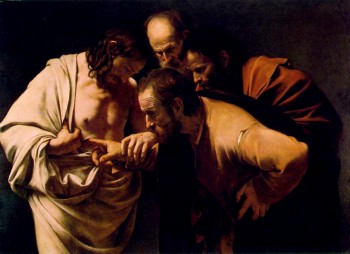
The gospel stories include other doubters, and make some distinctions between the spirit of our doubting. Thomas’ doubt is the stubborn kind, the kind of doubt that is rooted in suspicion – and perhaps in clinging to sorrow. Thomas has been as broken-hearted as the others by all that has happened, but it is harder for him to let his sorrow go. He’s a Missouri kind of guy, and he wasn’t there when Jesus appeared to the others. For him this is second-hand news, and what seems impossible to him will not be made possible by a tall tale, told by hid friends, whom he has never thought infallible.
 Luke tells a different story of Doubters, a story about the disciples a few days after Easter seeing Jesus in their upper room, and, Luke says, they were disbelieving in joy and still wondering . . . . So doubt can be ours in a less suspicious form, in a spirit more willing to be persuaded that inexplicable experience can be real. Doubt can even be ours in believing, according to Luke. And we can still be wondering as we move on, for the journey into a changed understanding does not happen like a thunderclap, it really is an experience of walking away from Egypt, carrying our doubts like unrisen bread, to keep us alive along the way. These doubts do not have a deep root of suspicion, these doubts seek knowledge and will accept experience, and even joy, with an open heart.
There’s a third Doubter, whose story is told in Mark 9: he’s the father of a boy who suffers frequent convulsions. He has brought his son to the disciples, in hope of healing, but they have not been able to help. Jesus arrives and asks what is happening here. The father tells about his son, saying sometimes the boy falls in the fire, sometimes in water and nearly drowns. Can you help him? he asks. And Jesus questions the question, calling it doubt, and asking for faith. And the father replies, Lord I believe; help my unbelief.
Jesus commands the convulsing spirit to leave the boy and it does. At first the boy appears dead, but then he is able to stand. It’s not a glorious moment, but it does seem to be freedom.  Later the disciples ask why they couldn’t do it. And rather enigmatically, Jesus replies, This kind can only be handled with prayer. Since Jesus quite specifically did not pray over the boy, he commanded, as the disciples had done (but without success), where is the prayer?
It is in the mouth of the father. The father, who prayed*, Lord, I believe, help my unbelief.* The father has to offer, on his child’s behalf, a heart full of hope, hope for the child as the child is now, rather than doubt about the life of the child – or the goodness of God – or the goodness of life itself – or of his own life, as the father. Not, I think, doubt in Jesus – the father was begging Jesus, but he was begging without hope, in himself or in his child, that God was with them in their scary and unpredictable life.
We hold our doubt in so many spirits, stubborn, truculent, weepy, stalwart, suspicious, wily, crippling, demanding, exhausted. Easter belongs to us when we are able, even in doubt, to honor the grace of our lives, and even find joy. Death is a very hard reality to disbelieve. Yet, death is the harshness in which hope seeks openings, for doubt that can welcome signs of life, and for joy in our love.
We owe Doubting Thomas our deep thanks. For Doubting Thomas pipes up. And because of him, Easter can be seen even through our doubts, and continues in our presence, as he does. _____________________________________________________ Illustrations:
1. The Incredulity of Thomas. Duccio, di Buoninsegna, 1308. Museo-dell’Opera-del-Duomo-Siena-Italy. Vanderbilt Divinity School Library, Art in the Christian Tradition.
2. The Incredulity of St. Thomas. Caravagio, Michelangelo. 1601. Neues Palais in Sansoucie, Potsdam, Germany. Vanderbilt Divinity School Library, Art in the Christian Tradition.
3. Endless Road. Margaret Hofheiz-Doring, 1971. Vanderbilt Divinity School Library, Art in the Christian Tradition.
4. This is Where I Find My Peace. 2008. Houston Texas. Vanderbilt Divinity School Library, Art in the Christian Tradition.
Previous Post

April 12, 2014
Easter Vision
Next Post
April 26, 2014 On the Emmaus Road
Browse Our Archives
Select a Category Bites Uncategorized
Select a Month December 2017 November 2017 October 2017 September 2017 August 2017 July 2017 June 2017 May 2017 April 2017 March 2017 February 2017 January 2017 December 2016 November 2016 October 2016 September 2016 August 2016 July 2016 June 2016 May 2016 April 2016 March 2016 February 2016 January 2016 December 2015 November 2015 October 2015 September 2015 August 2015 July 2015 June 2015 May 2015 April 2015 March 2015 February 2015 January 2015 December 2014 November 2014 October 2014 September 2014 August 2014 July 2014 June 2014 May 2014 April 2014 March 2014 February 2014 January 2014 December 2013 November 2013 October 2013 September 2013 August 2013 July 2013 June 2013 May 2013 April 2013 March 2013 February 2013 January 2013 December 2012
Follow Us!
TAKE THE
Religious Wisdom Quiz
What did God create on the first day?
Select your answer to see how you score.
Light Water Animals Plants
Related posts from The Bite in the Apple




TRENDING AT PATHEOS Progressive Christian

Why Christians Have a Sacred Duty to Vote:...
The Bible offers strong support for the sacred duty to vote. Here...

What Being a Modern-Day Apostle Means to Me
In my last column, I discussed the ins and outs of modern-day...

Did Ancient China Once Worship the God of...
Across human history, a common thread weaves through the origins of the...

Love Your Neighbor – Including Earth-Kin: Lev. 19,...
God’s command to love your neighbor means acting in an ethical and...

Lead a Church Study of “Jesus and Lao...
Guest writer Jack Thomas (The Irreverent Reverend) reflects on leading his church...

Principles for Understanding the Apostolic Ministry Today
Whenever people discover that my formal ministry title is "apostle," as in...
view all Progressive Christian blogs
Ad-Free & Subscriber Log-In Subscription Support
- About Us
- 2026 Calendar
- Videos
- Podcasts
- Library of World Religions
- Faith In Media Tracker
- Advertise With Us
- Write for Us
- Privacy Policy
- Terms of Service
- Do Not Sell My Data
- Contact Us
- Radiant Digital
- Manage Newsletter Subscriptions
- Unsubscribe From Notifications
- Sitemap
Copyright 2008-2026, Patheos. All rights reserved.
Subscription Support Ad-Free & Subscriber Log-In
Follow Patheos