
BuddhistCatholicContemplativeEvangelicalGeneral ChristianHinduJewishLatter-day SaintMuslimNew VisionsProgressive Christian
Beliefs
- Buddhist
- Catholic
- Contemplative
- Evangelical
- General Christian
- Hindu
- Jewish
- Latter-day Saint
- More Voices
- Muslim
- New Visions
- Pagan
- Progressive Christian
Topics
- Religion News
- Food and Religion
- Sports and Religion
- Religious Art
- Religious Music and Entertainment
- Religious Events
- History and Religion
- Style and Religion
- Politics and Religion
- Women in Religion
- Recreation Outdoors and Religion
- Business Finance and Religion
- Careers Workplace and Religion
- Education and Religion
- Family Parenting and Religion
- Health Fitness and Religion
- Home and Religion
- Relationships and Religion
- Technology and Religion
- Travel and Religion
Columnists
- Buddhist Columnists
- Business Finance and Religion Columnists
- Careers Workplace and Religion Columnists
- Catholic Columnists
- Contemplative Columnists
- Education and Religion Columnists
- Evangelists Columnists
- Family Parenting and Religion Columnists
- General Christian Columnists
- Health Fitness and Religion Columnists
- Hindu Columnists
- History and Religion Columnists
- Home and Religion Columnists
- Jewish Columnists
- More Voices Columnists
- Latter Day Columnists
- Muslim Columnists
- New Visions Columnists
- Nonreligious Columnists
- Pagan Columnists
- Politics and Religion Columnists
- Progressive Columnists
- Recreation Outdoors and Religion Columnists
- Relationships and Religion Columnists
- Religion News Columnists
- Religious Art Columnists
- Religious Events Columnists
- Religious Music and Entertainment Columnists
- Sports and Religion Columnists
- Style and Religion Columnists
- Technology and Religion Columnists
- Travel and Religion Columnists
- Women in Religion Columnists
Resource Library
- 2026 Calendar
- Library of World Religions
- The 100 Most Holy Places on Earth
- Patheos Answers
- Podcasts
- Videos
- Faith Leaders Database
- Anglican Episcopalian
- Bahai
- Baptist
- Buddhism
- Christianity
- Confucianism
- Eastern Orthodoxy
- Hinduism
- Holiness and Pentecostal
- ISKCON
- Islam
- Judaism
- Lutheran
- Methodist
- The Church of Jesus Christ of Latter-day Saints
- New Age
- Paganism
- Presbytarian and Reformed
- Protestantism
- Religion Behind the Scenes
- Roman Catholic
- Scientology
- Shia Islam
- Sikhism
- Sufism
- Sunni Islam
- Taoism
- Zen
- See all religions
Research Tools
 Ad-Free & Subscriber Log-In Subscription Support
Ad-Free & Subscriber Log-In Subscription Support
Follow Patheos 

- Trending:
- Forgiveness
- |
- Marriage
- |
- Consciousness
- |
- Death Penalty
- |
- Election
- |
- Halloween
 The Bite in the Apple
- Home
- Progressive Christian
- Doubt: The Demon and the Angel of Easter
Doubt: The Demon and the Angel of Easter
Last updated on: March 26, 2016 at 9:47 pm by Nancy Rockwell
Doubt: The Demon and the Angel of Easter 2016-03-26T21:47:29-04:00 Nancy Rockwell
Patheos Explore the world's faith through different perspectives on religion and spirituality! Patheos has the views of the prevalent religions and spiritualities of the world.
 The doubts that plague me are real, and they have power. They have the power to keep me from believing in myself. Especially at critical junctures, when they always start warning, scoffing, belittling, worrying away at my hope, if I can’t muster the presence of my angels, opportunities pass me by. In time, these lost moments become regrets. They are unforgettable. Sometimes they lend me confidence in another struggle, and sometimes they add to my doubts. And so it was with the disciples –
The Sunday after Easter is devoted to doubt. The story of Doubting Thomas is always read, no matter what year of the three year cycle we are in. Doubt is huge. And since the very first Easter, everyone has known doubt is important.
But waiting a week to bring doubt into focus makes it seem as if there is a Doubt Delay – first, you get excited and run around and celebrate – then, you doubt.
That isn’t the real story about doubt. Doubt was part of the entire Easter picture, from Maundy Thursday right through Easter Day. At the Last Supper the disciples drew back from Jesus’ foot washing – doubting his gesture, divining his meaning and shrinking from the changes to their own intentions, still intent on glory.
Outside his trial, Peter shrank into famed betrayals, unable to leave, unable to step forward, doubt and love struggling within him.
All the disciples were paralyzed by grief, the intense doubt that overwhelmed Jesus’ oft spoken assurances that he would rise, until it was Joseph of Arimathea who was able to handle the details of burial.
Pain is a guise of doubt, the mind and body unable to muster enough light to dispel the darkness. There is no record of what was said between the disciples from Friday until Easter morning, but we know what it would be among us: long silences punctuated by if onlys, why didn’t wes, how could theys. We know from their Easter astonishment that no one was saying, Let’s wait and see what happens.
Yet on Easter morning, doubt was as much their angel as their demon: some, certain of death, set out for the tomb to prepare the body. Each gospel lists different women. Always, Mary Magdelene, often his mother, and then various names. John lists Magdelene alone, who, on discovering the absence of the body runs back to tell the others, and Peter and John rush out, running ahead of her, racing each other. John arrives first but does not go in – overcome, at that point, by inner conflict, doubt surely being part of that. Peter rushes by him, enters in, sees the folded grave clothes, and his doubts and grief fall away. He rushes out, rejoicing. But Mary needs more than absence, more than clothing, more even than sight. When she hears her name, she knows.
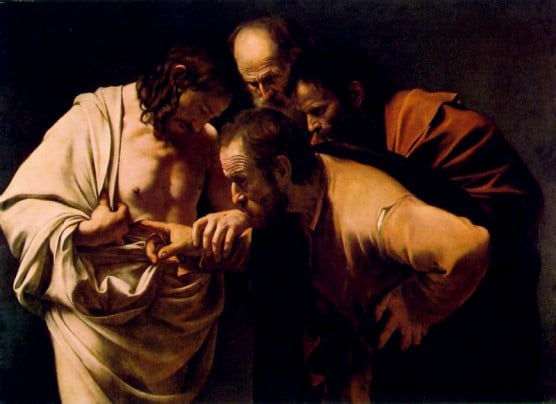
Thomas wasn’t there in the Upper Room when they returned, wasn’t there when Jesus came and amazed them all by eating a fish. And all their telling, all their amazement, did not dispel his skepticism. Yet there was enough faith in him to keep him from walking out, exclaiming You’re nuts! and leaving their madness behind. He proclaims he has to touch those wounds in order to believe, but he stays with them, his doubt as much an angel as a demon. Some days later he has the chance to touch those wounds, it is written.
Thomas is a Greek name, and it means twin, though his twin, if he had one, never appears, and some suggest we are, each of us, his twin. For each of us has our nagging doubts that sometimes prompt us to get up and investigate a situation that needs our attention, and that sometimes hold us back. If Thomas’ doubts are the most persistent, then he is our twin because our doubts persist, and at times are insistent, and they have the ability to lead us to new discoveries about ourselves and in our relationship with all that is holy.
My doubts are not so much about whether Easter happened, though I do question that at times, but about whether it is important, whether it has anything to do with me. After all, it is from my own suffering that I long to rise.
As our culture becomes more and more dystopian, it becomes harder to set aside cynicism. Among my friends are those who fell away from Downton Abbey because the series was too impossibly sweet, and those who stayed watching, but scoffed at the series for finding too much good in a world they believe to be much crueler than that. And in the new Fox series, Rosewood, an African American Medical Examiner (Morris Chestnut) holds out hope and faith in life to all those doubters around him, who are invested in one or another form of disbelief in their ability to be accepted in this world, in their ability to survive pain, and in the power of forgiveness.
Easter insists on an end to our victimization, and opens an endless Day of Peace, which we must begin to proclaim. The disciples move through degrees of despair and doubt in each other’ company in a long, varied conversation, in which all the things they think and feel are transformed from Demons into Angels. Easter is new life, rising. Not about escaping with our life, but walking in the power of God’s love, even into death. And that’s what it has to do with each of us.
__________________________________________________________________
Image:
The Incredulity of St. Thomas, by Caravaggio, Michelangelo. 1601-2. Postdam,Germany. Vanderbilt Divinity School Library, Art in the Christian Tradition.
Previous Post

March 20, 2016
What’s Up?
Next Post

March 30, 2016 Rising to Ordinary Things
Browse Our Archives
Select a Category Bites Uncategorized
Select a Month December 2017 November 2017 October 2017 September 2017 August 2017 July 2017 June 2017 May 2017 April 2017 March 2017 February 2017 January 2017 December 2016 November 2016 October 2016 September 2016 August 2016 July 2016 June 2016 May 2016 April 2016 March 2016 February 2016 January 2016 December 2015 November 2015 October 2015 September 2015 August 2015 July 2015 June 2015 May 2015 April 2015 March 2015 February 2015 January 2015 December 2014 November 2014 October 2014 September 2014 August 2014 July 2014 June 2014 May 2014 April 2014 March 2014 February 2014 January 2014 December 2013 November 2013 October 2013 September 2013 August 2013 July 2013 June 2013 May 2013 April 2013 March 2013 February 2013 January 2013 December 2012
Follow Us!
TAKE THE
Religious Wisdom Quiz
Who became jealous and tried to kill David several times?
Select your answer to see how you score.
Abiathar Abner Saul Samuel
Related posts from The Bite in the Apple



TRENDING AT PATHEOS Progressive Christian

What Being a Modern-Day Apostle Means to Me
In my last column, I discussed the ins and outs of modern-day...

Did Ancient China Once Worship the God of...
Across human history, a common thread weaves through the origins of the...

Love Your Neighbor – Including Earth-Kin: Lev. 19,...
God’s command to love your neighbor means acting in an ethical and...

Lead a Church Study of “Jesus and Lao...
Guest writer Jack Thomas (The Irreverent Reverend) reflects on leading his church...

Pastoral Wisdom for Responding to Sermon Pushback
Getting sermon pushback on your social justice sermon? Learn practical, Proverbs-based strategies...

Principles for Understanding the Apostolic Ministry Today
Whenever people discover that my formal ministry title is "apostle," as in...
view all Progressive Christian blogs
Ad-Free & Subscriber Log-In Subscription Support
- About Us
- 2026 Calendar
- Videos
- Podcasts
- Library of World Religions
- Faith In Media Tracker
- Advertise With Us
- Write for Us
- Privacy Policy
- Terms of Service
- Do Not Sell My Data
- Contact Us
- Radiant Digital
- Manage Newsletter Subscriptions
- Unsubscribe From Notifications
- Sitemap
Copyright 2008-2026, Patheos. All rights reserved.
Subscription Support Ad-Free & Subscriber Log-In
Follow Patheos