
BuddhistCatholicContemplativeEvangelicalGeneral ChristianHinduJewishLatter-day SaintMuslimNew VisionsProgressive Christian
Beliefs
- Buddhist
- Catholic
- Contemplative
- Evangelical
- General Christian
- Hindu
- Jewish
- Latter-day Saint
- More Voices
- Muslim
- New Visions
- Pagan
- Progressive Christian
Topics
- Religion News
- Food and Religion
- Sports and Religion
- Religious Art
- Religious Music and Entertainment
- Religious Events
- History and Religion
- Style and Religion
- Politics and Religion
- Women in Religion
- Recreation Outdoors and Religion
- Business Finance and Religion
- Careers Workplace and Religion
- Education and Religion
- Family Parenting and Religion
- Health Fitness and Religion
- Home and Religion
- Relationships and Religion
- Technology and Religion
- Travel and Religion
Columnists
- Buddhist Columnists
- Business Finance and Religion Columnists
- Careers Workplace and Religion Columnists
- Catholic Columnists
- Contemplative Columnists
- Education and Religion Columnists
- Evangelists Columnists
- Family Parenting and Religion Columnists
- General Christian Columnists
- Health Fitness and Religion Columnists
- Hindu Columnists
- History and Religion Columnists
- Home and Religion Columnists
- Jewish Columnists
- More Voices Columnists
- Latter Day Columnists
- Muslim Columnists
- New Visions Columnists
- Nonreligious Columnists
- Pagan Columnists
- Politics and Religion Columnists
- Progressive Columnists
- Recreation Outdoors and Religion Columnists
- Relationships and Religion Columnists
- Religion News Columnists
- Religious Art Columnists
- Religious Events Columnists
- Religious Music and Entertainment Columnists
- Sports and Religion Columnists
- Style and Religion Columnists
- Technology and Religion Columnists
- Travel and Religion Columnists
- Women in Religion Columnists
Resource Library
- 2026 Calendar
- Library of World Religions
- The 100 Most Holy Places on Earth
- Patheos Answers
- Podcasts
- Videos
- Faith Leaders Database
- Anglican Episcopalian
- Bahai
- Baptist
- Buddhism
- Christianity
- Confucianism
- Eastern Orthodoxy
- Hinduism
- Holiness and Pentecostal
- ISKCON
- Islam
- Judaism
- Lutheran
- Methodist
- The Church of Jesus Christ of Latter-day Saints
- New Age
- Paganism
- Presbytarian and Reformed
- Protestantism
- Religion Behind the Scenes
- Roman Catholic
- Scientology
- Shia Islam
- Sikhism
- Sufism
- Sunni Islam
- Taoism
- Zen
- See all religions
Research Tools
 Ad-Free & Subscriber Log-In Subscription Support
Ad-Free & Subscriber Log-In Subscription Support
Follow Patheos 

- Trending:
- Forgiveness
- |
- Marriage
- |
- Consciousness
- |
- Death Penalty
- |
- Election
- |
- Halloween
 The Bite in the Apple
- Home
- Progressive Christian
- Do You Believe in Miracles?
Do You Believe in Miracles?
Last updated on: May 3, 2016 at 11:46 pm by Nancy Rockwell
Do You Believe in Miracles? 2016-05-03T23:46:16-04:00 Nancy Rockwell
Patheos Explore the world's faith through different perspectives on religion and spirituality! Patheos has the views of the prevalent religions and spiritualities of the world.
 To tell you the truth, talk about miracles makes me squirm. An ongoing spiritual argument starts raging in my soul, and all the voices are loud. I deal with this by looking for an Off Button, which can be any number of ways of changing the subject.
The argument is between my belief and my horror at my belief. And both are engaged when people tell me about their miracles. There’s usually something triumphant in those testimonies. And I rarely hear words of deep thanksgiving.
How can any of us be smug about a miraculous outcome, when so many of us do not get a miracle?
When Downton Abbey’s Lord Merton’s deadly diagnosis was reversed upon retesting, my friend reacted angrily. “That doesn’t happen!” she pronounced, rejecting the episode as silly, and I thought of the ten months her husband lay suffering in a hospital, his prayers for a cure – and hers – were not answered. Yet in the same week, another friend, a colleague, who was told he had Parkinson’s, went for further testing at MGH, and was told he did not have the disease.
Why do miracles happen, and not happen? Happen to one and not another. Happen to us now and not then? Happen when we pray and not happen when we pray? Leave us, afterwards, sure and yet unsure, that they happened.
Morgan Freeman, in the final episode of his series, The Story of God, began with this question. And he hooked me from start to finish. I’m grateful for the way he explored the question.
He introduced a Latino immigrant, a Manhattan window washer who survived a fall from the 47th floor when the cables of his platform broke. He was injured, spent weeks in a coma, but is fine now. But he has trouble claiming the miracle even his doctors said it was, because his brother, who was with him on the platform, died. Why would God save him, and not his brother?
Most of us, as Freeman notes, believe God is watching over us always. So we expect miraculous care. But why not for the brother, too?
Freeman takes his question to a Seder where the rabbi tells him Judaism begins in miracles, Passover happens in the month of Nissan, which means miracles, and celebrates the miracles that saved the Jewish people in their long walk to freedom. The rabbi notes that the ritual ten drops of wine placed by each person on their plate represent sorrow for the blood shed by the Egyptians, and recognition that the miracles did not benefit everyone.
Freeman finds miracles are part of every religious tradition. He talks with a Vatican official about them. He also talks with a psychologist who believes we mistake random moments, that fall within the laws of mathematical probability, for divine intervention.
Freeman offers his own turning point in life: in 1980 he made three films, all of which were big hits: Lean on Me, Driving Miss Daisy, and Glory. Was this probability? Or was it a miracle?
He takes us to a Roman historian who tells us that the Circus Maximus, essentially a horse track, became a place of heavy gambling, illegal in Rome’s pantheon where the gods produced fate, not chance. The god Mithras, who could influence Fate, became a favorite of horse racers. The ruins of Mithras’ worship chamber, below the Circus Maximus, are open for visitors.
From a Taoist faith calculator, a follower of the Way of Lao Tsu, Freeman learns a theory of the energy of the universe that is always there and can be directed by us. Everything that happens, says the Tao, is a result of all we are connected to. And the adage, “Birds do not fly, they ride the wind, fish to do swim, they are carried” holds this message.
Freeman visits a doctor in Virginia who has experienced his own miracle of healing. Twenty years ago he was diagnosed with a rare and painful form of lymphoma, and has video of the giant tumors that made baseball sized lumps on his neck, under his arms and in his abdomen. He was told he had no hope and would soon die. His church gathered many times in circles of prayer for him, laying hands of blessing on him and calling for his healing.
And then he took a dose of chemotherapy, which he had been told would not heal him but would reduce his pain. And immediately his tumors began to shrink. In 48 hours, they were gone. The doctor believes that the power of faith in the people around him made the impossible possible.
Freeman then travels to the Orient, and learns a quite different story of healing, how Gautama Buddha, seeking the answer to suffering, retreated from his search to sit motionless under the Bo Tree, and after decades of motionlessness, became enlightened – freed – by simply letting go, and focusing his mind.
Freeman reminds us that inexplicable things occur all the time. People get breaks. Fall in love. Inspire one another.
I think of the treasures of memory I hold dear, such miracles as I want always to remember, because, as Freeman says, they give us hope, and move us to make what is merely possible, real.
_______________________________________________________________
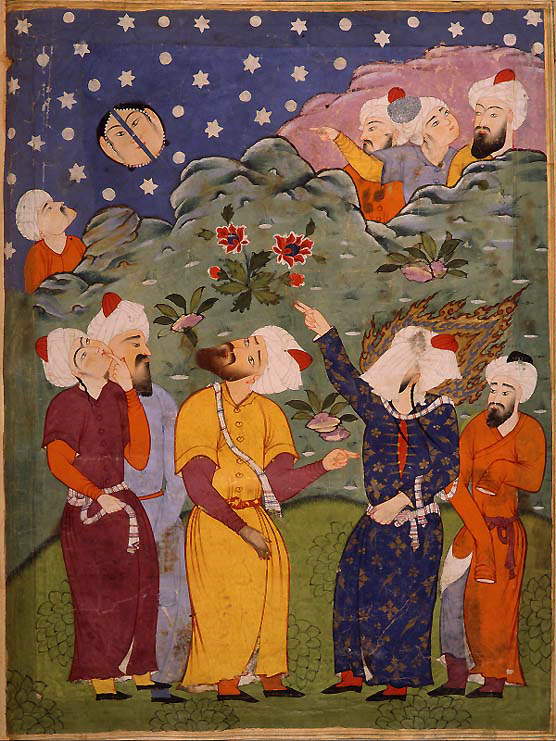
Image: Muhammed points out the splitting of the moon. Anonymous 16th-century watercolor from a Falnama, a Persian book of prophecy. Muhammed is the veiled figure on the right. Image from en-wikipedia.org.
Previous Post

May 1, 2016
A Shared Sense - Jesus' Prayer
Next Post

May 7, 2016 Fire Baptism
Browse Our Archives
Select a Category Bites Uncategorized
Select a Month December 2017 November 2017 October 2017 September 2017 August 2017 July 2017 June 2017 May 2017 April 2017 March 2017 February 2017 January 2017 December 2016 November 2016 October 2016 September 2016 August 2016 July 2016 June 2016 May 2016 April 2016 March 2016 February 2016 January 2016 December 2015 November 2015 October 2015 September 2015 August 2015 July 2015 June 2015 May 2015 April 2015 March 2015 February 2015 January 2015 December 2014 November 2014 October 2014 September 2014 August 2014 July 2014 June 2014 May 2014 April 2014 March 2014 February 2014 January 2014 December 2013 November 2013 October 2013 September 2013 August 2013 July 2013 June 2013 May 2013 April 2013 March 2013 February 2013 January 2013 December 2012
Follow Us!
TAKE THE
Religious Wisdom Quiz
How did Job's friends initially show their sympathy?
Select your answer to see how you score.
Sat in silence seven days Brought gifts Wept and tore clothes Offered sacrifices
Related posts from The Bite in the Apple



TRENDING AT PATHEOS Progressive Christian

Why Christians Have a Sacred Duty to Vote:...
The Bible offers strong support for the sacred duty to vote. Here...

What Being a Modern-Day Apostle Means to Me
In my last column, I discussed the ins and outs of modern-day...

Did Ancient China Once Worship the God of...
Across human history, a common thread weaves through the origins of the...

Love Your Neighbor – Including Earth-Kin: Lev. 19,...
God’s command to love your neighbor means acting in an ethical and...

Lead a Church Study of “Jesus and Lao...
Guest writer Jack Thomas (The Irreverent Reverend) reflects on leading his church...

Principles for Understanding the Apostolic Ministry Today
Whenever people discover that my formal ministry title is "apostle," as in...
view all Progressive Christian blogs
Ad-Free & Subscriber Log-In Subscription Support
- About Us
- 2026 Calendar
- Videos
- Podcasts
- Library of World Religions
- Faith In Media Tracker
- Advertise With Us
- Write for Us
- Privacy Policy
- Terms of Service
- Do Not Sell My Data
- Contact Us
- Radiant Digital
- Manage Newsletter Subscriptions
- Unsubscribe From Notifications
- Sitemap
Copyright 2008-2026, Patheos. All rights reserved.
Subscription Support Ad-Free & Subscriber Log-In
Follow Patheos