
BuddhistCatholicContemplativeEvangelicalGeneral ChristianHinduJewishLatter-day SaintMuslimNew VisionsProgressive Christian
Beliefs
- Buddhist
- Catholic
- Contemplative
- Evangelical
- General Christian
- Hindu
- Jewish
- Latter-day Saint
- More Voices
- Muslim
- New Visions
- Pagan
- Progressive Christian
Topics
- Religion News
- Food and Religion
- Sports and Religion
- Religious Art
- Religious Music and Entertainment
- Religious Events
- History and Religion
- Style and Religion
- Politics and Religion
- Women in Religion
- Recreation Outdoors and Religion
- Business Finance and Religion
- Careers Workplace and Religion
- Education and Religion
- Family Parenting and Religion
- Health Fitness and Religion
- Home and Religion
- Relationships and Religion
- Technology and Religion
- Travel and Religion
Columnists
- Buddhist Columnists
- Business Finance and Religion Columnists
- Careers Workplace and Religion Columnists
- Catholic Columnists
- Contemplative Columnists
- Education and Religion Columnists
- Evangelists Columnists
- Family Parenting and Religion Columnists
- General Christian Columnists
- Health Fitness and Religion Columnists
- Hindu Columnists
- History and Religion Columnists
- Home and Religion Columnists
- Jewish Columnists
- More Voices Columnists
- Latter Day Columnists
- Muslim Columnists
- New Visions Columnists
- Nonreligious Columnists
- Pagan Columnists
- Politics and Religion Columnists
- Progressive Columnists
- Recreation Outdoors and Religion Columnists
- Relationships and Religion Columnists
- Religion News Columnists
- Religious Art Columnists
- Religious Events Columnists
- Religious Music and Entertainment Columnists
- Sports and Religion Columnists
- Style and Religion Columnists
- Technology and Religion Columnists
- Travel and Religion Columnists
- Women in Religion Columnists
Resource Library
- 2026 Calendar
- Library of World Religions
- The 100 Most Holy Places on Earth
- Patheos Answers
- Podcasts
- Videos
- Faith Leaders Database
- Anglican Episcopalian
- Bahai
- Baptist
- Buddhism
- Christianity
- Confucianism
- Eastern Orthodoxy
- Hinduism
- Holiness and Pentecostal
- ISKCON
- Islam
- Judaism
- Lutheran
- Methodist
- The Church of Jesus Christ of Latter-day Saints
- New Age
- Paganism
- Presbytarian and Reformed
- Protestantism
- Religion Behind the Scenes
- Roman Catholic
- Scientology
- Shia Islam
- Sikhism
- Sufism
- Sunni Islam
- Taoism
- Zen
- See all religions
Research Tools
 Ad-Free & Subscriber Log-In Subscription Support
Ad-Free & Subscriber Log-In Subscription Support
Follow Patheos 

- Trending:
- Forgiveness
- |
- Marriage
- |
- Consciousness
- |
- Death Penalty
- |
- Election
- |
- Halloween
 The Bite in the Apple
- Home
- Progressive Christian
- Body and Soul
Body and Soul
Last updated on: August 16, 2015 at 7:19 pm by Nancy Rockwell
Body and Soul 2015-08-16T19:19:51-04:00 Nancy Rockwell
Patheos Explore the world's faith through different perspectives on religion and spirituality! Patheos has the views of the prevalent religions and spiritualities of the world.
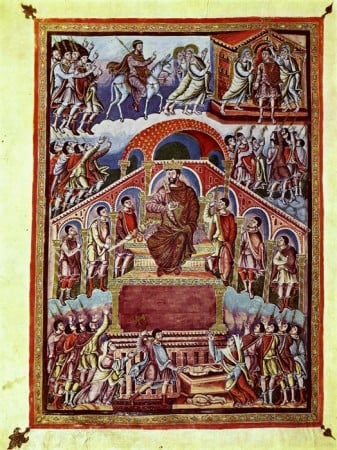 Wading through John’s 6th chapter, dense with repetitious mystical instructions about eating the body and blood of Jesus, is a trip through a sucking bog.
I’ve walked along one of these bogs, not too far from Walden Pond, and listened to its strange, insistent noises, its burps and belches and long wailing siren sounds, and gotten the creeps. John’s 6th chapter can do that to me, too. As, John says, Jesus did to large numbers of those who had been following him. They were creeped out, they had enough, they turned away and went home.
But I wonder, am I reading this right when I hear it the way they did? How could Jesus, who in Mark is so shy to be identified as a savior, and in Luke emphasizes the ordinary and accessible (trees and seeds and birds and bread and wine, as the doorways to holiness) turn into someone who insists on being worshiped as singularly divine and apart from all nature, in the space of a few decades and in the mind of John?
The companion narrative from I Kings, the story of Solomon, gives us an equally difficult fellow to pin down. Solomon was as bad as he was good, as terrible as he was great, as foolish as he was wise. He became legendary for his wisdom and his ability to bring disparate people together. And he also became legendary for his unbridled lust, his 700 wives and 300 concubines.
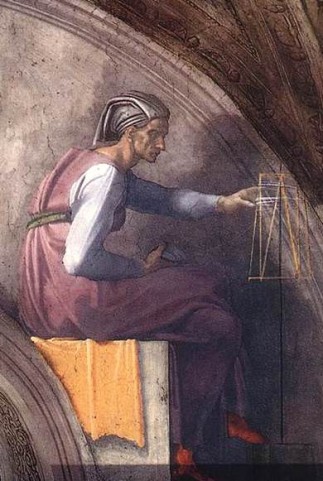 He built the awesome and cherished Second Temple, revered by Jews today and by hundreds of Sunday school children who have labored devotedly to replicate it as a way of exploring it.
Solomon also built temples to a number of other popular gods, and offered animal and human sacrifices in them as part of his politics.
Does Solomon remind us that Jesus, too, has many more dimensions to his character and life than we like to recall, or even know? Does Solomon show us that, for all his greatness, he could never be more than human – and that Jesus, too, wants us to remember his humanity, his flesh, his body and blood, and more than remember it, take him into our flesh, resurrecting him in our bodies, not in creeds we recite or rituals we invent or temples in which we turn him into glass, into gold, into painted effigies we can adore but cannot become?
Is John pointing Jesus’ words towards a gnostic drift that may be present in the community he writes for? Whatever our tradition, most of us manage to separate sacrament from real life, belief from experience, spiritual life from the part of us that makes deals, seeks sex, fumes and fusses about our lives. As Solomon himself did. And as Jesus, according to John, will not allow us to do to him. He will not, if John is right, allow us to make him into a personal comfort, ignoring the allictions of the lost, the least, the despised, the damned. We cannot pick and choose the parts of him we like, and leave the rest, according to John, that would be the real cannibalizing of him. We must, he says, ingest him completely.
 Solomon dedicated the Great Temple that held the Ark of the Covenant, saying it was to be a place where people could bring all the dark, howling, disconsolate, desperate, broken, shameful parts of themselves and their lives, and find there, in the presence of God, healing. Here are some of Solomon’s words:
When your people Israel, having sinned against you, are defeated before an enemy but turn again to you, confess your name, pray and plead with you in this house, then hear in heaven, forgive the sin of your people Israel. When heaven is shut up and there is no rain because they have sinned against you, and then they pray toward this place, confess your name, and turn from their sin, then hear in heaven, and forgive; and grant rain on your land. If there is famine in the land, if there is plague, blight, mildew, locust, or caterpillar; if their enemy besieges them in any of their cities; whatever plague, whatever sickness there is; whatever prayer, whatever plea there is from any individual or from all your people Israel, all knowing the afflictions of their own hearts so that they stretch out their hands toward this house; then hear in heaven your dwelling place, forgive, so that they may fear you all their days.
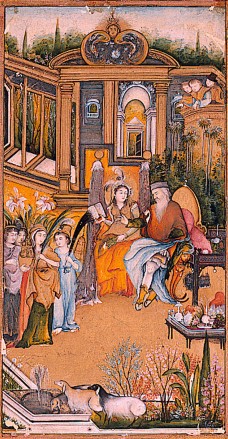 All of these sins were Solomon’s – these were deep human needs, human aching and groaning, that he knew. Is Jesus, who proclaims himself to be the new Temple of God, insisting that he must come into us, flesh and blood, in order to reach that holy place within us, and also in order to bring to us that holiness within him? Would he, who said he was more than the Temple, consent to be less in our lives than Solomon’s words?
At the beginning of his dedicating speech, Solomon declared it was God’s vow to dwell in deep darkness; but also to be the powerful presence of holiness for his people.
Majestic and abundant words, and more than a little creepy. Perhaps my own resistance to Jesus being associated with creepy things is part of my own idolatry. The world, and even my own heart at times, dwells in deep darkness. Body and soul, O Holy One, come into us body and soul.
__________________________________________________________
Illustrations
1. Judgment of Solomon. 880 AD. Attributes to Ingobertus. Chiesa di San Paolo, Rome. Vanderbilt Divinity School Library, Art in the Christian Tradition.
2. Solomon. Michaelangelo Buonarrotti, 1508-1512. Fresco. Sistine Chapel. Vatican City. Vanderbilt Divinity School Library, Art in the Christian Tradition.
3. Solomon Praying to the Holy Spirit. Vrelant, Guillaume. 1481. J. Paul Getty Museum, Los Angeles. Vanderbilt Divinity School Library, Art in the Christian Tradition.
4. Solomon and the Queen of Sheba. 1760 Made in Uttar Pradesh, India. Late Mughal. San Diego Museum of Art. Vanderbilt Divinity School Library, Art in the Christian Tradition.
Previous Post

August 9, 2015
Eternal Life
Next Post
August 24, 2015 What Defiles, What Defines
Browse Our Archives
Select a Category Bites Uncategorized
Select a Month December 2017 November 2017 October 2017 September 2017 August 2017 July 2017 June 2017 May 2017 April 2017 March 2017 February 2017 January 2017 December 2016 November 2016 October 2016 September 2016 August 2016 July 2016 June 2016 May 2016 April 2016 March 2016 February 2016 January 2016 December 2015 November 2015 October 2015 September 2015 August 2015 July 2015 June 2015 May 2015 April 2015 March 2015 February 2015 January 2015 December 2014 November 2014 October 2014 September 2014 August 2014 July 2014 June 2014 May 2014 April 2014 March 2014 February 2014 January 2014 December 2013 November 2013 October 2013 September 2013 August 2013 July 2013 June 2013 May 2013 April 2013 March 2013 February 2013 January 2013 December 2012
Follow Us!
TAKE THE
Religious Wisdom Quiz
What Christian group traces its origins to the Azusa Street Revival?
Select your answer to see how you score.
Lutherans Anglicans Pentecostals Methodists
Related posts from The Bite in the Apple




TRENDING AT PATHEOS Progressive Christian

Why Christians Have a Sacred Duty to Vote:...
The Bible offers strong support for the sacred duty to vote. Here...

What Being a Modern-Day Apostle Means to Me
In my last column, I discussed the ins and outs of modern-day...

Did Ancient China Once Worship the God of...
Across human history, a common thread weaves through the origins of the...

Love Your Neighbor – Including Earth-Kin: Lev. 19,...
God’s command to love your neighbor means acting in an ethical and...

Lead a Church Study of “Jesus and Lao...
Guest writer Jack Thomas (The Irreverent Reverend) reflects on leading his church...

Principles for Understanding the Apostolic Ministry Today
Whenever people discover that my formal ministry title is "apostle," as in...
view all Progressive Christian blogs
Ad-Free & Subscriber Log-In Subscription Support
- About Us
- 2026 Calendar
- Videos
- Podcasts
- Library of World Religions
- Faith In Media Tracker
- Advertise With Us
- Write for Us
- Privacy Policy
- Terms of Service
- Do Not Sell My Data
- Contact Us
- Radiant Digital
- Manage Newsletter Subscriptions
- Unsubscribe From Notifications
- Sitemap
Copyright 2008-2026, Patheos. All rights reserved.
Subscription Support Ad-Free & Subscriber Log-In
Follow Patheos