
BuddhistCatholicContemplativeEvangelicalGeneral ChristianHinduJewishLatter-day SaintMuslimNew VisionsProgressive Christian
Beliefs
- Buddhist
- Catholic
- Contemplative
- Evangelical
- General Christian
- Hindu
- Jewish
- Latter-day Saint
- More Voices
- Muslim
- New Visions
- Pagan
- Progressive Christian
Topics
- Religion News
- Food and Religion
- Sports and Religion
- Religious Art
- Religious Music and Entertainment
- Religious Events
- History and Religion
- Style and Religion
- Politics and Religion
- Women in Religion
- Recreation Outdoors and Religion
- Business Finance and Religion
- Careers Workplace and Religion
- Education and Religion
- Family Parenting and Religion
- Health Fitness and Religion
- Home and Religion
- Relationships and Religion
- Technology and Religion
- Travel and Religion
Columnists
- Buddhist Columnists
- Business Finance and Religion Columnists
- Careers Workplace and Religion Columnists
- Catholic Columnists
- Contemplative Columnists
- Education and Religion Columnists
- Evangelists Columnists
- Family Parenting and Religion Columnists
- General Christian Columnists
- Health Fitness and Religion Columnists
- Hindu Columnists
- History and Religion Columnists
- Home and Religion Columnists
- Jewish Columnists
- More Voices Columnists
- Latter Day Columnists
- Muslim Columnists
- New Visions Columnists
- Nonreligious Columnists
- Pagan Columnists
- Politics and Religion Columnists
- Progressive Columnists
- Recreation Outdoors and Religion Columnists
- Relationships and Religion Columnists
- Religion News Columnists
- Religious Art Columnists
- Religious Events Columnists
- Religious Music and Entertainment Columnists
- Sports and Religion Columnists
- Style and Religion Columnists
- Technology and Religion Columnists
- Travel and Religion Columnists
- Women in Religion Columnists
Resource Library
- 2026 Calendar
- Library of World Religions
- The 100 Most Holy Places on Earth
- Patheos Answers
- Podcasts
- Videos
- Faith Leaders Database
- Anglican Episcopalian
- Bahai
- Baptist
- Buddhism
- Christianity
- Confucianism
- Eastern Orthodoxy
- Hinduism
- Holiness and Pentecostal
- ISKCON
- Islam
- Judaism
- Lutheran
- Methodist
- The Church of Jesus Christ of Latter-day Saints
- New Age
- Paganism
- Presbytarian and Reformed
- Protestantism
- Religion Behind the Scenes
- Roman Catholic
- Scientology
- Shia Islam
- Sikhism
- Sufism
- Sunni Islam
- Taoism
- Zen
- See all religions
Research Tools
 Ad-Free & Subscriber Log-In Subscription Support
Ad-Free & Subscriber Log-In Subscription Support
Follow Patheos 

- Trending:
- Forgiveness
- |
- Marriage
- |
- Consciousness
- |
- Death Penalty
- |
- Election
- |
- Halloween
 The Bite in the Apple
- Home
- Progressive Christian
- Beasts of Sabbath
Beasts of Sabbath
Last updated on: August 24, 2013 at 3:25 pm by Nancy Rockwell
Beasts of Sabbath 2013-08-24T15:25:20-04:00 Nancy Rockwell
Patheos Explore the world's faith through different perspectives on religion and spirituality! Patheos has the views of the prevalent religions and spiritualities of the world.
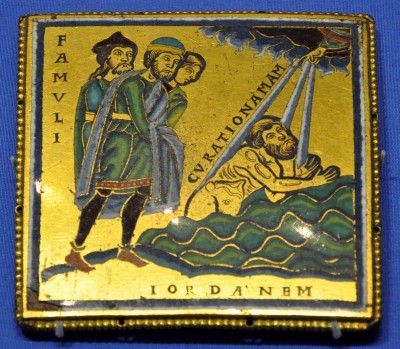 Dropsy –
It’s an old, old diagnosis of an old, old human sorrow: grotesque swelling of the body by retention of water. Now we call it edema and we have names for various causes of it. But in old books, in medical records from other generations, and in the third world where starved children suffer swollen bellies from it, dropsy is still the name for a suffering we, too, can see. I see them, in the grocery store, riding on motor carts, or painfully pushing one gargantuan leg in front of the other. At Walmart or Walgreens, the necessary places people have to go. And I look away. So as not to stare. Take furtive peeks. Feel sorry. Am appalled. This happens among us.
Jesus saw a man with dropsy on the Sabbath, at the home of a community leader where he had been invited for dinner. And he healed the man, and asked everyone there, did they think it was right to do this on the Sabbath. And they said nothing, because it wasn’t, according to the teachings, and they knew he knew that already; and because he had done a good thing, they could see that, too. He watched them, then, choosing places at table in this house of distinction. He began to talk about choosing where to sit at a wedding feast, which is also an occasion of distinction.
I’ve never s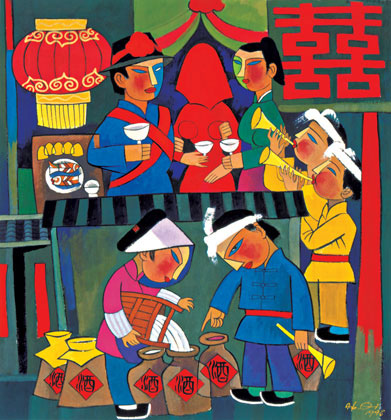 een people with dropsy at a wedding feast. Or, for that matter, at a nice dinner party. And in truth I can only think of one who made it to church, and she needed her husband and her cane to get out of the car, up the ramp, down the aisle. Maybe they decline some invitations, saying it is too hard for them. But the fact is they know they appear grotesque, and we shrink away. They see the little peeks, and the way we avert our eyes.
And we all see that the distinctions in seating at the feasts of life correlate with how we look. Jesus saw this, too, so we know this has been true for a very long time. He often used the wedding feast as an image for the reign of God, and once he talked about clothing being the foolish distinction we use, and once about foolish preparations. But in this story, he is talking about who sits where. And he admonishes them all not to seat themselves too high up in the chain of desirability, for it may be that the host will embarrass them by asking them to move down and make room for someone they have overlooked. Better, according to Jesus, to be asked to move up, than down.
We all know games of false humility that arise from this story: how men will hold the door for women but keep them out of the boardroom; how churches will build ramps but find reasons not to ask people in wheel chairs to be Deacons; how sex becomes a commodity in life, that can hold you back or help you advance in your work; how races and cultures can be considered grotesque, and unacceptable (think of what happened to Trayvon Martin, or go see Fruitvale Station or 20 Feet From Stardom, both true stories).
In our culture, social gatherings b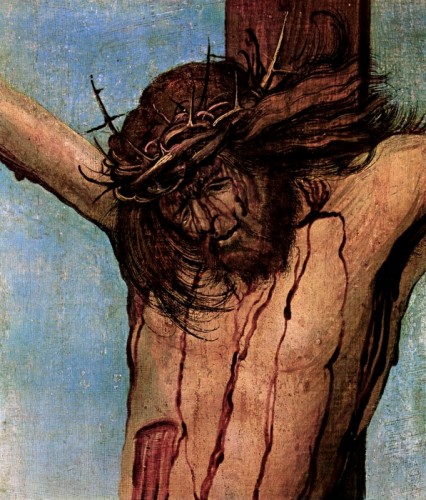 ecome red carpet events, the beautiful enter to be admired by the ordinary for their distinction, and the afflicted hide their wounds as best they can, or if they cannot, stay home.
Luke’s gospel presents several Sabbath healings of people with grotesque afflictions, the bent-over woman, the woman with a bleeding discharge, the man with dropsy.
Each story is a version of Beauty and the Beast. Beauty sees in the Beast what the rest of the world does not, and refuses to see a being unlike herself. At last, through a kiss, she restores him to his sense that he has his beauty again. Jesus, the beauty in Luke’s tales, restores many whom the rest see as grotesque, and presses the rest to see as he sees, to love as he loves, to become those who can heal distinctions based on illness, appearance, poverty, social roles, race, religion.
Sabbath, he struggles to make clear, is a day in which we recognize our lives and life itself as Gift. Not, What We Make of It. But, What We Find in It. Which, in each life, will include something grotesque, something painful and hard, some beastly part of others and of us. Sabbath welcomes us to a time when all the distinctions fall away and the original blessing of creation is heard again by all: It is Good.
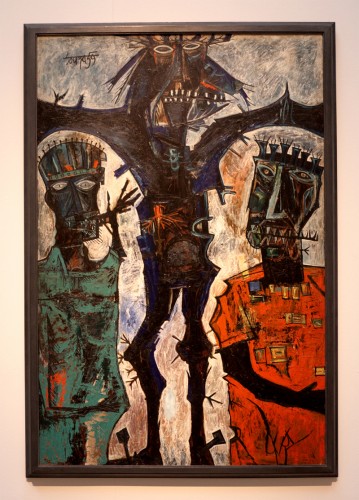 In the final act of Jesus’ story, he will become the Beast. And in his grotesque body, he will wait. Is waiting still, to be set free among us, here on earth, by a human kiss, once again.
Mary Oliver, the Cape Cod poet, says it this way:
Beauty without purpose is beauty without virtue. But
all beautiful things, inherently, have this function-
to excite the viewers toward sublime thought.
Glory to the world, that good teacher. . . . .
As for the body, it is solid and strong and curious
and full of detail; it wants to polish itself; it
wants to love another body; it is the only vessel in
the world that can hold, in a mix of power and
sweetness: words, song, gesture, passion, ideas,
ingenuity, devotion, merriment, vanity, and virtue.
Keep some room in your heart for the unimaginable.
______________________________________________
Illustrations:
1. Naaman is Cured of Leprousy. c.1150, from the Meuse Valley. Bristish Museum, London. Vanderbilt Divinity School Library, Art in the Christian Tradition.
2. Wedding at Cana, He Qi, China. Vanderbilt Divinity School,
Art in the Christian Tradition.
3. Crucifixion, Altdorfer, Albrecht, 1515-1516, Kassel, German, Vanderbilt Divinity School, Art in the Christian Tradition.
4. Crucifixion, F. N. Souza, 1959. Vanderbilt Divinity School, Art in the Christian Tradition.
Previous Post

August 18, 2013
The Bent Over Woman
Next Post
August 31, 2013 Leaving Home
Browse Our Archives
Select a Category Bites Uncategorized
Select a Month December 2017 November 2017 October 2017 September 2017 August 2017 July 2017 June 2017 May 2017 April 2017 March 2017 February 2017 January 2017 December 2016 November 2016 October 2016 September 2016 August 2016 July 2016 June 2016 May 2016 April 2016 March 2016 February 2016 January 2016 December 2015 November 2015 October 2015 September 2015 August 2015 July 2015 June 2015 May 2015 April 2015 March 2015 February 2015 January 2015 December 2014 November 2014 October 2014 September 2014 August 2014 July 2014 June 2014 May 2014 April 2014 March 2014 February 2014 January 2014 December 2013 November 2013 October 2013 September 2013 August 2013 July 2013 June 2013 May 2013 April 2013 March 2013 February 2013 January 2013 December 2012
Follow Us!
TAKE THE
Religious Wisdom Quiz
Which of the following is NOT part of the armor of God?
Select your answer to see how you score.
Shield of Knowledge Belt of Truth Helmet of Salvation Sword of the Spirit
Related posts from The Bite in the Apple




TRENDING AT PATHEOS Progressive Christian

Why Christians Have a Sacred Duty to Vote:...
The Bible offers strong support for the sacred duty to vote. Here...

What Being a Modern-Day Apostle Means to Me
In my last column, I discussed the ins and outs of modern-day...

Did Ancient China Once Worship the God of...
Across human history, a common thread weaves through the origins of the...

Love Your Neighbor – Including Earth-Kin: Lev. 19,...
God’s command to love your neighbor means acting in an ethical and...

Lead a Church Study of “Jesus and Lao...
Guest writer Jack Thomas (The Irreverent Reverend) reflects on leading his church...

Principles for Understanding the Apostolic Ministry Today
Whenever people discover that my formal ministry title is "apostle," as in...
view all Progressive Christian blogs
Ad-Free & Subscriber Log-In Subscription Support
- About Us
- 2026 Calendar
- Videos
- Podcasts
- Library of World Religions
- Faith In Media Tracker
- Advertise With Us
- Write for Us
- Privacy Policy
- Terms of Service
- Do Not Sell My Data
- Contact Us
- Radiant Digital
- Manage Newsletter Subscriptions
- Unsubscribe From Notifications
- Sitemap
Copyright 2008-2026, Patheos. All rights reserved.
Subscription Support Ad-Free & Subscriber Log-In
Follow Patheos