
BuddhistCatholicContemplativeEvangelicalGeneral ChristianHinduJewishLatter-day SaintMuslimNew VisionsProgressive Christian
Beliefs
- Buddhist
- Catholic
- Contemplative
- Evangelical
- General Christian
- Hindu
- Jewish
- Latter-day Saint
- More Voices
- Muslim
- New Visions
- Pagan
- Progressive Christian
Topics
- Religion News
- Food and Religion
- Sports and Religion
- Religious Art
- Religious Music and Entertainment
- Religious Events
- History and Religion
- Style and Religion
- Politics and Religion
- Women in Religion
- Recreation Outdoors and Religion
- Business Finance and Religion
- Careers Workplace and Religion
- Education and Religion
- Family Parenting and Religion
- Health Fitness and Religion
- Home and Religion
- Relationships and Religion
- Technology and Religion
- Travel and Religion
Columnists
- Buddhist Columnists
- Business Finance and Religion Columnists
- Careers Workplace and Religion Columnists
- Catholic Columnists
- Contemplative Columnists
- Education and Religion Columnists
- Evangelists Columnists
- Family Parenting and Religion Columnists
- General Christian Columnists
- Health Fitness and Religion Columnists
- Hindu Columnists
- History and Religion Columnists
- Home and Religion Columnists
- Jewish Columnists
- More Voices Columnists
- Latter Day Columnists
- Muslim Columnists
- New Visions Columnists
- Nonreligious Columnists
- Pagan Columnists
- Politics and Religion Columnists
- Progressive Columnists
- Recreation Outdoors and Religion Columnists
- Relationships and Religion Columnists
- Religion News Columnists
- Religious Art Columnists
- Religious Events Columnists
- Religious Music and Entertainment Columnists
- Sports and Religion Columnists
- Style and Religion Columnists
- Technology and Religion Columnists
- Travel and Religion Columnists
- Women in Religion Columnists
Resource Library
- 2026 Calendar
- Library of World Religions
- The 100 Most Holy Places on Earth
- Patheos Answers
- Podcasts
- Videos
- Faith Leaders Database
- Anglican Episcopalian
- Bahai
- Baptist
- Buddhism
- Christianity
- Confucianism
- Eastern Orthodoxy
- Hinduism
- Holiness and Pentecostal
- ISKCON
- Islam
- Judaism
- Lutheran
- Methodist
- The Church of Jesus Christ of Latter-day Saints
- New Age
- Paganism
- Presbytarian and Reformed
- Protestantism
- Religion Behind the Scenes
- Roman Catholic
- Scientology
- Shia Islam
- Sikhism
- Sufism
- Sunni Islam
- Taoism
- Zen
- See all religions
Research Tools
 Ad-Free & Subscriber Log-In Subscription Support
Ad-Free & Subscriber Log-In Subscription Support
Follow Patheos 

- Trending:
- Forgiveness
- |
- Marriage
- |
- Consciousness
- |
- Death Penalty
- |
- Election
- |
- Halloween
 The Bite in the Apple
- Home
- Progressive Christian
- As It Was in the Beginning – Stories of Wonder and Possibility
As It Was in the Beginning – Stories of Wonder and Possibility
Last updated on: April 20, 2016 at 10:21 am by Nancy Rockwell
As It Was in the Beginning – Stories of Wonder and Possibility 2016-04-20T10:21:39-04:00 Nancy Rockwell
Patheos Explore the world's faith through different perspectives on religion and spirituality! Patheos has the views of the prevalent religions and spiritualities of the world.
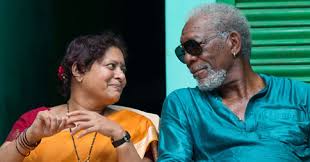 Morgan Freeman takes a whirl-wind look at creation tales in this Sunday’s segment of The Story of God, jetting from his childhood church in Mississippi to Jerusalem to Cairo to Rome to Tikal, the ruined Mayan city, to the banks of the Ganges and even to the Australian Outback, as he looks at the meaning and roots of origin tales.
He begins his search by for Eden in the Mesopotamian Valley, visiting archeological ruins of 9000 year old farm communities, the oldest known on earth. The houses are small stone chambers under the earth, built one next to the other. Each chamber contains a small burial space for the dead, who stayed with the living always, and whose bones were often taken out and put back – for what rituals? Was Eden here?
Near the largest of these communities is a stone circle, huge stones carved as beings, presumably gods. Archeologists surmise the communities had reached a size where people did not know each other well and therefore conflict was sure to be an issue. The stone circle functioned as a temple, gathering people together and reinforcing the essence of humanity and divinity in ways that would encourage peace.
One of those powerful rituals would have been telling a creation tale. The world around, these tales remind us that the gods are involved with us, from the beginning, and that we are, all of us, wonderfully made. In cultures everywhere, these tales are told in rites and ceremonies, nowadays.
In the western world, the 20th century held a prolonged clash between science and religion over the Eden tale, as science brought forth both evolution and the Big Bang theory of cosmology.
In Cairo, Freeman discovers the Islamic creation story is closer to the Big Bang in its assertion that the world began in fire and smoke and creation emerged in stages from these, but the concept of evolution is absent.
In Rome, Freeman explores the Eden tale he has known since childhood, the Jewish and Christian creation tale. He learns that creation is not science, and that the tale is talking about very different things ideas than science describes.
The story of Eden is not a story about how, where, when, or even why the world began. It is a story about our human relationship with God.
Eden tells of the connection between heaven and earth, and of divine involvement with humans, for we have heaven in us as well as earth.
Eden tells of the beginning of a conversation and a relationship that are still unfinished. And so Creation is an ongoing story.
In our knowing of God, there is nothing older than Eden, and yet, about Eden, we know next to nothing. In each of us, perhaps also in every living creature, there is a dream of a true home, where sorrow and sighing are no more, an idyllic place. A place from which we are inexplicably lost. That’s the familiar shape of Eden – longing and being lost. Eden lives outside history and inside us, an eternal moment that is never and now.
Freeman missed, in my opinion, what is perhaps the major role for the Eden tale and for all creation tales: to hold out possibility.
Eden is not merely an origin story, it is a path for the human spirit. The tale is centered in the touch of God and the blessing, It is good, that is given to every creature and every day. And none of the days, nor the creating in them, is over yet. And all of the goodness is still being revealed.
Most of the details are impossible. And yet – in the power of myth, the impossible is possible. As the Archangel said to Mary – nothing is impossible with God. As Jesus said in Matthew 19:26 to his disciples, With God all things are possible.
So the unknown time can be held in hope, because nothing is impossible in the Edenic goodness of life.
Freeman does capture the spirit of Eden and all these tales in his closing words: what is essential is our wonder and gratitude that we are here at all. On this, science and religions are in agreement. And the great words of liturgy still have power: As it was in the beginning, is now and ever shall be, world without end.
__________________________________________________________________________________________
Image: Morgan Freeman and a Hindu historian who tells him the creation tale of Mother Ganga, the river goddess who came from Brahma and Shiva, and who created the Hindu people and their world. Image credit: patheos.com.
Previous Post

April 17, 2016
Earth Day - The Last Supper?
Next Post
April 23, 2016 The Word That Defies Death: Shakespeare and Jesus
Browse Our Archives
Select a Category Bites Uncategorized
Select a Month December 2017 November 2017 October 2017 September 2017 August 2017 July 2017 June 2017 May 2017 April 2017 March 2017 February 2017 January 2017 December 2016 November 2016 October 2016 September 2016 August 2016 July 2016 June 2016 May 2016 April 2016 March 2016 February 2016 January 2016 December 2015 November 2015 October 2015 September 2015 August 2015 July 2015 June 2015 May 2015 April 2015 March 2015 February 2015 January 2015 December 2014 November 2014 October 2014 September 2014 August 2014 July 2014 June 2014 May 2014 April 2014 March 2014 February 2014 January 2014 December 2013 November 2013 October 2013 September 2013 August 2013 July 2013 June 2013 May 2013 April 2013 March 2013 February 2013 January 2013 December 2012
Follow Us!
TAKE THE
Religious Wisdom Quiz
What year did the Great Schism occur, splitting the Eastern and Western churches?
Select your answer to see how you score.
1517 AD 500 AD 325 AD 1054 AD
Related posts from The Bite in the Apple



TRENDING AT PATHEOS Progressive Christian

Why Christians Have a Sacred Duty to Vote:...
The Bible offers strong support for the sacred duty to vote. Here...

What Being a Modern-Day Apostle Means to Me
In my last column, I discussed the ins and outs of modern-day...

Did Ancient China Once Worship the God of...
Across human history, a common thread weaves through the origins of the...

Love Your Neighbor – Including Earth-Kin: Lev. 19,...
God’s command to love your neighbor means acting in an ethical and...

Lead a Church Study of “Jesus and Lao...
Guest writer Jack Thomas (The Irreverent Reverend) reflects on leading his church...

Principles for Understanding the Apostolic Ministry Today
Whenever people discover that my formal ministry title is "apostle," as in...
view all Progressive Christian blogs
Ad-Free & Subscriber Log-In Subscription Support
- About Us
- 2026 Calendar
- Videos
- Podcasts
- Library of World Religions
- Faith In Media Tracker
- Advertise With Us
- Write for Us
- Privacy Policy
- Terms of Service
- Do Not Sell My Data
- Contact Us
- Radiant Digital
- Manage Newsletter Subscriptions
- Unsubscribe From Notifications
- Sitemap
Copyright 2008-2026, Patheos. All rights reserved.
Subscription Support Ad-Free & Subscriber Log-In
Follow Patheos