
BuddhistCatholicContemplativeEvangelicalGeneral ChristianHinduJewishLatter-day SaintMuslimNew VisionsProgressive Christian
Beliefs
- Buddhist
- Catholic
- Contemplative
- Evangelical
- General Christian
- Hindu
- Jewish
- Latter-day Saint
- More Voices
- Muslim
- New Visions
- Pagan
- Progressive Christian
Topics
- Religion News
- Food and Religion
- Sports and Religion
- Religious Art
- Religious Music and Entertainment
- Religious Events
- History and Religion
- Style and Religion
- Politics and Religion
- Women in Religion
- Recreation Outdoors and Religion
- Business Finance and Religion
- Careers Workplace and Religion
- Education and Religion
- Family Parenting and Religion
- Health Fitness and Religion
- Home and Religion
- Relationships and Religion
- Technology and Religion
- Travel and Religion
Columnists
- Buddhist Columnists
- Business Finance and Religion Columnists
- Careers Workplace and Religion Columnists
- Catholic Columnists
- Contemplative Columnists
- Education and Religion Columnists
- Evangelists Columnists
- Family Parenting and Religion Columnists
- General Christian Columnists
- Health Fitness and Religion Columnists
- Hindu Columnists
- History and Religion Columnists
- Home and Religion Columnists
- Jewish Columnists
- More Voices Columnists
- Latter Day Columnists
- Muslim Columnists
- New Visions Columnists
- Nonreligious Columnists
- Pagan Columnists
- Politics and Religion Columnists
- Progressive Columnists
- Recreation Outdoors and Religion Columnists
- Relationships and Religion Columnists
- Religion News Columnists
- Religious Art Columnists
- Religious Events Columnists
- Religious Music and Entertainment Columnists
- Sports and Religion Columnists
- Style and Religion Columnists
- Technology and Religion Columnists
- Travel and Religion Columnists
- Women in Religion Columnists
Resource Library
- 2026 Calendar
- Library of World Religions
- The 100 Most Holy Places on Earth
- Patheos Answers
- Podcasts
- Videos
- Faith Leaders Database
- Anglican Episcopalian
- Bahai
- Baptist
- Buddhism
- Christianity
- Confucianism
- Eastern Orthodoxy
- Hinduism
- Holiness and Pentecostal
- ISKCON
- Islam
- Judaism
- Lutheran
- Methodist
- The Church of Jesus Christ of Latter-day Saints
- New Age
- Paganism
- Presbytarian and Reformed
- Protestantism
- Religion Behind the Scenes
- Roman Catholic
- Scientology
- Shia Islam
- Sikhism
- Sufism
- Sunni Islam
- Taoism
- Zen
- See all religions
Research Tools
 Ad-Free & Subscriber Log-In Subscription Support
Ad-Free & Subscriber Log-In Subscription Support
Follow Patheos 

- Trending:
- Forgiveness
- |
- Marriage
- |
- Consciousness
- |
- Death Penalty
- |
- Election
- |
- Halloween
 The Bite in the Apple
- Home
- Progressive Christian
- A Wilderness of Names
A Wilderness of Names
Last updated on: November 16, 2015 at 3:51 pm by Nancy Rockwell
A Wilderness of Names 2015-11-16T15:51:37-04:00 Nancy Rockwell
Patheos Explore the world's faith through different perspectives on religion and spirituality! Patheos has the views of the prevalent religions and spiritualities of the world.
 William Barnwell, an Episcopal priest who lives in New Orleans, has spent his life working for racial justice and reconciliation, mostly in the south but for about ten years in Boston, which is when we became friends. In retirement, he is choosing to spend his time volunteering in Louisiana’s infamous Angola maximum security prison, where men convicted of violent acts are locked away, often for decades. The majority of the prisoners are black.

A cell block is seen alongside an inner levee protecting from the Mississippi River at Angola State Prison in West Feliciana Parish, La., Monday, May 9, 2011. A convoy of buses and vans transferred inmates with medical problems from Angola, which is bordered on three sides by the Mississippi River, and temporary quarters were being built on higher ground as part of an effort to prepare for possible flooding. (AP Photo/Patrick Semansky)
Barnwell runs a different kind of Bible study there, guiding the men in conversations about their own lives, framing his questions from stories about Jesus’ life. When Jesus began his ministry he had just been plunged into a wilderness, Barnwell will say to men who have been plunged from a tropical southern environment into a vast, barren, cement world. *What are your wilderness experiences?*And he will go on: *Jesus was subjected to temptations? What temptations torment you?*And, who are the angels who have ministered to you?
 Sessions run four hours long, and over time Barnwell says he has seen hardened haters, white men with swastika and KKK tattoos, and black men with tattoos of violent gangs, begin to call each other friends. The stories they tell are not easy to hear. But Barnwell insists they are holy stories, because they are genuine stories in which faith is found, and hard-won, in the wilderness. This is our treasure, Barnwell says, our own stories of our lives.
Jesus asserts this truth to Peter, in Mark’s 8th chapter, while they are walking along. He asks his followers what names people are calling him, and they tell him quite a number of names, and he asks them who they say he is, and Peter blurts, Messiah! And Jesus tells him to quit saying that in public.
Why? Because it might be dangerous for him? Because he wants to wait till later to reveal that? Because he’s meek and humble and finds it embarrassing? None of these reasons hold water: Jesus walks ahead of them into danger and confrontation, not just in Jerusalem, but in every sermon, every town, a number of which he is thrown out of. And at the end of this passage he is urging them to understand that taking risks is part of being his follower. Nothing ever embarrasses him, not hanging around with prostitutes, not dining with rich men, not being crucified, so it does not make sense that he would cringe from the name Messiah as if it were unseemly. Waiting for the right time is a Markan theme for Jesus, yet in the entirety of this passage it does not seem a good fit, as he moves them away from cautious protection and toward cross-bearing.
 Perhaps he is pushing aside the name Messiah here, because it stops the conversation. It stops the story-telling. What more is there to say, after Messiah? And Jesus wants people to wrestle with who he is to them, wants them to wrestle with their own lives and the presence of the kingdom in their lives.
Jesus prefers the testimony of living experience to the rote recitation of meaning. This has been his consistent approach to worshipful life, according to the gospels, in which he chides the prayer-book reciting Pharisee and praises the awkward prayer of the publican, in which he resists Sabbath pieties and all pieties, in favor of mercies given and received. And yet, for most churchgoing Christians, the answer to who Jesus is has been removed from their experience and assigned to an ancient creed, usually the Nicene (325 CE) or Apostles (390CE) creed, both of which contain sets of approved names and defined divinity.
 Yes, the creeds are treasures of our history, as are the many more contemporary statements of faith. But they have the effect of leaving us speechless, when asked, Who do you say he is? The answer I commonly hear is, *I don’t know what I believe, really.*Which is an admission that the creeds don’t speak for people, but for institutions and for the past. Most Christians say them in worship as something-you-do, and leave it at that.
After hushing Peter’s show-stopping name Messiah, a name of glory, Jesus begins to talk about imminent danger. And Peter, who has just hailed Jesus with a triumphant name, begins to resist, urging cautious self-protection. Jesus then calls him Satan, stating emphatically that no one who will not pick up the cross can rightly claim to be a follower of Jesus. Saying, you are setting your mind on human things, not divine things. As we all do, as our churches do, setting our minds on Fairs and Feast Days, not on proclamations that lead to crucifixions. Saying the name Messiah isn’t enough, you have to walk the walk.
 Creeds, those 4th century Pledges of Allegiance, are not something I am willing to die for. And the history of Christianity holds more examples of those who died trying to give a more personal, and in some ways alternate, testimony, and who were executed by the Avenging Conformity Enforcers, than it does of those who died for the sake of the Creed.
Conformity of thought is an impoverished substitute for a heartfelt story, and Jesus knew that. In Angola State Prison, wronged and wrongful men know it, too, thanks to the ministry of an Episcopal priest, who, in his own recitations of the Creed, bows his head for the words, he has spoken through the prophets.
Mark 8 ends the story of names with Jesus saying*, If they’re ashamed of me now, wait till the resurrection – they’ll still be ashamed of me*. We would do well to stand in trembling before the awful unknown of what and who will rise, at last.
_________________________________________________________
Illustrations:
1. Angola, Louisiana State Prison, Google Images.
2. Angola, aerial view, 2011 AP Photo by Patrick Semansky, Google Images.
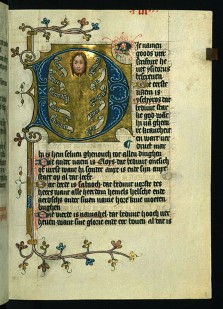
3. Holy Trinity and Ten Names of God Icon. 1404. Dirc von Delf. Walters Art Museum, Baltimore, MD
4. Holy Trinity Icon. Andrei Rublev. 1400. Moscow Russia. Vanderbilt Divinity School Library, Art in the Christian Tradition.
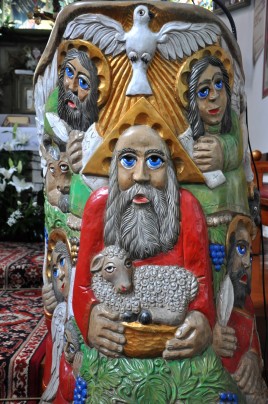
5. Holy Trinity carving, Poland. Vanderbilt Divinity School Library, Art in the Christian Tradition.
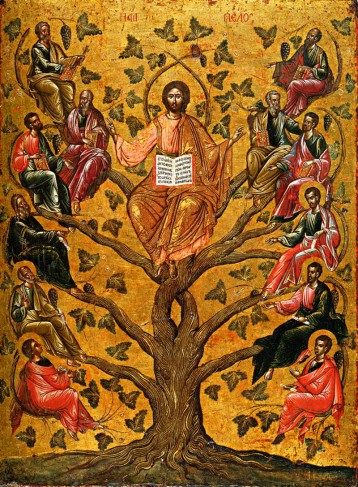
6. Eastern Orthodox Icon of Jesus as the True Vine, 16th c. Athens, Greece. Vanderbilt Divinity School Library, Art in the Christian Tradition.
Previous Post

August 31, 2015
Interruptions
Next Post
September 14, 2015 Child Like
Browse Our Archives
Select a Category Bites Uncategorized
Select a Month December 2017 November 2017 October 2017 September 2017 August 2017 July 2017 June 2017 May 2017 April 2017 March 2017 February 2017 January 2017 December 2016 November 2016 October 2016 September 2016 August 2016 July 2016 June 2016 May 2016 April 2016 March 2016 February 2016 January 2016 December 2015 November 2015 October 2015 September 2015 August 2015 July 2015 June 2015 May 2015 April 2015 March 2015 February 2015 January 2015 December 2014 November 2014 October 2014 September 2014 August 2014 July 2014 June 2014 May 2014 April 2014 March 2014 February 2014 January 2014 December 2013 November 2013 October 2013 September 2013 August 2013 July 2013 June 2013 May 2013 April 2013 March 2013 February 2013 January 2013 December 2012
Follow Us!
TAKE THE
Religious Wisdom Quiz
Who wrote many of the Psalms?
Select your answer to see how you score.
Moses David Solomon Paul
Related posts from The Bite in the Apple




TRENDING AT PATHEOS Progressive Christian

Why Christians Have a Sacred Duty to Vote:...
The Bible offers strong support for the sacred duty to vote. Here...

What Being a Modern-Day Apostle Means to Me
In my last column, I discussed the ins and outs of modern-day...

Did Ancient China Once Worship the God of...
Across human history, a common thread weaves through the origins of the...

Love Your Neighbor – Including Earth-Kin: Lev. 19,...
God’s command to love your neighbor means acting in an ethical and...

Lead a Church Study of “Jesus and Lao...
Guest writer Jack Thomas (The Irreverent Reverend) reflects on leading his church...

Principles for Understanding the Apostolic Ministry Today
Whenever people discover that my formal ministry title is "apostle," as in...
view all Progressive Christian blogs
Ad-Free & Subscriber Log-In Subscription Support
- About Us
- 2026 Calendar
- Videos
- Podcasts
- Library of World Religions
- Faith In Media Tracker
- Advertise With Us
- Write for Us
- Privacy Policy
- Terms of Service
- Do Not Sell My Data
- Contact Us
- Radiant Digital
- Manage Newsletter Subscriptions
- Unsubscribe From Notifications
- Sitemap
Copyright 2008-2026, Patheos. All rights reserved.
Subscription Support Ad-Free & Subscriber Log-In
Follow Patheos